
 By
By  August 26, 2025

Which Damp or Mould Law Actually Applies to Your Property? Why Guesswork Risks Everything
Every year, property owners and tenants across Sussex are blindsided by the legal realities of damp and mould. One black spot behind a wardrobe or a persistent musty smell isn’t just a nuisance—it can rocket your home into the sights of local councils, mortgage lenders, insurers, and tribunals. The real question isn’t if you’ll be held to a legal standard—but which one, and whether your evidence can hold its ground. This guide is your clear map through the maze, built from boots-on-the-ground experience and clinical legal logic.
If you don’t understand the law before damp spreads, you’ll understand it painfully after.
Guesswork leaves you exposed. The day a patch appears or a tenant’s cough lingers, alarms go off—not just in your kitchen, but across the desks of local authorities and mortgage lenders. UK legislation prioritises actionable evidence—sometimes just a cluster of dated photos or a simple GP letter can pull your property into legal scrutiny. The moment you can see, smell, or touch the problem, someone’s accountability clock starts ticking.
What Triggers a Legal Obligation for Damp or Mould in UK Property?

A home doesn’t need to be overrun with black mould to attract legal attention. In the UK, low-bar triggers—recurring condensation, salt streaks on brick, even “damp odours” reported by a tenant—can be enough for intervention. Councils, insurers, and courts don’t rely on subjective risk; they act on evidence—photos of peeling skirting, logged complaints, moisture reports, or medical notices (House of Commons Library 2023).
- Tenants: The law expects you to formally log issues—photos, timestamps, even texts or emails count. GP letters detailing ongoing coughs or skin rashes attached to damp lend extra weight.
- Landlords: Your responsibility begins at the first credible report. Ignored texts, vague phone updates, or “I’ll get to it” responses become ammunition against you later.
- Agents and professionals: Your value is accuracy—getting trusted, surveyor-certified proof that clarifies cause, not just symptoms.
Once damp or mould is logged in writing, both sides are on a legal timer. Hesitation or vague fixes will be used against you.
Those who document early—clear photos, moisture readings, open surveys—face shorter battles, fewer financial shocks, and rarely end up in tribunal chaos.
How Does the Law Divide Damp and Mould Repairs Between Landlords and Tenants?

Legal liability isn’t decided by who shouts louder: it’s mapped to root cause. The Landlord and Tenant Act 1985 and Building Regulations Part C make landlords responsible for the structure—anything due to leaks, rising damp, plumbing failures, bridging, or ground ingress. Tenant behaviour (like blocking vents, constant indoor drying, or not reporting problems) may tip the scale slightly, but structural issues almost always come back to the property owner.
Expert reports are your firewall. Sussex Damp Experts use forensic diagnostics, moisture metres, and salts testing to document whether a wall is suffering rising damp, condensation, or simply faulty repair. Without this, blame bounces endlessly between landlord and tenant—with both at risk of council intervention or court action.
Documented cause trumps opinion. Lifestyle blame without real proof fails fast in any regulatory dispute.
Landlord: Structure, hidden defects, or maintenance lapses = your bill.
Tenant: Daily stewardship, venting, and prompt reporting—fail here and your claim weakens.
If in doubt, get a third-party, PCA-accredited diagnosis. Councils default to those who act and document first.
When Is a Home Officially “Unfit for Human Habitation”—And Who Decides?

Under the Homes (Fitness for Human Habitation) Act, the test is simple: Would this home, in this state, harm health or basic living? This includes active black mould, chronic cold patches, recurring peeling paint, persistent leaks, or medical complaints (whether mild or severe).
- Enforcement: Any tenant, surveyor, or health professional can trigger a case. One credible GP letter, a run of damp complaints, or council referral—suddenly, your property may be unfit (UK Parliament 2023).
- Consequences: Expected repairs (or rent repayment) are ordered urgently. Delays see landlords penalised with compensation, forced rehousing, or prosecutions for repeated non-compliance.
- Tenant Power: If you log clear evidence and link it to discomfort or illness, your right to repairs becomes non-negotiable.
Waiting past the unfit threshold isn’t just risky—it’s an open invitation to legal, financial, and reputational loss.
Rule of thumb:
If health, comfort, or usability are hit—and you can show it—the law backs urgent repair and you hold the leverage.
Damp as a “Category 1 Hazard”: What Actually Changes?

The Housing Health & Safety Rating System (HHSRS) grades risks. Damp and mould become “Category 1” when there’s clear risk of harm—especially to children, elderly, or vulnerable tenants. This isn’t restricted to collapsed ceilings; black spots on a bedroom wall or chronic musty smells in a living room can meet the bar.
- Trigger: A professional survey, insistent tenant logs, NHS correspondence, or a credible third-party (like Sussex Damp Experts) documenting spreading mould or failed fixes.
- Council Response: Immediate investigation, legally mandated repairs (Improvement Notice), possible rental bans, and even prosecution for missed obligations.
- Financial Fallout: Delay amplifies legal risk and potential fines or forced rent repayments.
Landlords who ignore or patch over failings after a Category 1 flag stack up legal risk quickly. Robust calibration and clear evidence keep cases focused and mitigated.
When council or surveyor tags Category 1, delay compounds penalty—repair or face rapid escalation.
Essential Move:
Act at the first Category 1 warning—book an expert surveyor, log every step, and prioritise structural repair.
What Proof Turns a Complaint Into Official Council, Insurance, or Court Action?

“Complaint” alone gets little traction. Only reliable, calibrated evidence produces action:
- Photos: Dated, full-room shots plus detail close-ups—time-stamped, not blurry phone grabs.
- Moisture Reports: Metre readings, humidity/temperature logs—PCA surveyor-grade, not £10 gadgets.
- Written Reports: Independent surveyor letters, diagnosis, and clear cause mapping.
- Medical Evidence: Letters or records from a GP or NHS.
- Communication logs: Time-stamped messages, reports to landlord/agent, and council visits.
- Maintenance records: Previous repair invoices, survey recommendations, proof of prior fixes (successful or not).
Council officers and courts default to the side with the clearest, most systematic documentation.
The boring side—paperwork, not passion—wins. Whoever has calibration, timestamps, and independent evidence usually avoids long disputes.
Action Checklist:
- Log the problem day one.
- Commission a survey if the dispute goes unresolved or repairs fail.
- Bundle evidence to hand off to council, insurer, or solicitor as needed.
Council, Court, or Both—What’s the Fastest Way to Solve a Damp or Mould Dispute?
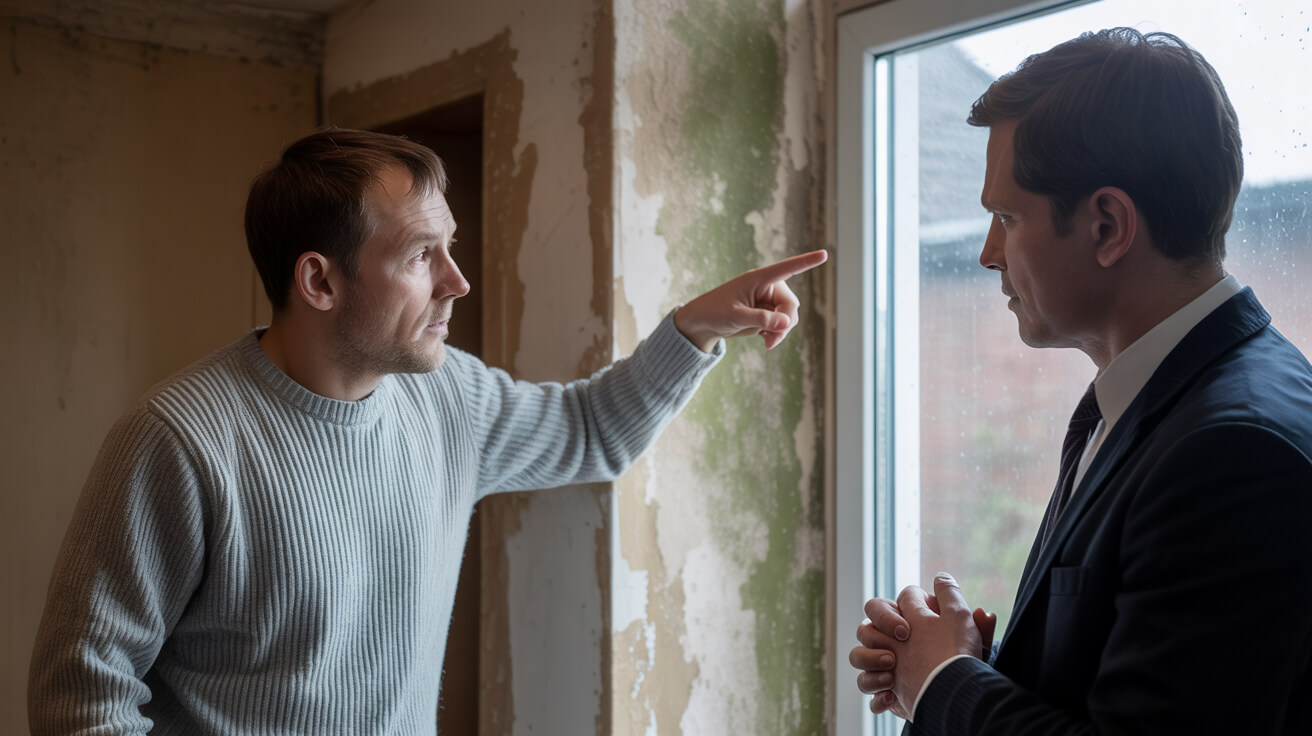
Disputes that drag devolve into expense and stress. The fastest escalation path is pairing evidence-led complaints with parallel council and legal action:
- Council: Start with a Housing Health & Safety Rating System (HHSRS) request. If hazards are found, councils can force repairs, restrict use, or—if the case is extreme—prosecute. An expert, site-calibrated survey guides the process and sidesteps argument.
- Court: If council is slow, or the issue is urgent, apply directly for repairs, rent repayment, compensation, or an injunction. Courts want full surveyor reports, documented logs, and proof that you offered landlords a chance to fix first.
- Both: Maximum pressure—most effective when landlord or agent is nonresponsive or repairs fail. Two-pronged action almost always yields a resolution.
Acting with proof—on both fronts—ends the circus of blame. Fast movers with evidence always get priority.
Escalation Reminder:
If you’re spinning in circles—compile all proof and escalate through both council and civil channels. It forces movement and minimises risk.
If Repairs Fail or Damp Recurs, How Can You Push Back Legally?

Failed fixes reset the legal clock. When damp returns or repairs fall short, UK law gives tenants extra teeth—with rising options for compensation, enforced repairs, and rent reduction.
- Compensation: For damaged belongings, health impact, or landlord breach of duty (Which? 2024).
- Enforced Repairs: Courts can set strict deadlines, send in ordered contractors, and penalise for any failure.
- Rent Reclaim: If your property’s uninhabitable due to damp, courts may authorise rent recovery for those periods.
- Landlord Shield: Fast, professional fixes—documented post-repair survey and aftercare records—practically close off future claims.
“Quick and dirty” repairs or ignoring repeated complaints make landlords fair game for tribunal penalty, council action, and battered reputation.
If it’s failed once, escalate. Recurring damp is a sign: real remediation, not cosmetic patching, is the only way out.
Immediate Advice:
If repairs falter, upshift: commission a new survey, log every complaint and every fix, and prepare for a claim if no action comes.
Sussex Damp Experts—Why Our Process Takes Guessing Out of The Equation
Resolving damp and mould legally isn’t a guessing game or a feather-dusting exercise. Sussex Damp Experts operate with methodical, PCA-accredited surveys, calibrated equipment, and documentation built for council, insurance, and court. This isn’t just about ticking boxes—it’s about closing legal risk with reports that land like a sledgehammer.
- Root Cause Diagnostics: BS6576 and PAS2035-compliant reports clarify fact from friction—so “lifestyle blame” falls away, and true sources get fixed.
- Aftercare: We guide clients through aftercare and dispute navigation, standing by results—no damp return, no repeat headaches.
- Forensic Evidence: We furnish date-stamped images, moisture maps, and reasoned conclusions tailored to each duty—legal, insurance, or council.
- Council & Lender Acceptance: Our reports open doors, unlock lost lending, and remove barriers in disputes.
Our reports reset legal momentum—landlords, tenants, and agents move from risk to resolution, not just rounds of frustration.
Proof Table—What Sussex Damp Experts Deliver For Every Stakeholder
| Legal Layer | Diagnostic Provided | Stakeholder Advantage |
|---|---|---|
| PCA & TrustMark | Accredited evidence, council-respected | Immediate legal standing, no delay |
| Standardisation | PAS2035/BS6576 diagnosis, fit for court | Mortgage & insurer approval, no rework |
| Root Source Focus | Moisture maps, substrate analysis | Sustainable fix, reputational boost |
| Case Navigation | End-to-end support, escalation guidance | Reduced fallout, clear next steps |
| Community Authority | Local knowledge, council relationships | Easy escalation, cut-down waiting |
Choose calibration over chaos. Whether you’re facing a tough letting tribunal or want your family home future-proofed, Sussex Damp Experts is the toolkit for navigating and winning these cases.
Ready to Move From Damp Doubt to Complete Resolution? Call Sussex Damp Experts
Legal complexity and repair jargon stop people acting. But you can sidestep uncertainty with a single move: lock in expert evidence and guidance early. Sussex Damp Experts are your shortcut through the maze—delivering forensic surveys, documentation that stands up everywhere, and support that doesn’t vanish after the invoice is paid.
You shouldn’t gamble with your property, tenancy, or business reputation. Our process gives you the confidence and leverage to act—before minor signs become major liabilities or ongoing disputes become reputational headaches. Take back control: document, escalate, and resolve with Sussex Damp Experts at your back.
A safer, dry, dispute-free asset—whether home or investment—starts here.
Frequently Asked Questions
Why does the legal responsibility for damp or mould disputes change depending on the property’s condition and cause?
The answer lies in how UK law classifies both the “why” and the “impact” of damp or mould in rented homes. If moisture is traced to leaks, a breached damp proof course, or structural neglect, the Landlord and Tenant Act 1985 forces the landlord’s hand—structural elements can’t be left defective. But the bar rises if the damp, mould, or condensation is creating a health risk or making the living space uninhabitable. There, the Homes (Fitness for Human Habitation) Act 2018 empowers tenants to legally demand a safe home and swiftly escalate inaction. When health or safety is at serious risk, the council steps in using the Housing Health and Safety Rating System (HHSRS) or, for high impact cases, the Environmental Protection Act 1990. The right lever is picked by matching the source of trouble to the specific level of harm caused, so that a slow drip doesn’t have the same legal handling as black mould in a child’s bedroom.
Wherever damp is undermining a home’s integrity or risking a tenant’s health, UK law closes loopholes—the only way out is professional remediation.
How does this affect disputes in practice?
- Building defects and water ingress: (e.g. leaking roofs, rising damp, failed render): Managed under the 1985 Act—landlord’s duty is clear.
- Ongoing, health-impacting mould or unsafe humidity: Triggers the 2018 Act and fast tenant legal routes.
- Hazards with proven risk (persistent respiratory symptoms, unusable rooms, escalating decay): Council enforcement via HHSRS and Environmental Protection can quickly override landlord stalling.
Can behaviour shift liability?
Very occasionally, if tenants block airflow, refuse reasonable access for repairs, or fail basic maintenance (with records), some cost or duty is shared. But the law nearly always sides with the party who controls the structure, not the lifestyle.
How can you prove who is liable for a damp issue in a rented property?
Proof rests on getting forensic with evidence, not relying on finger-pointing or assumptions. Landlords must repair faults with the building: blocked gutters cascading into brickwork, cracked render letting rain in, or a breached DPC. Tenants, meanwhile, are only liable for moisture linked directly to everyday living—like never opening windows, or not heating a property where this was contractually expected.
The reality: councils and insurers nearly always side with whoever backs their case with technical documentation. Survey logs showing capillary action, chemical salt maps or professional readings give Sussex Damp Experts the edge in disputed cases.
The person with the dated logbook, lab-graded readings, and timestamped photos wins—regardless of finger-pointing in emails.
How is joint responsibility shown?
- Water entering from structure: Landlord’s fix, regardless of occupation.
- Proven misuse of ventilation (windows sealed, vents blocked, heating never used): Only shifts responsibility with clear, written warnings and time-stamped reports.
- Ignored aftercare or blocked access: Can reduce compensation but is *never* enough to void statutory obligations on the landlord.
What documentation tips the balance?
- Surveyor’s moisture gradient logs matched to photographic evidence.
- Written reports to landlord or agent, with dates and signatures.
- Councils and courts want “who did what and when”—nothing else counts.
What does ‘unfit for human habitation’ actually mean in the law when damp is present?
“Unfit” isn’t reserved for disaster zones. In UK law, a property qualifies as unfit if persistent damp, mould, rot or cold is making it risky to health or impossible to use as intended. That’s a low bar: repeat black mould on walls after every “fix,” rooms unusable for sleeping due to water damage, or long-term cold and wet that triggers asthma is all it takes. The Homes (Fitness for Human Habitation) Act 2018 gives tenants the right to force repairs or compensation, and the courts no longer require a ceiling to collapse—a failed survey, a GP’s letter, or local council risk assessment is enough.
If your photos and health notes show real harm, the building’s now unfit—even before visible rot sets in.
What signs push a home into ‘unfit’?
- Damp or black mould reappearing after repair or redecorating
- Rooms that can’t be safely used by children, elderly, or those with lung conditions
- Structural decay (rotted skirting, warped doors, persistent leaks)
- Official warnings or council notices for unresolved hazards
Whose standard is used?
Expert reports, council HHSRS inspections, and medical evidence all count—courts only look for clear links between the property and the harm suffered.
How does the council’s HHSRS hazard system trigger compelled damp repairs—and what’s the process?
The council uses the Housing Health and Safety Rating System (HHSRS) as its scoring framework to assess hazards, including every type of damp and mould. Once a tenant (or advisor) complains, a council officer inspects and grades any risks. Category 1 hazards—like severe damp undermining health or building safety—must trigger an official Improvement Notice that gives the landlord a short deadline (often 21 to 28 days) to put it right. Category 2 hazards let the council use its own judgement on enforcement.
HHSRS scores are more than numbers—they drag landlords and agents to the table, with fines or repair orders following fast.
What is the step-by-step HHSRS route?
- Tenant logs complaint (with evidence, if possible).
- Council inspects and scores the property’s risks using the HHSRS matrix.
- If a high-risk (Category 1) hazard is found, an Improvement Notice is served, and repair work becomes mandatory.
- Non-compliance lets the council order repairs directly, recover costs from the landlord, or ban letting.
What gives landlords an advantage?
- Independent surveyor reports, photo logs, and action records head off most disputes and speed up council closure.
- Early engagement with Sussex Damp Experts keeps cases out of legal limbo and maintains reputation with local authorities.
What type of evidence actually convinces councils, courts, and insurers in a damp dispute?
Practically every win in a damp dispute boils down to evidence that is independent, timed, and as comprehensive as possible. Courts, insurers, and councils require consistent logs: clear, dated photos, expert surveyor’s reports, precise metre readings, and written records of every repair and complaint. PCA-compliant reports and PAS2035 documents from Sussex Damp Experts not only satisfy banks and insurers—they’re explicitly trusted by local councils too.
If the dispute lands in the laps of authorities, the chain of dated reports, survey images, and maintenance logs is what settles truth and liability.
Table: Core evidence for a winning claim
Every robust case is built on this bundle:
| Evidence Type | Source | Why It Works |
|---|---|---|
| Dated photos | Tenant/Landlord | Proves progression or lack of remedial works |
| Technical reports | Accredited Surveyor | Links symptoms to source, triggers enforcement |
| Moisture/humidity logs | Surveyor/Engineer | Objectifies cause and degree, not just claims |
| Health documentation | GP/Clinic | Binds issue to actual harm |
| Repair/communication log | All parties | Confirms notification, repair attempts, and response |
| Completed invoice | Contractor | Links cost, timing, and works to duties |
What never works?
Untimed, anecdotal, or “he said/she said” estimates. Without documentation, even the truth sounds weak.
When should you escalate a damp or mould problem legally—and what is the fastest, most effective step?
Escalation becomes your best tool as soon as deadlines slip, hazards persist, or your health/property is put at risk. Start with a dated request to the landlord or managing agent. If the response stalls, gather all your records and reach out to the local council for an HHSRS inspection, or—with surveyor documentation—go straight to court for compensation or an injunction to compel repairs. Real momentum comes from running parallel tracks: council enforcement commands immediate works, while a court case pressures for resolution or financial redress.
When dialogue dries up and rooms stay wet, evidence is your ticket—council action and court steps, used together, break the stalemate.
Lightning-quick escalation steps:
- Log every sign and report with dates and photos from the start.
- Make your written request explicit (include a “response needed by” date).
- Report directly to the council if unsafe or ignored, triggering HHSRS grading.
- If health is harmed or repairs stall, pursue court action with your full evidence bundle.
- Combine both routes; holding documentation at every stage makes your claim stronger and shields against retaliation.
How does your approach reflect leadership?
Landlords who document, diagnose, and act early build reputations that attract reliable tenants and keep their properties let. Tenants, agents, and property managers using a systematic record of every step rarely see claims drag into disputes—and stand out as the professionals that others trust with complex cases.
What distinguishes those who win damp disputes from those who end up stuck for months?
Success in damp disputes is usually down to discipline in evidence and speed of decisive action. The fastest, most reliable outcomes fall to those landlords and tenants who treat every complaint, survey, and dialogue as an official record, not a casual chat. Proactive maintenance, expert diagnostics, and upfront aftercare transform even contested cases into resolved ones—while missed deadlines, half-hearted repairs, or patchy paperwork allow disputes to fester.
Those who keep a calm head, complete file, and act before small problems grow always pull ahead in damp disputes.
Checklist: Best practice for unblocking disputes fast
- Keep a digital and hard-copy master file for all photos, survey reports, invoices and emails.
- Schedule regular aftercare checks—don’t rely on fixes unless they’re followed up.
- Request independent surveys for recurring or complex damp, to build a file councils and insurers trust.
- If you’re a landlord, anticipate council and court evidentiary standards before issues escalate.
- Bring in Sussex Damp Experts early to sidestep confusion, meet compliance and avoid costly delays.
What is the real advantage?
Leaders—be they landlords, agents, or tenants—don’t just wait for the law to act. They shape outcomes by being systematic, evidence-led, and ready to escalate if common sense fails. Compliance and integrity aren’t just legal tick-boxes—they make you the trusted party in any dispute.
For those ready to take control, resolve damp issues, and secure long-term property value and health, Sussex Damp Experts’ forensic and compliance-ready support stands behind every step.

