
 By
By  February 26, 2023


What Are Efflorescence Problems?
Efflorescence is a visible salt deposit left behind when water migrates through masonry, dissolving minerals and carrying them to the wall surface as the moisture evaporates. When you spot white, powdery stains on your brick, stone, or concrete, what you’re seeing isn’t just cosmetic—salts aren’t just stains, but evidence of water activity inside your property’s fabric. Recognising this as more than an eyesore can help you safeguard the value and health of your property.
Why Do Efflorescence Outbreaks Signal an Opportunity?
Efflorescence reveals a weakness in your building’s ability to repel or manage water. Owners and managers who act on early stains can often resolve issues before they escalate into structural or compliance failures. The stakes rise for anyone accountable to mortgage lenders, tenants, or conservation rules; ignoring these outward symptoms rarely works out in your favour.
“Surface salts aren’t the whole story—they’re the tip of something moving beneath.”
What Physical and Chemical Processes Cause Efflorescence?
Damp Diagnosis Quiz
- 1 Location
- 2 Appearance
- 3 Timing
- 4 Pattern
- 5 Results
Most Likely Diagnosis
—
—
What Is This?
—
Recommended Next Steps
Confidence Breakdown
This quiz provides general guidance only. A professional survey identifies the exact cause and recommends the right treatment.
Book a Professional Diagnosis →Efflorescence forms through a chain of scientific events: soluble salts present in building materials combine with intruding water, then migrate toward the surface as the water evaporates, emerging as fine, white deposits on exposed masonry.
How Does Water Create Salt Deposits in Masonry?
- Soluble salt presence: Materials like brick, mortar, and some stones naturally contain salts.
- Moisture migration: Rainwater, rising damp, plumbing leaks, or condensation allow water to enter the wall.
- Evaporation & crystallisation: As water moves toward the surface and evaporates, salts are left behind.
Conditions That Worsen the Risk
| Factor | Impact |
|---|---|
| Poor drainage | Concentrates water against masonry |
| Inadequate DPC | Allows rising damp and salt movement |
| Lime/Sand mortars | Higher salt content |
| Weather cycling | Drives repeated dissolution and re-crystalization |
Why Are Some Homes Hit Harder?
Pre-1930s solid-wall properties, basements, and buildings with legacy or incorrect repairs are often most at risk—especially in wet or coastal regions. Even modern properties can be affected if construction-phase materials were stored poorly or installed during wet weather.
How Can Efflorescence Be Reliably Identified and Distinguished?
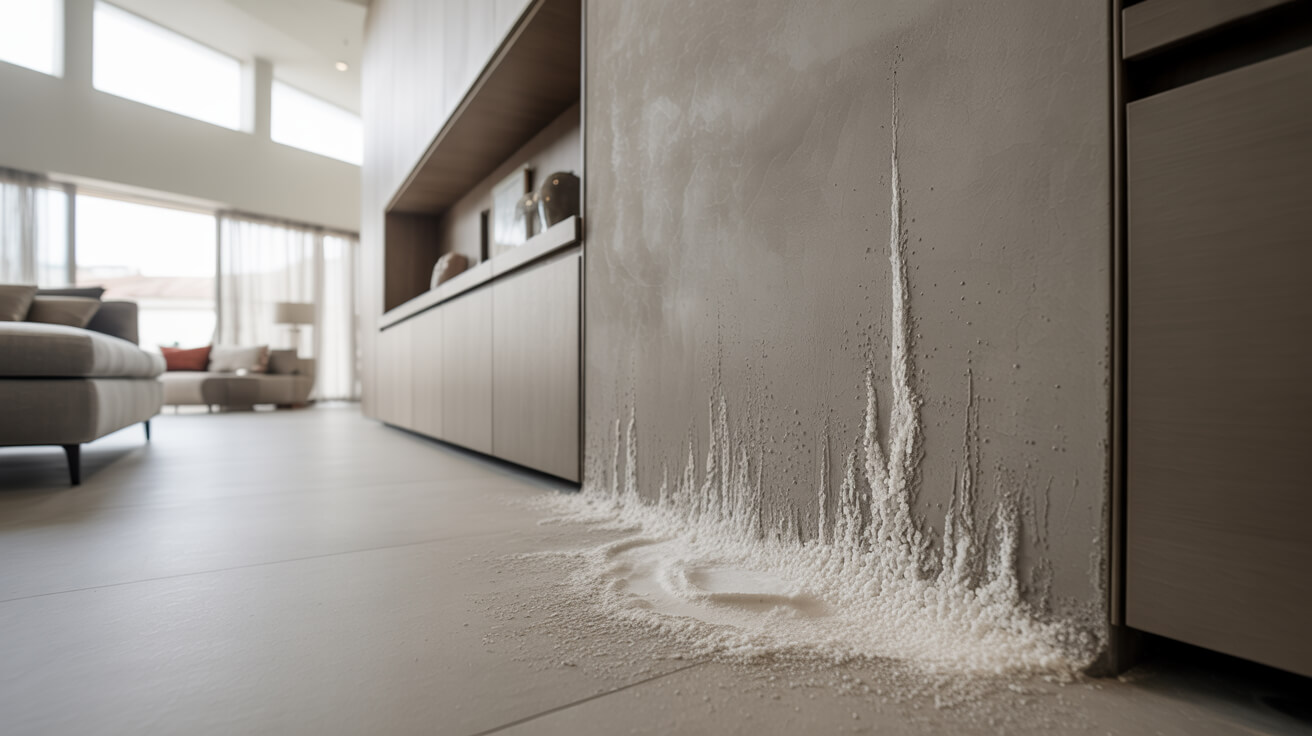
Differentiating efflorescence from mould, paint residue, or cement bloom is more than a visual exercise. Each has specific behaviours:
Diagnostic Features of Efflorescence
- Powdery to the touch—dry and fine:
- White or grey, sometimes crystalline or veined:
- Rubs away easily, dissolves in water:
- Appears only on masonry, not organic surfaces:
Distinction Table
| Sign | Efflorescence | Mould | Paint Residue |
|---|---|---|---|
| Feel | Dry, powdery | Damp/slimy | Flaky, sticky |
| Colour | White, grey | Black, green | Off-white, colour |
| Smell | None | Musty | Chemical/painty |
| Test | Water dissolves | No effect/smears | May smear, not dissolve |
When Should You Bring in a Specialist?
If stains return after each cleaning, or appear after new construction or refurbishment, it’s time to suspect an underlying moisture path. Professional salt spectrum analysis and moisture mapping reveal what basic examination can’t. In heritage buildings, errors can mean both property loss and regulatory breach.
“It’s not about what you wipe away today—it’s about what’s returning tomorrow.”
Why Is Ongoing Efflorescence a Threat to Property Value and Structural Integrity?
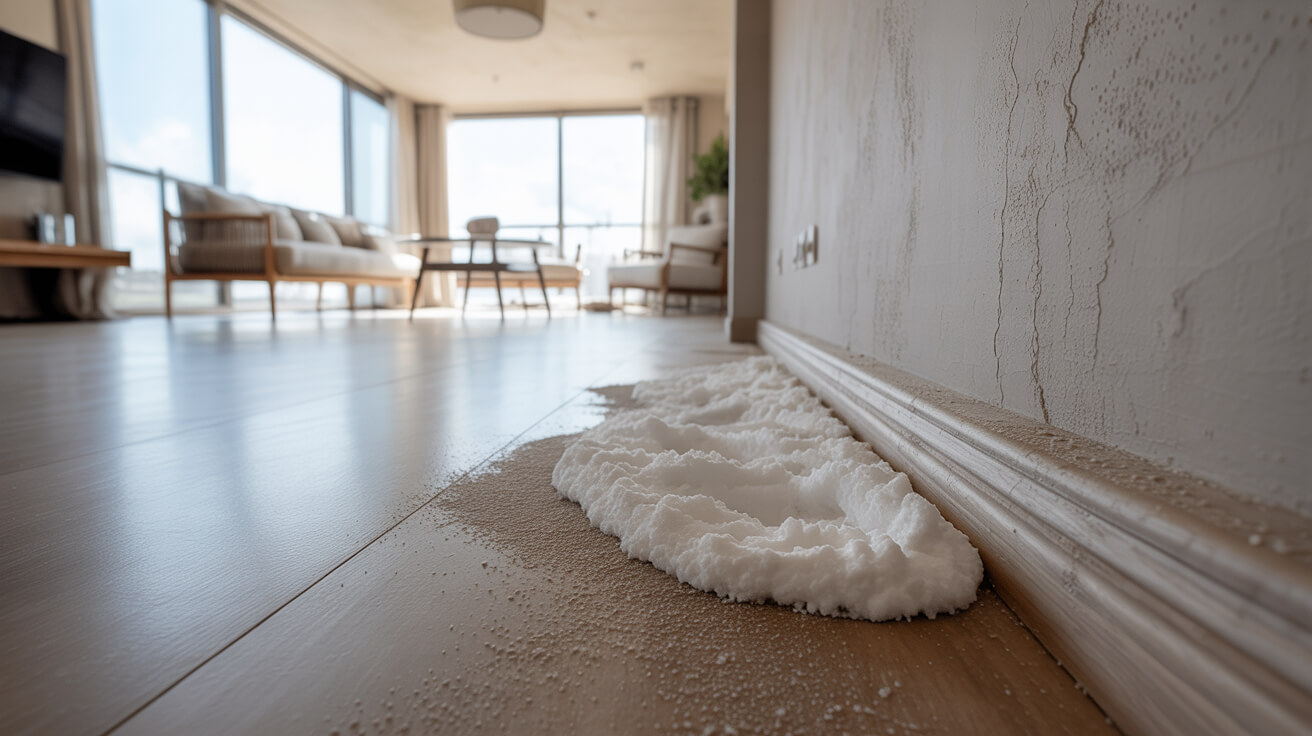
Persistent efflorescence isn’t just unsightly. It’s a warning that water is steadily working through your property’s core, risking:
- Spalling bricks: Crystals form in pores, shattering surfaces.
- Mortar decay: Repeated cycles erode cement or lime.
- Rebar corrosion: Salts travel through concrete, attacking steel.
- Lowered insulation: Ongoing damp undermines wall performance, raising energy costs.
| Risk | Outcome | Who’s Impacted |
|---|---|---|
| Sale/mortgage | Surveyor flags, devaluation | Sellers, buyers |
| Regulation | HHSRS breach, legal leverage | Landlords, agents, councils |
| Maintenance | Rising future costs | Portfolio/commercial owners |
| Compliance | Lost heritage status/audit fail | Heritage/local authority owners |
How Does Proactivity = Asset Protection?
Clients of Sussex Damp Experts benefit from survey-compliant fixes and reporting, preserving sale potential, regulatory compliance, and tenant trust. A surveyor’s note of “recurrent salts” can halt a transaction—proof of cure secures your leverage.
Which Materials, Buildings, and Environments Are Most Susceptible?
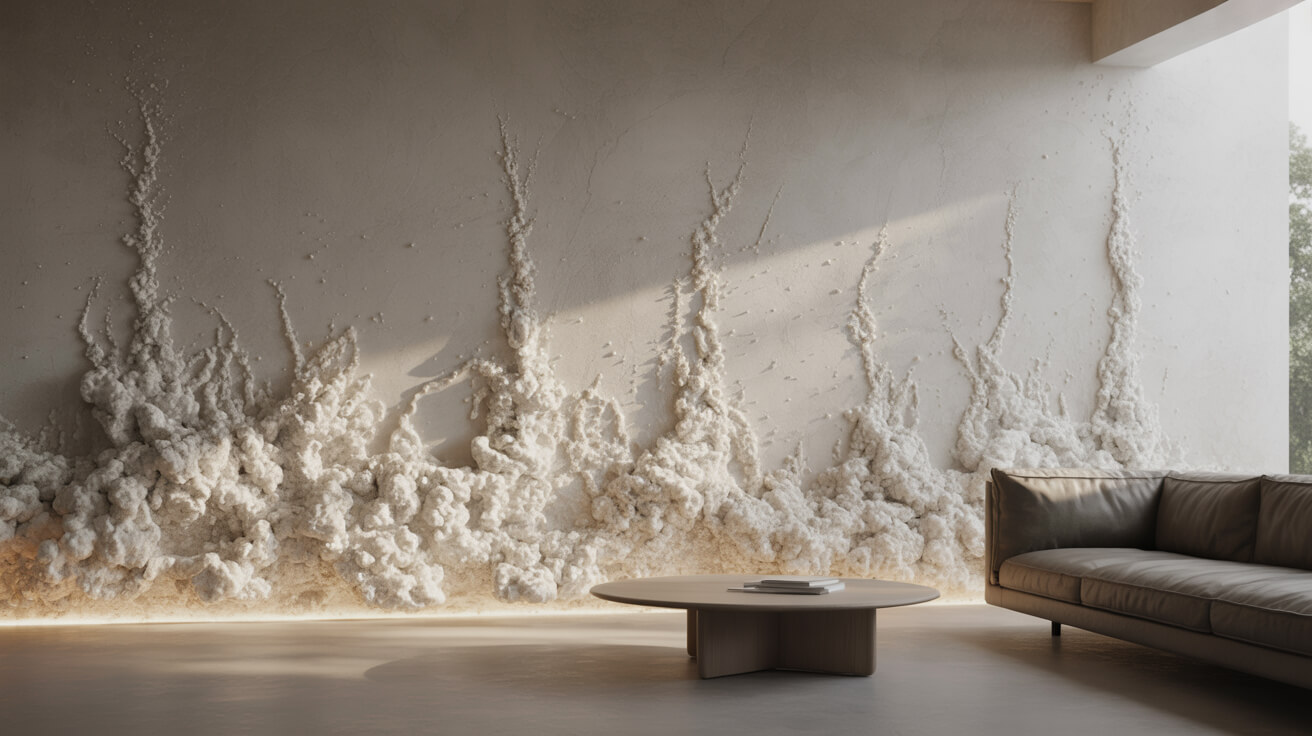
Not all masonry is equal, nor are all construction eras or remedies equivalent.
Materials and Sites Prone to Salt Deposits
- Lime mortars, soft brick, sand-based renders: High inherent salt content.
- Solid wall and heritage buildings: No modern cavity to block moisture.
- Basements and below-grade spaces: Exposed to constant hydrostatic pressure.
- Buildings in coastal, clay, or floodplain settings: Higher moisture and salt ingress risk.
- Sites with inadequate drainage or poor repairs: Key moisture pathways.
Susceptibility Matrix
| Feature | Risk Level | Preventive Note |
|---|---|---|
| Solid brick/stone | High | Use breathable mortars |
| Modern cavity wall | Moderate | Inspect DPC and insulation after works |
| Heritage/listed | High | Follow conservation guidance—no generic DPC |
| Basements | High | Tanking and pressure management essential |
“Most expensive repairs start long before visible damage—uncover risk early, and you can build confidence, not just compliance.”
When Does Efflorescence Indicate Serious Hidden Damp?
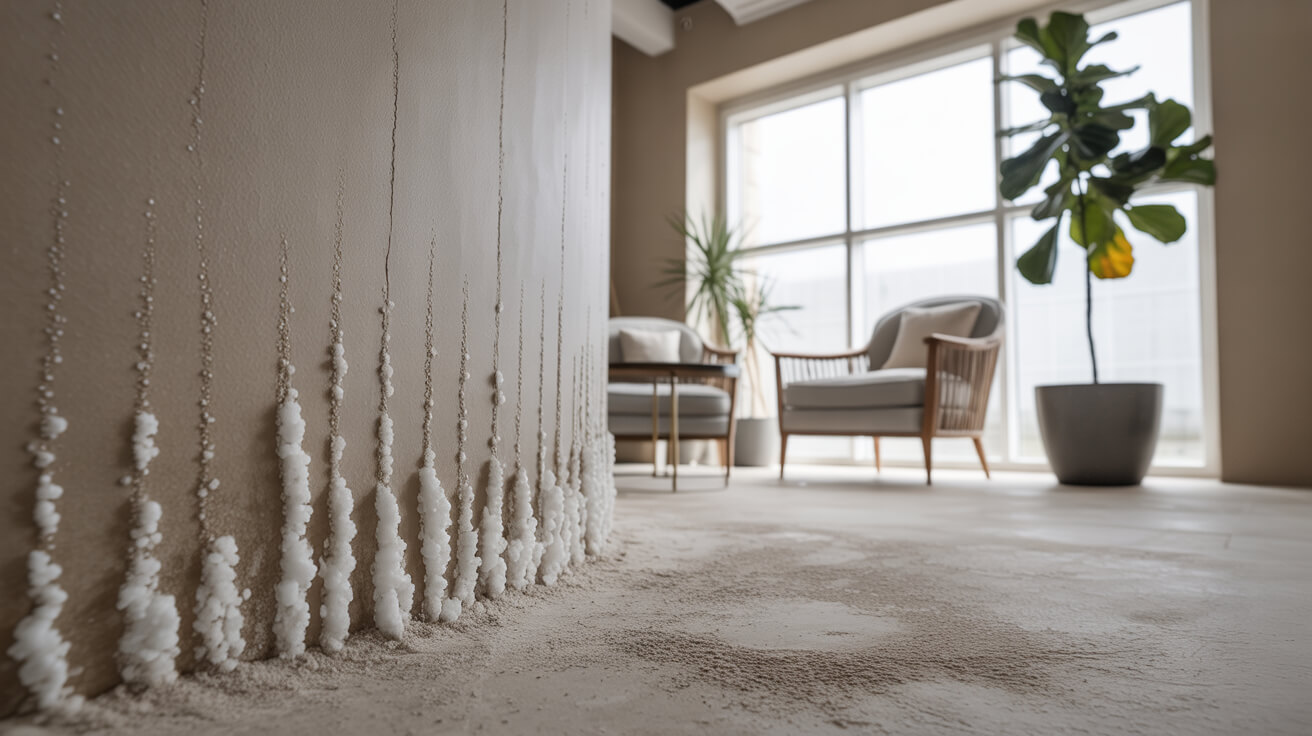
Not all white stains are urgent, but repeated, migrating, or multi-zone outbreaks demand escalation.
Key Escalation Signals
- Recurrence after cleaning or re-finishing:
- Linked symptoms: Plaster flaking, musty rooms, timber decay
- New stains after renovation, flooding, or leaks:
- Combined with rising bills or changing room climate:
Action Escalation Table
| Symptom | Underlying Cause | Decision Point |
|---|---|---|
| Back after removal | Persistent ingress | Book technical survey |
| Appears around insulation | Bridged DPC, trapped water | Diagnostic scan needed |
| In heritage/commercial setting | Regulatory/compliance risk | Compliance survey needed |
Expert Assessment: Why Accuracy Beats Guesswork
Only a specialist with advanced diagnostics (moisture detectors, salt analysis, substrate profiling) can distinguish harmless surface salt from a systemic threat. Misreading signals risks loss of insurance cover, failed sales, or exposed liability to regulators or tenants.
How Can Efflorescence Be Prevented During Construction and Maintenance?

Preventing efflorescence is not a once-off action—it is a life-cycle discipline. From build to annual inspection, each step either adds resilience or sets up future risk.
Best Practices for New Builds and Refurbishment
- Store all masonry and materials off ground and under cover until installed.
- Specify low-salt content mortars and sand for key structural repairs.
- Insist on DPC continuity during works, monitor after insulation or services run.
- Apply breathable protective finishes, not impervious or quick-fix coatings.
Maintenance and Aftercare Insights
- Annual external drainage and rainwater goods inspection
- Wall and parapet check after storms or long wet periods
- Ventilation watch—blockages equal trapped water and recurring salt
- Document issues, act early—heritage and commercial assets face stricter oversight
Preventive Checklist Table
| Preventive Action | Frequency | Responsible |
|---|---|---|
| Material storage/protection | During build | Site/project lead |
| DPC inspection | After works/annually | Surveyor/owner |
| Drainage checks | Every 6–12 months | Site/maintenance |
| Vent/blockage clearance | Each season | Maintenance/owner |
| Professional assessment | At sign of recurrence | Sussex Damp Experts |
Risk-aware maintenance reduces both headline costs and silent, compounding damage. Ongoing service plans from Sussex Damp Experts manage record-keeping, compliance, and field tasks for all property types.
Can Efflorescence Be Treated by Owners or Do You Need Specialist Intervention?
DIY cleaning or simple acid rinses address only the surface. Without root-cause diagnosis and regulatory-accepted remediation, the problem can repeat or worsen.
When Is DIY Sufficient?
- Isolated, first-time, dry-location stains
- Confirmed cause resolved (e.g., post-leak fix)
- Material not at risk from mild cleaning
When Is Professional Help Required?
- Any recurrence, especially after repeated DIY
- Heritage/commercial/let settings (compliance/warranty risk)
- Multiple or rapidly spreading locations
- Symptoms appear after construction/renovation (bridged DPC or material defect)
DIY Or Pro Table
| Scenario | DIY | Specialist |
|---|---|---|
| First mild outbreak | ✔️ | |
| Repeats, or after construction | ✔️ | |
| Commercial/Heritage/Let property | ✔️ | |
| Unknown or mixed results | ✔️ | |
| Visible damage to fabric/structure | ✔️ |
“You can buy a brush, but you can’t buy back compliance or heritage value lost through guesswork.”
Our experts provide not only treatment but documentation, evidence, and future risk protection. That’s the real difference between a cobbled fix and a professional solution.
Where Can You Find Expert Help for Efflorescence and Damp Problems?
Getting this decision right means more than securing a clean surface—it guarantees preservation, regulatory alignment, and stress-free asset management.
Why Sussex Damp Experts?
- Multi-system diagnostics—site, technical, and laboratory analysis
- Heritage and commercial compliance
- Pre-sale, insurance, warranty-ready documentation
- Long-term monitoring and review options
- Trusted across Sussex, by private owners, estate managers, and public sector asset teams
You never have to choose between visible finish and structural resilience. When you rely on Sussex Damp Experts, you secure both. Prevention, diagnosis, and enduring repair all flow from a single, accountable provider—positioning your asset where stability and compliance are never second guessed.
“Owning a property should be about returning home—never about nursing it through recurring stress.”
Those salts aren’t just stains. They are a conversation your walls are having about unseen risk. Let Sussex Damp Experts decode and resolve them for you—for safety, value, and confidence long after the visible mark is gone.
[Related guides: Damp proofing, moisture control, building compliance, heritage damp survey, landlord responsibility, condensation management, salt diagnosis.]
Frequently Asked Questions
What physical and chemical processes cause efflorescence in properties like yours?
Efflorescence stems from a silent partnership between water and salt: moisture seeps through brick, stone, or concrete, dissolves mineral salts, and then carries those salts to the surface. When the water evaporates, the salts crystallise as a white, powdery deposit—a visible clue that your wall’s defences have been breached, and a reminder that salts aren’t just stains. This is not just a quirk of old homes. Any property, from period terraced houses to contemporary developments, can develop efflorescence if underlying damp is present. The enabler is water ingress—rising groundwater, faulty guttering, breached damp proof courses, or even condensation from mismatched insulation strategies. In coastal or clay-rich regions, risk rises as groundwater carries more soluble minerals directly into your building’s envelope. Each fresh deposit signals active transport routes for moisture, which often go unnoticed beneath perfect paintwork until that tell-tale white haze forms. Consistent salt buildup is not just a cosmetic issue: it’s a tangible warning that your building’s performance envelope is compromised, making prompt diagnosis a catalyst for lasting property health.
The Chain Reaction Underneath the Surface
- Water enters porous construction materials via capillary action or hydrostatic pressure.
- Soluble salts dissolve, migrate through micro-channels, and accumulate internally.
- Evaporation drives crystallisation at the surface when internal humidity/hydrostatic gradients change.
- The process repeats with every moisture cycle or weather change, compounding the effect.
Solid walls and lime mortars, prized for breathability in heritage settings, are paradoxically more susceptible. Modern structures aren’t immune, especially where rushed site practices, poor damp proofing, or unventilated voids leave material exposed. To safeguard your investment, analysing not just the symptom but the systemic pathway is decisive. This is where a Sussex Damp Experts’ survey reveals both the overt and hidden: mapping moisture ingress routes and quantifying salt migration for a precisely engineered solution.
How can you distinguish efflorescence from mould, lime bloom, or other wall stains?
Efflorescence reveals itself through a set of forensic clues: the deposit is dry, powdery, white, or pale grey, dissolving immediately if touched with water. Unlike paint flakes, it does not smear or emit any chemical or musty smell. Mould, on the other hand, often appears as black, green, or even brown streaks—starts fuzzy, feels slimy or damp, and brings a pungent odour. Lime bloom, common in new render or mortar, is harder, whiter, more crystalline, and may feel gritty or require weak acid to shift. The crucial distinction is substrate: efflorescence only forms on mineral-based materials—bricks, stone, mortar—whereas mould colonises organic surfaces like timber or wallpaper.
Quick Diagnostic Table
| Property | Efflorescence | Mould | Lime Bloom |
|---|---|---|---|
| Appearance | White powder | Dark fuzzy patches | Chalky white crust |
| Surface | Dry, dusty | Damp, slimy | Gritty, hard |
| Odour | Odourless | Musty | Odourless |
| Substrate | Brick, block, stone | Wood, paper, paint | Fresh mortar |
| Solubility | Dissolves in water | Smears/spreads | Needs acid |
If the stain recurs after cleaning, or spreads beyond the immediate area, diagnosis is no longer DIY territory. Building owners and asset managers signal risk to buyers, tenants, and insurers by letting it linger: a repeat offender almost always means active damp. Laboratory salt analysis and advanced tools like moisture metres or thermal cameras, wielded by a competent professional, eliminate guesswork. This forensic clarity differentiates cosmetic issues from deeper compliance or valuation threats—ensuring intervention aligns with both your building’s history and your long-term interests.
Why does persistent efflorescence undermine your property’s value and structural resilience?
Chronic efflorescence is never just a blemish—it’s a live feed from your property’s unseen weakness. As salts repeatedly cycle to the surface, the same mechanism is churning away inside your walls: every moisture event deposits crystals that expand and exert pressure on bricks and mortar, risking crumbling (spalling), delamination, and in the case of reinforced concrete, corrosion of embedded steel.
Surveyors and insurers treat visible efflorescence as a probable sign of uncontrolled water movement—a red flag that unlocks more intrusive inspections, delayed sales, requests for costly further investigations, or demands to escrow funds until the “damp defect” is professionally cleared.
Landlords and portfolio managers face regulatory scrutiny: HHSRS or Section 11 non-compliance is often triggered by unresolved damp, turning what seems cosmetic into a liability. Builders and renovators risk call-backs or warranty claims if post-handover outbreaks aren’t properly resolved.
What’s the Real Cost of Inaction?
- Diminished property value and negotiation leverage
- Frozen or failed sales due to lender conditions
- Escalating remedial costs as decay penetrates deeper
- Legal exposure under health and safety, tenancy, and building regulations
- Market reputation damage
A Sussex Damp Experts diagnostic and remediation plan supports your status as a proactive asset steward—delivering not only technical solutions but quantifiable assurance you can show any stakeholder.
Which materials and environments make efflorescence more likely, and what property types should take action most urgently?
Vulnerability to efflorescence isn’t confined to the past—although period properties shoulder the highest risk. Heritage buildings, solid walled stock, and those constructed with lime mortars, clay bricks, or locally quarried stone feature the largest interconnected pore structures, making them natural pathways for migrating salts when water is present.
Modern cavity-wall homes are less susceptible, but not immune: poor site drainage, retrofitted insulation that bridges the damp proof course, or even minor leaks may open up new migration channels for years to come. Geographical setting matters: you may see more persistent efflorescence in clay-heavy soils or coastal environments thanks to elevated groundwater salts and higher baseline moisture.
Commercial properties and portfolios that include basements or below-ground spaces must pay heightened attention, where groundwater pressure and internal heating cycles pull moisture—and thus salts—into wall voids and finishes.
Susceptibility Checklist
- Pre-1930s solid wall or “heritage” construction
- Properties in high groundwater, coastal, or clay-dense regions
- Any building with suspected or recently breached DPC
- Sites with recurring leak, condensation, or intrusion issues
- Retrofits or extensions without reassessment of moisture dynamics
Crafting a sustainable maintenance and remediation plan means treating efflorescence not as an anomaly, but as a signpost to broader hydrothermal risks unique to your property. A technical survey can reveal material-environment dynamics—allowing bespoke, regulation-aligned interventions. Sussex Damp Experts specialise in blending these requirements with ongoing property stewardship, so future outbreaks become exceptions, not repeated costs.
When does efflorescence signal that urgent professional support is the only responsible move?
The line between “just clean it” and “get expert help” is crossed as soon as salt deposits become routine, persist seasonally, expand, or start co-occurring with symptoms like flaking plaster, warping wood, or visible mould patches. Escalation is non-negotiable if you are a landlord (especially under council or HHSRS scrutiny), a property seller facing surveyor notes, or a listed-building owner under conservation duty.
Ignoring recurrent efflorescence exposes you to latent risks: hidden leaks, rising damp, failed dpc, or bypassed cavity trays. These hidden failures often multiply the cost and complexity of remediation, far outperforming any perceived DIY savings or short-term denial.
Escalation Triggers Table
| Symptom | Implied Risk | Professional Diagnostic |
|---|---|---|
| Persistent white powder after storms | Active ingress | Moisture mapping |
| Expansion after insulation works | DPC bridge, hidden void | Thermal imaging |
| Surface loss, brick flaking | Structural decay | Salt type/profiling |
| Blue/green/grey salt crystal | Mixed or unusual salt attack | Laboratory geochemical test |
| Nuisance odour, rising bills | Combined condensation issues | Full property damp survey |
Rely on Sussex Damp Experts to apply advanced survey logic, cross-industry compliance criteria, and property-type specific algorithms to your survey: precision that ensures every recommendation stands up to scrutiny, from mortgage lenders to conservation officers.
Can efflorescence ever be permanently resolved with DIY methods, or is professional remediation essential?
DIY is a valid tactical response for isolated, first-time efflorescence on otherwise “healthy” walls. Dry brushing, dilute vinegar rinses, and improved ventilation may give transient relief. Yet, the moment you document recurrence—especially if it persists after heavy rain, seasonal change, or post-construction—you reach the limit of what home remedies offer.
DIY is not recognised as a permanent or compliant fix by surveyors, insurers, or regulatory authorities, especially in regulated asset spaces or heritage properties. Unchecked, repeated amateur removal risks compounding damp ingress, deepening salt cycles, and compounding future remediation costs.
DIY vs. Professional Table
| Scenario | Temporary Fix | Professional Solution |
|---|---|---|
| First-time, small patch | ✔️ | |
| Recurrent or spreading | ✔️ | |
| Heritage, commercial, tenanted | ✔️ | |
| Involving failed repair | ✔️ | |
| Associated with leaks | ✔️ |
True peace of mind—documented for insurance, mortgage, or sale—comes through independent, context-specific diagnosis and an engineered remediation plan. Sussex Damp Experts blend forensic step-mapping (not paint-overs), compliance guarantees, and long-term monitoring, letting asset owners concentrate on their business, not chronic damp drama.
Where can you secure trusted, proven expertise for efflorescence and property damp problems?
Efflorescence isn’t a one-brand, one-tool challenge. It is a multi-system, all-stakeholder problem that demands diagnostic accuracy, compliance fluency, and service aftercare. You want a partner who bridges the complexity between “visual issue” and “hidden system failure,” providing survey reports that unlock asset value and regulatory confidence.
Why Choose Sussex Damp Experts as Your Specialist Ally
- Proven record in diagnostics, moisture profiling, and compliance reporting for heritage, commercial, and private owners.
- Laboratory salt profiling and site-specific moisture mapping.
- Remedies aligned with UK compliance: BS6576, PAS2035, HHSRS, and listed-building conservation guidance.
- Ongoing monitoring, aftercare, and documentation for every intervention—define the gold standard in property stewardship.
Your property’s signature is unique. So should be your approach to damp and efflorescence. Protect your identity as a forward-thinking asset manager, trusted owner, or compliance-driven landlord: bring in expertise that stands behind every outcome and lets you move forward with confidence, not recurring patches.

