
 By
By  February 2, 2023


What are the Stages of Dry Rot?
Dry rot can erode the safety, value, and compliance standing of your property in a matter of months—often before a single visual cue is obvious. Recognising each phase of the fungus’s lifecycle, much like in Woodworm Lifecycle Decoded, gives you an operational advantage over escalating costs and risk. Every property owner, buyer, manager, or professional responsible for built environments in the UK must grasp that dry rot is not just a spot or a patch; it is a sequence of silent failures and missed intervention windows.
How Does Dry Rot Progress and Why Does It Matter?
The Serpula lacrymans fungus—responsible for nearly all damaging dry rot outbreaks—progresses as follows:
- Spores: Ubiquitous, dormant until exposed to excess moisture.
- Hyphae: Fine, fast-growing threads digesting wood cellulose soon after sporulation.
- Mycelium: Dense mats spread through timber, masonry, and even airbricks, seeking fresh food sources.
- Fruiting Body: Mushroom-like structure erupts, releasing millions more spores to restart the process elsewhere.
Each transition heightens the risk: what begins as a small spore-settling can end in a surveyor halting a property sale, an insurance company rejecting a claim, or a local authority mandating major works.
| Dry Rot Stage | Symptoms | Threat Behind the Scenes | What to Do |
|---|---|---|---|
| Spores | Invisible until dust gathers | Latent risk | Monitor moisture |
| Hyphae | White threads, subtle cracking | Internal wood decay | Assess risk profile |
| Mycelium | Matted, grey/white “cotton wool” | Aggressive spread through property | Immediate inspection |
| Fruiting Body | Mushroom with orange rim, spore dust | Mass spore release, wider danger | Full remediation |
You don’t control dry rot—the timeline does. Delay, and you’re always behind.
What Conditions Trigger Dry Rot in Buildings?
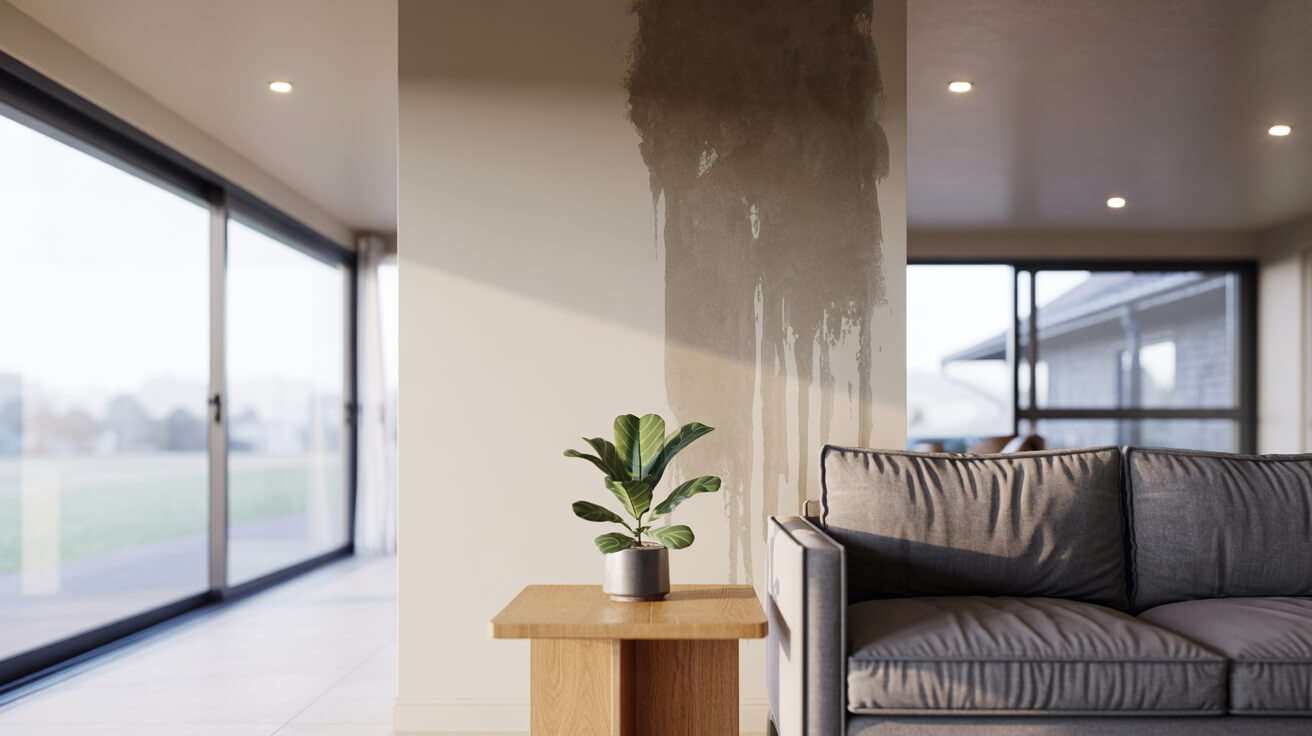
Dry rot does not discriminate between property ages or types; it takes advantage of consistent conditions: timber moisture above 20% and poor ventilation. Leaky plumbing, overflowing gutters, failed or bridged DPCs, and even modern insulation trapping humidity can create perfect launchpads for decay.
Why Old Remedies and Visual Inspection Fail
Repeated painting, basic repairs, or superficial patching won’t resolve the underlying cause. Moisture can accumulate unseen behind skirting, under floors, or within wall voids for months before symptoms surface. Building managers and owners who rely on superficial visual assessment or outdated “damp proofing” techniques end up fighting recurring outbreaks—and wasting capital.
Core Risk Factors for Dry Rot:
- Persistent hidden moisture: From leaks, condensation, or lack of airflow.
- Vulnerable construction details: Heritage lime plasters, bridging insulation, flawed modern repairs.
- Delay in tracing minor symptoms: Musty smells, “bouncy” floors, or peeling paint often precede visible rot by months.
- Inefficient aftercare: No post-repair humidity checks, skipped maintenance on repaired systems.
Actionable Takeaway
Don’t wait for visible symptoms. Regular humidity monitoring and targeted professional inspection minimise surprises.
How Do You Recognise Each Stage of Dry Rot—From Subtle Signs to Structural Threats?

Accurate diagnosis saves you more than money; it preserves peace of mind and liability status. Relying on a simple walkaround or a single visual tell risks missed infestations, insurance denial, or tenant disputes.
Practical Cues Per Stage
Early – Spores and Hyphae:
Look for light brown/orange dust beneath skirting, faint musty odour in enclosed spaces, and thin, white, silky threads at timber joints.
Intermediate – Mycelium:
Dense, white or grey, matted growth often bridges masonry gaps or lies below floorboards. Timber turns brittle, and normally hidden areas (like under window bays or behind kitchen units) become high-risk.
Advanced – Fruiting Body:
Distinctive mushroom shapes with orange margins and powdery spore deposits—easily the danger point where spread accelerates across a property.
Checklist: Is This Dry Rot?
- Spore deposits in enclosed, damp spaces?
- White/grey, sheet-like growth under or behind timber/masonry?
- Cuboidal (box pattern) cracking, wood easily breaking by hand?
- Mushroom-like growth in a hidden or previously damp area?
- High moisture readings (>20%) for more than a week?
If you answer yes to more than one point, get a professional survey—delay costs exponentially more as decay progresses.
The right move is a precise inspection, not a hopeful glance. The former saves your legacy, the latter just gambles it.
What Risks Escalate When Dry Rot Progresses Unchecked?
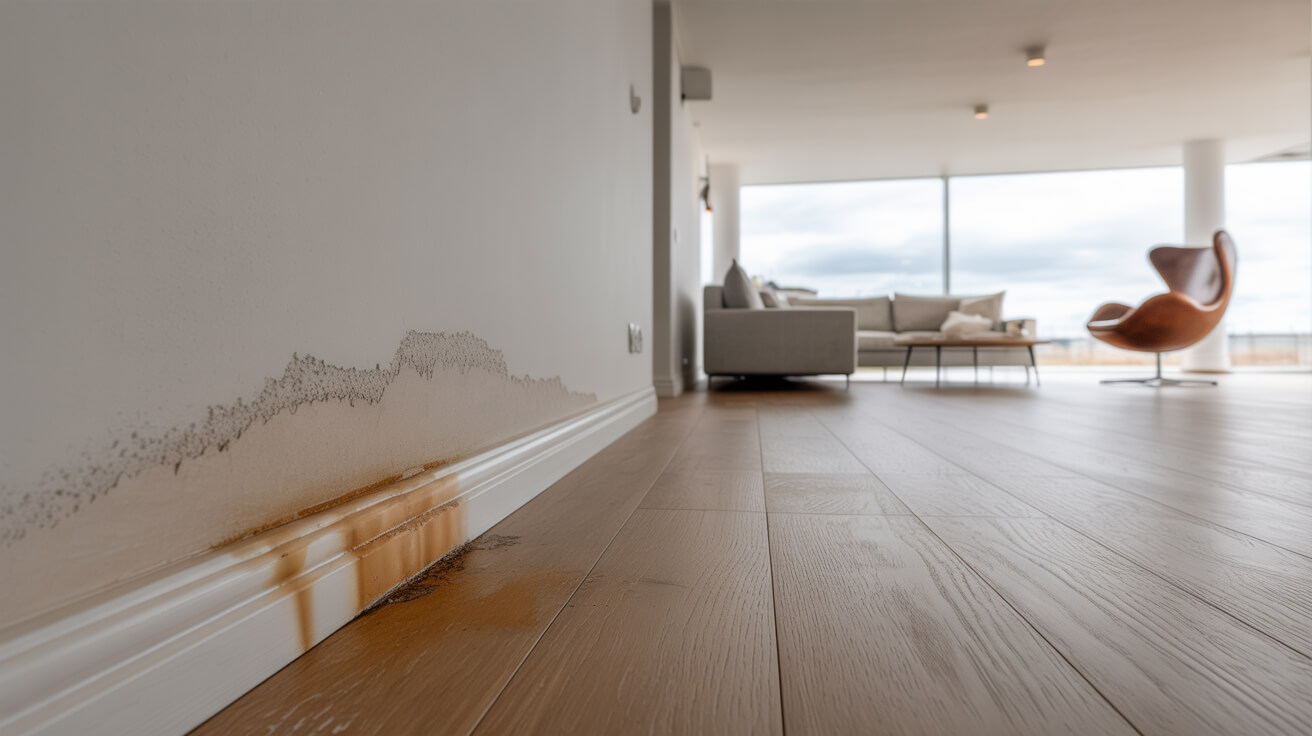
Every missed sign or delayed remediation compounds the cost, scope, and legal risk. Dry rot isn’t static: once mycelium penetrates sub-floors or party walls, adjacent rooms, properties, or flats become exposed—even with recent repairs.
Hidden Cost Matrix
| Delay (months) | Typical Scope | Likely Cost Increase | Ancillary Risks |
|---|---|---|---|
| 0–1 | Single joist/skirting | Baseline | Minimal if caught |
| 2–4 | Room-wide | x2–x3 | Flooring uplift, possible surveyor flag |
| 4–8 | Adjoining areas/walls | x5–x10 | Insurance contention; mortgage hold |
| 8+ | Structural/Floor-wide | x20+ | Tenant claims; legal disputes; asset devaluation |
When tenants, insurers, buyers, or council officers become involved, uncontrolled dry rot flips from repairable issue to a file of compliance and liability failings.
Regulatory and Financial Triggers
- HHSRS: Landlords failing to address dry rot face statutory enforcement.
- Insurance: Most policies exclude gradual/fungal decay; late action voids claims.
- Surveyor Reports: Advanced dry rot halts sales, refinancing, or trust with buyers.
Where Are Dry Rot Hotspots and Why Do They Hide So Easily?

You cannot stop what you cannot see. Council surveyors, property managers, and portfolio landlords frequently uncover advanced dry rot only after new complaints, tenant moves, or rediscovered voids. Dry rot thrives in “behind the scenes” joints, floor voids, and party walls.
Hotspot Map
| Location | Risk Factor | Inspection Method |
|---|---|---|
| Suspended/timber floors | Concealed moisture, poor airflow | Core sample, IR imaging |
| Basements/cellars | Persistent humidity | Humidistat, torch check |
| Bay windows | Cold bridging, leaks | Moisture probe |
| Chimney breasts | Condensation via cooling | Visual + damp metre |
| Party walls | Cross-contamination risk | Both-side probe |
Process-driven, cyclical inspections with targeted instrumentation (e.g., moisture metres, IR, borescopes) make “invisible” rot traceable before escalation.
When Should Decisive Professional Action Be Taken?

Waiting is the silent ally of dry rot. Landlords, agents, and owner-occupiers all benefit most by acting at first sight of risk—smell, sudden cracking, recurring mustiness, or humidity that lingers even after superficial fixes.
Urgency Benchmarks
- Surveyor or agent flags fungal decay: Act within two weeks to avoid compliance breaches.
- Active mushroom or mycelium growth: Immediate remediation required; skip DIY attempts.
- Above-20% timber moisture after repair: Professional follow-up for persistent sources and fail points.
Regret rarely speaks loudly, but every property manager hears it when avoidance becomes evidence in court.
How Does Professional, Heritage-Compliant Treatment Deliver Permanent Solutions?
Standard damp proofing is not enough—especially if your property is period, listed, or conservation-protected. Heritage-compliant intervention begins with forensic diagnosis. Sussex Damp Experts deploy PCA/BS6576-aligned methods—lime-safe replastering, breathable barrier membranes, and documentation trails standing up to both lenders and council officers.
Process of Professional Remediation
- Full moisture mapping: Identifies all ingress and risk points
- Lime and heritage-safe interventions: Respect original structure
- Regulatory and mortgage-compliant documentation: Enables sale, rental, or refinancing
- Ongoing aftercare: Warranty and annual inspection to prevent recurrence
Proof Layer: Real Case Reference
A Grade II listed property in Hastings, previously “treated” by generic contractors, suffered repeat outbreaks, failed sales, and council intervention. Only after heritage-compliant PCA protocols did future buyers and the council sign off. Cost: far less than three rounds of re-repairs.
Why Sussex Damp Experts Remain the Trusted Choice for Lasting Protection
Every property, regardless of age or use, deserves clarity and certainty when it comes to lasting protection from dry rot. Sussex Damp Experts integrate local experience, PCA-accreditation, and robust warranties to turn uncertainty into monitored, provable strength. From pre-purchase detector surveys to heritage-grade aftercare, your property’s risk position is upgraded for years ahead.
- Complete lifecycle protection: From root diagnostics to annual monitoring.
- Lender and council confidence: All reports and interventions prepared for scrutiny.
- Warranty-integrated, surveyor-backed solutions: For every stage, every compliance need.
If your goal is long-term value, operational peace, and real compliance—not momentary relief—invest in evidence, not guesswork. Use the expertise that the region’s professionals, landlords, and responsible owners trust.
In compliance, as in property—reputation isn’t given, it’s proven. Be the owner whose building stands out for all the right reasons.
Frequently Asked Questions
What Are the Stages of Dry Rot—And Why Does Each Phase Raise the Stakes for Your Property?
Dry rot does not announce itself neatly; it infiltrates your property in sequences as exacting as a specialist’s repair protocol. Each stage—spores, hyphae, mycelium, fruiting body—intensifies both the potential for structural harm and the cost of inaction. At first, microscopic spores—ever-present in dust—await a boost of rising humidity. The moment your timbers cross that silent line of 20%+ moisture, the transformation is set. Hyphae, invisible fungal threads, weave below the surface, quietly digesting cellulose. The transition to mycelium marks dry rot’s real expansion: white or grey mats fan beneath floorboards, crawling up skirting and even leaping through damp walls. When you notice a mushroom-like fruiting body erupting from joinery or hollow-sounding wood, it’s the organism’s final, devastating flourish—millions of new spores released, and structural integrity abandoned.
Why does understanding these stages matter for you? Because each offers a shrinking window for cost-effective intervention. Ignore early symptoms and routine repairs become full-scale timber replacement—sometimes followed by legal intervention if a surveyor’s report derails a sale or triggers a council notice. The chain reaction from spore to outbreak isn’t theoretical; Sussex Damp Experts encounter and document multi-stage failures every year, and see the same reality—fixes are affordable early, existential later.
The Four Stages at a Glance
| Stage | What Happens | Owner’s Early-Warning Sign |
|---|---|---|
| Spores | Dormant, dust-like presence | Subtle orange powder, usually ignored |
| Hyphae | Initial wood digestion | Faint white threads, wood just softening |
| Mycelium | Aggressive internal spread | Cottony mats, hollow sounds, concealed risk |
| Fruiting Body | Visible mushroom, spore mass | Large, rubbery fungus, structural failure |
Decoding the stage of dry rot attacking your building lets you steer the outcome with decisiveness, not hope. That’s the true leverage point for owners, managers, landlords, and listed-property stewards alike.
Why Does Dry Rot Start—And Which Building Factors Place You Most at Risk?
Dry rot is not a sign that your building is outdated or poorly maintained; it’s a direct result of precise environmental failures. Behind every outbreak is a hidden choreography of moisture ingress, air movement breakdown, and overlooked substrates. Modern extensions sealed with impermeable membranes, heritage walls smothered by cement render, leaking pipework between joists—all of these changes silently push your timber above safe moisture thresholds. Once damp is a constant presence—be it from gutter leaks, bridged DPCs, or unchecked condensation—spores germinate and the race begins.
Certain property types and details face disproportionate risk:
- Period homes with lost breathability due to modern materials.
- New builds where insulation traps humidity in voids.
- Basements and cellars with ground moisture but poor drainage.
- Leaky bathrooms/kitchens where slow drips meet hidden timber.
- Extensions where floor heights or external levels create new cold bridges.
Regulatory pressure is climbing—in England and Wales, HHSRS notices cite rising and persistent damp as leading enforcement factors. Insurers will quickly highlight “construction design fault” or “gradual damp” exclusions if you attempt claims post-facto. The best defence: systematic pressure checks, annual external envelope reviews, and a readiness to treat ingress as an urgent, not routine, fix. Risk does not announce itself through drama—it accumulates in silence and shadows.
How Can You Accurately Identify the Stage of Dry Rot Threatening Your Property?
Diagnosing dry rot’s progression is not a show of bravado; it’s an act of preservation. Miss the signs early and you sacrifice far more than timber—you risk insurance rejection, mortgage survey red flags, and expensive recurrence. The earliest warnings are easily dismissed: a touch of orange dust near boards, paint flaking for “no reason”, odd musty air every autumn. As the fungus enters the hyphal stage, you’ll spot thin white strands between floor joints or along subfloor timbers—tell-tale but easy to overlook if you’re untrained. The real peril arrives when mycelium fans out: a dense, fluffy or chalky web, especially in voids or on cool masonry, turning what should be sturdy into fragile, paper-dry splinters.
By the time fruiting bodies materialise, the internal destruction is widespread. Mushroom growth of any size means the organism has already digested core supports; major repairs cannot wait. Sussex Damp Experts deploy a blend of forensic substrate testing, borescope checks, and deep moisture mapping—no guesswork or “watch and wait” delay.
Checklist to Identify Dry Rot Stage
- Visual: Orange or brown spore dust, white hyphae threads, dense mycelium mats, rubbery mushroom bodies.
- Tactile: Wood crumbles under thumb, spongy or hollow sound when tapped, floors springy.
- Diagnostic: Moisture metre consistently above 20%, patchy subfloor chill, persistent musty odour.
- Scenario marker: Surveyor’s mortgage retest, sale stalling, landlord’s tenant complaint, or HHSRS warning.
Missing these cues equals silently accepting escalating costs and legal risk. Recognising them—then acting—puts you in control, not on the defensive.
What Are the True Financial and Legal Risks If Dry Rot Progresses Unchecked?
Dry rot does not stall for indecision; every unchecked week amplifies financial outlay and jeopardises your role as a responsible custodian. Early on, repairs might involve superficial treatments, perhaps patching plaster or swapping a few boards. Ignore early warnings and the upward curve is brutally obvious: beam-by-beam destruction, joist failures, secondary infestation into party walls. Failing to act triggers a relay race of consequences.
Risks escalate along four major axes:
1. Structural: Joists, lintels, sills require full replacement.
2. Financial: £400 can quickly balloon to £10,000–£50,000 when infestation leaps voids or walls.
3. Legal/Compliance: Tenancy and HHSRS laws actively penalise landlords or associations for ignoring damp and decay; insurance claims are regularly denied for “gradual” fungal damage.
4. Transactional: Sales stall on surveyor warnings, mortgage lenders withhold funds, and repeat issues branding your asset as “problematic” for years.
The best proof lies in the data: Sussex Damp Experts teams see insurance claim acceptance plummet by 80% once surveyor notes cite delayed action—no amount of post-hoc documentation compensates.
Most of your leverage is lost before you see a single mushroom. The rest is lost to delay and indecision.
Ownership is not merely holding the title; it’s protecting the underlying value with fast, competent intervention.
Where Does Dry Rot Hide—And How Can You Anticipate Outbreaks Before They Erupt?
Every property has forgotten gaps—places inspections skip, where dry rot orchestrates its expansion unseen. Floor voids, basements, party walls, roof eaves, and behind kitchen units are all favoured zones. If your building has ever suffered a slow leak, past condensation, or a forgotten “out of sight, out of mind” utility run, those voids carry amplified risk today.
Surveyors and agents, especially managing blocks or institutional assets, cannot afford to wait for symptoms. Sussex Damp Experts’ approach is systematic: risk-mapping, periodic deep cavity probes, moisture and air quality audits, and proactive substrate imaging. The average outbreak is spotted months too late because the detection routine stopped at what was visible—never what was probable.
Top Dry Rot Hotspots:
- Under suspended or timber floors (especially at external walls)
- Basement corners, behind immovable storage, and in unventilated plumbing voids
- Roof valleys, chimney breasts, poorly flashed junctions
- Areas with joined extensions, party wall cavities, or period property crawlspaces
A building’s health is won in its blindspots. Anticipating them doesn’t require paranoia; it requires a repeatable, documented system.
When Should You Escalate Past DIY and Call Experts to Protect Your Property and Status?
The tipping point is never scripted, but it’s always obvious in hindsight. If dry rot symptoms linger past a routine fix—persistent odour, a stubbornly cold/soft patch of floor, or the spectre of a fruiting body—professional help is urgent. Landlords, managing agents, and commercial stewards are doubly at risk: tenancy law binds you to strict repair deadlines, and insurers will not gently accept a timeline where DIY optimism trumped qualified intervention.
Sussex Damp Experts operate under full PCA and BS6576 regimes, supplying diagnosis reports, compliance-ready documentation, and a warranty structure that helps your asset withstand audits, sales, and legislative checks.
You should escalate to expert assessment when:
- Your own checks identify fungal bodies or dense mycelium
- Moisture remains >20% in any suspect area after leak/plumbing repairs
- Tenants, agents, or surveyors reference “mould,” “decay,” or “potential spread”
- The property is listed or requires heritage-specific interventions
The consequence of hesitating is not just financial; it’s professional. All stewards—owners, agents, or commercial project teams—are judged on their crisis response. Protect your status. Lead by acting before dry rot leads you into reputational crisis.
How Does Choosing Proven, Heritage-Compliant Damp Proofing Amplify Both Immediate and Enduring Value?
Decisions made in haste—patching, painting, or DIY chemical intervention—often seed future outbreaks and additional costs. Heritage properties demand a twin track: sensitive restoration and certified compliance. At Sussex Damp Experts every material, method, and record is selected to satisfy BCAPA (British Conservation Accredited Professionals) and BS6576 standards. Full photographic and written documentation, moisture remediation, heritage-safe interventions, and lender/authority attestation let your property stand proud—unencumbered by compliance drag or structural “surprises.”
When you invest in proven, compliance-forward damp proofing:
- Past claims or survey blemishes are erased with fully warrantied repairs
- Council and lender queries are met by verifiable, expert reports
- Heritage officers sign off with confidence; buyers/investors see asset value, not lingering liability
- Your risk profile shifts permanently—trust is built in, not patched on
Any property can endure cycles of maintenance; only those led by expertise and systematic action thrive. Whether for your home, investment, managed block, or a client’s prized heritage asset, true damp proofing is a strategy, not a single repair.

