
 By
By  August 26, 2025


Can You Really Be Evicted After Reporting Damp and Mould — Or Are You Protected?
Landlords cannot evict you simply because you report damp or mould—UK law has taken a hard turn to protect tenants, and knowing your rights turns fear into leverage. Yet, the anxiety is real. Many renters still keep silent, letting dangerous black mould creep beneath the paint, dreading a “no-fault” eviction the moment they flag the problem. What’s changed? Since 2015, legal shields have strengthened, stopping most revenge evictions in their tracks—provided you use the right reporting channels. In the real world, your tenancy isn’t at risk for standing up to leaks, rot, or mould—done right, the law, council, and survey specialists can have your back.
With a paper trail and expert support, your complaint becomes your defence—not a reason to pack your bags.
If you’re stuck between unhealthy damp and the fear of moving costs or lost deposits, know this: today’s system offers tenants new leverage. By understanding the legal process, documenting smartly, and acting early, you keep control over your home and health. Damp isn’t just “bad luck”—it’s formally recognised as a housing hazard, and professional diagnosis plus council action can put a stop to landlord threats. We’ll break down where protections start, what counts as evidence, and how Sussex Damp Experts secures your corner—so you live without dread.
What Counts as Retaliatory Eviction—And When Does UK Law Block It?
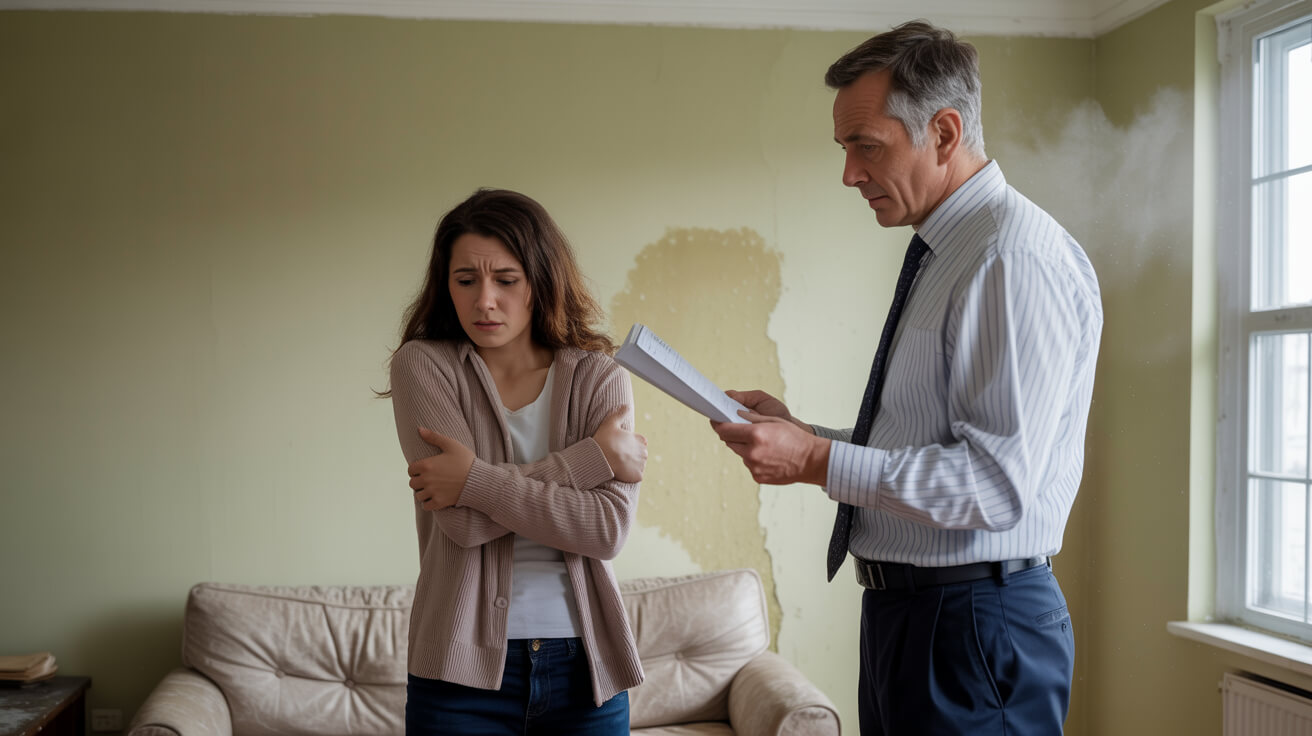
Retaliatory, or “revenge,” eviction happens when reporting problems like damp triggers a Section 21 (“no-fault”) notice from a landlord looking to dodge repairs. For years, tenants got shoved out for speaking up—a loophole for rogue owners. That changed with the Deregulation Act 2015, which rewrote the rules (Deregulation Act 2015: Section 33). Now, if you report a serious issue by the book, landlords can’t simply give you the boot for raising an official complaint.
How Legal Protections Actually Work
- Section 21 “Freeze”: When you formally report a disrepair (damp, mould, leaks) and the council serves a repair notice (under the Housing Health and Safety Rating System—HHSRS), your landlord cannot enforce a Section 21 eviction for six months after that notice is issued.
- Written Evidence Triggers Defence: Only formal, written complaints count. Conversations, texts, or offhand remarks don’t activate legal stretching room—emails, letters, and council forms do.
- Council Intervention Is Key: The law’s shield arises when Environmental Health steps in. If your landlord won’t budge, the council’s repair notice neutralises eviction attempts.
One email can stop a Section 21 dead—if you know the steps and get council action on your side.
The upshot: retaliation is no longer as easy as posting out a notice. But every real protection depends on you following the correct reporting steps and building a case that holds up.
How Can Tenants Build Evidence That Stands Up?

Landlords hold most of the cards—until you start stacking proper evidence. Your complaint isn’t just a whinge; it’s the start of a claim the law takes seriously, if you do the groundwork. Memory’s cheap—records pay, especially when things get uncomfortable. The right trail means the difference between being brushed aside and having the council, court, or letting agent backing you.
What Evidence Should You Always Keep?
- Photos with Dates: Photograph every spot, stain, and patch—show the scale and progression.
- Symptom Log: Note dates, affected rooms, visible mould, family health symptoms (think: coughs, sore throats, skin rashes).
- All Written Complaints: Every email or letter gets stored—ensure you can prove both what you sent and when your landlord received it.
- Surveyor Reports: Get a professional damp survey (by a qualified inspector: BS6576, BS8102, PAS2035)—the courts and councils trust this over hearsay.
- Correspondence With Landlord: Archive landlord replies, repair promises, or refusals. Even silence is evidence.
- Council Complaints: Keep every submission to Environmental Health—screen grabs, letters, or e-forms.
A stack of photos and a single surveyor’s report do more for you than ten phone calls.
Armed with this, you can demonstrate you acted responsibly—and if things escalate, you’ve given the council no excuse to ignore the risk.
Why Is Written Reporting the Real Legal Shield?

Saying “I called my letting agent” won’t cut it in court or with the council. UK tenant protection hinges on clarity and traceability. Landlords, agents, and judges want logs—they want to see when you raised the alarm, what you reported, and how you spelled it out. The system isn’t “call and hope”—it’s “document and defend”.
How To Report Damp So It Counts
- Write, Don’t Chat: Always use a dated letter or email, naming your address and specific problem. No verbal notifications—write everything.
- Add Proof: Attach crisp photos, surveyor notes, and symptom logs. The more solid, the better.
- Request Action/Deadline: State what you want fixed. Ask for a response within 14 days—that’s industry guidance.
- Save Everything: Make sure records are backed up and accessible. If it isn’t documented, it didn’t happen.
Send all written reports by recorded delivery or a reliable digital method with read receipts. Your paper trail isn’t bureaucracy—it’s a legal firewall.
In writing, on file, with proof—this is how you beat rogue landlords at their own game.
Don’t rely on memory or goodwill. You deserve a safe, damp-free home—and the courts support those who act transparently.
What Is a “Reasonable Response Time” for Damp and Mould Complaints?

Once you’ve written, time’s ticking for your landlord. The standard response window is 14 days (Shelter 2024). In urgent health cases, immediate action may be required. Dithering or ghosting isn’t acceptable—document every delay, as this gives you grounds for escalation.
Damp Complaint Timeline: A Quick Guide
- File Written Complaint: This starts the legal countdown.
- Wait 14 Days: Landlord should formally acknowledge and start works.
- Record All Communication: Even a late or vague reply counts as evidence.
- If Ignored, Escalate: Take your complaint and all your records to Environmental Health at the council.
Delay is your enemy—timelines protect your rights.
Some tenants wait months only to hear excuses. Mark your calendar on day one—this isn’t just housekeeping, it’s your rights in motion.
What If You Still Get a Section 21 After Reporting Damp?

Sometimes, landlords will still try their luck with a Section 21 even after you report issues. The good news—if you provided written complaint and the council issued a repair/improvement notice, that Section 21 almost always fails in court for six months from notice date.
What Should You Do If a Section 21 Notice Lands?
- Respond With Evidence: Forward all complaints, council responses, and proof to tenant support services—Shelter, Citizens Advice, or a legal clinic.
- Ask For Council Confirmation: Make sure you have physical proof that the council’s notice was served, and when.
- Remember: Law’s On Your Side: If your landlord pushes a Section 21 during the protection window, it’s most likely invalid ([BBC 2023](https://www.bbc.co.uk/news/uk-england-manchester-63663815)). Don’t just pack up.
- Bring in a Professional Surveyor: Having an expert report, especially from a BS6576/BS8102-qualified surveyor, shifts disputes dramatically.
A Section 21 is not a death sentence when your documents are in order and the council’s on record.
You’re no longer powerless. Stand firm—the paper trail and procedure are your shield.
What’s Changing for Tenant Protections? The Road Ahead

Tenant legislation is not standing still. The Renters (Reform) Bill aims to axe Section 21 all together (Gov White Paper 2023), a move designed to shut the door on revenge evictions entirely. But until that happens, paperwork and process remain vital.
Landscape Shifts and What You Can Do Now
- Improvements Since 2015: Section 21 no longer lets landlords shrug off serious repair requests without risk. Enforcement is real—and getting tighter.
- But Change Takes Time: New laws arrive slowly; housing crises don’t. Rely on what works now—write, record, and escalate.
- Future-Ready: As rules deepen, airtight documentation and professional survey evidence will hold up, whatever twists in Parliament.
Laws evolve, but thorough evidence never ages out of protection.
Don’t wait for a future fix—your strongest play is acting now, with the systems already in place.
How Sussex Damp Experts Drives Results When Rights Are on the Line

A landlord armed with plausible deniability and no surveyor evidence can stall, threaten, or ignore. That vanishes once Sussex Damp Experts are brought in. Our team does more than treat moisture—we map, document, and hand you a legal-strength, council-ready evidence pack. On top of diagnosis, you get every form, template, and support step you need to build a bulletproof case.
Our Court-Ready Approach
- Surveyor-Grade Reports: We issue detailed, standards-driven reports (BS6576/BS8102/PAS2035 compliant) recognised by councils, insurers, and mortgage lenders.
- Evidence Packs: Dated photos, symptom logs, source tracing, and escalation routes—we leave no gap.
- Process Partnering: From your first letter to council action, we provide templates, scripts, and practical next steps, so you don’t get lost in bureaucracy or deadlines.
- Aftercare Monitoring: Ongoing site visits, moisture checks, and compliance reviews to ensure your legal protection outlasts the initial dispute.
When your evidence and reporting are watertight, you’re in control—not your landlord.
We’re more than a fix-and-run outfit—our whole system is built for long, stress-free tenancies.
Five Steps to Defend Your Tenancy Against Damp, Mould, and Retaliatory Eviction
Securing your home from both moisture and landlords who resist repairs takes discipline, not stress. Here’s how Sussex Damp Experts guide you from problem to resolution:
- Capture Everything: Start with photos and written logs from the first sign of damp. Include symptoms, causes, and areas affected.
- Go Formal, Go Written: Every complaint, every update—put it in writing. Recorded delivery or verified email means it’s logged.
- Demand—and Document—Action: Give your landlord a 14-day reply window. Missed deadlines are evidence.
- Call for Council, Call for Experts: If ignored or brushed off, escalate with your full evidence bundle. Expert reports tip the scales in council reviews.
- Act, Don’t Wait: Each week lost brings more risk—health, structure, and your legal shield weaken.
The move from stress to control is a single letter and a proper evidence chain.
Protecting your home, health, and investment against both damp and unfair eviction is not a gamble—it’s a process. With the law as your scaffold, expert surveyors at your side, and the proof in your pocket, you can face any landlord or letting agent and come out secure.
Sussex Damp Experts: Your Assurance Against Damp and Hostile Eviction
Damp, mould, and slow repairs don’t have to come packaged with dread or bluff. With Sussex Damp Experts in your corner, you’re not just getting a patch or a promise—you’re building a solid legal wall between your health, your property, and the whims of landlords or agents. Your evidence becomes your shield, your process becomes your defence, and your outcome—a tenancy free from silent threats.
If you’re ready to reclaim your safety and leverage in the face of persistent damp, retaliatory notices, or bureaucratic flinching, it starts with a single step: collect evidence and act. Sussex Damp Experts stands ready to map, record, and escalate with you—so the only thing that spreads in your home is peace of mind.
Frequently Asked Questions
What legal steps prevent “revenge eviction” after reporting damp in rented properties?
Writing a clear, dated damp or mould complaint to your landlord is the first move in building a legal barrier against unfair eviction. When you officially report an issue and the local council follows by issuing an improvement notice or taking emergency action, the law blocks landlords from serving a valid Section 21 (no-fault) eviction notice for at least six months. This protection was firmly established under the Deregulation Act 2015 and is only triggered if the tenant’s report is in writing and the council confirms the problem with formal action.
Reporting issues verbally or by text isn’t enough—only written records backed by the council carry legal force against retaliatory eviction attempts.
Proof beats assumption—your strongest rights begin the minute you leave an evidence trail.
Sussex Damp Experts can guide you through the process, providing templates and symptom logbooks that align your documentation with what councils require. This clarity can turn a stressful situation into one where repairs take priority over threats, keeping your living conditions safe and your tenancy secure.
How does the legal “membrane” protect tenants?
- Complaint must be in writing (email or letter, dated)
- Council must issue an improvement notice or emergency order
- Section 21 notice served after that is legally invalid for six months
Having the right documentation in place greatly increases pressure on landlords to resolve damp quickly, and it reassures lenders and insurers that your tenancy follows the rules.
What types of evidence do councils and courts trust most when challenging a landlord’s denial?
Councils, lenders, and judges are swayed by methodical, time-stamped documentation—including photographic records of all affected walls, floors, or ceilings; a health and symptoms diary linking problems to the property and dates; and a log of every written exchange with your landlord. Layering in an independent surveyor’s report—particularly one that references BS6576 or BS8102 standards—makes your claim nearly bulletproof.
A single text or phone call is easily disputed. But when you assemble photos (with dates), log sustained symptoms, and gather repair requests in a paper trail, the risk shifts away from you. Third-party surveyor evidence that tracks causes and locations converts your complaint from a generic gripe to a council-grade enforcement trigger.
A folder of facts changes everything—silence is a landlord’s best friend, not yours.
Sussex Damp Experts routinely help tenants build ironclad evidence bundles, providing logbook templates and guidance for both simple and complex property types so that your case meets modern housing standards.
What should a defensive evidence bundle include?
- Dated photos covering affected areas and progression
- Written symptom/health diary (with times and dates)
- Log of emails, letters, and any repair requests
- PCA-accredited survey with cause and compliance reference
- Any communication from the council, plus tenancy agreement details
The right documentation will be taken seriously by councils, lenders, and courts, often unlocking faster repairs and stronger legal protection.
Are WhatsApp, texts, or phone calls accepted as damp complaints if a dispute arises?
Only formal, written evidence—such as dated emails or posted letters—anchors a damp complaint in a legal or council proceeding. While instant messages or phone calls make communication seem informal and quick, they leave you exposed if a dispute erupts or if a landlord chooses to contest your report.
If you use WhatsApp, texts, or phone for initial contact, always follow immediately with a written summary email outlining what was discussed, attaching dated photos and logs as proof. Written, time-stamped communication that references your address, complaint, and requested action (usually a 14-day response window) is the only way to ensure your record is considered if the case escalates.
A message in a chat disappears—an email or posted letter builds your legal wall.
Sussex Damp Experts offer templates and review services that help you shift from informal to ironclad complaint handling. Ensuring everything is backed up and logged can be the turning point in winning a dispute.
How to convert informal complaints into formal records:
- Always copy details from chats into a follow-up email or letter
- Attach supporting photos and logs to every message
- Reference your property address and request a response time
- Use pro templates to ensure nothing is missed
A solid record can dramatically increase your influence with landlords, councils, and insurance providers.
When should you escalate a damp or mould issue to your local council, and what’s the process?
If you receive no serious response or repair within 14 days of making a written complaint to your landlord—with evidence attached—it’s time to escalate. Under the Homes (Fitness for Human Habitation) Act 2018, landlords must address health risks promptly. If ignored, gather all your documentation and present it to the council’s Environmental Health or Private Sector Housing teams for formal intervention.
On the 15th day, compile your photo log, health diary, and any surveyor’s report, then submit your bundle through the council’s online reporting portal or direct email. Council officers may inspect, issue improvement notices, or even arrange repairs themselves. Once a notice is served, your tenancy gains a further six months of Section 21 eviction protection.
Every week of delay works against you—council escalation brings urgency back to your corner.
Vulnerable tenants or those with specific health conditions (young children, elderly, immuno-compromised) benefit from immediate council escalation. Sussex Damp Experts can help fill out forms, structure evidence, and maximise your case’s credibility if officials get involved.
What is the best escalation timeline?
- Day 0: Write to your landlord with a detailed, dated complaint
- Day 14: If no or poor response, escalate with full bundle to council
- Day 15+: Emergency cases move immediately, especially where health is at stake
Escalation isn’t confrontation—it’s your right as a tenant. Being systematic with your evidence increases the speed of repairs and reduces risk.
What should you do if you receive a Section 21 eviction after reporting damp or mould?
If a Section 21 notice lands after a documented damp complaint, do not panic—well-timed, written evidence can reinstate your rights. Immediately submit your full file (complaint record, photos, surveyor’s report, and correspondence) to your local council and reference the original damp report by date. If the council steps in with an improvement notice or emergency remedial order before the eviction completes, the Section 21 becomes invalid for six months.
Seek support from Citizens Advice, Shelter, tenant advocacy networks or ask Sussex Damp Experts for help compiling or reviewing your case file. Acting swiftly is critical—courts and councils are more likely to side with tenants who follow the letter of the process and present an unbroken evidence trail.
Delay cements the risk—decisive action resets the odds in your favour.
Sussex Damp Experts audit documentation, supply expert surveyor reports, and offer advice on assembling an emergency response pack so you never stand alone in a legal challenge.
Steps for emergency defence against eviction:
- Alert the council and reference all previous evidence
- Compile every document, record, and message
- Seek counsel or advocacy to defend your rights
- Use accredited, surveyor-backed reports to reinforce your case
The more exacting your records, the harder it becomes for a landlord’s Section 21 to succeed after a reported hazard.
How do Sussex Damp Experts help tenants secure legal protection and rapid damp resolution?
Sussex Damp Experts combine forensic-grade inspection, sector-recognised reporting, and strategic consultation to bolster tenancy rights and accelerate repairs. With PCA-accredited, BS6576/BS8102-compliant surveys—backed by moisture mapping, photographic logs, and compliance checklists—you gain the evidence councils and lenders trust most.
Every case is tailored: service adapts complaint templates and evidence bundles for flats, historic homes, and complex commercial sites. You’re coached on logbook routines, escalation triggers, aftercare plans, and warranty obligations so your position remains robust—even in disputes or fast-track council interventions.
The right documentation is like reinforced concrete—tenancy rights stand firm when your proof does the heavy lifting.
Support from Sussex Damp Experts goes beyond inspection: from prepping form submissions and legal escalation to monitoring after repairs, you’re covered every step. Request their “Section 21 Shield” toolkit or arrange a accredited survey to stay shielded from both complex hazards and shabby eviction tactics.

