
 By
By  November 21, 2023


Penetrating Damp Home Insurance: How Does Your Policy Really Protect You?
Penetrating damp doesn’t care if you’re a diligent homeowner or run a prime portfolio; all that matters is what’s written between the fine print of your insurance policy and the invisible risks hidden behind your walls. Many policyholders assume coverage, but the reality often reveals a gulf—one that becomes apparent only when a patch on your living room wall, and even confusion around the penetrating damp definition, spirals into devaluation, health debates, and legal urgency.
“The cost of assumption will always outpace the price of regular checks.”
Why Do Insurance Policies Exclude So Many Damp Scenarios?
Virtually all standard home and landlord policies exclude gradual ingress and “wear and tear.” Even with a clear penetrating damp definition, the presence of specific terms—maintenance, progressive, or pre-existing—shifts the burden of proof to you. If penetrating damp emerges after a storm, you’ll need compelling evidence of a sudden event and an absence of prior neglect. Insurers scrutinise the history:
- Was gutter clearance documented?
- Are inspection reports available from the prior 12 months?
- Did previous surveys recommend repairs never undertaken?
How Can You Pinpoint If Your Property Is at Risk?
The myth that cavity wall insulation or newer construction guarantees immunity leads many into complacency. Properties with solid brickwork, mixed substrates from extensions, or legacy windows/doors are far more exposed, and even state-of-the-art insulation can mask latent damp until it cascades.
Common eligibility checkpoints:
- Age and composition of external wall systems
- History of maintenance and prior insurance claims
- Type and recency of property surveys
Insurance-proofing table:
| Checkpoint | Required for Claim | Signals Red Flag |
|---|---|---|
| Maintenance log | Yes | Missed entries |
| Gutter inspection | Yes | No documentation |
| Prior survey action | Yes | Unresolved notes |
When your property’s risk profile is clear, your insurance pathway becomes frictionless. If any uncertainty lingers, schedule a compliance-focused review to shore up records and reinforce documentation before the next storm tests your defences.
What Triggers Penetrating Damp in Different Properties?

The pathway from a perfect finish to a deteriorating surface is never luck—it’s a convergence of moisture, materials, and missed opportunities. Different properties yield different vulnerabilities, but the common factor is predictability: penetrating damp leaves clues for those who know where to look.
Which Construction or Environmental Factors Signal Higher Risk?
- Victorian, Edwardian, or interwar solid-wall homes lack the barriers modern standards demand.
- Properties with previous extension joins, poorly mapped DPC upgrades, or varied brick/stone compositions, create multi-modal susceptibility.
- Coastal exposure, high-wind microclimates, and tall tree lines all correlate with increased frequency of water ingress incidents.
- Re-roofed or window-upgraded structures are especially prone to compromised seals and bridging around flashings and vents.
Are Insurers Attuned to Property-Specific Risks?
Insurance companies now deploy advanced analytics to cross-reference claim histories against known regional moisture vectors, making it your responsibility to preempt with evidence of ongoing stewardship.
For heritage and listed assets, compliance gaps (missing consents, material substitutions, unapproved interventions) amplify both the risk of structural failure and the chance your claim will be contested on technicality.
Insurance claim triggers to monitor:
- Storm/date-matched ingress events
- Failed or blocked drainage systems
- Failed repairs or recurrent “quick fix” patches
If your property fits a risk archetype, proactive intervention is non-negotiable. Align your next survey or checkup with Sussex Damp Experts and benefit from an approach mapped to both property specifics and insurance gatekeeping.
Where Are the Early Signs of Penetrating Damp Most Often Missed?

Penetrating damp rarely presents an obvious target. The earliest marks are subtle—a ring behind a cupboard, a line at the edge of a skirting board, an unexplained local chill. The places you least expect are the most dangerous.
What Are the “Silent Zones” That Put Claims at Risk?
- Areas hidden by fitted wardrobes, kitchens, or soft furnishings; often years pass before detection.
- Eaves, parapets, or attics where periodic condensation escalates into continuous ingress.
- Interface points between new floor slabs and old walls—classic bridging hazards in every property manager’s audit.
- Communal zones in blocks of flats, where shared services or insulation schemes mask failures.
How Does Missed Detection Impact Financial Results?
Each missed cycle reduces both property value and insurance leverage. By the time clear decay becomes visible in rooms used daily, the timeline of maintenance and survey logs may already have failed to provide a defensible story for the insurer—a prime reason even diligent landlords face refusal.
Visual detection cues to integrate:
- Persistent or spreading “tide marks” on wall finish, especially after rainfall
- Paint or paper visibly lifting, not just bubbling
- Black or grey patches in window reveals, suggesting persistent ingress
Smart investors and savvy homeowners treat these signs as triggers, not nuisances. Early action—preferably with a documented survey—means you set the pace, not the insurer. Maintain an annual or pre-sale inspection rhythm with Sussex Damp Experts to stay three steps ahead of claim denials or resale stagnation.
Why Do Most Damp Insurance Claims Fail—And What Changes Success Rates?
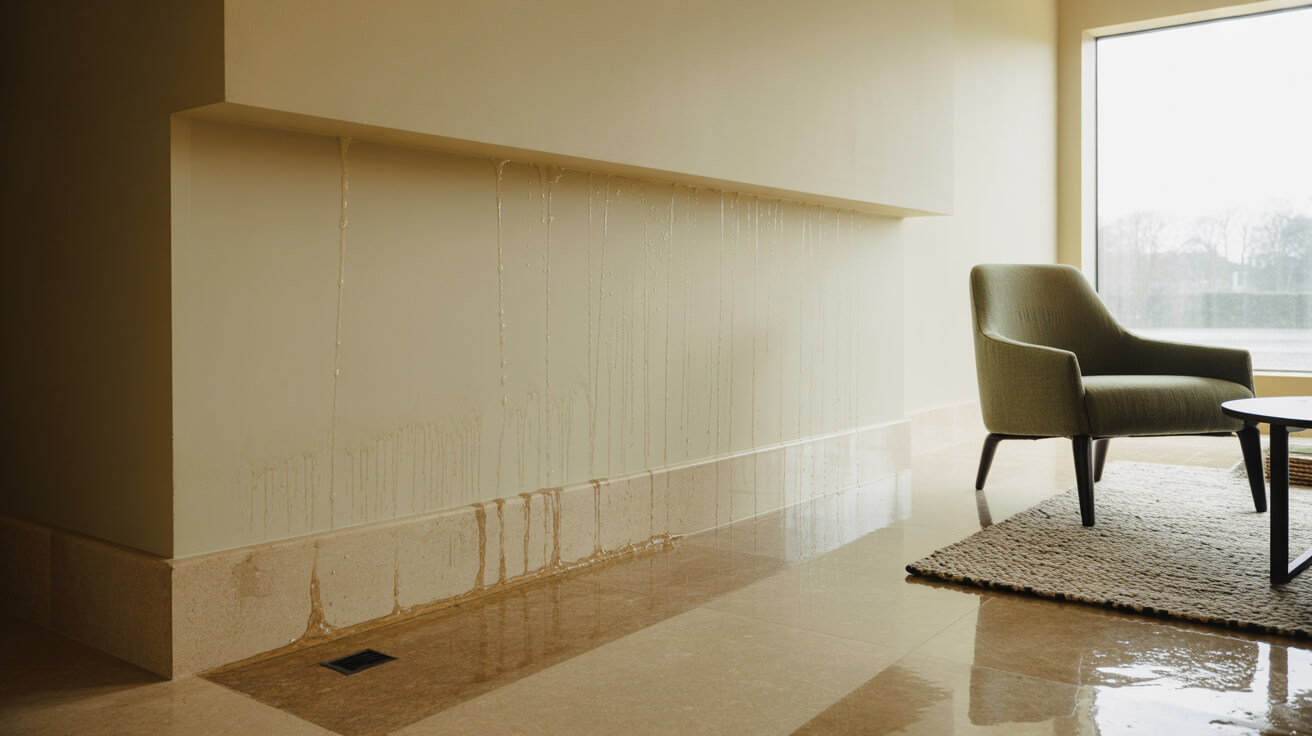
A denied insurance claim isn’t a technical inevitability—it’s the result of narrative breakdown. Insurers demand causality, chronology, and documentation. Lacking any one, your claim joins the backlog of unresolved files, especially for moisture ingress.
What Are the Main Pitfalls Leading to Denial?
- Unclear event timeline: The difference between identifying “when” and “why” often eludes homeowners, especially if documentation is delinquent.
- Unaccredited or vague survey: Damp proof specialists speaking in generalities (“elevated moisture found,” “possible ingress”) provide little defence.
- Premature or undocumented repair: Acting before your insurer inspects, or before a third-party surveyor crafts a full report, collapses your claim’s plausibility.
- Missing or inadequate visual evidence: Photos and logs that fail to sequence appearance with weather or maintenance history rarely persuade underwriters.
Proof Integration That Flips Outcomes
Success begins with a stepwise structure:
1. Date-stamped visual log aligned with local weather
2. Third-party expert report referencing relevant building standards (BS6576, PAS 2035)
3. Full disclosure of prior remediation, showing no history of “bandaid” fixes
4. Open channel with the insurer from the first sign—no guesswork or assumptions
Frequently Searched Claim Denial Reasons
| Denial triggers | Preventative action |
|---|---|
| Maintenance deemed inadequate | Record and save all service logs |
| No defined causal event | Align with weather/service reports |
| Repairs done before inspection | Schedule survey first, repair after |
If your last claim failed, the next one won’t—provided you invert the logic above. Turn every missed proof into documented evidence, and every unsuccessful survey into an insurance-aligned roadmap. Consult with Sussex Damp Experts before time or mistakes close your window.
How Do You Build a Successful, Insurance-Grade Damp Claim?

The only way to make insurers listen is to talk their language—structured, evidenced, time-aligned. Your pathway starts with preparation and ends with precision.
What Does a Full Damp Claim Dossier Consist Of?
- Visual logs: Date-stamped images and observer notes, linking effect (damp) to possible cause (event or location)
- Third-party survey: Referencing key standards, outlining cause, effect, and potential paths of ingress with quantified readings
- Maintenance schedule: Recent service, cleaning, and maintenance receipts; for multi-let or block properties, statutory checks
- Repair quotations: Itemised estimates for insurer-approved remedy, with descriptions of methods, materials, and provider credentials
- Insurer communication: Chronological log of all calls, emails, and requests, annotated with claim numbers and policy reference
Why Is Accreditation Non-Negotiable?
Reports or repairs from “generalists” rarely pass insurer muster. Names, accreditations, and standards count. Reference PCA, CRST, and TrustMark, embedding these in every document.
- Insurer-approved contractors
- PAS 2035/BS6576 aligned methods
- Full post-remedial verification cycle
A case assembled by Sussex Damp Experts is tuned for insurer reception—no missed references, no improvised approaches. The difference is recognised not just in payout percentages but in speed to result.
When Is Immediate Action the Difference Between Loss and Security?

Each day of inaction writes a new risk into your balance sheet and undermines leverage. The risk isn’t just practical—it’s legal and fiscal.
What Timeframes Matter Most for Loss Limitation?
- Notifying insurers within required periods: 7-14 days on most modern policies
- Fulfilling legal repair/service obligations under tenancy and housing law: deadlines enshrined in HHSRS and landlord statutes
- Completing repairs within a standard period to avoid regulatory or mortgage-lender rebuke
What Happens If You Delay?
- Insurers reset the claim, invoking exclusion after timeline lapses
- Tenants or leaseholders pursue claims or rent reductions
- Prolonged ingress triggers regulatory action or environmental fines (esp. for heritage blocks or managed premises)
- Property value deteriorates, disincentivizing buyers
Prompt action is tracked through documentation—let every new sign of damp cue not just a service call, but a logged, time-stamped report from Sussex Damp Experts. Future refusals or legal disputes should find you prepared, not scrambling.
Where Can You Find Accredited, Legal-Grade Support for Damp and Moisture Claims?

There’s a difference between “help” and help that stands up in front of an insurer, regulator, or mortgage underwriter. Accreditation, proof, and experience are more than badges; they’re non-negotiables.
What Accreditations and Process Cues Should You Demand?
- PCA, CRST, TrustMark, and FMB: Universally recognised stamps among insurers and financial institutions
- Adherence to PAS 2035, BS6576: Markers for methodologies tuned for remediation in heritage or high-value structures
- Sample documents and public references: Ask for anonymized report samples and check client testimonials
- Transparent terms and communication: Demand all costs, timescales, and steps in plain English
Comparing Contractors: Credentials Table
| Feature | Sussex Damp Experts | Generic Damp Co. | General Builder |
|---|---|---|---|
| PCA accreditation | ✓ | ✗ | ✗ |
| Reports insurance-ready | ✓ | ✗ | ✗ |
| Heritage/complex asset experience | ✓ | Partial | ✗ |
| Verified warranty/aftercare | ✓ | Partial | ✗ |
The above isn’t optional—it’s essential. Demanding these standards with every hire is what sets you, your organisation, or your property portfolio apart.
Secure Your Property, Your Policy, and Your Reputation—Start with Sussex Damp Experts
Every scenario outlined above points to a narrow, clear truth: Assumptions are expensive, documentation is insurance, and expertise is leverage. The moment to act is before the first sign, and the partner to call is the one whose credentials protect you not just from moisture, but from every technical and legal misstep that turns a small stain into a crisis.
Sussex Damp Experts gives your home, business, or managed portfolio access to the region’s leading calibrated remediation, survey, and compliance intelligence—a single point of contact, built for your peace of mind, financial security, and asset value.
Frequently Asked Questions
What does home insurance really cover when it comes to penetrating damp—and where does your responsibility begin?
Penetrating damp doesn’t just threaten the fabric of your property—it exposes the fault lines in typical insurance policies and your own risk management. Insurers will only consider a claim if you can show the damp results from a single, external event—sudden storm damage, an impact, a specific short-term breach. Gradual ingress, blocked gutters, missed maintenance, or subtle water migration aren’t covered; these are viewed as “wear and tear,” shifting the entire financial burden onto your shoulders.
Your actual cover depends on a complex intersection between your contract wording, your asset’s claims history, and how you document and respond to emerging issues. Missed timelines, lack of contemporaneous evidence, or retrospective repair all generate grounds for refusal. But a rigorous, event-driven approach—date-stamped photos, prompt notification, a BS6576-compliant survey from Sussex Damp Experts—can transform an insurer’s doubt into acceptance.
Table: Event vs. Exclusion Scenarios in Damp Insurance
| Scenario | Typical Insurance Response | What Validates the Claim |
|---|---|---|
| Sudden storm damage | Often covered | Weather report, prompt survey |
| Gradual gutter overflow | Usually excluded | None—“wear and tear” exclusion |
| Roof tile knocked loose | Covered if timely report | Dated evidence + accredited report |
| Long-term seepage/moss | Excluded | Not claimable |
The real protection begins long before you ever seek a payout: it’s built on the proof you assemble day-to-day, not just after discovery.
A property that’s regularly surveyed and formally logged won’t just weather the storm—it defines where true governance meets financial security.
What actually triggers penetrating damp in different property types—and how does that impact your claim odds?
Damp’s origin story isn’t one-size-fits-all. Victorian solid-wall houses invite lateral moisture through porous bricks; modern flats suffer when cavity wall insulation becomes saturated, bridging water to internal finishes. High-exposure buildings—coastal, high-rise, those with complex roof detailing—face compounded risk, and managing agents routinely miss hidden ingress after window swaps or clumsy repointing.
A forensic diagnosis links visible symptoms (staining, salt blooms, surface rot) to root causes: failed flashing, render cracks, blocked cavities, or even pressure changes due to building modifications. Insurers scrutinise not just the event, but your site’s risk profile—are you in a high-rainfall area? Is periodic maintenance documented? Do repairs match regulatory obligations for the building’s age and asset class?
Key Damp Triggers:
- Poorly drained parapets, balconies, or flat roofs.
- Window reveals and sills with porous or unsealed interfaces.
- Bridged DPCs after landscaping, paving, or interior refurbishment.
- HVAC or insulation retrofits causing unseen condensation points.
Every missed inspection or incomplete repair grows your exposure—financial and reputational. The best defence combines material science, real-time monitoring, and Sussex Damp Experts’ survey trail calibrated to modern standards (PAS2035, BS6576).
The gap between old building excuses and modern asset protection? It’s closed by diagnostic vigilance and audit-grade proof, not luck.
Where are early signs of penetrating damp most often missed, and why does that matter for both compliance and resale?
Penetrating damp hides in the shadows—literally. The earliest manifestations nestle behind kitchen cabinets, under windowboards, in shadowed corners of stairwells, or within partition walls mid-way across open-plan layouts. By the time “musty” transforms into structural or visible decay, weeks or months of silent intrusion may have passed, undermining any future claim and torpedoing capital value.
Windowless rooms, under-ventilated basements, and decorative cladding give moisture a free pass to travel invisibly. For landlords and block managers, missing early symptoms can escalate to HHSRS violations, emergency remedial orders, or insurance exclusion for “pre-existing conditions.” Homebuyers walk away from properties where hidden Mould or salt crystals signal long-neglected ingress.
Top Five Missed Zones for Early Damp:
- Vertical party walls (shared, multi-unit boundaries)
- Skirting beneath bay windows and radiators
- External corners—especially where old and new wall substrate meets
- Chimney breasts and fireplace alcoves after uncapped flue removal
- Floor-wall junctions hidden by fitted wardrobes or kitchen units
A systematic, sensor-driven approach—combined with Sussex Damp Experts’ annual mapping—turns what used to be luck into engineered resilience. For those invested in maximising asset or tenancy value, early-detected damp is never an accident; it is the byproduct of professional vigilance.
Why do most damp insurance claims get denied—and how can you change the outcome for your property?
Most claims fail on the same predictable grounds: absence of a dated incident, ambiguous documentation, or repairs completed before a formal insurer survey. An insurer’s lens is coldly technical: can you stitch together a timeline that links event, effect, and evidence in a way that leaves no room for “maintenance lapse” or “pre-existing” defence? Fail here, and even the most severe damp problem becomes your personal financial liability.
Real Denial Triggers (2024-2025 UK Insurance Patterns):
- Delay: Claim reported >14 days after visible symptoms.
- Evidence gap: Photos taken post-repair, not at “first find” stage.
- Credentials: Survey or repair carried out by non-accredited personnel.
- Chain of causation: No clear link between weather event and the physical defect.
Table: Common Denial Patterns — and How to Replace Them
| Denial Reason | Correction Path |
|---|---|
| Vague event report | Dated, location-linked survey (Sussex Damp Experts) |
| Pre-repair evidence | Photolog at “first noticed,” plus after |
| Gaps in maintenance | Asset log including gutter/roof/drain checks |
| Credentials lacking | BS6576, PAS2035, PCA or TrustMark-accredited |
When you act with the logic of an auditor—assembling evidence before, during, and after an incident—your claims migrate from denial to rapid validation. This is not about fighting insurers, but about presenting your stewardship as too robust to question.
How do you engineer an insurance-grade, defensible case for penetrating damp?
A defendable claim is more than a reactive fix; it’s the culmination of planned, recurring actions that document everything from symptoms to surveyor signatures. The dossier you submit must make it easy for insurers to say “yes, that’s valid” rather than defaulting to refusal. This isn’t about paperwork for paperwork’s sake. Your reputation, resale, and operational freedom hinge on the reproducibility of your evidence pipeline.
Minimum Essentials for a Winning Case:
- Visual log (photo/video), date-stamped at first symptom detection
- Incident timeline—clear, with maintenance check overlays
- Third-party surveyor diagnosis (acc. to current codes/standards)
- Contractor credentials matching both technical and insurer-recognised standards (BS6576, PAS2035, TrustMark)
- Insurer communication chain, aligned with contract clauses and deadlines
For agents, portfolio managers, or owners whose interests span multiple assets, every element above scales via systems—templated logs, QR-coded site records, and scheduled audits by Sussex Damp Experts. That’s how you not only win more claims but position as a model for buyers, tenants, and insurers who demand a transparent, accountable owner.
Audit trails aren’t bureaucracy—they’re the language of asset security in a market that punishes improvisation.
Identity sits not in the tools you use but in the reliability of the evidence record you build.
When should you act to secure both financial coverage and legal protection against damp?
Speed is leverage. From the minute a symptom appears—a damp patch, mould bloom, or unexplained chill—the countdown starts. Insurers expect immediate notification, council codes demand prompt remediation, and delay compounds both capital loss and regulatory exposure. Asset protection isn’t theoretical; it is a process where timelines aren’t negotiable.
Action Milestones for Owners and Managers:
1. Symptom noticed: log and photomap within 48 hours
2. Survey commissioned: <7 days, ideally via accredited partner
3. Insurer notified: per contract (often <14 days)
4. Remediation booked: after approval/proof cycle, always credentialed
For owners, landlords, agents, or any accountability-holder, delayed response no longer signals bad luck but managerial failure. This discipline is less about boxes ticked than about status earned—recognised by lenders, buyers, and tenants who rely on your vigilance.
At Sussex Damp Experts, we’ve optimised every intervention for speed and institution-level proof. That’s why property portfolios managed under our protocols carry higher asset transfer rates, smoother sales, and faster insurance payouts.
A regime of prompt action isn’t fear-based management—it is the operating principle of property leadership, signalling a forward posture to every stakeholder.
Where can you find certified, reliable support for damp investigation and remedial action—with no compromise on compliance or asset uptime?
No asset manager, landlord, or homeowner should have to gamble on unknowns. In damp control, the only way to eliminate “what if” is a system of trusted, externally validated partners. Not every provider is fit for purpose. Always verify the chain: is the surveyor PCA or TrustMark accredited? Is every remediation or report stamped and delivered under the magazine codes referenced by insurers and lenders?
Essential Agencies, Credentials & Contacts
| Need | Who / What / Where | Proof/Standard |
|---|---|---|
| Initial Survey | Sussex Damp Experts / PCA members / TrustMark | BS6576, PAS2035, TrustMark |
| Contractor vetting | TrustMark, Trading Standards | Reg no., insurance, reviews |
| Heritage/complex compliance | Listed Building Control, Sussex Damp Experts | Heritage Consents / PAS2035 |
| Tenant/landlord disputes | RICS, PCA, Environmental Health | Report, escalation protocol |
| Self-maintenance resources | HHSRS, local authority resources | Checklists / guides |
Every high-value property, managed block, or ambitious homebuyer in Sussex has a status choice to make: do you trust in documentation, proof, and accredited support—or in hope and improvisation? Compliance is no longer “best practice.” It is the cost of entry to financial certainty, operational ease, and portfolio growth.

