
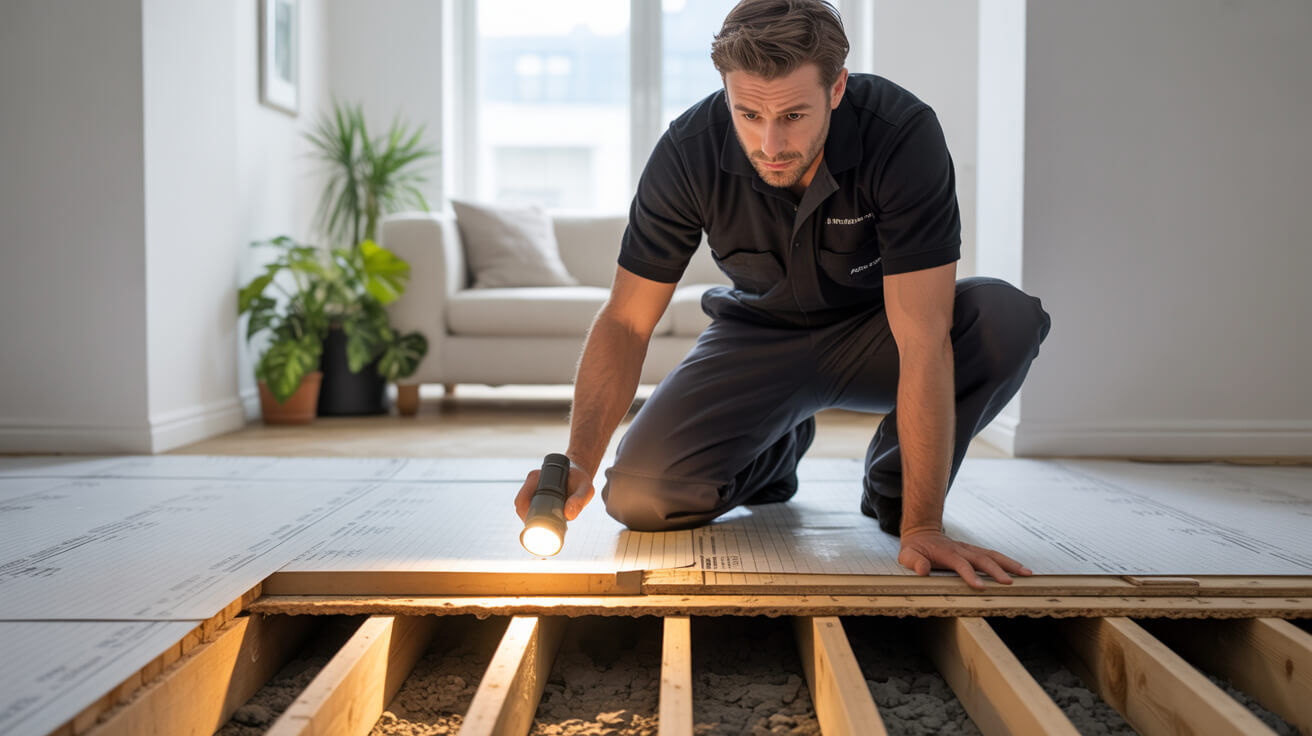
The technique is primarily applied where conventional ventilation is impractical, such as in historic or listed buildings and structures with inherent design constraints. It involves the application of damp proofing courses, tanking slurries, and supplementary moisture barriers in combination with sensor-based monitoring systems. By controlling moisture ingress and retention, it aims to preserve structural integrity and prolong the lifespan of the building.
Unvented subfloor post-treatment is employed to manage and control moisture build-up in subfloors that do not benefit from adequate natural ventilation. The method involves both initial remediation of damp conditions and ongoing evaluation to ensure prolonged effectiveness. In environments where the physical structure precludes traditional ventilation, this treatment offers a practical alternative that incorporates modern diagnostic technology, compliance with industry standards, and continuous performance monitoring.
The process is distinguished by its layered approach, which sequentially addresses moisture ingress, remediation, and prevention. The treatment is critical in preventing long-term issues such as mould growth, decay, and eventual structural compromise. This article provides a detailed exploration of the concept, history, methodologies, challenges, and future prospects inherent in unvented subfloor post-treatment.
Etymology or Name Origin
The term “unvented subfloor post-treatment” originated within the damp proofing industry as a way to describe procedures tailored to subfloors that lack adequate airflow. Historically, damp proofing relied heavily on the natural exchange of air; however, as construction techniques evolved, certain building designs began to preclude sufficient ventilation. The term “post-treatment” emphasises the sequential nature of these interventions—implemented after traditional substrate treatments—to ensure that any residual moisture is continually managed. Over time, the terminology has evolved to reflect both the technological advancements in treatment methods and the regulatory frameworks that guide the application of these techniques.
Overview / Context
Unvented subfloor post-treatment occupies a critical position within the broader context of damp proofing. At its core, this technique recognises that moisture can migrate through building materials via capillary action, hydrostatic pressure, and thermal bridging—mechanisms that are exacerbated when natural ventilation is absent. The methodology combines several processes to establish a durable barrier against persistent moisture ingress while incorporating robust monitoring systems for ongoing performance assessment.
The treatment protocol typically involves:
- Diagnostic Assessments: Utilisation of moisture metres, thermal imaging devices, and hygrometers to assess moisture levels.
- Remedial Interventions: Application of chemical damp proof courses (DPC) alongside tanking slurry applications.
- Monitoring Systems: Deployment of sensor-based monitoring to track drying curves and moisture gradients over time.
These components interact within a framework aligned with industry standards such as BS6576 and BS8102, ensuring that the treatment complies with recognised best practices while functioning effectively in diverse environmental conditions.
History
The evolution of unvented subfloor post-treatment is reflective of broader trends in construction management and building preservation. In earlier periods, damp proofing methods were limited to the use of passive barriers and ventilation enhancements. Traditional approaches often relied on the inherent design of a building to facilitate air exchange, which gradually became ineffective in structures with enclosed subfloors.
Origins and Early Practices
Early damp proofing efforts focused on the use of physical membranes and rudimentary chemical treatments aimed solely at curbing moisture ingress. Initial interventions were often unsophisticated, relying on the natural evaporation of moisture and the application of basic protective layers.
Industrial Emergence of Modern Techniques
With the onset of the industrial age, the need for more effective damp proofing became apparent. Advances in chemical engineering and material science led to the development of chemical DPC injections—a breakthrough that provided a more reliable moisture barrier. During this period, techniques evolved to incorporate tanking slurry applications, which offered improved adhesion and longevity in moisture-laden environments.
Contemporary Evolution
Modern unvented subfloor post-treatment has benefited from significant technological innovations, including:
- Digital Diagnostic Tools: thermal imaging and advanced moisture metres provide enhanced accuracy in determining moisture distribution.
- Integrated Monitoring Systems: Real-time sensor data helps maintain optimal moisture levels post-treatment.
- Regulatory Frameworks: Enhanced standards such as BS6576 and BS8102 have enforced rigorous quality control measures.
These advancements have led to more sophisticated and effective treatment protocols, ensuring both immediate remediation and long-term maintenance.
Concept / Description
Unvented subfloor post-treatment is defined as a systematic intervention aimed at reducing and managing moisture accumulation in subfloors where natural ventilation is insufficient. It consists of a multi-layered process that includes initial moisture assessment, application of chemical and physical barriers, and post-treatment monitoring.
Core Principles
- Moisture Migration Control: Preventing moisture from rising through subfloor materials by interrupting capillary action using chemical damp proof courses.
- Barrier Reinforcement: Application of tanking slurry to create an additional physical barrier that secures the integrity of the chemical treatment.
- Continual Monitoring: Deployment of moisture sensors and periodic inspections to detect any signs of treatment degradation or re-accumulation of damp.
Structural Components
The treatment typically includes:
- Chemical DPC Injection: A method involving the insertion of chemical inhibitors that form a moisture-resistant barrier.
- Tanking Slurry Application: A reinforcing layer that improves the bond between the chemical DPC and the underlying substrate.
- Sensor Integration: Use of moisture metres, thermal cameras, and hygrometers to continuously assess the effectiveness of the treatment.
Underlying Mechanisms
The process relies on an understanding of:
- Capillary Action: The movement of moisture through porous construction materials.
- Hydrostatic Pressure: The force exerted by water in the soil, pushing moisture upwards into the subfloor.
- Thermal Bridging: The conduction of heat, which can exacerbate moisture condensation in inadequately insulated areas.
These mechanisms inform the design and application of treatment methodologies, ensuring that interventions are targeted and effective.
Functionality / Purpose / Applications
The primary function of unvented subfloor post-treatment is to prevent the deleterious effects of moisture buildup in enclosed subfloors. This method serves multiple purposes across various contexts:
Protection of Structural Integrity
By reducing moisture levels, the treatment helps prevent:
- Decay and Deterioration: Limiting the conditions that foster mould growth and material degradation.
- Structural Weakening: Preserving the load-bearing properties of the building’s subfloor.
Enhancement of Thermal Efficiency
The treatment contributes to improved thermal regulation by minimising dampness:
- Energy Efficiency: Reduced moisture content leads to more stable internal temperatures.
- Comfort: Enhancing the living or working environment by preventing cold spots and damp patches.
Regulatory Compliance and Warranty
Adherence to industry standards ensures:
- Legal Compliance: Meeting the requirements of BS6576, BS8102, and other regulatory frameworks.
- Warranty Protection: Providing validated performance data that can support both insurance claims and warranty assurances.
Applications
This treatment is applicable in:
- Residential Buildings: Especially in heritage or older structures where natural ventilation is limited.
- Commercial Properties: Where continuous occupancy demands minimal disruption.
- Institutional and Public Buildings: Where maintaining long-term structural integrity is crucial.
The methodology is particularly beneficial in contexts where traditional vented solutions are impractical or insufficient, making it a preferred option for high-risk properties.
Classifications / Types / Variants
The methodology for treating subfloors can vary significantly based on the specific conditions and design requirements of the building. Unvented subfloor post-treatment is not a one-size-fits-all solution; instead, it encompasses several variants that can be tailored to the unique challenges of each case.
Chemical vs. Physical Treatments
- Chemical Treatments: Involves the injection of chemical damp proof courses (DPC) that form a moisture barrier by inhibiting water absorption in porous materials.
- Physical Treatments: Relies on the application of tanking slurries that create a physically robust layer, resisting moisture ingress through mechanical means.
- Hybrid Systems: Combine both chemical and physical treatments to provide a more comprehensive moisture barrier, especially in settings with high hydrostatic pressure.
Variations Based on Diagnostic Methodologies
Some treatment protocols are designed around continual monitoring with advanced sensor networks, while others rely on periodic, manual inspections. This can result in:
- Continuous Monitoring Systems: Incorporate real-time data logging and sensor integration to dynamically adjust treatment parameters.
- Intermittent Assessment Models: Depend on routine inspections supported by visual assessments and manual moisture readings.
Tailoring to Building Types
Unvented subfloor treatments are further classified based on the structural characteristics and usage of the building:
- Historic Structures: Treatment approaches that are minimally invasive to preserve architectural integrity, often using breathable plasters compatible with traditional materials.
- Modern Constructions: May adopt more aggressive chemical treatments and integrated digital monitoring systems due to fewer constraints arising from preservation concerns.
- Mixed-Use Buildings: Require solutions that balance the distinct needs of different areas, providing localised treatments where necessary.
Systems / Tools / Methodologies
A variety of systems and tools are employed to ensure the effective implementation of unvented subfloor post-treatment. Integration of technology with traditional methods is pivotal to achieving sustained performance.
Diagnostic Tools
- Moisture Metres: Provide quantitative measurements of water content within the subfloor materials.
- Thermal Imaging Cameras: Detect temperature variances that are indicative of moisture presence.
- Hygrometers: Measure relative humidity to inform the environmental conditions of the treated space.
- Borescopes and Salt Test Kits: Offer detailed inspections of the substrate, verifying the presence of salts that indicate moisture migration.
Treatment Equipment and Materials
- Injection Guns: Used for applying chemical DPC injections precisely at targeted locations.
- Tanking Slurry Mixers: Ensure consistent and uniform application of slurry treatments.
- Sealant Applicators: Critical for reinforcing the barrier and ensuring no gaps remain in the protective layer.
- Cavity Drain Membranes: Serve as an adjunct system that facilitates moisture removal from beneath the treatment layer.
Methodologies
- Chemical DPC Injection: A technique where inhibitors are injected into the subfloor, preventing the capillary rise of moisture.
- Tanking Application: Involves applying a tanking slurry that forms a robust, continuous barrier.
- Post-Treatment Monitoring: Utilises sensor networks and periodic dry-down evaluations to track moisture levels over time, ensuring the long-term effectiveness of the treatment.
- Iterative Remedial Procedures: Follow-up treatments or adjustments based on sensor feedback and periodic assessments.
A table summarising key diagnostic and treatment tools is provided below:
| Tool/Method | Function | Application Context |
|---|---|---|
| Moisture Metre | Measures water content in materials | Initial diagnosis and ongoing monitoring |
| Thermal Imaging Camera | Detects thermal anomalies linked to dampness | Visual inspection during assessment |
| Hygrometer | Assesses relative humidity | Environmental monitoring |
| Injection Gun | Applies chemical DPC accurately | Remedial chemical treatments |
| Tanking Slurry Application | Provides a mechanical moisture barrier | Reinforcement of DPC effect |
| cavity drain membrane | Facilitates moisture removal | Integration in high-risk subfloors |
Stakeholders / Entities Involved
Unvented subfloor post-treatment involves multiple stakeholders who play integral roles in both the execution and verification of the treatment. Their collaboration ensures that the treatment is not only technically sound but also compliant with regulatory standards.
Key Stakeholders
- Property Owners: Rely on the treatment to protect the structural integrity and value of their investments.
- Contractors and Installers: Responsible for applying treatment methods in accordance with industry standards.
- Surveyors and Technical Diagnosticians: Utilise diagnostic tools and methodologies to assess moisture levels and treatment efficacy.
- Regulatory Bodies: Enforce standards such as BS6576, BS8102, and HHSRS to maintain safety and quality in treatment practices.
- Certification Agencies: Provide independent validation of treatment performance, which is critical for warranty claims and insurance assessments.
Roles and Responsibilities
- Property Owners: Engage with installers for regular maintenance and compliance checks to safeguard their assets.
- Contractors: Implement precise installation techniques, ensuring proper surface preparation, cure times, and integration of diagnostic tools.
- Surveyors: Conduct periodic inspections and generate reports based on detailed moisture mapping and thermal analysis.
- Regulatory Agencies: Monitor adherence to established standards and provide guidelines for best practices in treatment procedures.
This multi-layered stakeholder involvement is essential to ensure that unvented subfloor post-treatment remains a reliable, long-term solution for damp management.
Legal / Regulatory / Ethical Considerations
The implementation of unvented subfloor post-treatment is subject to a comprehensive framework of legal and regulatory standards designed to ensure safety, efficacy, and consumer protection.
Regulatory Standards
- BS6576: Sets guidelines for the installation of chemical damp proof courses and ensures the quality of treatment applications.
- BS8102: Governs waterproofing practices for basements and subfloors, providing directives for both chemical and physical treatment methods.
- PAS2035: Offers guidelines for retrofit projects, emphasising sustainable practices and risk assessment in historic buildings.
- HHSRS (Housing Health and Safety Rating System): Provides a risk-based framework for evaluating damp-related hazards that may affect occupant health and safety.
Legal Implications
Adherence to these standards is crucial for legal compliance, as it:
- Minimises liability for contractors and property owners in the event of treatment failures.
- Provides a verifiable basis for warranty claims and insurance assessments.
- Ensures that all procedures are documented and performed according to established best practices.
Ethical Considerations
Ethical practices in damp proofing require prioritising consumer safety and ensuring transparency:
- Consumer Protection: Treatment methods must be clearly communicated and documented to allow property owners to make informed decisions.
- Environmental Responsibility: The use of chemical inhibitors and other materials must adhere to protocols that minimise environmental impact.
- Sustainability: Ethical considerations also encompass the long-term impact of treatment practices on both property longevity and community well-being.
These considerations ensure that the treatment process aligns with both legal requirements and broader ethical principles related to public safety and environmental stewardship.
Performance Metrics / Data / Measurements
The evaluation of unvented subfloor post-treatment effectiveness is based on a range of quantitative and qualitative performance metrics. These metrics provide a comprehensive view of the treatment’s performance over time and inform any necessary remedial actions.
Key Measurement Techniques
- Moisture Metre Readings: Utilise precise instruments to measure the water content in subfloor materials over time.
- Thermal Imaging Analysis: Identify temperature variances that suggest anomalous moisture levels.
- Hygrometer Data: Assess the relative humidity within confined subfloors to detect environmental conditions conducive to dampness.
- Drying Curve Analysis: Track the rate at which moisture levels decline post-treatment, ensuring that the process follows predicted performance models.
- Sensor Data Logging: Continuous monitoring via digital sensor networks that provide real-time feedback on moisture conditions.
Data Presentation and Use
The metrics collected are typically compiled into standardised reports that include:
- Graphical Representations: Drying curves, sensor log trends, and compliance checklists presented in tables or charts.
- Comparative Data: Analysis of pre- and post-treatment conditions to evaluate efficacy.
- Regulatory Benchmarks: Compliance measures relative to standards (BS6576, BS8102) are used to validate the treatment process.
These performance metrics are crucial for managing long-term maintenance strategies and ensuring that unvented subfloor treatments remain effective over the lifecycle of the building.
Challenges / Barriers / Limitations
While unvented subfloor post-treatment provides a viable solution for moisture management, several challenges and limitations can affect its overall success.
Technical and Operational Challenges
- Installation Errors: Issues such as inadequate surface preparation, improper cure times, and faulty integration of diagnostic tools can compromise treatment outcomes.
- Sensor Integration Difficulties: While continuous monitoring is essential, deploying sensor networks in confined subfloor environments can be challenging both technically and logistically.
- Material Compatibility: The chemical and physical properties of treatment materials must be carefully matched to the specific substrate and environmental conditions.
Economic and Social Barriers
- Cost Constraints: The expense of high-quality materials, diagnostic tools, and continuous monitoring systems can be prohibitive, particularly for older or lower-value properties.
- Consumer Awareness: Property owners may lack understanding of the importance of post-treatment monitoring and ongoing maintenance, leading to underinvestment in preventive measures.
- Regulatory Variability: Differences in regional standards and enforcement practices can create inconsistencies in treatment quality and performance expectations.
Conceptual and Methodological Limitations
- Inherent Variability: Differences in building construction, environmental conditions, and historical maintenance practices mean that no single treatment protocol can guarantee absolute success.
- Limitations of Current Technology: Despite advances in sensor technology and diagnostic tools, the accurate prediction and management of moisture dynamics remain complex and may require periodic adjustments.
- Dependence on Compliance: The effectiveness of treatment is heavily reliant on adherence to regulatory standards, and any deviations can lead to diminished long-term performance.
These challenges require a dynamic and adaptive approach to treatment that incorporates regular reassessment and iterative improvements.
Impact / Influence / Legacy
The impact of unvented subfloor post-treatment extends beyond immediate moisture control, influencing broader building maintenance practices and industry standards.
Structural and Economic Impact
- Preservation of Building Integrity: Effective treatment protects against decay, mould growth, and structural deterioration, thereby extending the lifespan of the building.
- Economic Benefits: By reducing the need for extensive repairs and prolonging the life of the structure, the treatment contributes to sustained property values and minimises long-term maintenance costs.
- Enhanced Energy Efficiency: Improved subfloor conditions lead to better thermal performance, reducing energy consumption and contributing to greater overall energy efficiency.
Industry Evolution
- Technological Advancements: The integration of digital diagnostic tools and sensor networks has set new benchmarks in damp proofing. These technologies continue to drive innovations in treatment methodologies and performance monitoring.
- Regulatory Influence: The evolving treatment standards, as articulated in critical frameworks such as BS6576 and BS8102, have contributed to a more systematic and rigorous approach to moisture management.
- Market Demand: Enhanced treatment protocols have led to increased consumer and regulatory expectations, pushing the industry toward higher quality and more sustainable practices.
Legacy and Future Benchmarking
The legacy of unvented subfloor post-treatment is evident in the way it has reshaped maintenance regimes and informed regulatory practices. The continuous evolution of treatment techniques has created a foundation for future innovations, serving as a benchmark for reliability and effectiveness in damp proofing.
Long-term, the integration of performance metrics and routine monitoring has transformed the approach to property maintenance, transitioning from reactive repairs to proactive management. This paradigm shift not only improves individual property outcomes but also has a broader influence on market standards and industry best practices.
Future directions, cultural relevance, and design discourse
Emerging trends in unvented subfloor post-treatment indicate a strong move toward digital integration and adaptive maintenance practices. The future landscape promises several key developments:
Technological Innovations
- Smart Sensor Networks: The deployment of wireless sensor arrays and real-time data analytics is poised to revolutionise post-treatment monitoring. These systems will enable continuous, automated assessment of moisture levels, triggering immediate corrective actions when thresholds are exceeded.
- Automated Diagnostic Tools: Advances in thermal imaging and machine learning algorithms are expected to enhance the predictive accuracy of moisture detection, allowing for preemptive interventions in at-risk areas.
- Digital Integration: The use of centralised digital platforms for data logging and performance tracking will facilitate dynamic maintenance schedules, bridging the gap between traditional techniques and modern, technology-driven solutions.
Regulatory Evolution
- Dynamic Compliance Frameworks: Regulatory bodies are likely to update standards to incorporate continuous monitoring data, meaning that real-time performance metrics could become a central element of compliance certification.
- Standardisation of Best Practices: With the increasing ubiquity of digital monitoring, best practices for unvented subfloor treatment may become more uniformly defined across different regions, reducing variability in treatment outcomes.
- Enhanced Documentation: Future protocols might mandate comprehensive digital records of treatment and monitoring activities, thereby providing a robust evidentiary basis for warranty claims and insurance assessments.
Cultural and Architectural Considerations
- Heritage Preservation: In historic and listed buildings, there is a growing emphasis on preserving original architectural features while ensuring modern standards of damp proofing. Development of minimally invasive treatment methods that respect traditional materials will become more prevalent.
- Sustainable Practices: The interplay between environmental sustainability and functional performance is prompting a shift towards eco-friendly treatment methods. Future innovations may focus on biodegradable or low-toxicity chemicals that minimise environmental impact.
- Design Integration: The aesthetics of damp proofing measures are becoming increasingly important, particularly in high-value properties. There is a rising trend towards integrating treatment solutions seamlessly into architectural design, ensuring that functionality and visual appeal are both maintained.
Interdisciplinary Dialogue and Future Research
- Collaborative Research: Ongoing dialogue among material scientists, engineers, architects, and regulatory experts is expected to yield integrated solutions that address the multifaceted challenges of damp proofing. This interdisciplinary approach will further refine treatment practices.
- Academic Contributions: Although the article refrains from direct academic references, the influence of experimental studies and long-term performance evaluations is likely to shape future treatment paradigms.
- Global Perspectives: As construction practices differ worldwide, future research may emphasise a comparative analysis of unvented subfloor post-treatment across diverse climatic, cultural, and regulatory environments. This could lead to more globally applicable guidelines and enhanced adaptability of existing treatments.
The convergence of technological innovation, robust regulatory frameworks, and interdisciplinary research is set to transform unvented subfloor post-treatment into a more efficient and sustainable practice. The integration of smart technologies and digital monitoring will provide building owners and property managers with unprecedented control over maintenance processes, ultimately leading to safer and more resilient structures. As these trends continue to evolve, the dialogue surrounding unvented subfloor management will increasingly highlight the importance of sustainable practices and adaptive, data-driven solutions in addressing the perennial challenge of damp proofing.

