
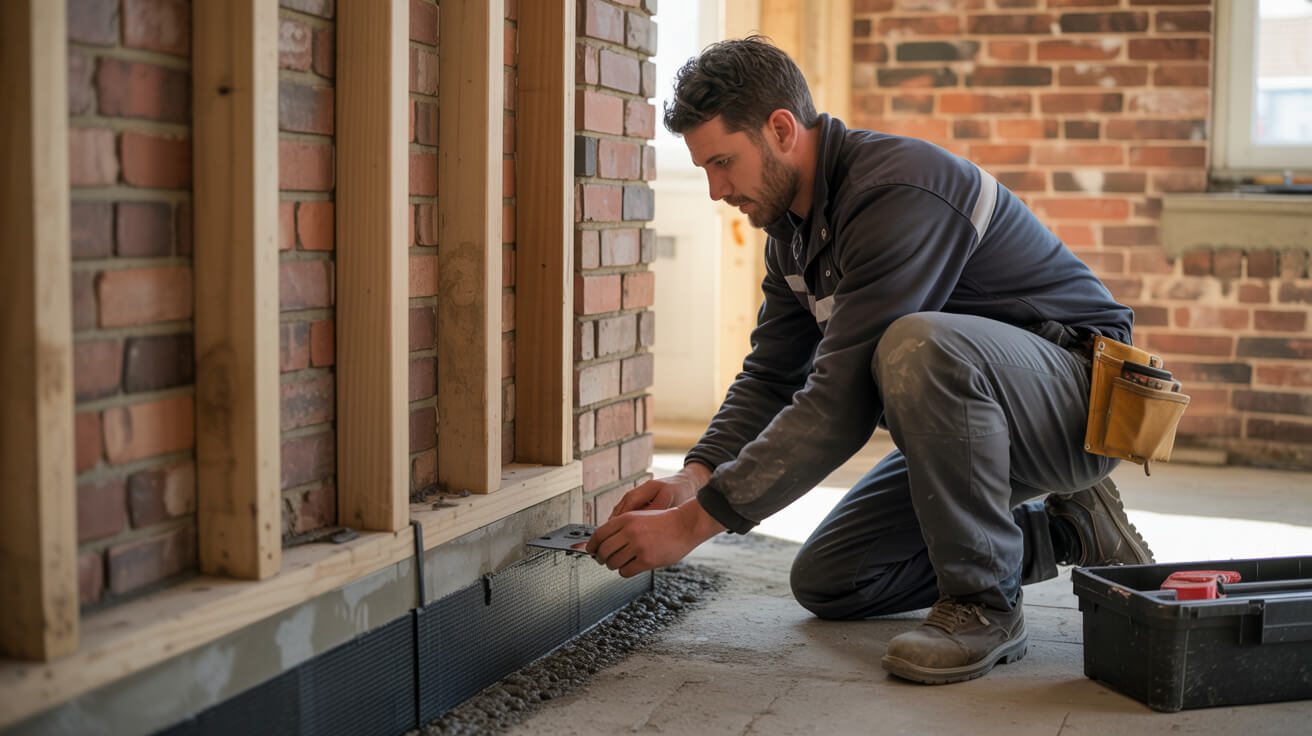
This interface is governed by complex processes such as capillary action, thermal bridging, and differential vapour permeability. As such, understanding timber contact with masonry is essential for diagnosing damp problems and developing appropriate remedial measures to ensure long-term structural integrity.
Timber contact with masonry significantly influences the effectiveness of damp proofing systems. The juxtaposition of wood and brick creates conditions that may foster moisture accumulation, leading to condensation, salt deposition, and eventually decay in building materials. The interaction of these materials under various environmental conditions demands rigorous analysis and meticulous treatment practices.
Through precise diagnostics and carefully executed treatments, professionals aim to mitigate the adverse effects that arise from this contact, thereby preserving the building’s durability and performance. A detailed understanding of the underlying physical and chemical mechanisms is vital for effective damp management in both modern constructions and heritage structures.
Overview / Context
The intersection between timber and masonry is a subject of considerable importance in the field of damp proofing. In many buildings, especially older or historically significant structures, timber components such as beams, floorboards, or cladding are in direct contact with masonry walls. This proximity creates a complex microenvironment where moisture transfer occurs due to differences in material porosity, thermal inertia, and capillary properties.
Physical and Chemical Dynamics
The moisture behaviour at the timber-masonry interface stems from several interrelated phenomena:
- Capillary Action: Masonry, being porous, readily absorbs water. Timber, with its fibrous structure, also takes up moisture through capillary channels. When these materials are in contact, water can migrate from the masonry into the timber, particularly under conditions of high ambient humidity.
- Thermal Bridging: Timber typically has lower thermal conductivity compared to masonry. This difference produces a thermal bridge at the junction, causing localised temperature gradients. Such gradients can lead to condensation as warm, moist air contacts cooler surfaces.
- Vapour Permeability: The variations in vapour permeability between the two materials critically determine how moisture moves. Timber often releases moisture more readily than masonry, potentially leading to a build-up in areas where the moist air becomes trapped.
Construction and Environmental Influences
The nature of the timber-masonry bond is further influenced by:
- Material Quality: The inherent properties of timber species and the specific composition of Masonry (brick, stone, or concrete block) play crucial roles in determining the moisture dynamics.
- Construction Techniques: Historical and modern construction methods, including the presence or absence of damp proof courses (DPC), significantly impact the moisture behaviour at the interface.
- External Conditions: Local climate, site drainage, and internal environmental factors such as heating and ventilation practices govern the overall moisture balance in a building.
Importance in Damp Proofing
Understanding the processes occurring at the timber-masonry interface is essential for:
- Accurate Diagnostics: Differentiating between damp caused by rising moisture and that resulting from thermal bridging is vital for determining appropriate remedial measures.
- Effective Treatments: Treatments such as chemical DPC injections, tanking, and the use of breathable plasters depend on accurately characterising the behaviour of moisture across the interface.
- Sustainable Maintenance: Regular monitoring using modern diagnostic tools helps in managing and mitigating long-term damp issues, thus preserving the building’s value and ensuring health and safety.
History
The evolution of approaches to address timber contact with masonry has been shaped by both technological advancements and changes in construction practices over the centuries.
Early Understandings
Historically, buildings were constructed using materials that naturally interacted without the sophisticated damp proofing systems available today. Early builders relied on empirical observations. Timber decay and masonry dampness were observed phenomena, yet the underlying mechanisms were not fully understood. Many early remedial attempts were based on surface-level interventions without a clear insight into the detailed dynamics at the interface.
Industrial Emergence and Standardisation
With the advent of industrial construction methods in the 19th and early 20th centuries, a clearer understanding of material properties began to emerge. The widespread use of chemical treatments led to the development of rudimentary damp proof courses. As scientific inquiry progressed, engineers began to study material interactions systematically. This research laid the groundwork for establishing standardised practices, such as the formulation of BS6576 for chemical DPC application and BS8102 for basement waterproofing.
Modern Developments
Advancements in diagnostic technologies, including precise moisture metres, thermal imaging cameras, and borescopic inspections, have revolutionised the understanding of moisture dynamics at timber-masonry interfaces. Contemporary treatment methods now integrate these diagnostics with innovative treatment systems that employ both chemical and physical barriers. Standards such as PAS2035 and HHSRS have further refined the approach, emphasising preventive maintenance and long-term performance.
Concept / Description
The fundamental concept of timber contact with masonry in damp proofing revolves around the interaction between disparate materials that fundamentally differ in moisture absorption, release capabilities, and thermal behaviour.
Definition and Scope
Timber contact with masonry refers to the physical conjunction where wooden components abut masonry structures, leading to interactive dynamics that influence moisture distribution within a building. This interface is critical because it can serve as both a pathway and a repository for moisture, affecting the integrity of both materials.
Physical Mechanisms
Several physical mechanisms govern the behaviour at this interface:
Moisture Migration
- Capillary Action: Water is drawn upwards by masonry due to the capillary properties of its porous structure. Timber, with its natural absorbency, can exacerbate this effect by further drawing moisture from the masonry.
- Temperature Differentials: As a result of thermal bridging, the differences between the cooler masonry and warmer interior air create conditions conducive to condensation.
Thermal Bridging and Condensation
- Heat Flow Dynamics: Timber’s lower thermal conductivity compared to masonry creates a thermal bridge at the contact point. This results in localised cooling, leading to moisture condensation on the masonry surface.
- Effects on Material Integrity: The condensation can facilitate mould growth, salt efflorescence, and subsequent degradation of both timber and masonry, undermining the damp proofing measures.
Vapour Permeability and Moisture Retention
- Differential Moisture Release: The contrasting responses of timber and masonry to moisture mean that water can become trapped at the interface. Timber may release stored moisture over time, while masonry retains water, sustaining a humid microenvironment.
- Chemical Interactions: The presence of soluble salts and other chemical agents in masonry can further interact with moisture, contributing to the deterioration of timber.
Theoretical Models
The interactions at the timber-masonry interface are modelled using principles of fluid dynamics, thermodynamics, and material science. Researchers use mathematical formulations to quantify capillary action and thermal bridging, while empirical testing with moisture metres and thermal imaging provides validation for these models.
Functionality / Purpose / Applications
The study of timber contact with masonry extends beyond theoretical interest; its implications are practically significant in various construction and maintenance contexts.
Diagnostic Applications
For accurate diagnosis of damp issues at the timber-masonry interface, advanced diagnostic tools and methodologies are employed. These include:
- Moisture Metres: Devices calibrated to measure the moisture content in both timber and masonry.
- Thermal Imaging Cameras: Equipment that detects temperature variances and pinpoints areas of potential condensation.
- Borescopic Inspections: Methods that visually assess the condition of the interface by allowing an examination of internal structures without significant disruption.
- Salt Analysis Kits: Tools that determine the presence and concentration of salts, which serve as indicators of historic or ongoing moisture challenges.
By employing these tools, professionals are able to accurately diagnose the extent of damp issues, leading to more targeted and effective remedial measures.
Treatment and Maintenance
The practical purpose of understanding timber contact with masonry is to guide the implementation of effective treatment and maintenance strategies. Such strategies are designed to:
- Mitigate Moisture Penetration: Employ treatments like chemical damp proof courses (DPC) that penetrate the masonry to block capillary action, and the use of tanking slurries for external waterproofing.
- Enhance Material Performance: Improve the performance of timber by using preservatives and water-repellent treatments, ensuring it remains structurally sound despite continuous exposure to moisture.
- Facilitate Long-Term Monitoring: Integrate moisture sensors and thermal imaging into ongoing maintenance schedules, allowing stakeholders to track the effectiveness of the treatments over time.
These applications are crucial for both new constructions and heritage restorations, where maintaining the integrity of the interface is critical to preserving the overall health of the building.
Use Cases in Various Contexts
- Residential Construction: In homes, especially those constructed in temperate climates or with heritage significance, the maintenance of timber-masonry interfaces is key to preventing damp-related decay and ensuring a comfortable indoor environment.
- Commercial Buildings: For commercial properties, effective damp proofing directly correlates with lower maintenance costs and enhanced operational efficiency, protecting both the infrastructure and business interests.
- Heritage and Restoration Projects: For listed buildings or structures of historical importance, preserving the original materials through sensitive, effective treatment methods is essential. The methods adopted must align with both modern damp proofing practices and traditional construction techniques.
Classifications / Types / Variants
The interaction between timber and masonry can be classified based on construction methodology, material characteristics, and environmental conditions. Recognising these classifications helps in tailoring interventions to specific scenarios.
Types of Timber-Masonry Interfaces
There are multiple configurations in which timber and masonry may interact:
- Direct Contact: Situations where timber elements are in unmediated contact with masonry surfaces. Such configurations are typically found in older buildings where construction standards were less rigorous.
- Separated or Buffered Interfaces: Applications where a physical barrier (e.g., an air gap, insulation board, or damp proof course) is introduced to mitigate direct moisture transfer.
- Partial Contact: Instances where only certain sections of timber components (such as cladding or beams) are in contact with masonry, creating localised areas of potential moisture accumulation.
Material and Environmental Influences
Variations in outcomes at the timber-masonry interface depend largely on:
- Timber Species: Different timber species exhibit distinct moisture absorption and decay characteristics. Hardwoods may respond differently from softwoods in moisture-laden environments.
- Masonry Composition: The type of masonry—be it brick, stone, or concrete block—affects its porosity, capillarity, and overall moisture retention properties.
- Environmental Conditions: Ambient humidity, rainfall, and temperature variations significantly influence the moisture dynamics at the interface, thereby affecting the long-term performance of interventions.
Comparative Analysis
A comparative evaluation across various classifications reveals:
- Direct Contact Interfaces: often suffer from persistent moisture migration and require extensive remedial treatment due to continual exposure.
- Buffered Interfaces: typically exhibit reduced moisture issues as the barrier minimises direct water transfer.
- Partial Contact Configurations: may display mixed behaviours, with localised treatment being required to address areas prone to damp accumulation.
Systems / Tools / Methodologies
Multiple diagnostic and treatment systems are employed to manage issues arising from timber contact with masonry. These methods are rooted in advanced measurement techniques and targeted treatment interventions.
Diagnostic Systems
Key diagnostic systems include:
- Moisture Metres: These instruments provide real-time data on the moisture content of both timber and masonry, allowing for precise identification of damp areas.
- Thermal Imaging Cameras: thermal imaging is used to visualise temperature differences at the interface, which can indicate the presence of condensation or thermal bridging.
- Borescopic Devices: These are used for internal examination of structures, enabling experts to assess the condition of the interface without invasive disassembly.
- Salt Test Equipment: Tools for assessing the concentration of soluble salts on masonry surfaces, which can highlight issues related to long-term moisture exposure.
Treatment Methodologies
A range of treatment methodologies are applied based on diagnostic findings:
- Chemical Damp Proof Course (DPC) Injections: These involve the application of chemical barriers that penetrate masonry to inhibit moisture rise.
- Tanking Slurry Applications: This method uses a specially formulated slurry that creates a waterproof barrier on exterior masonry surfaces.
- Cavity Drain Membranes: Installation of membranes in cavity walls to prevent moisture transfer from external sources.
- Breathable Plaster Systems: These systems allow moisture to escape while still providing an effective protective finish.
Monitoring Techniques
Long-term monitoring is essential for ensuring the longevity of treatment:
- Moisture Sensor Loggers: Devices that continually record moisture levels in critical areas, providing data for ongoing maintenance decisions.
- Periodic Thermal Imaging: Routine thermal inspections help identify any new areas of condensation or treatment failure.
- Scheduled Re-Inspections: Regular assessments by certified professionals ensure that any emerging issues are promptly addressed.
| Diagnostic Tool | Function | Application |
|---|---|---|
| Moisture Metre | Measures water content in materials | Identifying damp areas in timber and masonry |
| Thermal Imaging Camera | Detects temperature variances that suggest condensation | Visualising thermal bridging and moisture pockets |
| Borescope | Provides internal view of material interfaces | Assessing concealed damages or moisture ingress |
| Salt Test Kit | Measures soluble salt concentrations | Evaluating long-term moisture effects |
Stakeholders / Entities Involved
The management of damp issues at timber-masonry interfaces involves a diverse group of stakeholders, each contributing distinct expertise and responsibilities toward effective building maintenance.
Homeowners and Property Managers
- Role: Responsible for the overall upkeep and maintenance of buildings, homeowners and property managers must monitor signs of dampness and ensure timely intervention.
- Focus: They benefit from clear diagnostics and preventive maintenance plans that minimise risk and preserve property value.
Surveyors and Damp Proofing Experts
- Role: Professional surveyors and specialists conduct detailed assessments using calibrated diagnostic tools to evaluate the extent of damp conditions.
- Focus: Their expertise is critical for advising on appropriate remedial measures backed by regulatory standards and technical precision.
Contractors and Builders
- Role: These professionals implement treatment methods and repairs following established protocols and standards.
- Focus: Ensuring that installations, such as chemical DPC or tanking slurry applications, are executed with precision to achieve durable results.
Regulatory Bodies and Certification Agencies
- Role: Organisations that establish and enforce building standards, such as BS6576, BS8102, PAS2035, and HHSRS, are essential for maintaining consistent quality.
- Focus: Their guidelines ensure that treatments are both effective and compliant with safety norms, influencing industry practices and legal accountability.
Legal / Regulatory / Ethical Considerations
The practice of managing timber-masonry interfaces in damp proofing is subject to a comprehensive regulatory framework that governs building practices. Adhering to these standards is essential for ensuring both safety and performance.
Regulatory Standards
Key standards include:
- BS6576: Specifies the guidelines for chemical damp proof course applications, providing methodologies for safe and effective treatment.
- BS8102: Outlines best practices for basement waterproofing, addressing factors such as moisture ingress and structural integrity.
- PAS2035: Focuses on retrofitting existing buildings, particularly heritage structures, and offers detailed protocols for preserving historic elements while applying modern damp-proofing methods.
- HHSRS: The Housing Health and Safety Rating System considers dampness as a significant hazard affecting building habitability and occupant health.
Legal Implications
Failing to adhere to these regulatory standards can result in:
- Warranty Issues: Non-compliance may void treatment warranties or lead to insurance claim rejections.
- Legal Liabilities: Property owners and contractors may face legal challenges if treatments result in structural or health hazards.
- Financial Consequences: Poor performance of damp proofing measures can significantly decrease property valuations and affect mortgage approvals.
Ethical Considerations
There are ethical dimensions involved in ensuring that all repairs and maintenance measures are conducted in a manner that prioritises occupant safety and structural integrity. Upholding these standards not only ensures compliance but reinforces public trust in construction practices and building maintenance services.
Performance Metrics / Data / Measurements
Quantitative data is integral to assessing the effectiveness of damp proofing systems, particularly in relation to timber-masonry interfaces. Several metrics and measurement techniques facilitate precise evaluation.
Key Metrics
- Moisture Content: The percentage of water present in both timber and masonry, measured using accurately calibrated moisture metres.
- Temperature Discrepancies: Thermal imaging can reveal areas experiencing significant temperature differences, indicating potential condensation zones.
- Soluble Salt Concentration: Measurements of salt deposition provide insight into historical moisture issues and ongoing damp conditions.
Data Monitoring Techniques
- Continuous Logging: Sensors can be installed to continuously monitor moisture levels, providing real-time data for proactive maintenance.
- Scheduled Re-evaluations: Periodic assessments, including thermal imaging and borescope inspections, help verify that treatment methods remain effective over time.
- Data Correlation: Performance data is often correlated with environmental conditions to establish trends and predict potential failures before significant damage occurs.
| Metric | Measurement Method | Significance |
|---|---|---|
| Moisture Content | Digital Moisture Metre | Indicates the water percentage in building components |
| Temperature Gradient | Infrared Thermal Imaging | Identifies shadow regions prone to condensation |
| Salt Concentration | Chemical Test Kits | Reflects long-term moisture issues and material deterioration |
Challenges / Barriers / Limitations
Despite the advancements in modern damp proofing, several challenges persist when addressing timber contact with masonry.
Diagnostic Ambiguities
- Complex Interactions: The overlapping mechanisms of capillary action, thermal bridging, and vapour permeability make isolation of individual issues challenging.
- Measurement Variability: Inconsistencies in diagnostic tools and variations in environmental conditions can lead to data misinterpretation.
- Subtle Early Signs: Initial symptoms, such as mild discoloration or slight damp patches, may not immediately trigger extensive remedial measures, delaying intervention.
Technical and Material Constraints
- Diverse Material Responses: Timber species display varying tendencies for moisture absorption and decay, complicating standardisation of treatment methods.
- Inconsistent Treatment Outcomes: Variations in application techniques, such as the uniformity of chemical injections or the thickness of tanking slurry layers, contribute to differing treatment results.
- Long-Term Effectiveness: Sustaining the performance of treatment methods over decades requires ongoing monitoring and periodic maintenance, which may be resource-intensive.
Economic and Social Factors
- Cost Implications: The financial burden of advanced diagnostic tools and high-quality treatment materials can be significant, particularly for older buildings.
- Access to Expertise: The availability of certified professionals with specialised knowledge in damp proofing is limited in some regions, impacting both diagnosis and treatment.
- Stakeholder Coordination: Successful damp management necessitates coordination among multiple stakeholders, including homeowners, professionals, and regulatory bodies, creating logistical challenges.
Methodological Limitations
- Evolving Standards: Rapid advancements in technology and treatment methods necessitate continuous updates. Existing practices may be rendered obsolete, requiring ongoing education and adaptation.
- Data Standardisation: Integrating and standardising data from various diagnostic tools remains an ongoing challenge, impacting long-term monitoring effectiveness.
Impact / Influence / Legacy
The interaction of timber with masonry has a profound and lasting impact on building practices and the evolution of damp proofing methods.
Economic Impacts
- Property Valuation: Persistent damp issues significantly depress property values by affecting both aesthetics and structural integrity.
- Maintenance Costs: Ineffective damp proofing results in higher long-term maintenance expenses, influencing investment decisions and insurance premiums.
- Market Dynamics: The prevalence of damp-related issues influences the broader construction market, driving innovations in treatment technologies and diagnostic methodologies.
Structural and Technical Legacy
- Advancement of Treatment Methods: Challenges posed by timber-masonry interfaces have spurred innovation in damp proofing treatments, leading to the development of sophisticated chemical and physical barriers.
- Integration of Technology: The increasing use of advanced diagnostic tools, such as thermal imaging and continuous monitoring systems, represents a significant shift in the methodology of damp management.
- Regulatory Evolution: The legacy of historical damp problems has contributed to the establishment of comprehensive building standards and regulations, ensuring that modern practices are both effective and safe.
Influence on Construction Methodology
- Design Considerations: Modern building designs increasingly incorporate strategies to mitigate damp through material selection, layout optimization, and the integration of preventative systems.
- Sustainability Practices: There is a growing emphasis on eco-friendly and sustainable treatment methods that reduce reliance on chemical interventions while maintaining effectiveness.
- Heritage Conservation: In heritage and conservation projects, the need to respect traditional materials while achieving modern damp proofing standards has led to innovative, sensitive restoration techniques.
Future Directions, Cultural Relevance, and Design Discourse
Emerging trends in the management of timber contact with masonry are poised to transform current practices. The convergence of digital technology, material science, and sustainable construction heralds a new era for damp proofing.
Technological Innovations
Future research in this field is likely to focus on:
- Smart Sensor Systems: Continuous, real-time monitoring using advanced moisture sensors and IoT devices to provide instant feedback on damp conditions.
- Predictive Analytics: The use of big data and machine learning to develop predictive models that forecast potential failure points at the interface, enabling preemptive treatment.
- Integrated Treatment Systems: The development of hybrid systems that combine chemical, physical, and bio-based treatments to offer more resilient and environmentally friendly solutions.
Evolving Regulatory Frameworks
Regulatory bodies are expected to revise and expand standards to accommodate new technologies and emerging practices. Anticipated changes include:
- Enhanced Building Codes: Adoption of stricter guidelines that address the complex interactions at timber-masonry interfaces and mandate robust diagnostic protocols.
- Sustainable Compliance Measures: Greater emphasis on eco-friendly treatments and the minimization of harmful chemicals in construction practices, reflecting broader environmental concerns.
- Standardisation of Data Integration: Development of frameworks for the consistent collection and interpretation of diagnostic data across different treatment regimes.
Cultural and Design Perspectives
The cultural relevance of these issues is increasingly significant as aesthetic and historical considerations come to the fore:
- Heritage Preservation: In regions with significant historical architecture, methods that balance modern damp proofing with the preservation of original materials are paramount.
- Design Innovation: Emerging design movements seek to integrate functional damp proofing with innovative architectural elements, creating buildings that are both visually appealing and structurally sound.
- Public Perception and Education: Ongoing public education efforts are instrumental in raising awareness about the importance of effective damp management, thereby influencing both consumer choices and industry practices.
Strategic Outlook
As the field evolves, the collaboration between interdisciplinary teams—including material scientists, construction engineers, regulatory experts, and environmental researchers—will be crucial. This synergy is expected to:
- Drive continuous improvement: in both diagnostic and treatment methodologies across various building types.
- Inspire a new generation of sustainable construction practices: that prioritise long-term durability, performance, and environmental stewardship.
- Enhance the dialogue between regulatory bodies and industry professionals,: leading to more resilient and adaptable standards that reflect current technological capabilities and market demands.
The future of managing timber contact with masonry will be marked by a balance of tradition and innovation—a convergence where heritage preservation intersects with cutting-edge technology. As research deepens and performance data become increasingly robust, the industry is poised to achieve even higher levels of reliability and efficiency in damp proofing practices. This evolution will ultimately pave the way for building practices that not only safeguard structural integrity but also support sustainable, long-term property maintenance in a rapidly changing world.

