
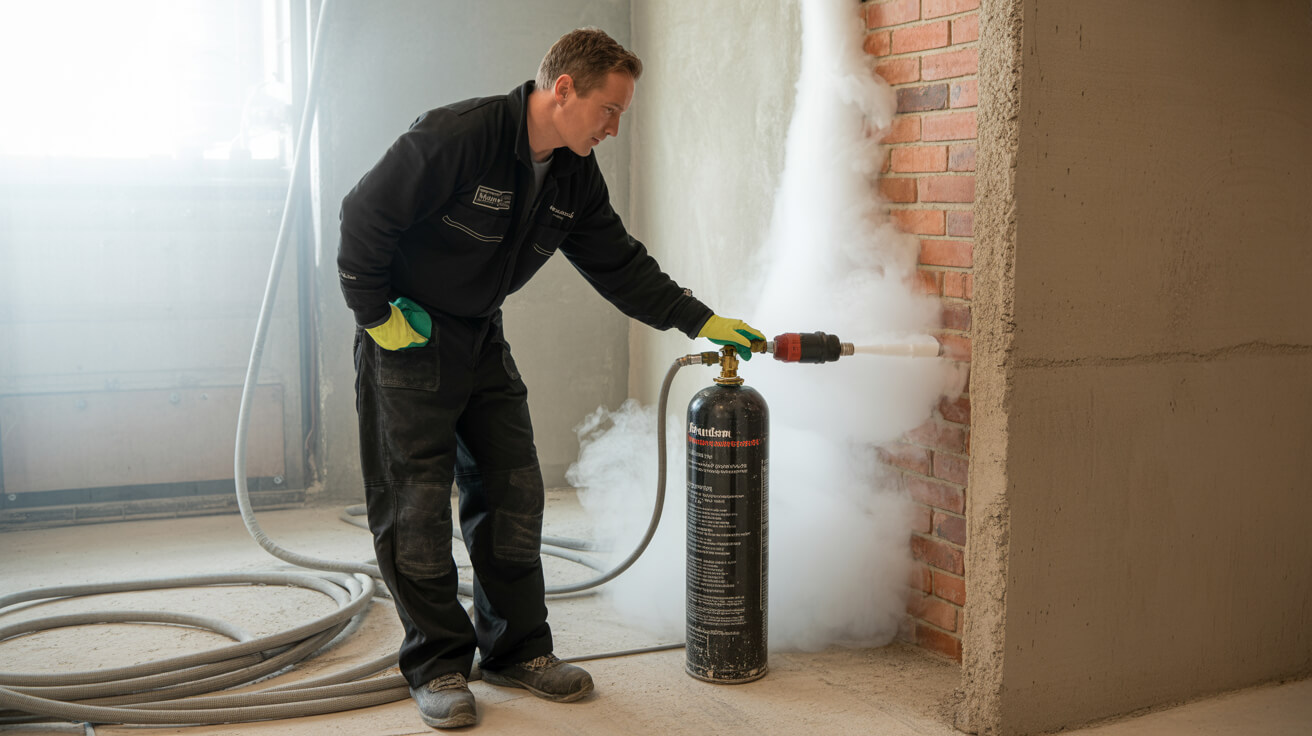
Advanced diagnostic methods have led to the incorporation of cryogenic techniques in damp proofing, enhancing the reliability of moisture assessments. The nitrogen bubble chamber allows for precise control of temperature and pressure in an oxygen-free environment, enabling detailed observation of moisture migration through building materials. This technology supports improved evaluation of damp proof course (DPC) performance and material integrity, thereby contributing to enhanced building preservation.
Etymology or Name Origin
The term “nitrogen bubble chamber” traces its origins to high-energy physics, where bubble chambers were first introduced to visualise charged particle trajectories. Originally, these devices were filled with a superheated liquid that formed bubbles along the paths of ionising particles. In adapting this concept for damp proofing diagnostics, liquid nitrogen is used to create an inert environment in which bubble formation indicates moisture migration. This semantic evolution reflects both the instrument’s scientific lineage and its modern application in building diagnostics.
Overview / Context
damp proofing addresses the crucial challenge of moisture intrusion in building structures, which can lead to a range of deterioration issues. In contemporary building maintenance, ensuring the durability and integrity of construction materials is paramount. Moisture can cause material degradation, structural instability, and a reduction in property value. Hence, advanced diagnostic methods are required to preemptively assess and remediate such issues.
The nitrogen bubble chamber recently emerged as a sophisticated instrument in the diagnosis of damp proofing performance. It integrates principles from cryogenic physics and materials science to evaluate how well damp proofing systems, such as chemical DPCs and tanking methods, resist moisture infiltration. By simulating an extreme, controlled environment, the device helps establish critical data on material diffusion properties and response under stress. The application of inert gas testing in building diagnostics is particularly relevant in settings where precision and data integrity are of utmost importance, such as in heritage building conservation and high-value commercial properties.
History
The development of the nitrogen bubble chamber can be traced back to the mid-20th century when bubble chambers were first utilised in particle physics research. These early instruments played a pivotal role in advancing experimental methodologies for visualising particle interactions. As research progressed, the underlying principles of cryogenic cooling and bubble formation were refined, leading to adaptations for other scientific and industrial applications.
Over the decades, the challenges associated with moisture in buildings, including rising damp and condensation issues, prompted the exploration of new diagnostic techniques. The adaptation of bubble chamber technology to damp proofing was driven by the need for more accurate moisture detection and an improved understanding of material behaviour under extreme conditions. Early field experiments demonstrated that nitrogen-based systems could significantly enhance diagnostic reliability by providing a stable, inert testing environment.
Subsequent innovations led to the integration of digital imaging and sensor technologies with traditional bubble chamber methods. This evolution was bolstered by the development of stringent industry standards, such as BS6576 and BS8102, which necessitated more precise diagnostic tools. The historical progression from rudimentary cryogenic experiments to sophisticated on-site testing systems has cemented the nitrogen bubble chamber’s role in modern damp proofing diagnostics.
Concept / Description
At its core, a nitrogen bubble chamber is designed to expose building materials to a controlled cryogenic environment under an inert gas atmosphere. The chamber utilises liquid nitrogen to reduce the temperature rapidly, achieving conditions that inhibit chemical reactions and stabilise the sample under examination. Within this controlled environment, the formation of bubbles is observed and recorded as an indicator of moisture activity.
Scientific Principles
- Cryogenic Cooling: Liquid nitrogen is used to achieve cryogenic temperatures, which creates conditions that allow for precise observation of material properties.
- Inert Atmosphere Creation: By using nitrogen—a non-reactive gas—the chamber eliminates the influence of oxygen, ensuring that the reactions observed are solely due to moisture dynamics.
- Bubble Nucleation: The observable formation of bubbles within the test sample is a direct indicator of the movement of moisture through the material. Variables such as bubble size, density, and distribution are correlated with the material’s permeability and moisture content.
System Components
- Temperature Control Unit: Ensures a consistent cryogenic environment by regulating the temperature throughout the test period.
- Pressure Regulation System: Maintains a stable, reduced pressure environment necessary for consistent bubble formation.
- High-Purity Nitrogen Supply: Guarantees that the atmosphere within the chamber is free from contaminants that could affect the test results.
- Optical and Sensor Array: Captures high-resolution images and quantitative data on bubble nucleation and distribution.
- Data Logging Module: Records temperature, pressure, and nucleation metrics for subsequent analysis.
Material and Process Characteristics
- Nitrogen Purity: It is crucial that the nitrogen used is of high purity (typically 99.99% or higher) to ensure an inert testing environment.
- Bubble Formation Metrics: The rate and distribution of bubble nucleation are key performance indicators that correlate with the effectiveness of damp proofing.
- Repeatability and Reproducibility: The controlled environment established within the chamber allows for repeatable tests, providing consistent data across multiple samples.
Functionality / Purpose / Applications
The primary functionality of the nitrogen bubble chamber is to evaluate the performance of damp proofing systems under controlled, replicable conditions. By subjecting material samples to cryogenic temperatures in an oxygen-deprived atmosphere, the device offers a precise measurement of moisture penetration and material response.
Key Applications in Damp Proofing
- Assessment of Damp Proof Course (DPC) Efficacy:
- The chamber tests the permeability and adhesion properties of DPC materials by simulating harsh, real-world exposure conditions.
- Observations of bubble nucleation provide direct insights into the performance and reliability of the applied DPC.
- Material Durability Studies:
- Materials treated with damp proofing solutions are evaluated for their long-term resistance to moisture.
- The nitrogen bubble chamber method aids in testing the longevity of repairs and identifying potential failure points.
- Comparative Diagnostic Analysis:
- Comparative studies between traditional diagnostic methods and nitrogen-inert setups help establish the superior accuracy and reliability of cryogenic testing.
- Data derived from the chamber can be benchmarked against standard moisture metre readings and thermal imaging outputs.
- Forensic Evaluation:
- In cases of ambiguous damp-related failures, the chamber provides additional data to discern subtle issues within the building envelope.
- Forensic studies using this technology can determine whether recurring damp issues are due to material degradation or installation errors.
Use Case Scenarios
- Residential Assessments: In heritage or older residential structures where traditional damp proofing methods may be unreliable, the nitrogen bubble chamber offers an objective measure of moisture ingress.
- Commercial Diagnoses: High-value commercial properties benefit from the precision of cryogenic diagnostics in ensuring that damp proofing treatments meet stringent regulatory standards.
- Heritage Building Conservation: The non-invasive testing method is particularly useful in listed buildings, where preserving the structural integrity is imperative and invasive testing methods are discouraged.
Classifications / Types / Variants
Different configurations of nitrogen bubble chamber technology exist to address varying diagnostic needs:
- Standard Laboratory Model:
- Designed for controlled research settings.
- Provides high precision with tight environmental controls and high-resolution imaging.
- Field-Deployable Unit:
- Adapted for on-site building diagnostics.
- Balances portability with sufficient control of cryogenic conditions.
- Enhanced Imaging Variant:
- Integrated with advanced optical systems for detailed visualisation of bubble dynamics.
- Tailored for applications requiring high-resolution data capture.
- Hybrid Diagnostic Systems:
- Combine traditional damp proofing assessments with inert gas testing.
- Allow for comparative analyses by providing dual modality diagnostics.
These variants are designed to accommodate the breadth of practical scenarios encountered in damp proofing diagnostics, ranging from academic research and controlled experiments to field applications in commercial, residential, and heritage contexts.
Systems / Tools / Methodologies
The efficacy of the nitrogen bubble chamber is enhanced by its integration into a broader diagnostic ecosystem that incorporates a variety of tools and methodologies:
Diagnostic Tools
- Moisture Metres and Hygrometers:
- Provide baseline data on environmental moisture levels prior to chamber testing.
- Serve as complementary devices to validate findings from cryogenic tests.
- Thermal Imaging Cameras:
- Capture temperature gradients and identify areas of potential moisture accumulation.
- Assist in correlating bubble formation with thermal behaviour in building materials.
- Injection Systems and DPC Analysis Tools:
- Used to apply chemical damp proof course treatments that are subsequently evaluated in the chamber.
- Ensure that the performance of different DPC formulations can be directly compared.
- Data Logging Devices:
- Continuously record temperature, pressure, and nucleation data.
- Allow for the generation of detailed drying curves and performance metrics during tests.
Methodological Frameworks
- Standardised Testing Protocols:
- Protocols governed by industry standards such as BS6576 and BS8102 ensure consistency in test conditions.
- These guidelines provide detailed procedures for equipment calibration, sample preparation, and data interpretation.
- Integrated Data Analysis:
- Digital data logged during testing is processed using specialised software.
- Analytical methods include regression analysis, statistical validation, and comparative studies with established benchmarks.
- Hybrid Testing Approaches:
- By combining inert gas diagnostics with conventional visual and sensor-based assessments, practitioners achieve a more comprehensive overview of material performance.
- Controlled Environment Methodologies:
- The nitrogen bubble chamber’s design emphasises reproducibility, enabling multiple tests under identical conditions for greater reliability in results.
Stakeholders / Entities Involved
A variety of professionals and organisations contribute to the implementation and evolution of nitrogen bubble chamber diagnostics in damp proofing:
Primary Stakeholders
- Damp Proofing Specialists:
- Experts who design and implement damp proofing systems in buildings.
- Utilise advanced diagnostic tools to verify the integrity of their installations.
- Building Surveyors:
- Rely on precision diagnostic data to support property evaluations, mortgage surveys, and compliance assessments.
- Materials Scientists and Engineers:
- Conduct research into the properties of construction materials and damp proofing treatments.
- Use data derived from cryogenic tests to inform material innovation and product development.
- Regulatory Bodies and Standard-Setting Organisations:
- Develop and enforce standards that ensure the reliability and safety of damp proofing treatments.
- Bodies such as the British Standards Institution (BSI) influence the methodologies integrated into diagnostic practices.
- Heritage Conservation Experts:
- Focus on non-destructive diagnostic methods that protect the historic integrity of listed buildings.
- Use advanced testing to inform remediation strategies that are sensitive to heritage restrictions.
End-User Entities
- Facilities Managers and Building Owners:
- Require accurate diagnostic information to maintain property value and ensure structural integrity.
- Contractors and Installation Experts:
- Depend on detailed test results to improve installation practices and remedy identified deficiencies.
- Insurance Assessors and Mortgage Surveyors:
- Utilise diagnostic outcomes to determine risks and establish benchmarks for property valuations.
- Research Institutions and Technical Laboratories:
- Engage in the development and refinement of diagnostic tools, contributing to the continuing evolution of the technology.
Legal / Regulatory / Ethical Considerations
Advanced diagnostic technologies such as nitrogen bubble chamber systems must conform to rigorous legal and regulatory frameworks. Compliance ensures that their use is both safe and effective while also protecting the interests of all stakeholders involved.
Regulatory Frameworks
- Building Regulations and Standards:
- Systems must adhere to detailed guidelines such as BS6576 and BS8102, which regulate the application of chemical and physical damp proofing methods.
- Standards ensure that the diagnostic outputs are reproducible and reliable across different testing environments.
- Safety Protocols:
- The use of liquid nitrogen and cryogenic equipment mandates strict safety procedures.
- Regulations require operators to employ certified personal protective equipment (PPE) and adhere to established operating guidelines to mitigate risks.
- Certification and Accreditation:
- Diagnostic tools and testing methodologies often need accreditation from recognised bodies.
- Certifications provide assurance that the instrument meets defined quality and performance benchmarks, which is particularly important in legal and forensic contexts.
- Ethical Considerations:
- The deployment of advanced diagnostics must balance the need for precision with the preservation of building integrity.
- Ethical usage involves transparency in reporting outcomes and ensuring that diagnostic procedures do not inadvertently cause additional damage or lead to unnecessary remediation.
Environmental Considerations
- Sustainability and Resource Usage:
- The sourcing and use of high-purity nitrogen must be managed responsibly, balancing diagnostic benefits against environmental impacts.
- Emerging practices may focus on reducing the ecological footprint of cryogenic testing through improved energy efficiency and resource management.
Performance Metrics / Data / Measurements
The effectiveness of nitrogen bubble chamber diagnostics is measured using a variety of performance metrics, which provide quantitative data to support decision-making in damp proofing:
Key Metrics
- Temperature Stability:
- The chamber’s ability to maintain consistent cryogenic conditions is crucial for reproducibility.
- Stability is measured using integrated thermal sensors and temperature loggers.
- Pressure Regulation:
- Maintaining a controlled, low-pressure environment ensures that bubble nucleation strictly reflects moisture-related phenomena.
- Pressure sensors quantify fluctuations and support calibration adjustments.
- Bubble Nucleation Rate:
- The frequency and pattern of bubble formation serve as direct indicators of material permeability and moisture migration.
- High-resolution imaging and optical sensors capture detailed data on nucleation events.
- Nitrogen Purity:
- The purity of the nitrogen used is essential for creating an inert atmosphere that does not interfere with the material’s response.
- Purity levels are monitored using gas chromatography and inline sensors.
- Sensor Accuracy and Resolution:
- Devices such as moisture metres and thermal cameras are calibrated against known benchmarks to ensure reliability.
- The accuracy of these measurements is critical for correlating test data with material performance metrics.
- Data Logging and Analysis:
- Digital logging of environmental parameters and nucleation events allows for the generation of drying curves, thermal response graphs, and quantitative performance assessments.
- Data is typically reviewed using specialised software designed to analyse multi-dimensional test outputs.
| Performance Metric | Measurement Method | Significance |
|---|---|---|
| Temperature Stability | Thermal sensors, data loggers | Ensures reproducible cryogenic conditions |
| Pressure Regulation | Pressure transducers | Essential for consistent bubble formation |
| Bubble Nucleation Rate | Optical imaging, high-speed cameras | Direct indicator of moisture migration |
| Nitrogen Purity | Gas chromatography | Critical for maintaining an inert atmosphere |
| Sensor Calibration Accuracy | Comparative testing with benchmarks | Validates measurement reliability |
Challenges / Barriers / Limitations
While nitrogen bubble chamber diagnostics offer high levels of precision, several challenges remain that can impact their broader implementation in damp proofing.
Operational Challenges
- Complexity in Setup and Calibration:
- Achieving and maintaining the required cryogenic conditions necessitates careful calibration of temperature and pressure controls. Minor variations can lead to significant differences in test outcomes.
- Technical Limitations of Sensors:
- Despite advances in imaging and measurement technology, deviations and noise in sensor outputs can complicate the interpretation of bubble nucleation data.
- Integration with Traditional Methods:
- Reconciling data from nitrogen bubble chamber tests with other diagnostic methods requires sophisticated analytical techniques and can introduce additional layers of complexity.
Economic and Social Barriers
- High Equipment Costs:
- The acquisition, operation, and maintenance of cryogenic equipment typically involve substantial financial investment, potentially limiting accessibility for smaller operations.
- Training Requirements:
- Operators must be highly skilled in both the technical and safety aspects of cryogenic testing, necessitating comprehensive training programmes.
- Regulatory Hurdles:
- Compliance with evolving safety and operational standards may pose challenges, particularly in regions where advanced diagnostic technologies are not yet fully integrated into building codes.
Philosophical and Political Considerations
- Resistance to New Technologies:
- Stakeholders accustomed to traditional methods may be reluctant to adopt new technologies, despite their demonstrated benefits in precision and reliability.
- Debates on Diagnostic Efficacy:
- There remain discussions regarding the comparative effectiveness of inert gas testing versus conventional methods, where differing opinions can influence policy and industry practices.
Impact / Influence / Legacy
The adoption of nitrogen bubble chamber diagnostics represents a significant milestone in the evolution of damp proofing technologies. Its influence can be observed across several dimensions:
Technological Advancements
- Enhanced Diagnostic Accuracy:
- The controlled experimental conditions provided by the chamber have enabled a level of precision previously unattainable in moist-proofing evaluations. This precision has led to improvements in material formulations and treatment methodologies.
- Integration into Industry Standards:
- Data derived from nitrogen bubble chamber tests have informed updates to standards and guidelines like BS6576 and BS8102, ensuring that emerging diagnostic practices are aligned with best practices.
- Catalyst for Further Innovation:
- The successful adaptation of cryogenic techniques into practical building diagnostics has spurred continued research into non-invasive, high-resolution testing methods.
Industry-Specific Contributions
- Improved Building Longevity:
- Accurate assessment of damp proofing performance contributes to more effective remediation strategies. This leads to longer-lasting building envelopes and reduced long-term maintenance costs.
- Risk Management and Property Valuation:
- Enhanced diagnostic capabilities support more reliable mortgage surveys and property evaluations. Better understanding of moisture-related risks helps mitigate financial losses and informs insurance underwriting.
- Heritage Conservation Applications:
- For historic buildings, non-destructive testing methods such as nitrogen bubble chamber diagnostics are particularly valuable, preserving the structural and aesthetic integrity of heritage properties while ensuring that remedial measures are effective and minimally invasive.
Legacy in Diagnostic Methodology
- Benchmarking for Future Technologies:
- The nitrogen bubble chamber sets a high standard for diagnostic precision in damp proofing. Its methodologies form a benchmark against which future technological innovations are measured.
- Contribution to Interdisciplinary Research:
- The cross-pollination of principles from experimental physics and building science has opened new avenues for research, encouraging collaborations that extend beyond traditional disciplinary boundaries.
- Sustainable Maintenance Practices:
- With improved diagnostic accuracy, remediation strategies can be more targeted, reducing unnecessary repairs and preserving the integrity of building structures over the long term.
Future Directions, Cultural Relevance, and Design Discourse
Emerging research and evolving methodologies suggest several trajectories for the future development of nitrogen bubble chamber diagnostics in damp proofing.
Technological Integration and Innovation
- Advances in Sensor Technologies:
- The next generation of sensors is expected to offer even higher resolution data, enhancing the reliability and depth of bubble nucleation analysis. Real-time integration with artificial intelligence will further optimise data interpretation.
- Automation and Digital Twin Models:
- Integrating nitrogen bubble chamber diagnostics with digital twin environments could enable continuous, automated monitoring of building conditions. This would support predictive maintenance frameworks that are dynamically adjusted based on real-time data.
- Energy Efficiency Enhancements:
- Future developments may focus on reducing the environmental footprint of cryogenic testing. Innovations in energy-efficient cryogenic systems and nitrogen recycling methods are likely to emerge in response to sustainability concerns.
Regulatory and Economic Considerations
- Evolving Standards and Certification Protocols:
- As the adoption of advanced diagnostic techniques grows, regulatory bodies may update existing standards or introduce new guidelines specifically tailored to inert gas-based diagnostics. This evolution will facilitate broader acceptance and standardisation within the industry.
- Cost Reduction and Wider Accessibility:
- Continued technological improvements and economies of scale are expected to lower the cost of nitrogen bubble chamber systems, making them more accessible to a wider range of stakeholders—from large-scale commercial operations to smaller residential service providers.
- Investment in Training and Certification:
- The complexity of the technology necessitates comprehensive training programmes and robust certification processes, ensuring that operators are equipped with the necessary skills to maximise the technology’s potential.
Cultural and Design Implications
- Impact on Building Aesthetics and Preservation:
- The application of advanced diagnostics is influencing how building condition is conceptualised and preserved. In heritage conservation, non-invasive testing methods such as these are increasingly valued for their ability to maintain architectural integrity.
- Shifts in Industry Narratives:
- The successful integration of nitrogen bubble chamber technology has the potential to redefine industry narratives around damp proofing. As diagnostic capabilities improve, the focus may shift from reactive maintenance to proactive, data-driven preservation strategies.
- Interdisciplinary Influences:
- This technology exemplifies the synergistic relationship between disparate fields—experimental physics, materials science, and building diagnostics—encouraging ongoing discourse on innovation and interdisciplinary research methodologies.
- Design Discourse and Future Forecasts:
- Discussions surrounding the cultural relevance of advanced diagnostics include their potential to shape future building designs. Architects and engineers may increasingly consider diagnostic data as a fundamental component of design processes, ensuring that new constructions are optimised from the outset for moisture management.
| Aspect | Emerging Trends | Future Impact |
|---|---|---|
| Sensor Integration | AI-driven data analytics, enhanced optical systems | Real-time monitoring and automated diagnostics |
| Cost Reduction | Economies of scale, improved production techniques | Broader accessibility and entry into smaller markets |
| Regulatory Evolution | Updated standards specific to inert diagnostics | Streamlined certification processes and increased industry trust |
| Sustainability | Energy-efficient cryogenics, nitrogen recycling | Reduced environmental impact and improved operational efficiency |
| Interdisciplinary Research | Collaborative studies between physics, materials science, and building engineering | Holistic advancements in diagnostic methodology |
As research and technological innovation continue to drive the evolution of damp proofing diagnostics, the nitrogen bubble chamber is poised to remain a central tool in this domain. The integration of advanced sensor technologies, predictive analytics, and automated monitoring systems will likely transform diagnostic practices and redefine standards of building preservation.
The future of nitrogen bubble chamber diagnostics is intertwined with broader trends in smart building technologies and environmental sustainability. By leveraging continuous advancements, stakeholders may achieve unprecedented levels of precision and efficiency in damp proofing assessments, ensuring that buildings are maintained to the highest standards while meeting rigorous regulatory requirements. This ongoing evolution underscores the potential of advanced diagnostic systems to not only improve technical outcomes but also to influence the cultural and design discourse surrounding modern building practices.

