
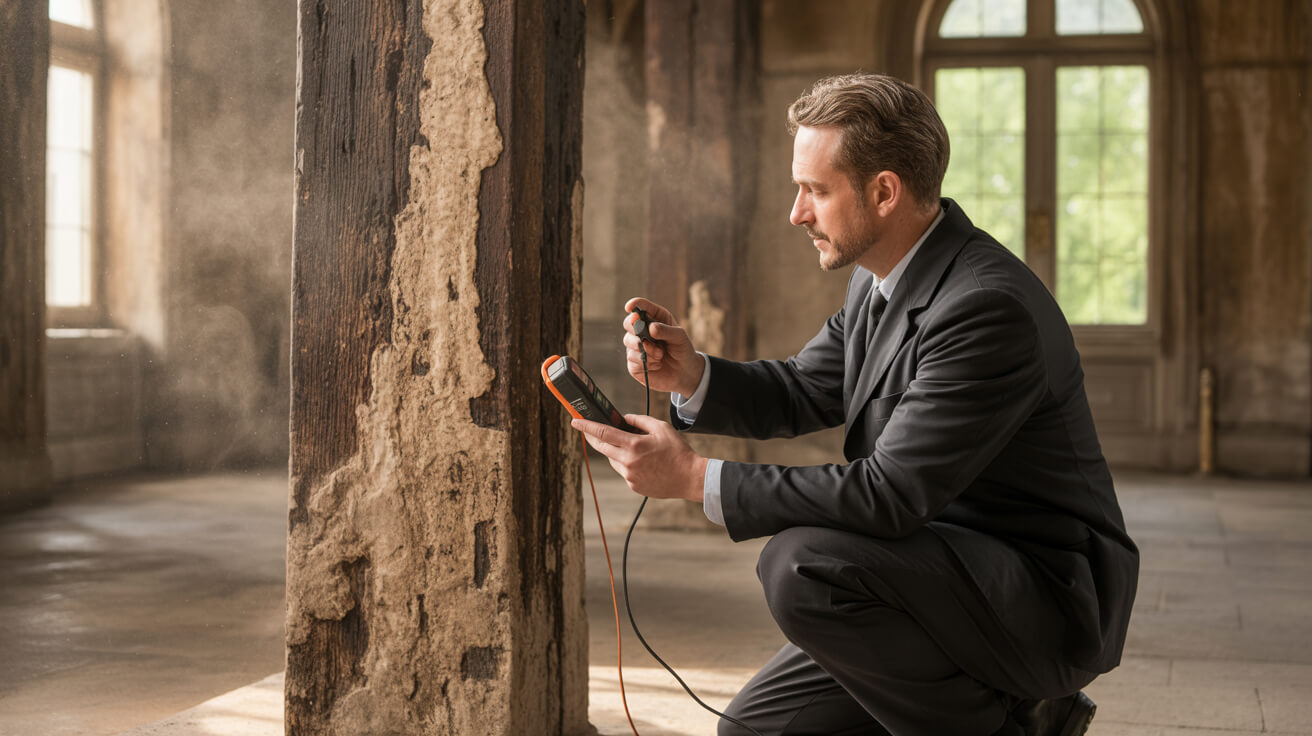
Donkioporia expansa is a filamentous fungus recognised for inducing dry rot in wooden structures, particularly within historic buildings. Its enzymatic degradation of timber contributes to significant deterioration, compromising both the safety and cultural value of heritage properties. Understanding its biology, detection methods, and remediation strategies is essential for preserving historic buildings and complying with modern damp proofing standards.
Overview / Context
Donkioporia expansa belongs to a group of wood-decay fungi that accelerate decay through enzymatic degradation of cellulose and lignin in timber. It primarily occurs in environments where moisture accumulates due to inadequate damp proofing, poor ventilation, or structural defects in historic buildings. The fungus’s presence signals underlying conditions such as persistent dampness and inefficient moisture control.
In the broader context of damp proofing, the management of fungal decay, including that induced by Donkioporia expansa, is crucial for both structural preservation and heritage conservation. The phenomenon of dry rot in historic buildings necessitates a comprehensive strategy that integrates precise diagnostics, targeted remediation, and proactive maintenance protocols tailored to older construction methodologies.
Historic buildings, often constructed with traditional materials and methods, are more vulnerable to moisture-induced deterioration due to the lack of modern protective barriers. The interplay between ancient construction techniques and contemporary damp proofing practices gives rise to unique challenges. The integration of diagnostic technologies—such as moisture metres and thermal imaging—with time-honoured conservation principles creates a dynamic framework for managing such defects. This multifaceted approach serves to mitigate the spread of fungal decay while upholding the architectural and cultural integrity of heritage properties.
History
The recognition of wood-decay fungi as significant contributors to the deterioration of timber predates modern damp proofing techniques. Historical records indicate that the phenomenon of dry rot was observed in structures built during the pre-industrial era, although scientific understanding of the responsible organisms was limited. Over time, advances in microbiology led to the identification and classification of various decay fungi, including Donkioporia expansa.
Discovery and Early Studies
Initial observations of widespread timber decay in historic buildings prompted early research into the underlying causes. During the 19th century, surveyors and builders noted patterns of discoloration, salt efflorescence, and structural weakening, but the specific pathogens involved remained largely undifferentiated. With the advent of microscopy and mycological analysis in the early 20th century, researchers began to isolate and identify fungal species responsible for decay, establishing the foundation for today’s understanding of Donkioporia expansa.
Evolution of Damp Proofing Techniques
Traditional methods to combat timber decay in historic structures were often rudimentary, involving the application of lime washes, pitch, or basic chemical treatments. As the industrial era progressed, the evolution of damp proof courses (DPCs) and tanking methods introduced more systematic approaches to moisture control. However, the unique characteristics of historic materials meant that these modern interventions were not always directly applicable, requiring adaptations to suit the irregularities of older construction.
Subsequent research throughout the 20th and 21st centuries further refined diagnostic and treatment techniques, incorporating advanced instrumentations such as thermal imaging and moisture sensors. These innovations have improved the detection of latent fungal activity and allowed for more precise, less invasive treatment modalities, particularly in sensitive heritage contexts.
Modern Approaches in Heritage Conservation
In recent decades, the emphasis has shifted towards interventions that balance effective damp proofing with the preservation of original building fabric. Contemporary strategies advocate for non-invasive diagnostic measures and heritage-sensitive restoration methods that integrate seamlessly with existing structures. The advent of digital diagnostic tools and predictive maintenance systems has further modernised the approach, enabling real-time monitoring and more targeted remediation. Conservation experts now rely on an interdisciplinary method that combines field surveys, laboratory analysis, and advanced imaging to develop tailored action plans for individual buildings, thus ensuring both structural safety and preservation of historic character.
Concept / Description
Donkioporia expansa is a basidiomycete fungus that initiates the process of Dry rot in timber by secreting a suite of enzymes that decompose key cell wall components. Its ability to break down cellulose and lignin renders it a potent agent of decay, particularly in environments where moisture control is deficient. The fungus’s activity results in the gradual loss of wood strength, leading to increased vulnerability of historic buildings to collapse and further deterioration.
Biological Characteristics
The organism displays a characteristic branching network of hyphae, which infiltrates wooden substrates and produces enzymes such as cellulases and ligninases. These enzymes facilitate the breakdown of structural polymers, weakening the timber over time. Microscopic examination of infected wood typically reveals filamentous structures penetrating deep into the grain, accompanied by the production of spores that aid in its dissemination.
While Donkioporia expansa thrives in moist conditions, its presence is not solely dependent on rainfall; ambient humidity, inadequate ventilation, and thermal bridges also contribute to the microclimate favourable for its growth.
Mechanisms of Infection
The infection process commences when airborne spores of Donkioporia expansa settle on surfaces in conditions of elevated moisture. Once the spores germinate, the resulting hyphae colonise the timber, exploiting existing cracks and imperfections. As colonisation proceeds, the fungus alters the physical and chemical environment within the wood, creating a feedback loop that perpetuates moisture retention. This alteration not only accelerates decay but may also facilitate the penetration of additional fungal agents, compounding the structural damage.
Diagnostic Features
The early detection of Donkioporia expansa is critical for effective intervention. Diagnostic features include:
- Visual Indicators: The appearance of discoloured patches, salt efflorescence, and a characteristic musty odour.
- Instrumental Analysis: Techniques such as moisture metre readings and thermal imaging are utilised to detect hidden decay.
- Laboratory Analysis: In some cases, microscopic analysis and culture testing are performed to confirm the presence of the fungus.
These diagnostic methods provide comprehensive insight into the extent of decay, enabling conservation specialists to plan targeted treatments.
Functionality / Purpose / Applications
The practical application of our understanding of Donkioporia expansa is fundamental to the field of damp proofing. Its role as an initiator of dry rot necessitates a range of strategies spanning early detection, effective treatment, and long-term preventive measures.
Diagnostic Methodologies
Effective management begins with a robust diagnostic process. Modern tools, such as high-precision moisture metres, thermal imaging cameras, and borescopic instruments, are employed to map moisture distribution and identify decay zones. Detailed survey reports encapsulate these findings, establishing a baseline that informs subsequent intervention measures. The integration of digital diagnostics with traditional survey techniques ensures that assessments are both accurate and comprehensive, particularly in the complex environments of historic buildings.
Treatment and Remediation Strategies
Once detected, the approach to treating Donkioporia expansa necessitates a multi-tiered strategy:
- Chemical Interventions: These include damp proof course (DPC) injections and fungicidal treatments designed to arrest the progression of decay. Chemical formulations are selected based on their compatibility with historic materials, minimising adverse reactions.
- Physical Remediation: Applications such as tanking slurries and cavity membrane installations provide a physical barrier to moisture penetration without detracting from the building’s aesthetic integrity. In cases where traditional materials are preferred, breathable plasters and lime mortars may be employed, balancing repair with heritage conservation principles.
- Preventative Maintenance: Preventative measures, including improved ventilation, regular monitoring with moisture sensors, and scheduled re-inspections, are critical to mitigating recurrence. These strategies help maintain optimal conditions within the building, reducing the likelihood of fungal proliferation.
A combination of these methods, tailored to the unique conditions of the building, ensures that repair is both effective and sustainable over the long term.
Preventive Applications in Heritage Conservation
Preventative maintenance in historic buildings requires a delicate balance between modern interventions and the preservation of original fabric. Preventive applications include:
- Environmental Control: Enhancing natural ventilation and utilising humidity control systems to maintain conditions that deter fungal growth.
- Regular Monitoring: Implementation of digital sensor networks for continuous tracking of moisture levels and temperature fluctuations.
- Scheduled Maintenance: Developing a routine inspection and remediation plan that preempts decay before it becomes extensive.
These practices, essential for prolonged structural health, are particularly pertinent to heritage buildings, where preserving historical authenticity is of paramount importance.
Classifications / Types / Variants
Donkioporia expansa is categorised within the broader group of fungal pathogens responsible for wood decay. It is specifically associated with dry rot, a condition distinct from the wet rot phenomena observed under different environmental conditions. Fungal agents causing dry rot have a unique enzymatic profile that differentiates them from other decay organisms.
Comparative Classification
- Dry Rot Fungi: Donkioporia expansa is one of several species that initiate dry rot, characterised by their capacity to induce extensive decay through the degradation of cellulose and lignin.
- Differentiation from Wet Rot: Unlike fungi that thrive in persistently wet conditions, dry rot fungi can proliferate even with intermittent exposure to moisture, making them particularly dangerous in historic buildings where damp proofing is compromised.
- Subcategories: Further distinctions within dry rot infections are made based on growth patterns, spore production, and the specific physical manifestations of decay.
Understanding these classifications is crucial for devising targeted diagnostic and treatment protocols that address the idiosyncrasies of each variant.
Systems / Tools / Methodologies
A suite of systems and methodologies is employed to manage and mitigate the effects of Donkioporia expansa in historic buildings. These systems integrate advanced diagnostic tools with traditional conservation practices to ensure an effective response to damp and decay.
Diagnostic Instruments and Technologies
Technological advancements have provided a robust arsenal of tools that are fundamental to the detection and mapping of fungal decay:
- Moisture Metres: Provide quantitative measurements of water content within timber, offering initial insights into potential decay zones.
- Thermal Imaging Cameras: Detect temperature variations on surfaces that often correspond with areas of hidden decay.
- Borescopic Inspection Tools: Allow for a visual examination of internal wood structures without invasive testing.
- Salt Test Kits: Used to confirm the presence of salt efflorescence, a common byproduct of fungal activity.
These tools work in unison to produce a comprehensive diagnostic profile that guides subsequent treatment decisions.
Treatment Technologies and Materials
The treatment of fungal decay in historic buildings is a nuanced process that must reconcile modern efficacy with heritage conservation:
- Chemical DPC Injections: Involve the introduction of fungicidal agents into the timber to inhibit the progression of decay. These chemicals are selected for their effectiveness and compatibility with traditional materials.
- Physical Barriers: Techniques such as tanking and the application of breathable plasters create a moisture-resistant barrier that prevents further fungal ingress while allowing the structure to “breathe.”
- Hybrid Approaches: In some instances, a combination of chemical and physical treatments is applied to maximise efficacy, particularly in cases where decay is advanced.
Careful selection of treatment methods is critical; interventions must be tailored to the material properties of the historic structure, ensuring that repair measures do not compromise the building’s architectural integrity.
Monitoring and Maintenance Protocols
Long-term success in managing fungal decay is contingent upon continuous monitoring and proactive maintenance:
- Digital Sensor Networks: These systems provide real-time data on moisture, temperature, and humidity levels, enabling early detection of potential issues.
- Regular Reinspections: Scheduled assessments ensure that preventive measures remain effective and that any recurrence of decay is promptly addressed.
- Historical Data Analysis: Longitudinal studies of past interventions and ongoing monitoring data inform best practices, supporting iterative refinement of treatment techniques.
Such systematic approaches are indispensable for maintaining the longevity of remediation efforts and protecting the structural and aesthetic value of historic buildings.
Stakeholders / Entities Involved
The management of Donkioporia expansa in historic buildings involves collaboration among multiple stakeholders, each contributing specialised expertise and oversight.
Property Owners and Managers
Owners and managers of historic buildings bear the primary responsibility for undertaking and funding the necessary damp proofing measures. Their investments must balance the need for effective decay prevention with preserving the building’s historical character, ensuring that interventions do not detract from the overall heritage value.
Heritage Conservation Agencies
These organisations play a crucial role by setting guidelines and standards for conservation practices. They are tasked with ensuring that remediation methods conform to preservation requirements and that all work aligns with broader cultural and historical objectives.
Surveyors and Contractors
Expert surveyors and specialised contractors are essential for diagnosing the extent of fungal decay and implementing treatment measures. Their skills in using advanced diagnostic instruments and applying tailored remediation techniques are critical to achieving lasting results. Detailed survey reports and precise execution of restoration protocols help secure compliance with industry standards, as reflected in frameworks like BS6576 and BS8102.
Regulatory Authorities
Government bodies and local councils enforce regulatory frameworks that govern damp proofing interventions. These authorities ensure that remediation work meets the stringent safety and quality guidelines necessary in historic buildings, thereby protecting the public interest and maintaining structural integrity.
Legal / Regulatory / Ethical Considerations
An array of legal and regulatory frameworks governs the treatment of damp-related decay in historic buildings. Compliance with these frameworks is essential to ensure adherence to industry standards and the preservation of cultural heritage.
Regulatory Frameworks
Key standards such as BS6576, BS8102, and PAS2035 provide comprehensive guidelines for diagnosing and treating damp conditions. These frameworks establish consistent methods for evaluating moisture levels, identifying fungal activity, and applying remedial measures that are safe and effective. Compliance with these standards is mandatory for professional practitioners and offers a benchmark for quality and reliability.
Heritage and Conservation Laws
Historic buildings are often subject to additional conservation regulations designed to protect cultural assets. Such regulations may require approval from heritage conservation agencies and necessitate the use of specific materials and techniques that align with traditional construction practices. Adherence to these laws ensures that remediation efforts do not compromise the building’s historical authenticity or aesthetic value.
Ethical Considerations
Ethical practices in damp proofing emphasise the need to preserve the historical integrity of buildings while implementing effective decay prevention strategies. Transparency in diagnostic reporting, informed consent for treatment options, and the careful balancing of modern interventions with conservation principles are critical components of ethical practice. By maintaining rigorous ethical standards, professionals can build trust with property owners and uphold the long-term cultural significance of heritage structures.
Performance Metrics / Data / Measurements
Quantitative performance metrics and systematic data collection are integral components of an effective damp proofing regime. These measures help assess the success of diagnostic and remedial interventions and inform continuous improvement strategies.
Diagnostic Accuracy
Metrics such as moisture content levels, temperature differentials detected through thermal imaging, and spore counts obtained from laboratory analysis serve as indicators of fungal activity. These quantitative measures provide a reliable basis for determining the extent of infestation and guiding treatment planning.
Treatment Efficacy
The durability and effectiveness of interventions are measured by monitoring post-treatment conditions over an extended period. Performance metrics include:
- Recurrence Rate: The frequency with which fungal decay reappears after treatment.
- Moisture Stabilisation: The degree to which moisture levels are reduced and maintained within acceptable thresholds.
- Longevity of Remediation: The duration for which the applied treatment remains effective before requiring additional intervention.
These data points aid in refining treatment protocols and ensuring that interventions deliver sustained protection.
Monitoring and Maintenance Metrics
Continuous monitoring systems provide critical data through digital sensors that track moisture levels, temperature, and humidity. Regular data logging enables pattern analysis and early detection of deviations from established baselines. This proactive approach supports timely maintenance actions, reducing the risk of extensive decay and promoting long-term structural health.
Challenges / Barriers / Limitations
The effective management of Donkioporia expansa in historic buildings presents several complex challenges that span technical, operational, and economic dimensions.
Technical and Operational Issues
- Diagnostic Ambiguity: The heterogeneity of historic materials and the presence of multiple decay agents can complicate the accurate identification of fungal activity. Inconsistent moisture distribution and variations in building fabric may lead to ambiguous readings, necessitating multi-modal diagnostic approaches.
- Tool Limitations: While modern diagnostic tools have advanced considerably, their effectiveness can be limited by the age and composition of historic structures. calibration of instruments for older materials often requires specialised knowledge and adaptation of standard methods.
- Treatment Constraints: Remedial interventions must be carefully calibrated to avoid damaging original building elements. The application of chemical treatments, for instance, must be managed to prevent adverse reactions with traditional materials such as lime plaster or timber.
Economic and Social Impacts
- High Costs: The financial implications of thorough damp proofing in historic buildings can be considerable. Property owners may need to allocate significant resources not only for initial treatment but also for long-term maintenance strategies.
- Market Implications: The presence of fungal decay has a direct impact on property valuation, insurance underwriting, and mortgage assessments. Economic pressures may delay timely interventions, exacerbating the decay and potentially leading to further structural deterioration.
- Stakeholder Perceptions: The communication of damp management strategies to owners and other stakeholders can be challenging. There is often a perceived trade-off between modern interventions and the preservation of historical authenticity, making it essential to balance technical efficacy with aesthetic considerations.
Limitations of Current Methodologies
- Incomplete Remediation: Some treatment methods may arrest the spread of decay but fail to reverse existing damage. In historic buildings, where repeated interventions are impractical, any residual decay may continue to compromise structural integrity over time.
- Material Incompatibility: The use of contemporary chemical treatments may not always be compatible with the original construction materials. Efforts to preserve historical authenticity often require the use of specialised materials that, while less aggressive, may also be less robust in their protective capabilities.
- Regulatory Constraints: Legal and regulatory guidelines in heritage conservation impose additional constraints on the methods available for treatment. These constraints, while designed to protect cultural heritage, can limit the range of effective interventions and necessitate compromises between modern efficiency and historic preservation.
Impact / Influence / Legacy
The influence of Donkioporia expansa on historic buildings extends far beyond immediate structural damage, affecting multiple dimensions of cultural heritage, economic stability, and conservation practice.
Structural and Heritage Impact
The progression of dry rot driven by Donkioporia expansa undermines the integrity of wooden structures, leading to visible deterioration in historic buildings. As timber decays, the overall stability of the building is compromised, increasing the risk of collapse or significant structural weakness. This degradation not only diminishes the physical asset but also erodes its historical and cultural value, rendering heritage properties more vulnerable to neglect and subsequent loss.
Economic Consequences
From an economic perspective, the presence of fungal decay exerts downward pressure on property values. Historic buildings afflicted by severe dry rot often suffer from diminished marketability, higher insurance premiums, and challenges in obtaining mortgages or refinancing. These financial implications have broader ramifications for communities, as deteriorating heritage assets can lead to reduced investment and economic stagnation in areas that rely on historic charm as an economic driver.
Evolution of Damp Proofing Practices
The challenge posed by Donkioporia expansa has driven innovation in both diagnostic and remediation methodologies. Over decades, the field of damp proofing has evolved from rudimentary interventions to sophisticated, multi-disciplinary approaches that integrate modern technology with traditional conservation techniques. The experience gained from managing fungal decay has laid the groundwork for new treatment protocols that not only arrest decay but also aim for sustainable, long-lasting protection. These advances have contributed to a continuous improvement cycle in the workmanship and scientific understanding of damp proofing, ensuring that best practices evolve alongside changing environmental conditions and regulatory standards.
Legacy and Cultural Significance
The management of damp in historic buildings is intrinsic to the preservation of cultural heritage. The decay wrought by Donkioporia expansa is not merely a technical problem; it represents a tangible loss of history and a weakening of societal identity. Ensuring the longevity of heritage structures requires a deep commitment to both conservation science and cultural stewardship. This dual legacy, bridging modern technology and traditional craftsmanship, stands as an enduring contribution to the field of preservation.
Future directions, cultural relevance, and design discourse
Emerging trends in technology and conservation are poised to reshape the strategies used to manage dampness in historic buildings, ensuring that obstacles such as those posed by Donkioporia expansa are met with innovative, integrated solutions.
Technological Innovations and Advanced Diagnostics
Ongoing research in digital diagnostics is transforming the landscape of damp proofing. The integration of Internet of Things (IoT) devices for real-time environmental monitoring is enhancing early detection capabilities. Advanced sensor networks and machine learning algorithms are being developed to predict areas of potential decay before visible damage occurs. Such innovations not only improve the precision of interventions but also facilitate a proactive maintenance regime that minimises downtime and cost.
Regulatory and Policy Developments
Future regulatory frameworks are expected to evolve in response to both the technological advancements and emerging research in conservation science. Enhanced standards that incorporate digital diagnostics and data-driven decision making could lead to more robust and responsive guidelines, providing clearer pathways for treatment while preserving historic authenticity. The evolution of these frameworks will likely foster closer collaboration between heritage conservation authorities, industry experts, and research institutions, paving the way for more integrated and sustainable approaches.
Cultural and Design Discourse
The discussion surrounding historic building conservation is expanding beyond technical repairs to include broader cultural and aesthetic considerations. As societies place a growing emphasis on sustainable practices and the preservation of cultural heritage, the methods used to address damp-related decay are increasingly being scrutinised for both their effectiveness and their impact on historical authenticity. Contemporary design discourse is exploring ways to integrate necessary damp proofing measures into the architectural narrative of a building, ensuring that interventions are seen not as intrusive modifications but as essential components of the building’s evolving history.
Architectural innovations are beginning to reflect a synthesis of modern technology and traditional craftsmanship. Design movements emphasise adaptive reuse, where restoration efforts are integrated seamlessly with the existing structure, preserving original materials while upgrading performance. This approach fosters a dynamic dialogue between the past and the present, enriching the cultural relevance of heritage buildings without compromising their historical significance.
Research and Academic Inquiry
Future research remains essential in advancing our understanding of fungal decay and its interaction with historic building materials. Ongoing studies in material science, microbiology, and environmental monitoring are expected to yield new insights that drive further innovations in diagnostic and treatment methods. Collaborative efforts across disciplines will likely generate more comprehensive, nuanced approaches to conservation, ensuring that interventions remain adaptive and effective over the long term.
The integration of interdisciplinary research with practical conservation techniques will continue to inform the field, shaping future best practices. As novel materials, digital tools, and refined diagnostic protocols emerge, the management of damp in heritage buildings will evolve into an increasingly sophisticated discipline—one that marries scientific rigour with a deep respect for cultural legacy.
In this evolving landscape, the challenge posed by Donkioporia expansa is not merely a technical problem but a catalyst for ongoing innovation, regulatory refinement, and cultural dialogue. By embracing new technologies and methodologies while adhering to the principles of heritage conservation, the field is poised to overcome the persistent challenges of damp and fungal decay. This iterative process embodies a commitment to preserving the integrity of historic buildings while ensuring that they continue to serve their cultural and functional roles in modern society.

