
 By
By  April 11, 2026


If You Can Hear Deathwatch Beetle, What Does That Actually Mean?
If you can hear deathwatch beetle tapping, you are probably hearing active adults in season, not a direct readout of how badly your timber is damaged.
The sound confirms present adult activity, usually in spring or early summer, but it does not tell you how much wood has already been lost inside the beam. According to English Heritage, the tapping noise is made by the male beetle, and severe attack can hollow beams and lead to structural failure. That is why the sound matters without functioning as a severity scale on its own.
If you hear faint ticking in a roof void on a still May night, the safest reading is not “this beam is failing tonight.” It is “there is current adult activity, and this timber now needs context.” Babergh District Council advises that activity in historic buildings has to be judged from several clues together, including fresh frass, new holes, damp conditions and where the affected timber sits in the structure.
The sound should start an investigation, not end one. Historic England makes the broader conservation point that treatment may be unnecessary where there is no evidence of active or significant attack, so hearing tapping is a prompt to assess, not to panic.
What the Tapping Sound Is Really Telling You

Deathwatch beetle tapping is a courtship signal, so it tells you about adult behaviour now, not the full history of damage inside your timber.
Most quick guides stop at “they tap to attract mates.” That is true, but incomplete. What matters is the sequence behind it: adults emerge, males tap, mating follows, eggs are laid into cracks or old tunnels, and larvae continue the destructive phase out of sight. The English Heritage guidance notes that larvae may take four to twelve years to complete growth before adults emerge in spring or early summer.
Adult tapping versus larval damage
When you hear a neat, rhythmic tap, you are most likely hearing adult communication rather than the main feeding stage. The structural harm is done by larvae tunnelling through susceptible timber over years, especially where oak has been damp or water-damaged and where fungal change has made the wood more suitable. A new sound can therefore sit on top of a much older hidden problem, as the English Heritage advice makes clear.
That research gap is still surprisingly recent.
“The tunneling activity hadn’t really been investigated until Cranfield’s partnership with NMRN started.” — Cathryn Harvey, PhD researcher, Cranfield University / National Museum of the Royal Navy Source
If the sound is intermittent, do not write it off. In many period properties, especially roof spaces and concealed beam ends, the first clue is not visible fresh damage but the sound of the infestation reaching its adult stage. Babergh’s assessment criteria treat tapping as one live sign among others, not as a standalone verdict.
Why audible sound is a late clue
By the time tapping is audible, the insects have usually spent years developing inside the timber. Sound tells you adults are active now. It does not tell you how much effective section remains, whether the heartwood has been weakened, or whether the affected timber still performs safely.
Why Sound Alone Cannot Grade Severity
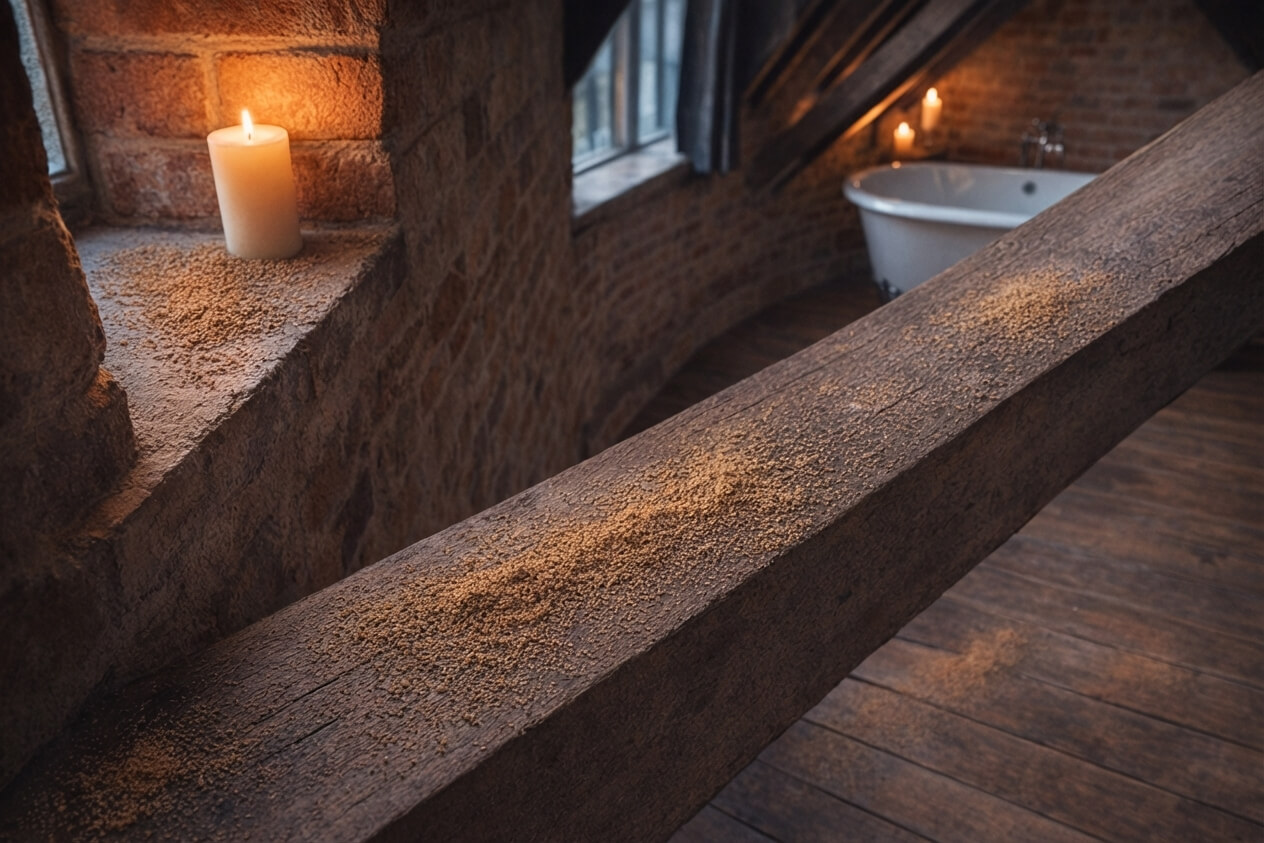
Sound alone cannot tell you how deep the tunnelling runs, how much cross-section has been lost, or whether the timber is structurally adequate.
That is the central diagnostic limit. Tapping can confirm adult activity in season, but it cannot quantify internal galleries, prove current larval feeding at depth, or tell you whether a bearing end or joint has lost too much residual section. The English Heritage fact sheet is clear that severe attack can hollow beams and cause structural failure, but it does not treat sound as a way of measuring that severity.
Silence is just as easy to misread. If you hear nothing, that may mean no adults are active at that moment. It may also mean the season is wrong, the timber is too cool, the area is too noisy, or the infestation is historic rather than current. Babergh warns that old holes do not prove active attack, and old frass can fall from cracks when timber dries and shrinks.
Historic England adds an important structural caution. In many roofs, the strength sits mainly in the heartwood, so minor outer damage may not justify treatment unless fungal attack or low durability has changed the timber more deeply.
If you are buying a period house, this is often where advice goes wrong.
“We heard the tapping in the loft and assumed the worst, but what really mattered was whether the oak was still damp and whether the beam ends were actually weakened.” — a heritage homeowner in Sussex
Property Care Association takes the same evidence-first approach. Its guidance on wood-destroying insects makes clear that diagnosis should be based on investigation, not isolated signs, and that older larvae deep in timber may not be reached by surface treatment alone.
| What sound can tell you | What sound cannot tell you |
|---|---|
| Adult beetles are probably active now | How much timber cross-section has been lost |
| The activity is likely seasonal | Whether the timber is structurally safe |
| The infestation may still be live | How deep the tunnelling runs |
| A closer inspection is justified | Whether larvae are active in every affected area |
| Quiet roof spaces can reveal hidden activity | Whether treatment is necessary |
What a Proper Deathwatch Beetle Survey Actually Checks

A proper deathwatch beetle survey checks timber condition, moisture, decay context and residual section, not just the presence of tapping.
Once deathwatch beetle is suspected, the real job is to establish whether the attack is active, how extensive it is, what made the timber suitable, and whether any affected members are structurally important. The Historic England framework is the right one: assess the extent of damage, understand the moisture source, and do not separate insect attack from the building conditions that allowed it.
That distinction shapes every competent inspection.
“Sound tells us to investigate. It does not tell us, on its own, whether your timber needs treatment, repair, or simply careful monitoring.” — our senior timber surveyor, Sussex Damp Experts
Frass, holes and surface evidence
Fresh evidence usually shows itself before any instrument does. The English Heritage guidance describes fresh emergence holes as sharp and clean, usually 2 to 3 mm across, with piles of frass beneath. It also notes that deathwatch frass is made up of larger rounded pellets that will roll when disturbed. Those details help separate active emergence from historic damage.
Hole pattern matters as much as hole size. A few old holes in a dry, non-structural board do not mean the same thing as clustered fresh holes at a concealed beam end in damp masonry. Timber-framed heritage guidance specifically flags roof plates and beam ends as serious locations because attack there can develop out of sight in structurally important timber.
Moisture, decay and timber condition
Moisture is often the deciding factor. The English Heritage fact sheet advises measuring timber moisture content and states that beetles can breed where the wood is above 16% moisture content. That does not turn one high reading into proof of severe infestation, but it does separate dry, stable timber from timber still capable of supporting attack.
Detailed timber assessment reports show how this works in practice. Surveyors combine moisture readings with resistance drilling and decay evidence to judge whether the risk is superficial, localised or structurally significant. In older oak, the risk rises where fungal attack has altered heartwood or where persistent damp affects bearing zones.
If your surveyor is moving through a church roof or a period cottage, the sequence is practical. What timber is this. What load does it carry. Where is water getting in. Is the attack local or dispersed. Only after that do frass, probing and moisture readings become a meaningful severity judgement.
| Indicator | Lower concern | Higher concern |
|---|---|---|
| Frass | Old, dark, disturbed | Fresh pale pellets below holes |
| Exit holes | Scattered, weathered | Sharp-edged new holes in clusters |
| Timber moisture | Drying or consistently low | Persistently elevated or leak-related |
| Structural probing | Firm, good resistance | Soft zones, voids, reduced section |
| Location | Isolated trim or joinery | Beam ends, roof plates, major oak members |
Why location changes everything
A sound in decorative joinery is not judged the same way as a sound in a principal beam. Historic England notes that much insect damage affects outer sapwood and may have limited structural importance, but that changes where heartwood has been modified by fungal decay or where the timber is already in a vulnerable structural position.
At Sussex Damp Experts, we treat that distinction as central. You need to know where the attack sits, why it is there, and whether the timber still has safe residual section.
When Deathwatch Beetle Activity Does Not Need Treatment

Deathwatch beetle activity does not always need treatment, especially where the evidence points to old attack in timber that is now dry and sound.
That matters in heritage buildings, where unnecessary treatment can damage historic fabric without solving the real issue. Historic England says treatment may be unnecessary and stresses that the underlying damp problem should be addressed before deciding whether further work is needed. Once moisture ingress is stopped and the timber dries, conditions often become far less favourable to continued attack.
Monitoring instead of immediate intervention
Monitoring is often the right response where you have old holes, no fresh frass, no new adults, stable or falling moisture readings, and no evidence of meaningful strength loss. The English Heritage guidance recommends a simple seasonal check: paste tissue paper over old holes and inspect in spring for fresh emergence through the paper.
If you own a listed or period property, proportion matters. Babergh advises against unnecessary drilling and indiscriminate spraying of historic timbers, noting that localised paste treatment is often more appropriate where intervention is justified.
Environmental control first
Moisture control is the real turning point.
“If you can control the moisture in the timber, the beetles choose not to live there.” — Tobit Curteis, architectural conservator, quoted in The Guardian The Guardian: Medieval panel paintings under threat from beetles and bats
Regular roof inspection before and after winter, and after high winds, allows small defects to be dealt with before they become damp timber, rot and insect attack. Broader conservation advice frames the issue in the same way, linking insect and fungal attack to moisture, ventilation and unsuitable building conditions. If your timber is drying, your leaks are resolved and the structure remains sound, monitoring may be better than intervention.
When Treatment Is Necessary and What It Involves

Treatment is necessary when active attack is supported by evidence and the timber or its environment still allows the infestation to continue.
That usually means more than hearing tapping once. It means fresh frass, new sharp-edged holes, continued dampness, attack in structurally important timber, or testing that shows significant section loss. The English Heritage fact sheet is explicit that severe attack can hollow beams and lead to structural failure, so once the evidence shows ongoing damage in important members, treatment stops being optional.
Targeted treatment, not blanket spraying
The Property Care Association’s code of practice is useful here because it puts diagnosis first. Recognised options include water-based, solvent-based and boron-based formulations, as well as pastes and gels for specific uses. In heritage settings, that usually supports targeted treatment rather than spraying every old timber with holes.
Where residual section has already been compromised, treatment is only part of the answer. Local repair, splicing, support to a weakened bearing end or selective replacement may also be needed. Detailed timber assessment reports show why: internal condition, moisture history and decay pattern determine whether repair, reinforcement or limited replacement is appropriate.
Moisture remediation is part of treatment
If the timber stays wet, the problem stays open. Historic England is clear that the first task is to stop water ingress and allow the environment to dry before deciding what further work is needed. Treatment without moisture control may reduce insect activity, but it does not remove the reason the timber became vulnerable.
Protecting Your Property After Deathwatch Beetle
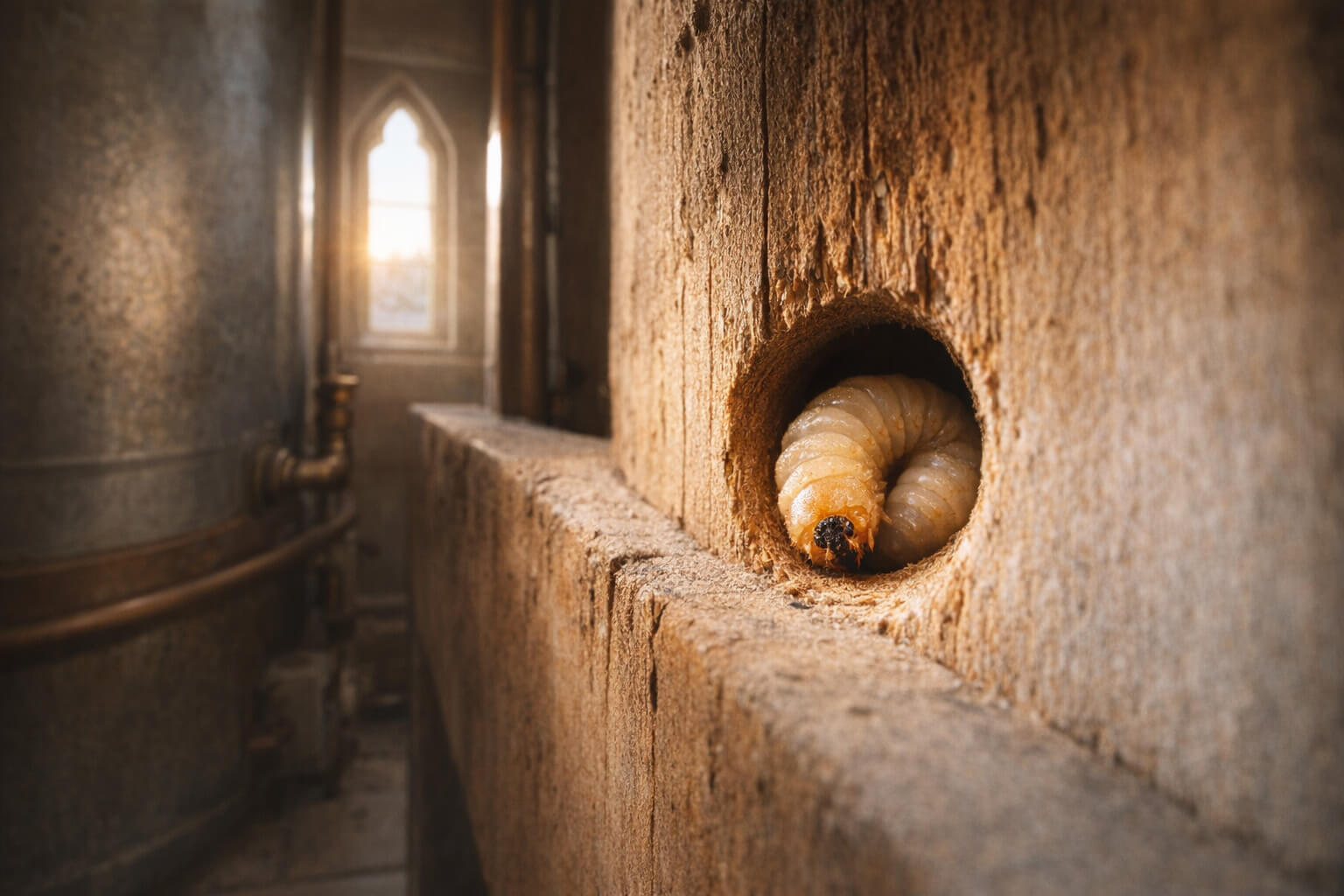
Protecting your property after deathwatch beetle means monitoring moisture and timber condition together, not waiting for the sound to come back.
Once active attack has been assessed, management matters more than guesswork. The English Heritage advice recommends looking for fresh frass and new adults in spring, when activity is most visible, and that makes repeated like-for-like inspection more useful than occasional random checks.
A sensible routine is straightforward. Keep a record of affected areas. Photograph exit-hole zones. Recheck roof voids and concealed beam ends after heavy rain, roof repairs or ventilation changes. If you hear new tapping, find fresh frass or see moisture rise around old attack, treat that as a prompt to review the situation.
Regular roof inspection and quick repair of minor defects keep small leaks from turning into wet timber and insect problems. Long-term control starts with keeping water out.
If your property has already had one episode of damp-associated attack, be careful after building works. New insulation, reduced ventilation, changed guttering or roof alterations can all shift moisture patterns. Broader retrofit guidance makes the same point, warning that environmental changes can create new conditions for fungal and insect attack if moisture is not controlled.
For owners in Sussex and the South East, Sussex Damp Experts combines moisture diagnostics with timber assessment, so you get a clearer answer about whether the sound you heard points to historic evidence, current adult activity or a more serious structural issue needing targeted repair.
If tapping is paired with fresh frass, damp staining, fungal decay or weakness in major oak members, do not rely on the sound alone. A specialist survey gives you something better than reassurance or alarm. It gives you evidence.
Frequently Asked Questions
Can you hear deathwatch beetles in winter, and what does winter silence mean?
Usually not, and winter silence should not reassure you on its own. If you hear nothing in colder months, that normally means the adults are inactive or the conditions are poor for audible tapping, not that the timber is definitely clear.
That distinction matters because many owners check once in December or January, hear silence, and mentally close the file. In practice, winter is a weak season for sound-based reassurance. Adult activity is less obvious, roof spaces are colder, and background noise can disguise faint tapping. Heavy insulation, wind across slates, rain on roof coverings, central heating systems, and road noise can all mask subtle timber sounds. In a larger loft or church-like roof void, you may simply be standing too far from the affected member to hear anything useful.
Winter is still valuable, just in a different way. It is often the best time to inspect the conditions that would allow beetle problems to continue or return. Look for condensation on rafters, staining at wall plates, blocked gutters, slipped tiles, cold damp pockets at beam ends, and signs that ventilation has been reduced by later insulation or boarding. If the suspected timber sits near an external wall or chimney abutment, pay close attention there. Those are the places where moisture problems can persist quietly while the building seems inactive.
If you already know one area is suspect, use winter to build a baseline. Take photos, note any staining, record where you listened, and compare those observations with a follow-up check in late spring or early summer. That comparison is far more useful than a single silent visit. You are looking for change in the environment as much as change in the sound.
The practical takeaway is simple. Winter silence lowers certainty, not risk. If the timber matters structurally, treat winter as the season to inspect conditions and spring as the season to test whether the infestation is still expressing itself acoustically.
How can you tell deathwatch beetle tapping from pipes, mice, timber movement, or other noises in an old house?
You can often narrow it down, but you usually cannot confirm it by ear alone. Deathwatch tapping tends to sound light, dry, and repeated, while pipes, rodents, and ordinary building movement are more often irregular, heavier, or tied to obvious triggers.
Start with the pattern. Pipe noises often follow heating cycles, hot water use, or rapid temperature changes. Water drips usually become more noticeable after rain and rarely keep a clean repeated rhythm. Mice and rats scratch, scurry, rustle, or gnaw; they do not usually produce a tidy tap-tap pattern from one fixed point. Timber movement tends to create isolated creaks and sharp clicks as the structure warms, cools, or settles. Deathwatch noise is more likely to come in short, deliberate bursts that sound contained within the wood rather than moving through the void.
Location helps as much as timing. A faint repeated sound from deep inside an old oak beam in a quiet roof space is more suspicious than a click from beneath a bathroom floor or beside a clipped heating pipe. Even so, period buildings are full of misleading noises. Loose cables can knock lightly. Metal straps can tap in wind. Old boards can click as humidity shifts. Once you are primed to hear beetles, almost any repeated sound starts to feel incriminating.
A practical way to sort this out is to build a comparison log over several days. Record the time, temperature, weather, whether the heating was on, whether water had recently run, and whether the sound stayed in one place. If it appears only after the boiler starts, that points one way. If it returns on still evenings from one old hardwood member, that points another. If it travels across the ceiling line, it is less likely to be beetle tapping.
Your best next step is to use sound to narrow the search area, not to make the diagnosis. If the tapping keeps returning from one timber zone, combine listening with physical inspection instead of trying to identify the source by ear alone.
Does listed building status change what you can do if you suspect deathwatch beetle?
Yes. If your property is listed, the problem is not only whether beetles are present. It is also whether the way you inspect, expose, treat, or repair the timber could affect protected historic fabric or require consent.
That changes the order of decisions. In an unlisted property, owners sometimes jump straight to drilling, stripping finishes, lifting boards, or applying broad chemical treatments. In a listed building, that approach can create unnecessary loss. Historic timbers may preserve carpenters’ marks, smoke-blackening, surface finishes, old tool evidence, and repair history that contribute to the building’s significance. Even apparently small opening-up works can remove evidence that cannot be put back. If the suspect timber sits in a primary frame, roof structure, or decorative historic screen, the heritage value may be as important as the defect itself.
Your first step should be controlled documentation, not disturbance. Record where the sound seems strongest. Photograph holes, debris, staining, distortion, and surrounding defects such as failed flashings or overflowing gutters. Avoid DIY spraying, heavy probing, cutting back beam ends, or lifting historic finishes unless you understand whether the action is proportionate and whether consent may be needed. In some cases, careful local repair is straightforward. In others, exposing concealed members or replacing substantial timber sections becomes a conservation matter, not just a maintenance job.
There is also an added complication in many older roofs: bats. If a roof void supports a roost, access, treatment choice, and timing may all be more restricted than you expect. Builders used to modern remedial jobs sometimes underestimate how quickly heritage and wildlife constraints can reshape the sequence of work.
The practical takeaway is that listed status should shape the diagnosis from the start. In a heritage building, you do not investigate aggressively and then think about significance later. You assess, justify, and intervene only as far as the building truly requires.
Will deathwatch beetle affect a property sale, mortgage, or insurance claim?
It can, but the real problem is usually uncertainty rather than the existence of old holes. A sale, remortgage, or insurance discussion becomes difficult when no one can clearly explain whether the infestation is historic, active, localised, or structurally important.
For buyers, the pressure point is usually interpretation. A mortgage valuer may note timber infestation and recommend further investigation if visible damage appears in roof members, beam ends, or floors. A surveyor may also qualify the report if they cannot establish whether the issue is old, ongoing, or significant to the structure. Once that happens, transactions often slow down. Buyers become cautious, lenders ask for clarification, and sellers may face renegotiation not because collapse is imminent, but because the risk has not been defined properly.
Insurance is a different issue and often misunderstood. Many standard policies treat rot, insect attack, and gradual deterioration as maintenance matters rather than insured events. Some claims may only be considered where there is a covered event in the background, such as storm damage causing sudden water ingress, and even then the consequential beetle problem may not be fully covered. That means you should read the exclusions carefully rather than assume infestation equals payout.
If you are selling, a clear specialist report usually helps more than a generic statement that “deathwatch may be present.” The useful report is the one that explains which timbers are affected, whether the conditions are dry or damp, whether the signs are historic or current, and whether structural repair is needed. If you are buying, ask for specifics. Which members were inspected. Were moisture readings taken. Was the roof void actually entered. Is there evidence of movement, decay, or recent debris.
The practical takeaway is that property transactions hinge on clarity. Old attack with good evidence can often be managed. Uncertain risk in major oak structure is what tends to trigger delays, lender caution, retention requests, or price pressure.
Can you confirm deathwatch beetle yourself with a phone recording app, stethoscope, or home monitoring device?
You can collect useful clues, but you cannot confirm deathwatch beetle properly with consumer listening tools alone. A phone recording, stethoscope, or simple home monitor may help you notice a pattern, but none of them can tell you species, extent, structural significance, or whether treatment is justified.
Phone recordings are the weakest option, even though they are the easiest. Built-in microphones are designed for voice, not faint structure-borne sounds inside old timber. They also capture traffic, wind, rain, heating noise, footsteps, and your own handling of the device. On playback, random clicks can sound more organised than they were in the moment. A recording can still be useful as a reference if you are trying to remember when and where the sound occurred, but it is not dependable proof of beetle activity.
A stethoscope can be more useful if you already suspect one exact timber and the surrounding space is very quiet. It may help you compare one beam or joint against another. Even then, you are still listening to a noise, not diagnosing the timber behind it. Home monitoring devices fall somewhere between convenience and false confidence. Some can flag intermittent acoustic events over time, but they do not identify what made the sound. Without moisture readings, visual evidence, and timber assessment, you risk collecting data that sounds technical but answers very little.
If you want your own checks to be genuinely useful, structure them. Record the date, time, temperature, weather, and whether heating, plumbing, or extraction fans were operating. Mark the exact location on a plan or photo. Note whether the sound was rhythmic, isolated, or travelling, and whether you saw staining, debris, or damp nearby. That information can help a surveyor narrow the investigation quickly.
The practical takeaway is to treat DIY listening as triage. It may help you identify where and when to inspect. It cannot replace species identification, moisture assessment, or a professional judgement on timber condition.
Can deathwatch beetles come back after treatment or repair?
Yes. Deathwatch beetles can return after treatment or repair if the conditions that made the timber attractive remain, or if similar conditions develop elsewhere later. Treatment reduces present risk, but it does not make your building permanently resistant if moisture and decay return.
That is why some owners feel they are facing “the same problem again” when the real issue is building condition rather than treatment failure. You might repair one damp beam end, dry it successfully, and then create a new vulnerable zone a few years later through blocked gutters, failed flashings, reduced roof ventilation, or an insulation upgrade that traps humidity. In older buildings, risk is rarely uniform. One repaired area can stay sound while another, previously dry location becomes suitable after an unrelated defect.
It also matters what “repair” really achieved. If a local splice was carried out well but the wall pocket stayed damp, the surrounding timber may still be vulnerable. If a chemical treatment was applied but the moisture source was never fully resolved, the root cause is still in place. If later works change airflow through a loft or alter how moisture escapes from the building, the balance can shift again without an obvious leak. That is why broad reassurance is often misleading. What matters is not whether treatment happened once, but whether the building remains dry and stable afterwards.
Your follow-up should be calm and consistent. Recheck the same areas in the same season each year. Keep simple records of leaks, condensation, blocked gutters, and any works that affect the roof build-up or ventilation pattern. If new tapping appears in a different location, do not assume the original treatment failed. It may reflect a separate moisture problem affecting another member.
The practical takeaway is that re-infestation is usually a building-management issue. If your property stays dry, well ventilated, and properly maintained, the risk drops sharply. If moisture returns, the beetle may as well.

