
 By
 April 11, 2026


If You Ignore Deathwatch Beetle, Your Structure Keeps Weakening
If you leave deathwatch beetle untreated, your timber can keep losing strength for years while the building appears unchanged.
When the infestation stays active, larvae continue tunnelling through damp, fungus-softened wood. The real danger is not the flight holes you can see on the surface. It is the section loss you cannot see inside beams, joists, wall plates and joints, which can lead to sagging, distortion and, in severe cases, structural failure, as set out by English Heritage.
The short answer
What happens structurally is usually invisible for years, then suddenly obvious and expensive. Timber in older buildings does not always fail dramatically without warning. More often, it loses stiffness, then loses reliable bearing at joints and ends, and only later shows visible symptoms such as springy floors, local movement, cracks in finishes or roof distortion. By the time you notice those signs, the timber may already have lost enough section at a joint or bearing to change how the structure behaves, as described in RICS guidance on wood-boring insects.
Deathwatch beetle is different from minor surface woodworm because it attacks structural hardwoods. Its larval stage can last 4 to 12 years, with tunnels enlarging as the larvae grow. In a severe, long-running attack, a beam can be substantially hollowed from within while still looking solid from the room side.
You might see a few old flight holes and assume the problem is historic. Then the floor near an external wall starts to feel springy. A roof timber sounds dull when tapped. A beam end near damp masonry feels softer than it looks. That is the pattern to watch: modest visible evidence, serious concealed consequences. Dampness and wood-boring activity can weaken joists to the point that they powder and need replacement.
“We only investigated properly when the floor started feeling uneven underfoot. By then, the beam looked fine from the room but was much worse where it disappeared into the wall.” — A listed building owner in East Sussex
If the conditions remain right, the larvae keep feeding, the section keeps shrinking, and the repair scope keeps growing. For years, nothing appears urgent. Then a joint, bearing or beam end crosses a threshold.
Why It Is Never Just Beetles

If deathwatch beetle is active in your property, the deeper problem is usually moisture and decay, not insects on their own.
Treatment aimed only at the insect does not dry wet timber, stop rainwater ingress, improve ventilation or reverse fungal damage already established in the wood. In old buildings, deathwatch beetle is part of a wider building-fabric problem. You are often dealing with damp timber, fungal modification of that timber, and then beetle activity exploiting the weakened material, which is why SPAB warns against simplistic insect-only thinking.
Damp, decay and beetle activity form one system
Deathwatch beetle is strongly associated with older hardwoods, especially oak, where long-term dampness and fungal attack are already present. Guidance on the insect notes that it commonly attacks damp hardwoods and is often found where fungal decay has occurred. If you ignore the beetle, you are usually also ignoring the moisture source that made the timber vulnerable in the first place.
That moisture source is usually an ordinary building defect, not an exotic one. A leaking gutter. A defective roof covering. A blocked air brick. A beam end built into damp masonry. Poor roof-void ventilation. In period buildings, structural vulnerability is commonly the result of insect activity acting alongside damp and decay, not insect activity in isolation. Research from Historic England found that deathwatch infestation would not thrive if timber moisture stayed below about 15%, which is why moisture control matters so much.
“The key to controlling insect infestations is controlling moisture.” — Mike Parrett, Building pathologist, chartered building surveyor and founder, Michael Parrett Associates
That is why “spray and forget” is the wrong model. An insecticide does not restore lost timber. It does not rebuild bearing at a joint. It does not stiffen a wall plate already reduced by decay and galleries. A conservation-led approach keeps the emphasis where it belongs: understand the conditions, understand the timber, then decide what intervention is actually justified.
Hidden damage matters more than visible signs
Old holes do not tell you how much sound timber remains. Fresh frass does not tell you whether the loss is superficial or structural. A clean-looking beam face does not prove that the end buried in the wall is still sound. That gap between what looks sound and what is still structurally sound is the central risk with untreated deathwatch beetle.
If you own a Sussex cottage, farmhouse or listed building, that risk is easy to underestimate. Big oak beams look reassuring. They can still be badly reduced where moisture lingers longest, especially around joints, mortices, housings and embedded ends.
What Happens Year by Year

Untreated deathwatch damage builds slowly enough to be missed, but steadily enough to change how your structure behaves.
The larvae spend years inside the timber, not weeks. The life cycle can last 4 to 12 years, which is why delay is so costly: one missed season may not create a crisis, but repeated years of activity can turn a manageable defect into structural carpentry, opening-up work and, eventually, local failure.
A practical progression timeline
| Delay period | What is happening inside the timber | What you may notice |
|---|---|---|
| Years 1-3 | Eggs hatch in cracks or joints and larvae begin concealed feeding | Usually little beyond old holes or isolated dust |
| Years 3-7 | Galleries enlarge, fungal-softened zones extend, effective section starts to reduce | Local softness, frass, slight springiness, isolated cracking |
| Years 7-12+ | Repeated cycles weaken joints, beam ends and load paths | Sagging, movement, distorted finishes, repair becoming likely |
| Advanced neglect | The remaining sound shell may be too thin for the load | Temporary propping, opening up, partial replacement |
| Moisture still unresolved | Timber stays hospitable to decay and future attack | Recurrence, spread, rising repair scope |
In the early years, false confidence is the problem. The larvae feed, but the outer face of the timber may change very little. You can have a roof truss, floor beam or wall plate that still looks dry and characterful on the exposed side while the concealed arris or joint shoulder is being reduced.
Later, the structural meaning changes. A timber does not have to lose all of its substance to become a problem. It only has to lose enough section in the wrong place. The most serious reductions are often not mid-span, where everyone can see them, but at supports, joints, housings and bearings. A specialist assessment prepared for a heritage project in Exeter uses the idea of loss of effective cross-section, which is a useful way to understand the risk: strength depends on how much sound wood remains and where that sound wood sits within the loaded section.
If the moisture source stays active, the building eventually starts to show you the cost of delay. Floors feel less firm. Ceiling lines drift slightly. Cracks reopen and stop closing properly. Roof members may show local deflection near supports. Doors begin to bind for reasons that seem unrelated. At first, that does not look dramatic. Over time, it becomes a pattern of hidden timber loss approaching a structural threshold.
Years of apparent stability do not prove the timber is safe. They often mean the damage is still concealed.
The Joints Fail Before the Beams

The most serious deathwatch damage is often where your timber transfers load, not where it looks worst.
A large beam can sometimes survive limited surface damage without losing much structural value. A joint or bearing has far less margin. If decay and galleries reduce a tenon, shoulder, bearing end or wall-plate seating, the structure loses reliability exactly where forces are concentrated. That is why untreated deathwatch beetle so often becomes a joint problem before it becomes an obvious beam problem.
Why beam ends and joint housings are high risk
Moisture collects where timber meets masonry, where ventilation is poor, and where water lingers. Joist ends against external walls and damp floor zones are typical risk areas for timber deterioration, and the same principle applies to deathwatch-prone historic timbers.
In practical terms, that means wall plates, tie-beam ends, lintel bearings, joist pockets, sole plates and joint housings deserve close attention. These are the areas where damp is retained longest and where local section loss has the biggest structural effect. A beam that looks substantial in the room can still be failing at the last few centimetres you cannot see inside the wall.
Females lay eggs in cracks, crevices and old flight holes. In structural carpentry, those sheltered interfaces are everywhere: open joints, aged shrinkage lines, old housings and disturbed arrises. They are also where the consequences of continued feeding are most severe.
Load transfer fails quietly at first
When joints weaken, buildings usually adapt before they fail. Loads shift into adjacent fibres, nearby fixings or neighbouring timbers. That often produces slow distortion rather than sudden drama. You may see cracked plaster along a beam line, sloping boards above a bearing wall, local roof spread, or a dropped ceiling where a support has weakened.
This is why “nothing happens for years” is false comfort. The damage is still developing. The structure is simply redistributing load until it can no longer do so safely.
What a Surveyor Actually Finds

A proper inspection often shows that the timber you trust visually is not the timber carrying the load safely.
That is the hard part of deathwatch beetle. You see the exposed face. A specialist looks for moisture, bearing condition, local softness, drilling resistance, access limits and hidden damage at the ends. Inspection is often restricted by access, season and visibility, so wood-boring insect risk can be understated in routine surveys.
What concealed damage looks like when opened up
When boxed-in or plastered areas are opened, the pattern is often familiar. The visible face remains comparatively intact. The hidden side shows frass, softened fibres, tunnel networks, decay staining or local crushing at the bearing. In older oak, you may find a hard outer shell around a badly compromised joint zone. In suspended floors, the joist end in the wall can be much worse than the span visible from below.
You may have had a survey report that mentioned “possible old woodworm” and left it there. Then a more focused inspection probes a beam that looks sound from the room. The exposed face feels firm. At depth, the resistance drops. Around the beam end, the timber proves softer than it appears. That gap between appearance and residual strength is why deathwatch beetle creates false confidence.
Moisture readings and visual impressions in old buildings also need care. Big hardwood members do not behave like new joinery, and one exposed face rarely tells the whole story.
The gap between perception and structural reality
A buyer may hear “historic holes” and think “cosmetic.” A specialist asks different questions: is it active, where is the moisture, where are the joints, and how much sound section is left where it matters?
At Sussex Damp Experts, we approach deathwatch risk as a building-fabric problem first. We trace the moisture pathway, identify the vulnerable timber zone, assess the likely extent of concealed loss and decide whether structural engineering input is needed. That is how you separate harmless old evidence from a beam end, wall plate or floor zone that is quietly becoming unsafe.
The Cost of Waiting vs the Cost of Acting

The cheapest stage is usually diagnosis and moisture control. The expensive stage begins when hidden timber loss becomes structural repair.
Early action usually means investigation, targeted drying measures, repair of the moisture source and confirmation of whether activity is current. Waiting increases the chance that you will also need opening-up work, temporary support, specialist carpentry, making good and, in older buildings, more complex conservation decisions. Severe attack can hollow beams, which is why delayed cases so often move beyond treatment into structural works.
A simple cost curve
| Stage | Typical scope | Cost pressure |
|---|---|---|
| Early suspicion | Inspection, moisture checks, monitoring | Lower |
| Hidden section loss found | Carpentry repair, splicing, local strengthening, making good | Higher |
| Structural involvement across key timbers | Temporary support, wider opening up, multiple timber repairs | High |
| Listed or heritage intervention | Specialist access, conservation input, slower repair process | Highest |
Delay becomes expensive because wetness, decay and uncertainty compound into opening-up work, temporary support and structural repair. Once you need to expose concealed bearings, lift floors, open ceilings or inspect embedded beam ends, the job is no longer a simple timber-treatment exercise. It is a building repair project.
“Almost all problems of decay in timber structural components originate from faults in the design or maintenance of other components of the building.” — Robert Demaus, Partner, The Demaus Partnership
That shift matters even more in listed and period buildings, where original fabric, matching materials, access and conservative repair methods all slow the work down. Early clarity matters because the indirect costs rise too: sales slow, lenders ask for further reporting, buyers renegotiate, and insurers often focus on gradual deterioration rather than sudden insured damage. Once opening up starts, occupied rooms can become work areas.
When Your Building Needs Professional Assessment
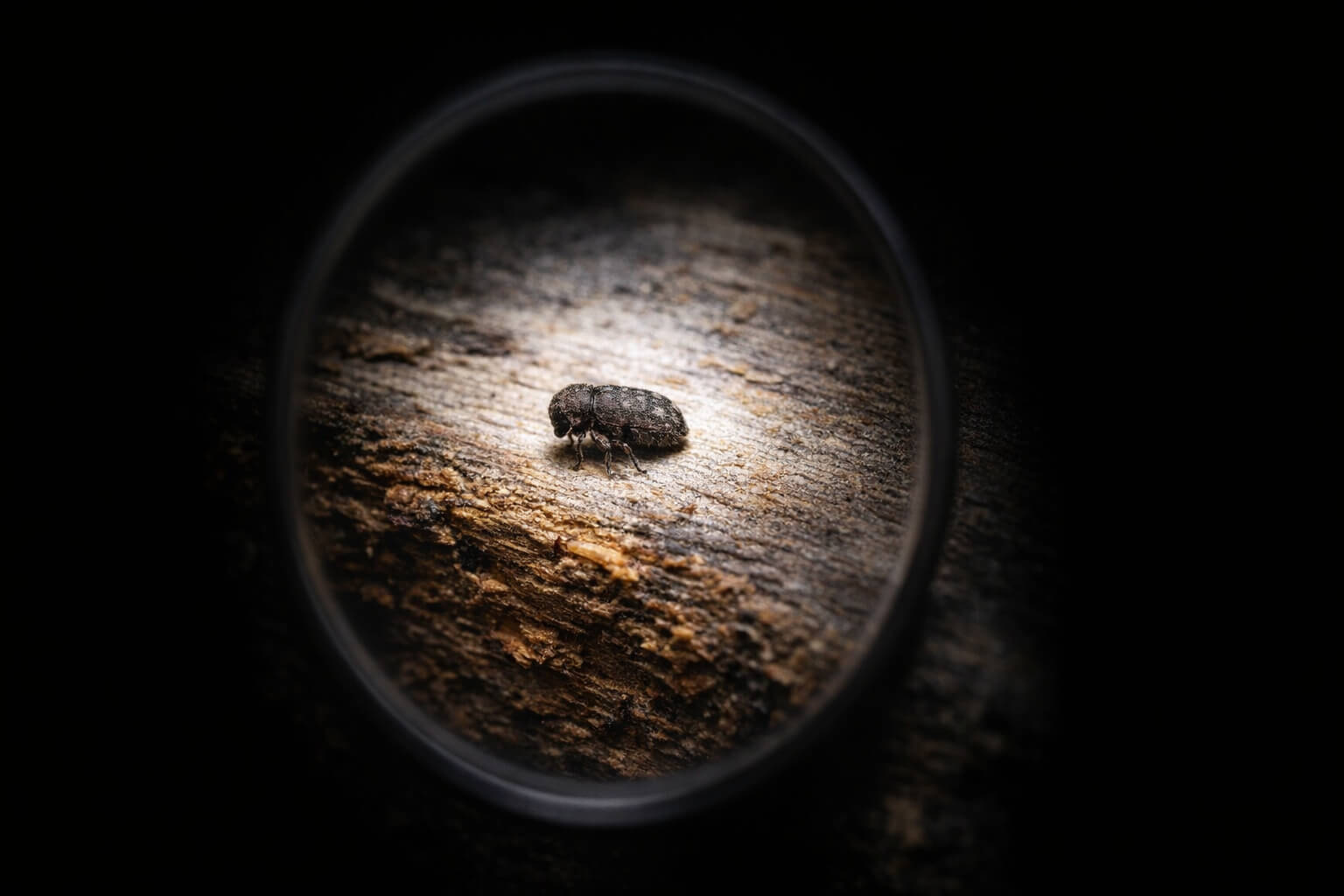
If your timber shows fresh frass, local softness, springiness, distortion or damp around structural members, you should treat the issue as more than a pest sighting.
You should seek specialist assessment when the affected timber is load-bearing, when moisture is still present, when the building is old or listed, or when a survey has raised concern without confirming extent. A proper inspection should establish whether the problem is active, where the damp is coming from, which timbers are structurally important, and whether concealed ends or joints need closer investigation.
“We do not start with the holes. We start with moisture, timber condition, and the concealed bearing points, because that is where the real structural risk usually sits.” — Senior Surveyor, Sussex Damp Experts
Our team at Sussex Damp Experts inspects the vulnerable timbers, traces the moisture source and distinguishes historic evidence from present structural risk. We explain what is historic, what is active, and what has become structurally significant, so you can act on the real condition of the timber rather than the holes on the surface.
Frequently Asked Questions
1. Can deathwatch beetle spread from one beam into the rest of your building?
Yes, but the pattern is selective rather than indiscriminate. The more useful question is not “can it spread?” but “which nearby timbers are realistically at risk next?” That depends on timber type, location, moisture history and structural role.
An infested oak beam does not automatically mean every surrounding timber is vulnerable. Principal structural oak close to damp masonry is usually a higher concern than isolated decorative oak fixed to a dry internal wall. A non-structural oak lintel cover, decorative brace or reclaimed beam in a heated room may show old evidence without offering good conditions for further breeding. By contrast, an adjacent principal rafter foot, wall plate, tie-beam end or embedded lintel bearing can be far more attractive if it shares the same sheltered, moisture-prone environment.
Softwood is a useful edge case. Deathwatch beetle is associated mainly with hardwood, especially old oak, but adjacent softwood should not be dismissed if it is already damp, decayed or in direct contact with affected hardwood. In practice, that means a dry pine board across the room is a very different proposition from a softwood roof member fixed hard against a damp, infested oak junction. External wall zones are also higher risk than internal partitions because they are more likely to hold moisture, suffer rain penetration, or trap condensation around beam ends and joist pockets.
You should also think vertically as well as horizontally. Spread risk is often greater within one moisture-affected structural line — for example wall plate to rafter foot to truss bearing — than between unrelated timbers in different parts of the house. That is why a localised infestation can still justify a broader inspection of the surrounding structural zone.
Treat spread as a targeted inspection problem: check the connected, moisture-prone timbers first, not every piece of wood in the building.
2. Will deathwatch beetle die out on its own if your house dries naturally?
Sometimes activity declines when timber stays dry enough for long enough, but you should not treat “it might dry out” as a strategy. What matters is verified stability, not a short run of better-looking conditions.
A useful decision rule is to separate improving timber from reliably dry timber. If readings are still moving around the high teens or above, especially after wetter weather, confidence should stay low. If a vulnerable hardwood zone remains above about 20% moisture content, monitoring alone is usually a weak plan because the timber is still well within a risk band for biological activity. If readings fall below roughly 15% and stay there consistently, confidence increases — but one dry summer is not enough in an old building with cyclical moisture. As a working rule, you need at least two contrasting seasons of stable dry behaviour before “drying out naturally” starts to look credible rather than convenient.
Monitoring alone is more reasonable when four things are true at the same time: the timber is not structurally critical, the moisture source has been clearly corrected, readings are trending down and staying low, and there is no new frass, movement or local softening. Monitoring is much less defensible when the member is load-bearing, the wetting source is uncertain, the timber end is concealed, or readings remain borderline after winter.
There is also a timing trap. Even when conditions improve, previously laid eggs or established larvae may still complete part of their lifecycle. That means a small amount of late emergence does not automatically prove failure of the dry-out. What matters is the overall trend across time, not one isolated sign.
Do not rely on “natural drying” unless you can prove stable low moisture through changing seasons and rule out a hidden wetting source.
3. Is it safe to stay in a house with untreated deathwatch beetle?
Sometimes it is, and sometimes it is not. The answer turns on structural significance, not simply on the presence of the beetle. A known but untreated infestation in a decorative timber does not carry the same safety meaning as an unresolved problem in a principal beam, wall plate or bearing end.
If you are living in the property, think in terms of risk zones rather than whole-building labels. One room, floor bay or roof area can be unsuitable for normal use while the rest of the house remains broadly occupiable. That matters for insurers too. Once an infestation is known and untreated, especially in structural timber, you can move from “hidden condition” into “known defect.” That may influence future claims if damage worsens and the insurer argues that deterioration was ongoing rather than sudden. Mortgage valuers can also treat deathwatch differently from common woodworm because it is associated with structural hardwood and concealed damage, not just surface evidence. A valuer may therefore push for a specialist report even where a buyer initially assumes the issue is routine.
There are also regulatory and heritage angles. If compromised structural timbers need significant repair in a listed building, you may need conservation input and sometimes formal consent depending on the scope of works. Building control can also become relevant where structural replacement, strengthening or altered load paths are involved. That does not mean you must leave the property, but it does mean the problem is no longer just a maintenance inconvenience.
A practical threshold helps. Low concern means historic evidence in non-critical timber with no active moisture issue. Medium concern means structural timber plus unresolved uncertainty. High concern means known deformation, visible movement, or compromised bearings in load-bearing members.
If the issue is in structural timber and remains unresolved, base your decision on structural risk, insurance exposure and repair implications — not on whether the house still feels normal today.
4. Does treatment restore timber that has already been damaged?
No. Treatment may control active infestation, but it does not reverse the structural consequences of timber already lost. If galleries, decay and section loss have reduced the capacity of a beam, joint or bearing, that missing material does not return when the biology is dealt with.
This is where many expensive misunderstandings begin. You can have a technically successful treatment result and still have a structurally unsatisfactory timber. The treatment may stop further feeding, but the element may remain too weak, too soft at the bearing, or too reduced at a joint to be trusted under normal load. In practical terms, that means you should separate two questions that are often bundled together: has the infestation been controlled, and is the timber still adequate for its job?
The answer to the second question depends on location, not just percentage loss. A modest amount of loss in a lightly stressed visible face may matter less than a smaller amount at a tenon, wall pocket or rafter bearing where load transfer is concentrated. That is why some treated timbers can remain in place with monitoring, while others need splicing, strengthening, resin repair, local replacement or full replacement. In heritage work, there is often a further judgement about how much original fabric can responsibly be retained. Repair is not always all-or-nothing.
There is also a sequencing point. If treatment is carried out before anyone assesses the structural role of the member, you may get false reassurance. The timber may look cleaner, quieter and apparently “sorted,” while the actual load path is still compromised. That is why structural diagnosis and biological control should inform each other rather than happen in isolation.
Treat treatment as the end of active attack, not the automatic restoration of strength. The real decision comes after that: does the timber still deserve to stay in service?
5. What happens if a survey cannot confirm whether the infestation is active?
That outcome is more common than many owners expect. An inconclusive result does not mean the survey failed. It usually means the survey has identified uncertainty that matters and narrowed down where that uncertainty sits.
There are several reasons activity can remain unconfirmed. The inspection may take place outside the main emergence period. The critical beam ends may be sealed into walls or boxed by finishes. Old holes may be visible while the most important evidence lies deeper in the timber. In historic buildings, large oak members can also mislead visual inspection because the outer shell may stay hard long after inner condition has changed. An inconclusive finding is therefore often a map of limits: what could be seen, what could not, and which hidden areas now matter most.
The next step should match the consequence of being wrong. If the timber is decorative, dry and easy to revisit, monitoring may be enough. If the timber is structural, concealed and associated with damp, uncertainty has a higher cost. In that case, follow-up may include opening up a local area, probing suspect ends, moisture comparison across seasons, or targeted monitoring for fresh activity. In other words, you are not trying to force certainty everywhere. You are trying to reduce uncertainty where it would change a structural or financial decision.
This matters particularly for buyers and sellers. “Inconclusive” often tempts one side to minimise and the other to catastrophise. Both reactions are unhelpful. A better reading is: the survey has not proved active infestation, but it has identified enough risk to justify the next level of evidence before major decisions are made.
Treat an inconclusive result as a risk-management outcome, not a dead end. The next question is not “why didn’t they know?” but “what extra evidence would change the decision?”
6. Does untreated deathwatch beetle affect selling, buying or insuring a property?
Yes, often because uncertainty has a price even before major repair begins. Untreated deathwatch beetle in structural timber can affect value, negotiation, lending confidence and insurance appetite because it raises unanswered questions about hidden condition.
The most awkward cases are often transactional edge cases rather than obvious disasters. For example, a buyer’s survey may raise suspected deathwatch late in the conveyancing process, after price and timing already feel settled. At that point, a lender may ask for a specialist timber report before issuing final approval, or a buyer may seek a retention because the extent of repair cannot yet be priced. In listed buildings, the uncertainty can widen further because repair options may be constrained by conservation requirements, access issues, or the need to retain original fabric. That can make two properties with similar visible evidence commercially very different.
For sellers, the challenge is credibility. If you know active structural timber risk is unresolved, “we’ve never had a problem” is rarely persuasive. Buyers and valuers will focus on what remains uncertain: concealed beam ends, ongoing moisture, repair scope, and whether the issue has been professionally assessed. For buyers, the practical question is not simply “should I walk away?” It is whether the defect is understood well enough for the price, programme and likely repair route to make sense. Some buyers proceed successfully once uncertainty is reduced. Others are caught by delay, not by decay alone.
Insurance adds another layer. Known untreated infestation can affect how future damage is characterised, particularly where gradual deterioration is involved. That may influence claims, renewals or policy wording even if no immediate refusal occurs.
If deathwatch appears during a sale or purchase, do not negotiate around guesswork. Reduce uncertainty first, then negotiate on scope, cost and risk with clearer footing.

