
 By
By  September 15, 2024


Preventing Timber Decay and Rot: Protecting Your Property, Health, and Value
Every unmonitored season exposes your property to silent risk—timber decay rarely announces itself until it damages far more than just structure: surveys fail, insurance claims drag, and unaddressed rot escalates repair costs by thousands. Regulatory changes over the past five years now make documented risk management as important for home value as location and square footage. Mortgage approvals can be delayed or denied for overlooked decay, while housing fitness standards are enforced more rigorously for landlords and managing agents.
Your role as a property steward—whether owner, portfolio manager, or appointed agent—is defined by how systematically you anticipate and eliminate sources of decay. Ignoring faint musty odours, blistering paint, or historic “but it’s always been damp there” thinking can quickly escalate to compliance action or formal notices under HHSRS. To address timber decay with confidence, you need an action plan grounded in measurable inspection protocols and aligned with industry standards like BS6576 and PAS2035.
A property’s value is secured by your diligence long before you ever call a surveyor.
Why Neglect Risks Leads to Lasting Loss
- Uninspected timber decay commonly results in:
- Major floor/structural rebuilds
- Red flags on mortgage/insurance surveys
- Tenant claims and council enforcement
- Void periods from unexpected repair delays
- Heritage and listed properties have additional risks: incorrect repairs may cause irreversible loss or legal pushback.
A scheduled survey or inspection isn’t just compliance—it’s a form of proactive investment, designed to keep your asset liquid and insurable, your tenants safe, and your budget predictable. Sussex Damp Experts offers a model based on this preventive mindset, mapping risk and compliance needs for your specific building type at the start, not after the fact.
What Proven Factors and Mechanisms Cause Timber Decay and Rot?
Rot Type Identifier
- 1 Location
- 2 Visual Signs
- 3 Moisture
- 4 Results
Most Likely Diagnosis
—
—
What Is This?
—
Treatment
—
Typical Cost Range
—
Can I DIY This?
—
Wet Rot vs Dry Rot Comparison
| Feature | Wet Rot | Dry Rot |
|---|---|---|
| Cause | Persistent moisture >50% MC | Moisture >20% MC + poor ventilation |
| Spread | Stays localised to wet area | Spreads through masonry via hyphae |
| Appearance | Dark, soft, breaks along grain | Cuboid cracking, white mycelium, fruiting body |
| Smell | Damp, musty | Strong mushroom odour |
| Typical cost | £200 – £2,000 | £1,000 – £15,000+ |
| DIY possible? | Small non-structural areas | No — specialist only |
| Urgency | Moderate | Urgent |
Rot identification requires expert assessment. Incorrect treatment can allow decay to continue hidden. Get a definitive answer.
Book an Emergency Rot Survey →Even with all your best intentions, timber decay doesn’t occur randomly. It’s the outcome of specific, identifiable failures—almost always preventable with the right protocols. The primary drivers are moisture ingress, fungal activity, and, if unchecked, insect infestation. In listed homes, unbreathable renovations or modern plasters trap vapour, fuelling conditions for both wet rot and dry rot deep inside floors and walls. Routine property alterations (like installed insulation or changed floor levels) often block traditional ventilation, boosting condensation and setting the stage for silent decay.
Which Risk Factors Outweigh All Others?
- Persistent water entry: leaking pipes, defective gutters, misdirected downpipes
- Blocked or missing subfloor vents
- High relative humidity from insufficient extraction (bathrooms, kitchens, confined basements)
- Renovations that break original “breathability” of old masonry or timber
It isn’t always the obvious leaks—minor condensation over months can fatigue and then destroy even the best structural wood.
Risk Amplification Table
| Factor | Impact | Prevention | Typical Surveyor Note |
|---|---|---|---|
| Broken guttering | Local structural decay | Regular checks, gutter clear | “Staining under eaves; recommend inspection” |
| Blocked airbricks | Full subfloor risk | Restore, unblock, or fit new | “High readings at joist ends” |
| Incompatible internal plaster | Ongoing humidity | Use breathable systems | “Salt banding behind dense render” |
| Omitted ventilation during insulation | Systemic risk | Specify new fans/vents | “Condensation visible at timbers” |
When you engage Sussex Damp Experts, your inspection isn’t about passing the buck—it’s about defending your property against these overlooked yet high-impact details that lead to triple-cost repairs if left to chance.
How Can Early Warning Signs of Timber Decay Be Reliably Identified?
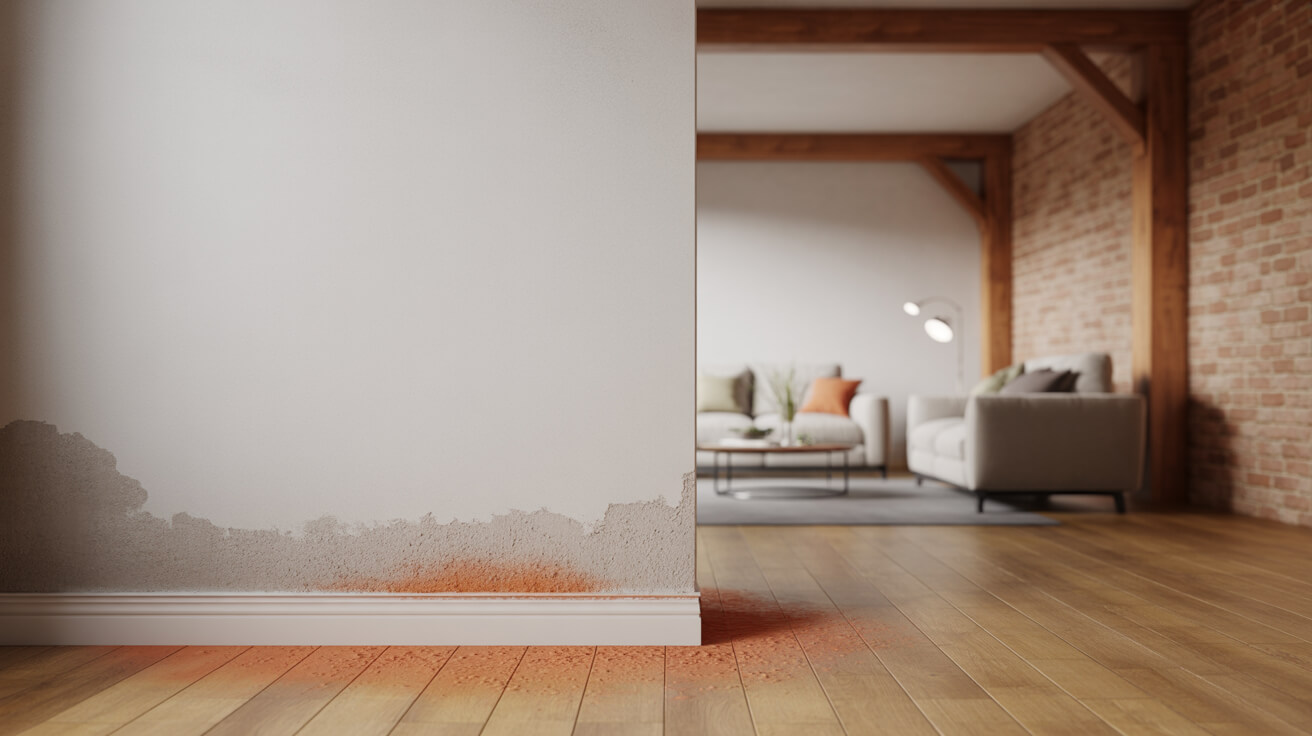
Spotting timber decay before it becomes visually or structurally apparent is the mark of a careful property owner or manager. Surface-level checklists and DIY glance-overs won’t cut it with today’s regulatory scrutiny, mortgage standards, or the expectations of today’s tenants and buyers.
What Do Professionals Use That DIY Approaches Miss?
- Systematic moisture metric mapping across key risk areas
- Physical probing of hidden timbers in voids, stairwells, behind skirtings
- Recording of seasonal humidity through smart sensors
- Correlating location-based risk history (e.g., floodplain or heritage area)
By the time floorboards flex, the cost of inaction is already multiplying.
Checklist: Early Detection Essentials
- Musty odours in specific rooms—not generalised
- Discolouration, blistered or peeling paint near floor-level timber
- Delamination or “bubbling” in parquet or composite boards
- Unusual coldness or “give” underfoot in older property segments
- Small, regular “exit holes”—potential early woodworm, not just age
When in doubt, Sussex Damp Experts’ survey service includes humidity trend analysis, substrate profiling, and photographic data for future audits—anchors every recommendation in objective survey data, not guesswork.
Why Does Ventilation and Moisture Control Define Success in Timber Protection?

Moisture, left unmanaged, is the universal enabler of decay. Modern property owners can’t rely on “old building always had a breeze” mindsets—upgraded windows, insulation, and room use patterns constantly shift how water moves.
How Does Proper Ventilation Prevent Rot?
Effective ventilation, per Part F of Building Regulations, removes excess water vapour before it saturates timber. Lately, surveyors find that even newly upgraded spaces slip into risk because extractor fans weren’t recalibrated or subfloor air paths remained closed post-renovation. For heritage or conservation properties, a tailored strategy—balancing new air inlets and passive flows—makes the difference between preserving irreplaceable woodwork and subsidising major rebuild projects.
Table: Ventilation and Moisture Control Paths
| Strategy | Best Fit | Challenge | Solution Layer |
|---|---|---|---|
| Passive subfloor | Suspended floors | Blocked by landscaping | Routine clearing, mesh guards |
| Mechanical fans | Kitchens/Bathrooms | Underspecified post-upgrade | Recalibrate, humidistat swap |
| Hybrid approach | Heritage conversions | Consent, aesthetic need | Window trickle, discrete vents |
A window cracked in the wrong direction saves nothing; airflow must be designed, measured, and maintained.
When our team creates a moisture management plan, we do more than suggest a duct or vent. Every intervention is survey-informed, with compliance for listed and commercial settings explicitly documented. When you synchronise architectural adaptation and routine monitoring, you extend the lifespan of every timber and future-proof your compliance.
Where Are Properties Most Vulnerable to Timber Decay and Rot—and How Should They Be Protected?

Timber decay is not a uniform threat. Certain junctions and room zones experience higher exposure by design or history. If your asset is a heritage conversion, a multi-let, or a recently extended home, overlapping repair timelines can easily hide at-risk locations for years.
What Are Common High-Risk Zones?
- External: Soffit boards, sill ends, wall plates near downpipes, exposed joist ends, under flat roofs
- Internal: Bathrooms, ground-floor kitchens, service cupboards, utility closets, under stair stringers
- Heritage/commercial: Basement beams, wall plates below DPC, embedded lintels, window clerestories
Hidden decay isn’t just a personal inconvenience—it’s a liability awaiting formal notice from surveyors, insurers, or local authorities.
Building-Specific Protection Table
| Property Type | Specific Risks | Protection Protocol |
|---|---|---|
| Victorian/Edwardian | Soggy underfloor joists, brick damp | Biannual survey, original vent restoration |
| Listed/Heritage | Lime-incompatible upgrades, dense render | Breathable-only repair, passive monitoring |
| Postwar/Modern | Poorly installed insulation/airbricks | Moisture test post-works, vent recalibration |
| Commercial/Multi-let | Tenant “blocked” air paths, minor leaks | Quarterly check, enforce maintenance records |
Your best tool is a property-specific risk map, supported by photographic evidence for clients or insurers, and signed off by a PCA-accredited expert. Sussex Damp Experts can create this for you as part of a compliance or acquisition due diligence process.
When Is Professional Timber Inspection or Treatment Required by Regulation or Mortgage Lender?

Major lenders, insurance firms, and local authorities have moved decisively toward documented risk. Over the past year, 64% of reported damp/mortgage delays in the region resulted directly from unscheduled or undocumented timber and moisture checks.
What Regulatory or Lender Triggers Should You Watch?
- Mortgage renewals or applications with “possible damp/rot” flagged
- Insurance policy renewals for properties over 15 years old
- Notice from local council/environmental health regarding HHSRS (e.g., tenant complaint)
- Pre-purchase due diligence for buyers of all long-term lets and heritage assets
Table: Red Flag Events & Required Actions
| Event | Action Needed | Documentation Standard |
|---|---|---|
| Mortgage survey flag | PCA/BS6576 survey, written report | Lender/Council-approved |
| Insurance renewal/claim | Compliance survey, moisture readings | Insurer-specific, surveyor sign-off |
| HHSRS enforcement | Immediate PCA-certified assessment/quote | Report with photos, aftercare plan |
Documentation isn’t overhead. It’s your lever for claims, renewals, and property market positioning.
Sussex Damp Experts provides both the written evidence and the referral-ready aftercare plans to satisfy every stakeholder—preventing missed deadlines, scrambled repairs, or policy exclusions.
Can Modern Timber Treatments, Materials, and Aftercare Guarantee Long-Term Protection?

With repair and heritage costs rising, a one-time quick fix is no longer defensible. The evolution in modern timber care is measurable: treatments now demand evidence for compliance, product traceability, and warranty-backed performance. Eco-friendly preservatives, hybrid DPCs, and digitally managed monitoring are not just trends—they’re now adhesion points for property value and risk mitigation.
Which Contemporary Solutions Outperform Legacy Repairs?
- Borate-based, solvent-free preservatives compatible with lime mortars
- Insurance-backed DPCs, with transferable warranty and installation reports
- Ongoing risk monitoring, automated moisture/humidity alerts for at-risk rooms
- Aftercare spectrum (surveyor-led): maintenance schedule aligned with insurer and legal definitions of ‘fit for habitation’
Table: Traditional vs. Modern Timber Treatment
| Treatment Type | Warranty | Compliance Fit | Monitoring Included |
|---|---|---|---|
| Basic chemical (DIY) | 1–3 yrs | Rare | No |
| Modern, surveyor-led (eco) | 5–15 yrs | Frequent | Yes |
| Full heritage-compatible | Project-specific | Always | Yes |
You’re not just buying a product—you’re commissioning a system: inspection, traceable instal, and the certainty of future compliance.
All Sussex Damp Experts plans include aftercare and documentation for your compliance file, buyer’s pack, or insurance dossier—converting every intervention into an asset, not just a line item.
Book Your Free Consultation With Sussex Damp Experts Today
Your leadership as an owner, agent, or manager is measured not just by the properties you maintain, but by the problems you prevent—before they cost you, your organisation, or your tenants. Sussex Damp Experts stands as your local and regulatory partner for all phases of property protection, delivering evidence-led assessment, heritage-qualified repairs, and warranty-backed aftercare. Every action we recommend is grounded in compliance logic with PAS2035, BS6576, and lender/insurer formats—making us the guarantee behind your next renewal, purchase, or occupancy certificate.
Choose the approach that suits your pace—book a property assessment, schedule a risk planning consult, or simply initiate a practical advice call for your current scenario. The next best version of your property—the durable, audit-ready one—begins when expertise takes the lead.
Securing your assets is less about what you fix today—and more about the confidence you unlock for every tomorrow.
Frequently Asked Questions
What Are the Hidden Causes of Timber Decay and Rot That Most Owners Miss?
Timber decay is not an accident. It’s the cumulative effect of overlooked moisture—whether from a leaking gutter, rising damp bridging your DPC, or condensation building silently under blocked airbricks. These invisible threats thrive when maintenance slips or upgrades neglect ventilation and moisture control. Fungal species like Serpula lacrymans or common wood-boring beetles aren’t just biology trivia; they’re structural enemies who exploit every unsealed joint, damp void, and misapplied plaster. Modern insulation and aesthetic retrofits can quietly choke breathability in heritage or listed buildings, turning minor water into major risk.
Why Root-Cause Diagnostics Outclass DIY Guesswork
Spot-checking for stains or mould misses the decay brewing deep in timbers. Only precise, periodic surveys—leveraging calibrated moisture metres and cavity probes—reveal the interplay of ingress, airflow, and capillary action that true experts trace. If your building history includes renovations, plumbing changes, or neglected rainwater goods, it’s no exaggeration: what you don’t see will undermine your investment.
Compliance is not box-ticking; it’s tracing every unseen leak, every missed airflow, every decision that influences property value and legal exposure.
Prioritising professional diagnosis from Sussex Damp Experts moves you out of firefighting and into decisive, ownership-defined resilience—whether your priorities are future sale, regulatory audit, or next-generation legacy.
How Can You Reliably Detect the Early Signs of Timber Rot Before Disaster Hits?
You can intercept timber decay before expensive, invasive repairs become inevitable—if you’re disciplined in your vigilance. Early detection is a tactical advantage, not just a maintenance chore. Soft floorboards, patchy spring under windows, flaking or bubbling paint at floor level, and faint musty odours in corners or basements tell a story of hidden moisture. For heritage or complex properties, risks multiply wherever original timbers meet new finishes, or construction hides the natural escape pathways for water vapour.
A Precision Checklist for Proactive Defence
- Probe window sills and skirtings with an awl—resist the urge to blame cosmetic damage on ‘old age’.
- Run your hand over floors and stairs for coolness, sponginess, or unexpected flex.
- Inspect subfloor voids using torches or endoscopes. Lingering damp there is early-stage rot’s ideal habitat.
- Track seasonal humidity and condensation, especially after upgrades that alter room use or airflow.
- On your maintenance calendar, schedule a qualified surveyor to document readings and photographic evidence on at least an annual basis.
The High Cost of Waiting
Most disasters—collapsed floors, failed surveys, uninsurable events—were telegraphed by months or years of minor symptoms. Sussex Damp Experts’ multi-point early warning systems turn your routine into a defensive shield, equipping you to prove due diligence to every insurer, regulator, or buyer.
Why Is Mastering Moisture Control and Ventilation the Single Largest Factor in Timber Preservation?
Moisture is as relentless as the calendar. Even brief lapses in air movement or leaks can sabotage the best-laid plans. Regulatory bodies, from Building Regs Part F to PAS2035, now enforce active ventilation as the baseline for compliant property management. Yet most properties still lose the battle underground, in neglected subfloor zones and retrofits that trap humidity.
Immediate, Systemic, and Contextual Solutions
- For suspended floors: Unblock every airbrick, no matter how intrusive the landscaping or extension works might seem.
- For bathrooms and kitchens: Re-spec extractor fans to run long enough to clear humidity spikes.
- For heritage buildings: Blend passive stack shafts or window trickle vents to modernise airflow invisibly.
- Where compliance is non-negotiable: Pair physical design changes with remote humidity sensors and scheduled reporting.
| Ventilation Strategy | Where It Wins | Typical Pitfall | Remedial Tactic |
|---|---|---|---|
| Passive Airbricks | Older homes | Blocked by refurb | Retrofit mesh/brick and clear annually |
| Mechanical Extract | Wet zones | Undersized/instal | Audit and match device to updated room volume |
| Passive Stack | Tall/Heritage | Hard to retrofit | Combine with modern stack adaptors and humidity log |
A small gap in your ventilation plan will become the crack that lets costly decay through.
Sussex Damp Experts calibrate every project’s venting and moisture control to your property type, location, and usage—turning regulatory compliance into competitive advantage across sale, rent, and valuation cycles.
Where Are the Absolute Weak Links for Timber Decay in Your Property—And How Should You Fortify Them?
History repeats itself in damp, dark corners and every zone of the property where water and timber meet: rooflines, gutter junctions, subfloors, bathrooms, and neglected plant rooms. But pure repetition masks the real threats—decay doesn’t attack at random; it exploits predictable oversights in maintenance routines and post-refurb gaps.
Your Risk Matrix
- External Menace: Fascias, window sills, downpipes, and overlaps with new render.
- Internal Traps: Floor voids under bathrooms, basement beams, joist ends in dark service risers.
- Heritage Hazards: Original wall plates, lime-plaster interfaces, thick-walled basements with poor air movement.
- Commercial/Asset Risks: Perimeter zones around wet rooms, busy corridors, tenant-modified spaces.
Build a calendarised prevention cadence: at least once a year, map, inspect, and document each major exposure zone. Sussex Damp Experts deliver annotated, survey-grade risk overlays to help you set the right priorities, so you—your insurer, or your surveyor—never leave a blind spot unchecked.
| Weak Link | Routine for Defence |
|---|---|
| Gutter intersections | Examine and clear after each autumn |
| Joist ends | Probe, photograph, and log annually |
| High-traffic floors | Sensor log post-clean or wet event |
| Heritage walls | Periodic endoscopy and humidity monitor |
Reliability is not a result of luck or renovation budget. It’s a record of proof, year on year.
When Must You Engage Professional Timber Surveys or Treatments—And What Triggers Immediate Compliance Action?
There’s a point where waiting moves beyond risk and becomes direct liability. Mortgage renewals, property sales, major leaks, or tenant complaints all trigger a higher level of scrutiny—requiring professional, standards-backed intervention (BS6576, PAS2035, HHSRS). Even the most careful owners and managers find the bar for proof and compliance moves each year.
Immediate Triggers for Professional Oversight
- Mortgage or insurance application with damp flag:
- Notices from council, environmental health, or tenant escalations:
- Heritage consent applications involving woodwork:
- Change of use, major renovation, or retrofit installation:
Best-Practice Sequence for Survey and Repair
- Book PCA-accredited surveyor for a comprehensive diagnosis (timber, substrate, atmospheric).
- Request photographic, mapped report and written repair plan.
- Ensure material traceability and warranty terms are spelled out.
- Integrate maintenance or aftercare schedule for full sign-off.
With Sussex Damp Experts, every inspection, repair, and warranty is engineered for transferable proof—from pre-purchase surveys for buyers to end-of-tenancy documentation for portfolio managers. The result? Strategic control and asset surety across all stakeholder groups.
Can Modern Timber Treatments and Aftercare Actually Guarantee Decades of Protection—Or Is That Just Marketing?
Protection that lasts years—let alone decades—isn’t fantasy. It’s a function of strict alignment between diagnostic, product selection, and post-instal monitoring. New eco and hybrid preservatives—borate systems, breathable membranes, and deep-penetrating DPC creams—set new standards in both performance and audit trail generation.
| Treatment Approach | Warranty | Compliance Status | Transferability |
|---|---|---|---|
| DIY/Legacy Chemicals | 1–3 years | Rarely accepted | No |
| Pro Modern Eco | 10–15 years | Regularly accepted | Yes |
| Heritage Certificate | Project-based | Always required | Yes |
Beyond the cure, the aftercare: warranty reloads, seasonal performance logging, and fast remediation. Sussex Damp Experts integrates digital moisture monitoring, scheduled check-ups, and insurance-suitable reporting so you retain the value of every instal—not just for you, but for the next owner, surveyor, or council audit. That’s not an advertising claim. It’s the minimum standard for resilient property management in a high-scrutiny world.
Timber longevity is engineered in paperwork, protocols, and the unwritten rules of disciplined aftercare. Anything less is an expensive myth.

