
 By
 April 8, 2026


Why old walls tick after dark
If you hear faint ticking from old walls or beams at night, one possible cause is deathwatch beetle — but sound alone is not proof. In older houses, the real concern is not the noise itself but whether damp has made structural timber, especially old hardwood such as oak, attractive to a wood-boring insect that can stay hidden for years, according to Mid Suffolk District Council’s guidance on wood-boring insects.
When that ticking really could be coming from the timber
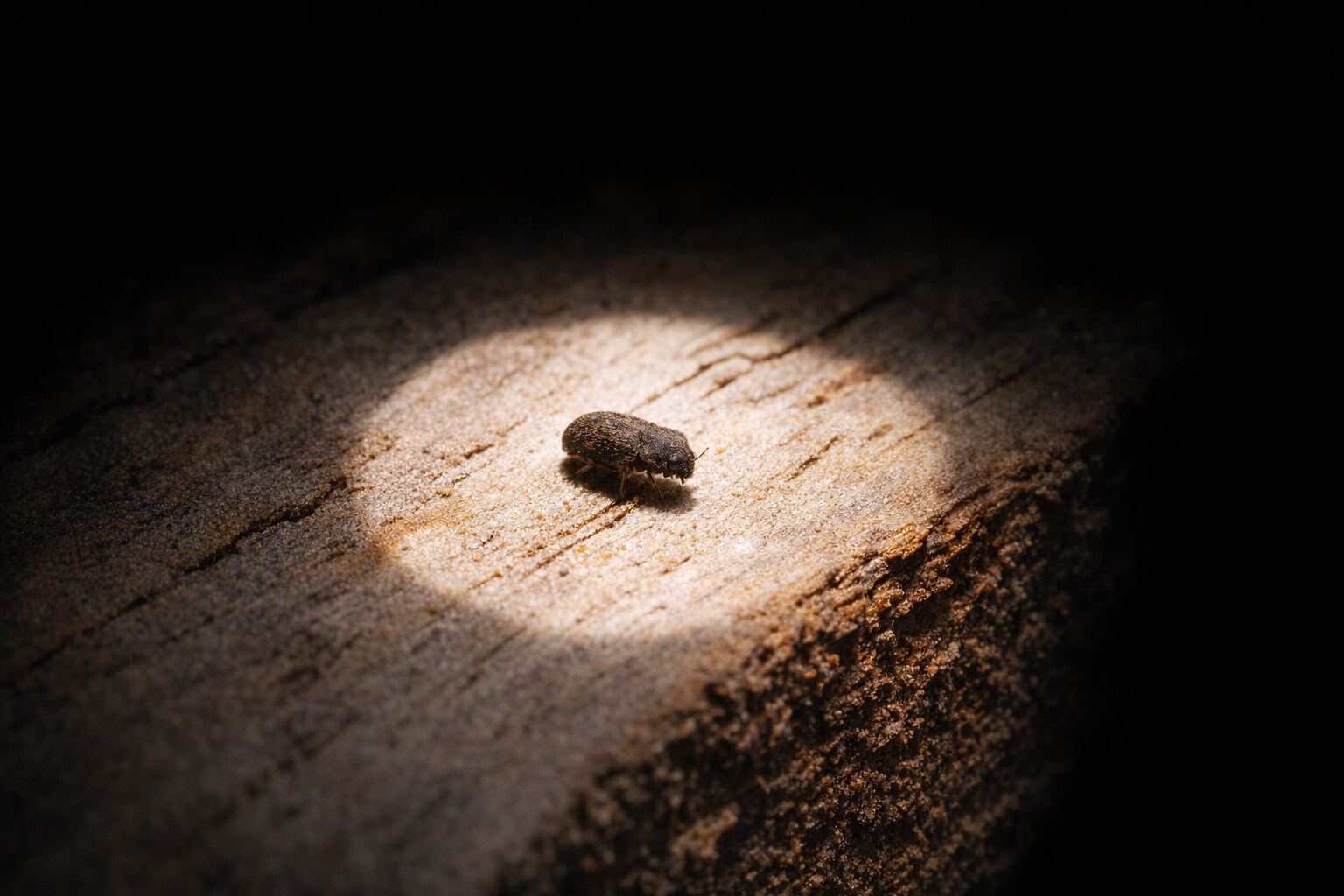
You may be hearing deathwatch beetle only when the sound lines up with old timber, damp history and the right season.
A dry, regular tick in a quiet room can fit deathwatch beetle because adult beetles are known to produce a tapping sound in timber during courtship. But the key word is can. Old houses also click, settle, cool down and creak, and pipes, radiators, rodents and birds can all make night-time noises that feel stranger at 2am than they do in daylight. Mid Suffolk’s guidance for historic buildings makes the same point: you need more than a noise before you decide you have an active infestation.
Why you hear it most when the house is quiet
Deathwatch beetle does not become audible because night is special. You notice it because the rest of the building has gone still. English Heritage explains that the male beetle makes the famous tapping noise by striking the wood, which is why people once connected it with a “death watch.” In plain terms, it is not a haunting. It is communication inside the timber.
A tiny sound that would vanish under traffic or conversation can suddenly seem sharp once the house settles. You are not imagining it. You are hearing the building more clearly.
When deathwatch beetle is plausible
The suspicion rises if your home is older, has large exposed or concealed hardwood timbers, sits in southern England, and has a history of damp, leaks, poor ventilation or fragile oak beams. The Natural History Museum says deathwatch beetle is common and widespread in the south of England, while Mid Suffolk’s historic-building guidance notes that the tapping is associated with spring courtship and that wood-boring insects in old buildings are commonly linked to excess damp.
It also becomes more plausible when the sound seems tied to a beam, ceiling timber or wall area that already shows age, staining or previous repair.
When it is probably something else
If the noise comes from a modern stud wall, a pipe chase, a radiator line or a plastic service void with no timber signs nearby, deathwatch beetle becomes much less likely. The same goes for fluttering or soft scrambling, which more often points to birds, bats, rodents or insects in cavities rather than a beetle tapping inside old wood. Wall sounds have several possible causes. Timber clues are what narrow it down.
You hear a dry, steady tick from the same corner of an old bedroom ceiling on warm evenings, yet the modern extension stays silent. That is worth noticing — not because it proves anything, but because it gives you a place, a season and a building element to investigate.
What a deathwatch beetle actually is

You are dealing with a wood-boring beetle, not a superstition, if the source really is deathwatch beetle.
Deathwatch beetle is the common name for Xestobium rufovillosum, a dark brown wood-boring beetle whose larvae develop inside timber. It sits within the wider “woodworm” conversation, but it is not the same as the common furniture beetle that causes many of the smaller holes seen in ordinary joinery and floorboards. That difference matters because the building risk, timber preference and repair approach are not the same.
The insect behind the noise
The Natural History Museum describes deathwatch beetle as a wood-boring species with adults around 5–9 mm long, and notes that it can be confused with the smaller common furniture beetle, Anobium punctatum. One practical difference for you is context: deathwatch beetle is more strongly associated with large structural hardwood timbers, while common furniture beetle is far more at home in everyday softwoods and joinery.
The Natural History Museum also notes that deathwatch beetle holes are around 3 mm across, larger than the holes more often associated with common furniture beetle. Size alone is not enough, but it becomes useful once other clues start lining up.
Why the sound happens
The famous ticking is part of mating behaviour. Adult beetles tap on the timber during courtship, which is why the sound may be heard in quiet rooms during spring. That matters because it links the sound to adult activity, not to the whole hidden larval stage. The noise is one moment in a much longer process inside the wood, as Mid Suffolk’s guidance also notes.
“Homeowners often focus on the noise because it is unsettling, but the survey question is always the same: what has made that timber suitable in the first place?”
— Daniel Mercer, Chartered Building Surveyor, independent historic buildings practice
Why it shows up in southern England and older buildings
Older buildings offer the right combination of age, hardwood, moisture history and concealed structural timber. The Natural History Museum says the species is common in southern England, and English Heritage links it particularly to hardwoods such as oak that have been altered by damp and fungal decay. That is why period houses, churches, barns and timber-rich properties come up so often in discussions of deathwatch beetle.
If you live in a Victorian, Georgian or older property, especially one with original beams or concealed roof timbers, the question becomes more relevant before you even start looking for holes.
Why old oak beams are the real risk factor

You should worry less about the insect in isolation and more about the damp, fungus and old hardwood that make it possible.
Many articles drift into simple pest-control language here. That misses the real story. Deathwatch beetle is usually a timber-condition problem first. Research published in the Journal of Chemical Ecology found that female deathwatch beetles were attracted to volatiles from wood-decaying fungi and decayed oak, but not to undecayed oak, beech or pine. That fits conservation guidance: the beetle thrives where moisture and decay have already changed the timber.
Deathwatch beetle prefers the right timber in the right condition
English Heritage says deathwatch beetles mainly attack hardwoods, particularly oak, and that infestation is often associated with water-damaged or fungus-affected timber. That is the crucial distinction. Dry, sound timber is far less welcoming. The beetle is often a sign that something has been wrong with moisture for a long time.
This is why deathwatch beetle turns up so often in old beam ends, roof timbers near historic leaks and structural members buried into masonry.
Why damp matters more than the beetle itself
Mid Suffolk’s guidance for historic building owners puts it plainly: wood-boring insects are a symptom of excess damp in a building, and infestation is likely to continue until humidity and moisture conditions improve. That is why a quick spray-and-forget approach often disappoints. If the roof still leaks, if beam ends stay wet in masonry, or if ventilation remains poor, you have not solved the real problem.
“With deathwatch beetle, damp and decay usually write the invitation. The insect is the visible part of a longer story about moisture, neglect or trapped wet in old timber.”
— Hannah Weller, PCA-certified timber inspector, private remedial surveying consultancy
Conditions that make deathwatch beetle more or less likely
The table below gives you a quick sense of whether your situation leans toward deathwatch beetle or away from it. It is not a diagnosis. It is a sorting tool.
| Condition | Risk tends to increase | Risk tends to decrease |
|---|---|---|
| Timber type | Old hardwood, especially oak beams | Modern softwood joinery or plasterboard-only walls |
| Moisture history | Roof leaks, damp masonry, poor ventilation, fungal decay | Dry, well-ventilated, sound timber |
| Building age | Period, heritage or timber-rich property | Modern extension with little exposed structural timber |
| Season | Spring to early summer adult activity | Isolated winter-only clicking with no timber signs |
| Visible clues | Larger round holes, frass, localised timber weakness | No holes, no dust, no suspect wood nearby |
This pattern comes from the overlap between English Heritage, the Natural History Museum, PCA guidance and Mid Suffolk’s historic-building advice: old hardwood plus moisture plus evidence in the timber is the combination that matters.
How to check whether you actually have deathwatch beetle

You need to inspect the timber, not just listen to the sound, if you want a realistic answer.
The most useful question is not “Did I hear something odd?” It is “What in the building supports that explanation?” Deathwatch beetle leaves clues, but they need careful reading because old properties often carry historic holes and old damage that have not been active for years. The difference between active and historic matters more than most homeowners first realise, as Mid Suffolk’s guidance makes clear.
What to look for in the timber
The Natural History Museum says deathwatch beetle holes are circular and around 3 mm in diameter, and both NHM and PCA describe the frass as distinctive rather than simply flour-like dust. English Heritage adds an important caution: adults sometimes emerge from cracks in the wood instead of making obvious new holes, so the absence of neat holes does not automatically rule the beetle out.
Look for clusters of round holes in older hardwood beams, pellet-like debris beneath them, soft or crumbling edges, and any signs the timber has also suffered from damp. If you find dead beetles on window boards, floors or near a beam in spring, that is more useful than one night of mysterious ticking.
What the bore dust tells you
Frass is one of the best clues, but only if you read it properly. Fresh frass matters more than old debris shaken loose from dry, shrinking timber. Mid Suffolk says active outbreaks may show sharp-edged holes and pale, fresh-looking bore dust, while old holes and old frass may only reflect a past infestation. English Heritage makes the same point: holes alone do not prove activity.
You brush off the shelf above an old beam, come back a fortnight later, and find fresh pale pellets under the same spot. That tells you far more than the sound alone.
Why a damp survey matters more than an insect ID
A good survey does not stop at naming the beetle. It asks why the timber became suitable in the first place. English Heritage says that if wood moisture content is above 16%, deathwatch beetles can breed. Historic-building guidance keeps returning to the same principle: solve the moisture path, or the timber stays at risk.
A cosmetic inspection can also mislead you. A beam face may look acceptable while the hidden end, buried in damp masonry, is far worse.
What happens if you ignore it

You may be ignoring years of hidden timber loss if active deathwatch beetle is left untreated in damp structural wood.
The damage is slow, which is why people underestimate it. Larvae can remain inside timber for years before emerging as adults. The Natural History Museum says some individuals may complete their life cycle in one year while others take four to five years, and English Heritage notes that larval development may last much longer in some conditions. That long timeline is why a beam can look stable while quietly losing sound material within.
The slow structural cost
This is not usually a dramatic overnight failure. It is gradual weakening, often in the places you cannot see well: beam ends built into damp masonry, concealed roof timbers, wall plates and old joist bearings. PCA’s code of practice says heavy deathwatch infestation in large timbers may require probing, drilling or other internal checks, and even exposing built-in ends for investigation.
English Heritage also notes that severe attack can hollow beams to the point of structural failure. That is not the everyday outcome in every case, but it is why you should not dismiss active deathwatch beetle in major timbers as harmless background decay.
When it becomes a safety or sale issue
Once the conversation shifts from surface signs to structural timber, the stakes change. You may need to know whether a beam is still sound, whether a buyer’s survey is likely to flag timber risk, or whether a repair has to be planned before wider refurbishment goes ahead. In period properties, what looks like “old woodworm” can turn out to be an active, damp-driven problem in timber that still carries load.
If you are buying, selling or refinancing an older home, uncertainty alone can become expensive. A clear diagnosis usually saves time later.
Why listed buildings face extra complications
Historic buildings need a lighter touch and a smarter diagnosis. Mid Suffolk’s guidance says comprehensive spray treatment in a listed building may require listed building consent and should be justified by an independent assessment, while local authority conservation guidance makes the same broad point: sensitive like-for-like repairs may be treated differently from larger structural works. Historic England also warns that some timber treatments can harm bats in roof spaces, which adds another layer of care in older buildings.
“In a listed building, the wrong treatment can do nearly as much harm as the infestation. You have to think about fabric, consent, moisture and sometimes protected species before you reach for chemicals.”
— Rebecca Hale, Conservation Officer, local authority historic environment team
You may be dealing with an insect, a repair and a conservation question at the same time. That is why old buildings rarely benefit from a rushed, one-product answer.
How deathwatch beetle treatment actually works

You fix deathwatch beetle properly by drying the timber, confirming activity and repairing damage — not by spraying everything in sight.
That may sound less dramatic than a “kill the bugs” approach, but it is more honest. Treatment is about the building as much as the insect. If moisture has primed the timber for attack, the repair strategy has to start there. Mid Suffolk’s guidance, PCA practice and wider traditional-building advice all point the same way: remove the conditions, then decide what treatment and repair are actually justified.
Solving the moisture problem first
The first job is to identify why the timber has stayed damp enough to support infestation: leaking roof coverings, blocked gutters, condensation in roof voids, beam ends trapped in wet masonry, poor ventilation, or incompatible modern materials that hold moisture in old fabric. Historic building guidance from councils, RICS and Historic England stresses diagnosing the cause of damp rather than treating symptoms in isolation.
That approach sounds slower. In practice, it is usually quicker than repeated failed treatments.
Treatment options
Once you know whether the infestation is active and how far damage has gone, the options usually fall into three groups: targeted preservative treatment where appropriate, local timber repair or replacement where strength has been lost, and environmental correction so the timber dries and stays drier. PCA’s code says repairs and replacements should be carried out where needed and that new timbers should be protected from damp, especially where they contact masonry.
In some cases, careful monitoring is also part of the plan, particularly where activity is uncertain and the building is historically sensitive.
Why DIY surface spray rarely works
PCA’s homeowner guidance is unusually blunt on this point: brush or spray treatment may kill eggs and younger larvae near the surface, but it is doubtful that it will kill older larvae deeper in the timber. Mid Suffolk similarly notes that spray treatment can be hard to control, may be less effective in holes and cracks, and can damage historic fabric if overused or if holes are drilled unnecessarily.
That is why broad DIY spraying often gives false reassurance. The smell changes. The deeper problem may not.
How the main approaches compare
| Approach | What it can help with | Main limitation |
|---|---|---|
| Surface insecticidal treatment | Eggs and younger larvae near accessible surfaces | Limited reach into deep, concealed timber |
| Local timber repair | Restores strength where damage is confined | Works only if the moisture source is also solved |
| Timber replacement | Needed where sections are structurally unsound | May involve more invasive work and heritage constraints |
| Moisture correction and ventilation | Makes the building less suitable for reinfestation | Does not reverse timber loss already present |
| Monitoring only | Useful where activity is uncertain or historic | Unsafe if active structural damage is already present |
That is why Sussex Damp Experts approaches suspected deathwatch beetle as a timber-and-moisture investigation first. The useful question is not “What product do I need?” but “What is sustaining the problem, and how sound is the timber now?”
What to do tonight if you are hearing the sound right now
You do not need to panic tonight, but you do need to start gathering better evidence.
The best next step is calm observation. Night noises make people jump to the strangest conclusion first. Old buildings reward the opposite habit: listen carefully, look closely, and let the pattern build. If the house is trying to tell you something, it will usually do so more than once. Mid Suffolk’s guidance on active versus historic infestation points in the same direction: collect signs, not stories.
Immediate steps
If you hear the sound again, note the room, time, weather and where it seems strongest. Check whether the property has old hardwood beams or concealed structural timber in that area. Look beneath suspect timbers for fresh debris. If it is spring or early summer, adult activity is more relevant than it would be in midwinter. PCA advises that April to June is the best time to organise a survey for deathwatch beetle because adults are emerging then.
If you can do so safely, photograph holes, cracks, frass and any staining or softness around the timber. Clean away loose dust below the suspect area and check again later. Mid Suffolk and English Heritage both describe tissue-paper monitoring over suspect holes as a simple way to see whether insects punch through during the emergence season.
You wake again to the same faint ticking, stand still in the dark, and realise it always seems to come from the old beam by the chimney breast. That is the moment to stop guessing and start recording.
When to book a professional damp and timber survey
Book a specialist survey if the sound keeps recurring in the same location, if you can see larger holes or fresh frass, if the timber feels weak or damp, or if the property is old enough that structural hardwood is likely to be involved. You should also move quickly if you are buying, selling or renovating a period property and the issue touches roof timbers, main beams or concealed timber ends. PCA’s code makes clear that heavy infestation in large structural timbers needs proper investigation, not guesswork.
You do not need a horror story. You need a clear answer. If you are in Sussex and you want to know whether that ticking is active deathwatch beetle, historic damage or something else entirely, Sussex Damp Experts can inspect the timber, trace the moisture source and tell you what really needs doing.
Frequently Asked Questions
FAQ 1 — Can deathwatch beetle spread into modern timber or furniture?
You are less likely to see deathwatch beetle spread through a modern house than through damp, older hardwood already in poor condition.
That distinction matters. Deathwatch beetle is not like a general household pest that happily moves from one dry timber to the next. The species is strongly associated with old hardwood, especially oak, that has already been altered by damp and fungal decay. The Natural History Museum describes it as a pest of structural timber and furniture, but English Heritage and conservation guidance repeatedly connect it with moisture-damaged hardwood rather than ordinary, dry modern joinery. In practical terms, that means a healthy new staircase, kitchen carcass or stud partition is not usually its preferred next stop, even if the house contains an affected historic beam elsewhere. Natural History Museum
Where you do need to be careful is when newer work connects directly to damp old fabric. If an extension ties into wet masonry, if replacement timber is built into persistently damp walls, or if old leaks remain unresolved, you may create more suitable habitat than you realise. PCA guidance on wood-boring beetles stresses that treatment and repair decisions depend on the timber involved, the extent of infestation and the conditions around it. That is why professionals do not usually think in terms of “spread through the whole house” but in terms of “where else do the same damp conditions exist?” Property Care Association
So if you are worried about spread, look at connected risk zones rather than everything made of wood. Roof intersections, beam ends, cellar ceilings, chimney-adjacent timbers and any old hardwood close to historic damp problems deserve the most attention. Dry, modern timber in well-ventilated areas is usually a much lower concern. The practical takeaway is simple: stop the moisture pathway, and you usually shrink the beetle’s options at the same time.
FAQ 2 — Why do beetles sometimes appear after treatment or repairs?
You may still see adult beetles for a while after work, because treatment and drying do not erase every stage instantly.
This can be one of the most frustrating parts of the whole process. You repair a leak, improve ventilation, maybe carry out targeted treatment, and then a beetle appears on a sill weeks or months later. That does not automatically mean the whole plan has failed. Mid Suffolk’s guidance says it may take time for the last insects to leave after treatment or after the damp cause has been addressed, and PCA guidance also treats monitoring as part of responsible follow-up rather than proof that nothing worked. Mid Suffolk District Council
The reason is biological. Deathwatch beetle spends most of its life hidden inside timber, and the visible adult stage is only the end of a much longer cycle. If larvae were already deep within the wood before conditions changed, some may still complete development and emerge later. That is also why professionals do not judge success from a single sighting. They look for a pattern: is fresh frass still appearing, are new signs concentrated in the same area, does the timber remain damp, and are more adults emerging over successive seasons? One beetle after repairs is a question. Repeated fresh evidence in the same timber is a stronger warning.
This is where good records help. Keep photographs, dates and room locations. Note whether the timber was opened up, repaired or only monitored. If the property is historic, remember that conservative repair sometimes aims to disturb as little fabric as possible while the building dries and stabilises. The practical takeaway is not to panic at one late emergence. Instead, treat post-work sightings as information. They should be reviewed alongside moisture readings, timber condition and whether fresh activity is truly continuing.
FAQ 3 — Will deathwatch beetle affect a mortgage, sale or insurance decision?
You are most likely to face lender, valuer or buyer questions about timber condition, not panic about the insect’s name alone.
What often changes a transaction is not “deathwatch beetle” written on a page, but the uncertainty it creates. A lender or valuer may want to know whether the timber is structurally sound, whether the infestation appears active, and whether damp has been identified and addressed. RICS guidance on wood-boring insects pushes surveyors toward that broader view of risk, including the environmental conditions that allow infestation to continue, rather than treating old holes as a verdict by themselves. In practice, that can mean a retention, a request for a specialist timber report, or a valuation that assumes further investigation is needed before costs are clear. RICS
If you are selling, the most useful move is to reduce ambiguity early. A buyer is less likely to be alarmed by a well-written specialist report than by a vague survey note that mentions possible beetle damage in major timbers. The same applies to remortgaging. Lenders are often trying to understand whether they are looking at historic attack, an active moisture-led problem, or a structural repair issue that could affect value. PCA guidance supports this survey-led approach, especially where large structural timbers are involved. Property Care Association
Insurance is harder to predict because policies, exclusions and evidence requirements vary. In some cases, insurers may ask for maintenance records, specialist reports or proof that the cause of damp has been addressed before they take a view on damage or further risk. So the practical takeaway is to gather good documents, not guess at outcomes. Clear photographs, maintenance records and a proper timber-and-moisture assessment usually help far more than trying to downplay the issue.
FAQ 4 — How do listed building rules change what you can do about deathwatch beetle?
You should usually seek specialist advice before agreeing to treatment, because listed buildings often require a documented repair strategy, not just a quick fix.
If you own a listed building, your first step is rarely to book broad chemical treatment. It is to establish what is affected, whether the infestation is active, and what work is likely to alter historic fabric. Mid Suffolk’s guidance says comprehensive spray treatment may require listed building consent and should be backed by an independent assessment, which means you may need a surveyor or timber specialist before you approve any contractor’s proposal. Mid Suffolk District Council
In practical terms, gather the basics early. Keep photographs of the affected timber, note where it sits in the building, collect any old survey reports, and record visible damp history such as leaks or previous repairs. If structural members may need opening up, splicing, replacement or drilling, your conservation officer may want to see why lighter-touch repair will not work. Depending on the scale of work, you may be asked for drawings, a method statement, a schedule of repairs or a heritage justification. The more original material involved, the more careful that process usually becomes.
There are also things to avoid. Do not assume a contractor’s standard treatment specification will automatically suit a listed building. Do not approve invasive drilling or wholesale timber replacement without understanding whether consent is needed. Historic England adds another layer: some timber treatments in older roof spaces can affect bats, so ecological advice may also be necessary before work begins. Historic England
The practical takeaway is simple. In a listed house, the right question is not just “How do I stop the beetle?” but “What work can I justify, document and carry out without harming the building or creating a consent problem later?”
FAQ 5 — Can you prevent deathwatch beetle without using chemical treatment?
You can often reduce risk substantially by controlling moisture, improving maintenance and monitoring vulnerable timbers before insect treatment is needed.
That answer matters most in older buildings, where unnecessary chemical treatment can create new problems without fixing the cause. Mid Suffolk’s guidance says wood-boring insects are a symptom of excess damp, and traditional-building advice from councils and conservation bodies repeatedly puts maintenance first: keep roofs sound, rainwater goods clear, ventilation working and embedded timber as dry as the building reasonably allows. If the environment becomes less suitable, you often reduce the likelihood of ongoing infestation without spraying everything. Mid Suffolk District Council
Prevention is not glamorous. It looks like clearing gutters, fixing slipped slates, checking chimney flashings, reducing condensation in roof spaces and making sure replacement timbers are not built into wet masonry without protection. It also means avoiding the temptation to seal old buildings with impermeable materials that trap moisture. Cotswold District Council’s traditional-building guidance warns against inappropriate waterproofing measures in historic fabric and points owners toward whole-building moisture diagnosis rather than cosmetic damp “solutions.” Cotswold District Council
Monitoring matters too. If you own a period property with oak beams, you do not need to wait for obvious fragility. You can photograph vulnerable areas, inspect them seasonally, clean beneath suspect timbers and note any fresh debris or adult beetles. Imagine a beam over a chimney breast that has had leaks in the past. Even after repair, that spot deserves routine checking because its history makes it more vulnerable than the rest of the room.
The practical takeaway is that chemicals are only one tool, and often not the first one. If you keep old timber dry, ventilated and well maintained, you may prevent the conditions deathwatch beetle needs most.
FAQ 6 — How is deathwatch beetle different from other wood-boring insects in old houses?
You need the right insect identified because different beetles prefer different timbers, create different risks and do not all justify the same response.
Homeowners often lump everything together as “woodworm,” but that can lead to bad decisions. The Natural History Museum separates deathwatch beetle from common furniture beetle, noting that Anobium punctatum is smaller and more typical of everyday joinery and softwood items, while deathwatch beetle is more associated with structural hardwoods. PCA guidance broadens that picture by distinguishing deathwatch from house longhorn beetle and lyctus powderpost beetle, each with different timber preferences and treatment implications. Natural History Museum
Why does that matter to you? Because the same hole does not always mean the same problem. Common furniture beetle is widespread and may be found in floorboards, roof softwoods and joinery. Deathwatch beetle raises more concern when it is tied to old oak or other hardwood structural timbers and to damp or fungal decay. House longhorn, by contrast, is associated with structural softwoods rather than the old damp hardwood conditions more typical of deathwatch beetle. Misidentifying one as another can mean overreacting, underreacting or choosing the wrong treatment. Property Care Association
There is also a diagnostic difference in what each insect says about the building. Deathwatch often points you back toward hidden moisture history in old hardwood. Another beetle may point instead to sapwood-rich joinery, imported hardwood products or untreated softwood roof timbers. So the useful question is not just “Do I have woodworm?” but “What does this species suggest about the timber and the building conditions around it?”
The practical takeaway is not to diagnose from folklore or from one photo online. If structural timber is involved, the species matters because the building answer depends on it.

