
 By
 April 7, 2026


Spotting deathwatch beetle activity in spring
If you want to know whether deathwatch beetle is active in your property, spring is usually the best time to inspect. Adult Xestobium rufovillosum start to emerge, fresh frass is easier to spot, and the damp conditions that helped the infestation along over winter are often still visible. The beetle is especially associated with southern England and older buildings with oak structural timbers, as the Natural History Museum notes.
A useful spring check answers four practical questions. Are the signs fresh or historic? Are the timbers structural? Is damp still present? And do you need a specialist survey, or just careful monitoring? Those decisions matter far more than panic about holes alone.
Why spring is the right time to inspect

You should inspect suspect timbers from March to June, with April and May usually giving you the clearest signs of active emergence.
Spring is when deathwatch beetle becomes easiest to interpret. Adults are emerging, new evidence is easier to spot, and the damp conditions behind the problem have often not fully dried. Property Care Association guidance advises inspection from April to June while beetles are emerging, which is why late spring is often the most useful window for a homeowner check.
What happens in spring that you can actually detect
Adult beetles emerge from the timber and leave fresh round exit holes. You may also notice pale new frass beneath a beam, or hear the distinctive tapping made during courtship. That tapping is a mating signal, not the sound of larvae feeding inside the wood.
Why April and May are especially useful
Early spring often gives you the first clear signs after months of winter stillness. By late spring, warmer conditions can make adult activity easier to spot, but you can still connect it to roof leaks, condensation or long-term damp that has not fully dried. That is why a spring check usually tells you more than a quick glance later in the year.
Why spring also exposes the damp conditions behind the problem
According to Cadw, roofs should be checked before and after winter, and after high winds, because small defects can quickly become larger repair problems. If a slipped tile, failed flashing or poorly ventilated roof void has kept timber damp through winter, spring is when both the building defect and the insect evidence are most likely to show themselves together.
That link between rainwater management and timber health is just as important in heritage settings.
“Unless you’re able to keep the building intact and drain the rainwater, they can be terribly vulnerable to damp and environmental problems.” — Dr Lucy Wrapson, Hamilton Kerr Institute / University of Cambridge The Guardian: Medieval panel paintings under threat from beetles and bats
On the first warm weekend in April, you might climb into your loft and notice a pale sprinkling beneath an old beam that looked clean in January. That is exactly the kind of moment when a spring check earns its keep.
| Time window | What you may notice | What it suggests |
|---|---|---|
| March | First adult activity, occasional fresh debris | Early emergence may be starting |
| April-May | Fresh holes, pale frass, occasional adults, tapping | Best practical inspection window |
| June | Continued emergence, more obvious surface signs | Active season may still be visible |
| After heavy rain | Dark staining, damp patches, musty smells | Moisture source may still be active |
| Quiet evening checks | Tapping from concealed timber | Supportive sign of courtship activity |
How to tell deathwatch beetle from other wood-boring insects

You can often separate deathwatch beetle from common furniture beetle by checking hole size, frass shape and the type of timber affected.
Not every wood-boring insect in a house is deathwatch beetle. The most common point of confusion is common furniture beetle. If you treat all exit holes as the same, you can misjudge both the level of risk and the timbers that deserve closer attention.
Exit hole size and shape
Deathwatch beetle usually leaves round holes around 2-3 mm across. Common furniture beetle holes are typically smaller, often 1-2 mm. If you are checking old structural timbers in spring, that size difference is one of the quickest field clues.
Frass differences
Frass is where many quick inspections go wrong. Deathwatch beetle frass is not just vague sawdust. It includes small bun-shaped pellets. Common furniture beetle frass is finer and more lemon-shaped. If you describe everything as “wood dust”, you lose one of the best clues you have.
Timber preferences
Deathwatch beetle is strongly associated with older hardwoods, especially oak, and with timber that has been damp and affected by fungal change. Common furniture beetle is much less selective and is frequently found in softwood as well as hardwood. That is why an old oak beam in a period property deserves a different level of scrutiny from a few scattered holes in light joinery.
| Feature | Deathwatch beetle | Common furniture beetle |
|---|---|---|
| Exit hole size | Usually 2-3 mm | Usually 1-2 mm |
| Frass type | Bun-shaped pellets | Fine, lemon-shaped frass |
| Preferred timber | Damp, decayed hardwoods, especially oak | Softwood and hardwood |
| Typical location | Old structural timbers, period buildings | General building timber and furniture |
| Most useful inspection season | Spring, especially April-June | Adults often seen over a longer warm-season window |
A step-by-step spring timber inspection you can do yourself

You can carry out a useful spring timber check by combining close visual inspection, gentle testing and a search for the moisture source nearby.
A homeowner check will not replace a proper survey, but it can tell you whether the evidence looks fresh, whether the timber matters structurally, and whether damp is still driving the risk. Work methodically. Avoid unsafe voids. Do not damage old timber just to satisfy curiosity.
What to look for and where
Start with the timbers most likely to matter: roof beams, old oak lintels, cellar or ground-floor joists, beam ends built into masonry, and timber close to chimneys or long-standing damp patches. Then look below those areas as well as at them. Fresh pellets on insulation, floorboards, stored boxes or window ledges often tell you more than the face of the beam itself.
Tools and preparation
Keep it simple. A bright torch, phone camera, thin rule, gloves and a small brush are enough for most first checks. If you already own a moisture meter, use it as a clue rather than a verdict. Surface readings can be misleading on old timbers, especially if coatings, dirt or earlier treatments are present.
How to test suspect timbers
Look closely at the hole edges first. Fresh holes tend to look sharp and pale. Older ones are darker and softer around the edges. Brush away loose debris beneath the timber, then come back later to see whether anything new has appeared. If the timber is cracked or open-grained, inspect those crevices too, because adults may emerge from cracks rather than obvious holes.
If you gently press a penknife into a suspect surface and it slips into a softened outer layer but meets firm resistance a few millimetres in, that often suggests surface decay rather than total internal loss. It is still a warning sign, not proof that the whole beam has failed. Probe lightly. In historic timber, rough scraping and aggressive gouging can do real harm.
Listen as well as look
A quiet evening check can help, especially in an undisturbed loft or over a ceiling where old beams run through. Tapping is useful supporting evidence in spring, but it is never enough on its own. Match it with holes, frass, adults or damp conditions before drawing conclusions.
Trace the moisture source at the same time
Every insect check should become a damp check. Look for staining below roof coverings, blocked gutters, cold unventilated corners, condensation on roofing felt, and musty patches where timber meets masonry. Spring is such a useful inspection point because winter defects have not yet disappeared from view.
A practical way to think about it is this.
“What worries you in spring is not the old holes you already knew about, but the fresh pale debris that appears after a quiet winter and points you back to a damp beam end or roof defect.” — A conservation officer in West Sussex
You brush away old-looking dust below a beam, return a week later, and find fresh pale pellets in the same place. That does not prove the whole structure is under attack. It does tell you the evidence deserves a more careful look.
Active infestation vs old damage — the critical distinction

You should treat fresh holes, pale frass and recent adults as stronger evidence than old dark holes, dry timber and long-settled debris.
This is where many properties are misread. Old buildings often carry the record of earlier insect attack for decades. That does not mean the beetles are still present. Much attack found in old buildings is historic rather than current, so the real question is whether anything fresh is happening now.
Signs that suggest current activity
Fresh activity usually looks cleaner, lighter and more recent. Hole edges are sharper. Frass is pale and newly deposited. You may find adults in season, or notice that new debris appears after you have carefully cleared the area beneath a timber. High moisture and visible decay strengthen the case further.
Signs that suggest historic damage only
Historic attack often presents as dark weathered holes, no new frass, and timber that is now dry enough to be less hospitable. In old cottages and listed properties, it is common to find beams that were attacked years ago but are no longer active. That may still matter structurally, but it changes the next decision. You may need repair or strengthening, not automatic insecticide.
Why getting this wrong matters
If you treat old damage as active, you can pay for unnecessary work and disturb sound historic fabric for no good reason. If you dismiss fresh signs because “the holes look old”, you can miss ongoing decay in important structural timber.
| Fresh sign | Often historic sign |
|---|---|
| Sharp pale hole edges | Dark rounded hole edges |
| Pale new frass beneath timber | Old dust with no repeat deposits |
| Adult beetles in spring | No current insects seen |
| Damp or decaying timber nearby | Dry stable timber |
When monitoring is the smarter answer
If the evidence is unclear, monitoring beats guesswork. One practical method is to cover selected holes and check whether fresh emergence breaks through in the next season. That is often the right call in an old building where over-treatment would be a mistake.
If you are buying a period cottage and the details say “historic woodworm”, pause there. That phrase may be accurate. It may also mean nobody has checked whether the damage is old, active, superficial or structural.
When a spring check should lead to a professional survey
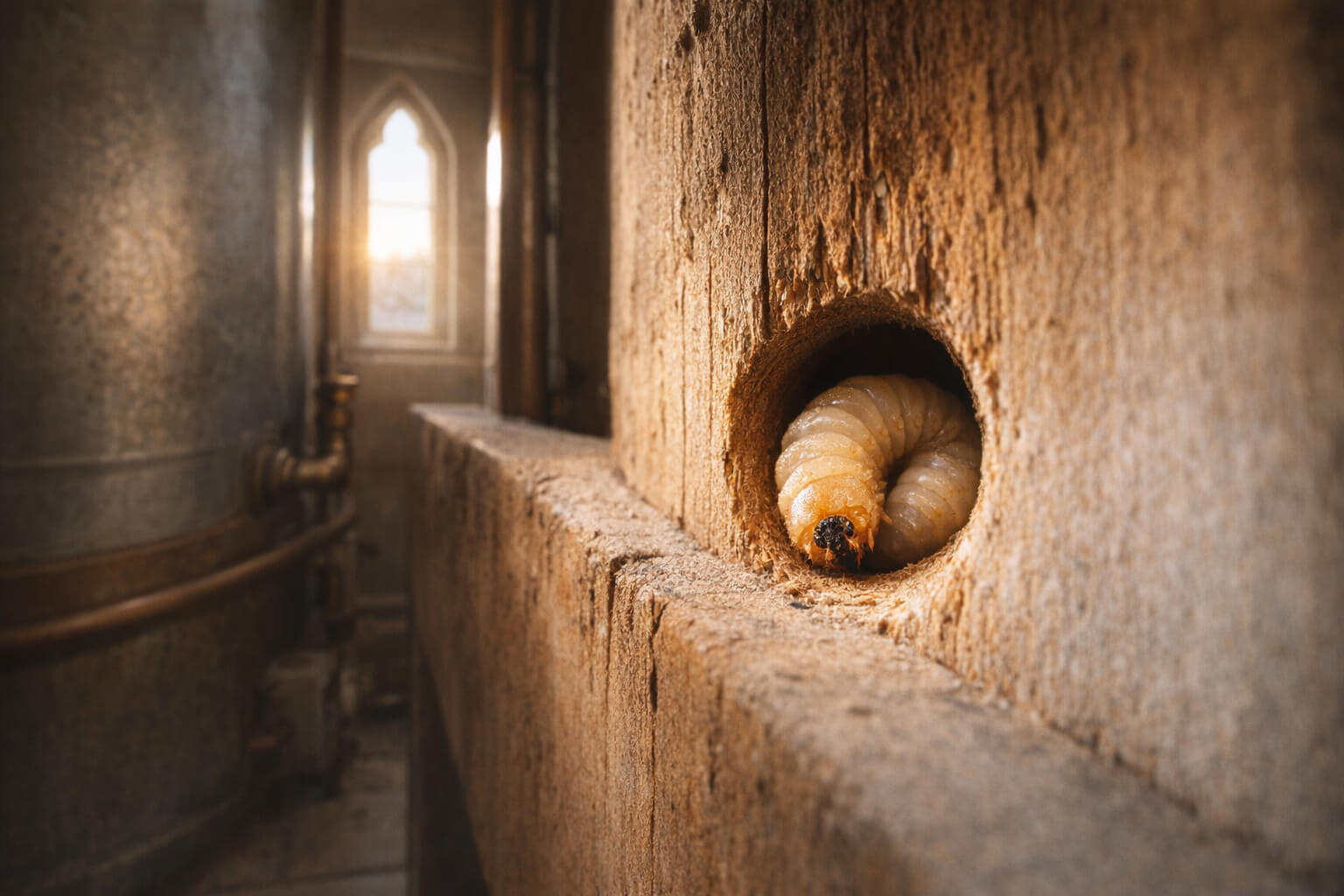
You should move from DIY inspection to a survey when structural timbers, uncertain activity, purchase decisions or heritage constraints raise the stakes.
Some situations need better evidence than you can gather with a torch and a quick look. Structural beams, beam ends in walls, concealed floor timbers and listed fabric all fall into that category. So do pre-purchase surveys, where a vague note about old insect attack can affect negotiation, repair budgets and peace of mind.
Situations where DIY inspection is not enough
Call for help if you have fresh spring signs in a major timber, if the wood feels soft and damp, if there is visible fungal decay, or if you cannot tell whether the damage is active or historic. Listed buildings need extra care because repair choices affect historic fabric, and significant timber work may require listed building consent.
What a specialist survey involves
A proper survey should identify the insect species, assess whether activity is current, trace the moisture source, judge the structural significance of the damage and set out whether monitoring, targeted treatment, local repair or replacement is justified. At Sussex Damp Experts, we assess the moisture source and the timber evidence together because one without the other can mislead you.
That is the practical mindset a specialist should bring.
“Our first question is never ‘what should we spray?’ It is ‘what has kept this timber damp enough for deathwatch beetle to stay active, and is the damage current or historic?’” — Our senior surveyor, Sussex Damp Experts
Heritage and roof-space complications
Historic buildings add another layer. Conservation guidance favours retaining as much original timber as possible and avoiding automatic wholesale replacement. Roof spaces can add yet another issue: bats. Historic England’s bat survey guidance explains that bat surveys may be needed for some projects, and roof-space work may need extra care where protected species are present.
The heritage risk is not theoretical.
“For almost 100 years, the deathwatch beetle has been responsible for the continued loss of a great deal of historic timber on the Victory.” — Diana Davis, National Museum of the Royal Navy The Guardian: HMS Victory DNA research against deathwatch beetle
An estate agent might describe a period property as having “historic woodworm to roof timbers”. That deserves more than a shrug. It may mean harmless old evidence. It may mean active insect damage plus damp. A survey is what separates those two.
What happens if deathwatch beetle is confirmed — and what does not need to happen

You should expect moisture control and careful diagnosis first, not a rushed assumption that every affected timber must be sprayed or replaced.
The sequence is simple. Confirm activity. Find and correct the dampness that made the timber suitable. Then decide whether targeted treatment, repair, strengthening or replacement is actually needed. That order matters.
Evidence-based treatment approaches
Treatment timed to emergence can help kill eggs and young larvae before they enter the wood, but surface treatment is unlikely to reach older larvae working deeper below the surface. That is why drying the timber and correcting the moisture source matter so much.
What responsible treatment looks like
Responsible treatment is selective. It may include drying the building, improving ventilation, fixing the roof or rainwater goods, monitoring through another spring, locally repairing weakened timber and using insecticide only where the evidence supports it. In a listed or period building, the aim is usually to keep as much original material as possible.
If your spring check has produced fresh evidence, or if you are dealing with a period property where structure and moisture are both in play, Sussex Damp Experts can carry out a combined timber and damp survey and set out the options in plain language.
Conclusion
You can learn more from a careful spring timber check than from a year of worrying about old holes.
Spring gives you the best chance of seeing fresh emergence, new frass and the damp conditions that often sit behind deathwatch beetle. The key is not to treat every mark as an emergency. Look for fresh evidence, distinguish active attack from historic damage, and follow the moisture trail as carefully as the insect trail. If the timber is structural, the evidence is unclear, or the building is listed, a specialist survey is the sensible next step.
Frequently Asked Questions
What should you do if you first notice suspicious holes or dust in autumn or winter?
You do not need to wait passively until spring, but you also do not need to jump straight to treatment. If you find suspicious holes, loose bore dust or weakened timber in autumn or winter, the sensible move is to record what you can see, check whether moisture is still present, and set up a simple monitoring plan so spring emergence can confirm or rule out current activity.
Start by taking clear photos with a scale beside the holes. A coin or steel rule is better than guessing from memory. Then note the location properly: “north loft slope, beam above chimney breast” is far more useful than “loft beam”. If you can do so safely, brush away loose debris beneath the suspect area and lay down a clean sheet of paper, card, or even a labelled freezer bag cut open flat. That gives you a clean surface to inspect over the next few weeks. If new debris appears during a quiet, cold period, it may still be historic material dropping from movement or drying, but you now have a timeline.
Winter is also a good time to inspect the conditions around the timber. Ask yourself:
- Is there staining from a recent leak?
- Is the area cold and poorly ventilated?
- Is there masonry nearby that stays damp after rain?
- Is insulation blocking airflow around the timber?
That matters because winter often reveals the building defect more clearly than the beetle. Condensation on roofing felt, overflowing gutters, slipped coverings and saturated wall heads may all be easier to spot in bad weather than in May.
Then plan a follow-up inspection window. Mark your diary for two checks: one in late March and another in late April or May. If the timber matters structurally, or if you are buying or selling the property, arrange a specialist assessment sooner rather than later. Waiting for spring is useful for diagnosis. It is not a reason to ignore possible damp, decay or structural weakness through the winter months.
What should you do if you find suspicious holes in furniture, panelling, or other movable timber items?
You should separate the object question from the building question first. A loose timber item, a fitted panel, and a structural beam do not carry the same level of risk, so the right next step depends on what the object is, how fixed it is to the building, and whether nearby fabric shows related signs.
A simple way to sort it is to place the item into one of four groups. A movable object includes furniture, boxes, benches, or loose shelves. Built-in joinery includes cupboards, stair parts, shutters, and fitted seating. Decorative fixed fabric includes wall panelling, screens, and linings. Heritage furnishings include church pews, lecterns, altar rails, or carved oak pieces that may be significant in their own right. The more fixed and historic the item is, the less you want to treat it casually.
Your first triage steps should be practical. If the item is movable, isolate it from carpets and soft furnishings. Inspect the underside, backboards, drawer runners, rebates, hidden joints, and any area that sits against a wall. Vacuum around it gently and keep the debris if you want a specialist to inspect it later. Then check the surrounding area. If a chest, bench, or panelled section shows holes but the nearby floor, wall timbers, or beam ends also show fresh evidence, you may be looking at a wider building issue rather than a problem confined to one object.
Be careful with damp antiques. If you bring an oak chest from an unheated barn straight into a warm, dry room, you can trigger movement, cracking, and misleading debris loss. Let it acclimatise gradually. The same caution applies to pews, carved panels, or large fitted screens removed from old buildings for “cleaning”.
If the item is valuable, painted, carved, or historically important, contact a furniture conservator rather than a general repair contractor. If the object is fixed to the building, or if nearby structural timber may also be involved, a timber surveyor is the better first call. The aim is to decide whether you are dealing with an isolated object, part of the building fabric, or both.

