
 By
 April 7, 2026


Is Woodworm a Deal-Breaker When You’re Buying a House?
The short answer your reader needs
Woodworm is not an automatic reason to pull out of a purchase. In many houses, especially older ones, the holes you can see are old, inactive and limited to surface timber. Babergh’s guidance is clear that old flight holes do not necessarily need action if they relate to a past infestation rather than current activity.[1]
What matters is what sits behind the holes. If the timber is still sound, the infestation is historic and the building is dry, your purchase may be manageable. If the timber is wet, decaying or structurally important, the risk changes fast.
That is why the real buying question is not “Does the house have woodworm?” It is “Is it active, what caused it, how far has it gone, and what will it take to put right?”
“Most of the damage seen will be historic and superficial, limited to the outer sapwood margins.”
— Tim Floyd, conservation scientist and chartered surveyor. (countrylife.co.uk)
Why woodworm is not one single level of risk
The phrase woodworm covers several wood-boring beetles, and they do not all create the same level of threat. Common furniture beetle is the usual culprit in softwood joinery, floorboards and roof timbers. Deathwatch beetle is a more serious concern in older buildings because it is associated with hardwoods, especially historic oak, and often appears where damp and decay have been present for some time.[2]
Risk also depends on the timber itself. A few holes in an old loft hatch are one thing. Active attack in joist ends, purlins, rafters or beam bearings is another. Spelthorne’s guidance makes the key point: timber can look poor at the surface and still retain a solid core, but insect attack, damp and structural weakness often overlap and must be diagnosed together.[2]
You also need to separate evidence from impact. Holes tell you there has been beetle emergence. They do not, on their own, tell you whether the infestation is current, whether the timber is weakened, or whether the cause is still present.
The four outcomes: proceed, renegotiate, pause, or walk away
You can make this decision more clearly if you treat woodworm as a four-way filter rather than a yes-or-no problem.
Proceed if the evidence looks historic, the timber is dry, no structural members are affected and the report confirms no active infestation. In that case, you are buying a house with a past issue, not an open-ended repair risk.
Renegotiate if there is active or recent attack, but the repair scope is clear and costed. That usually means local timber treatment, moisture correction and limited repair. Your leverage comes from defined work, not fear.
Pause if the survey is vague, access was restricted, or the report cannot tell you whether key timbers are affected. That is the stage where small uncertainty can become a large post-completion bill.
Walk away if the house has widespread damp, decayed structural timber, inaccessible roof or floor voids, and no reliable way to define scope before exchange. At that point, you are not pricing a defect. You are gambling on one.
Your aim is not to avoid any house with woodworm. Your aim is to avoid buying unknown timber decay with unknown moisture problems attached.
How to Tell Whether the Woodworm Is Active or Old
What fresh holes, frass and flight activity can tell you
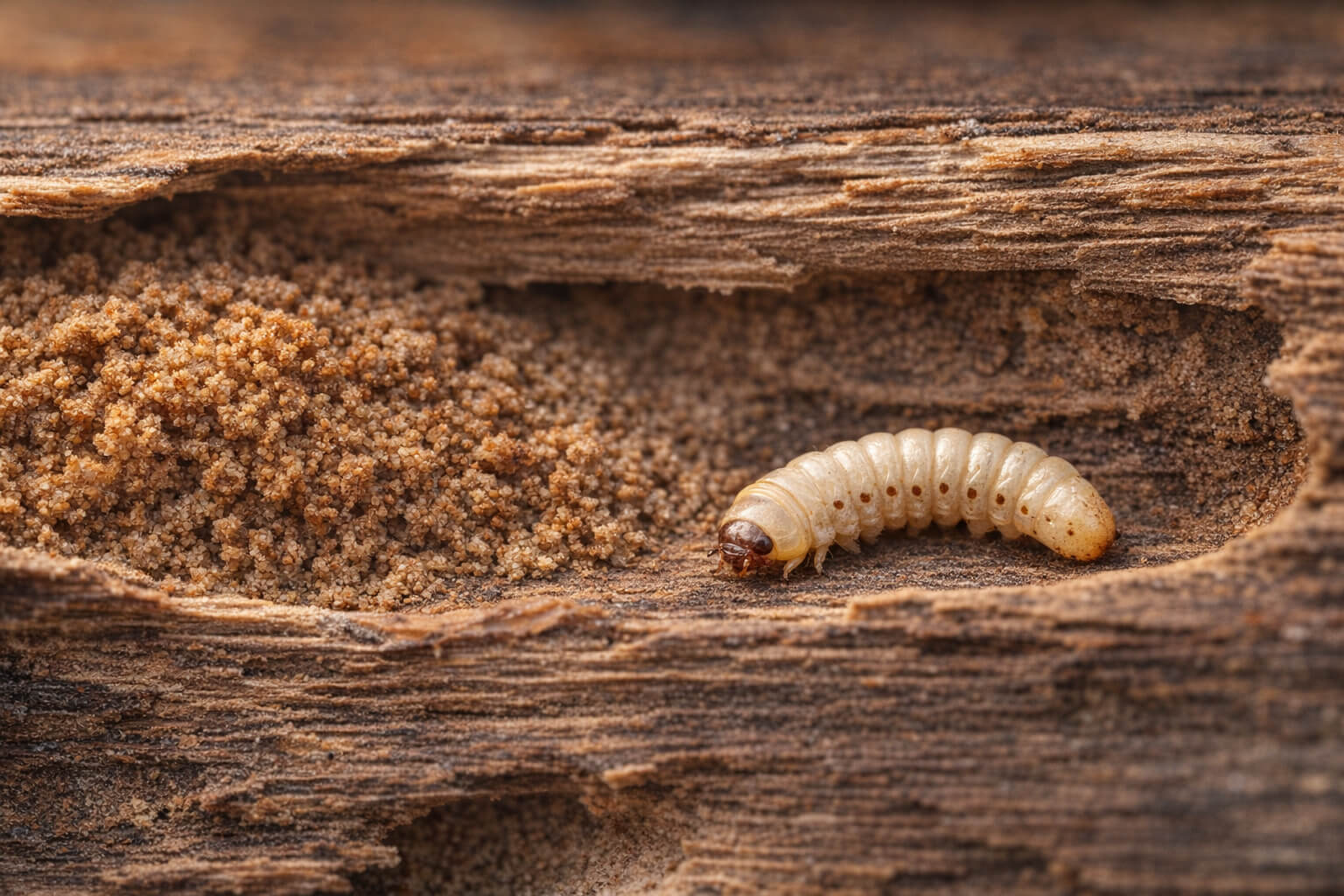
The best clue is not the hole itself but what is happening around it now. Babergh notes that active attack may show as sharp-edged holes and fresh-looking frass, the fine bore dust or pellets left by emerging beetles.[1] If the edges are worn, dusty and clearly aged, the activity may be historic.
Fresh frass suggests recent emergence, but it needs care. Dust can be disturbed by vibration, cleaning or building work. You need to know whether it keeps appearing, whether it sits directly below suspect holes, and whether the timber feels dry and firm or soft and damp.
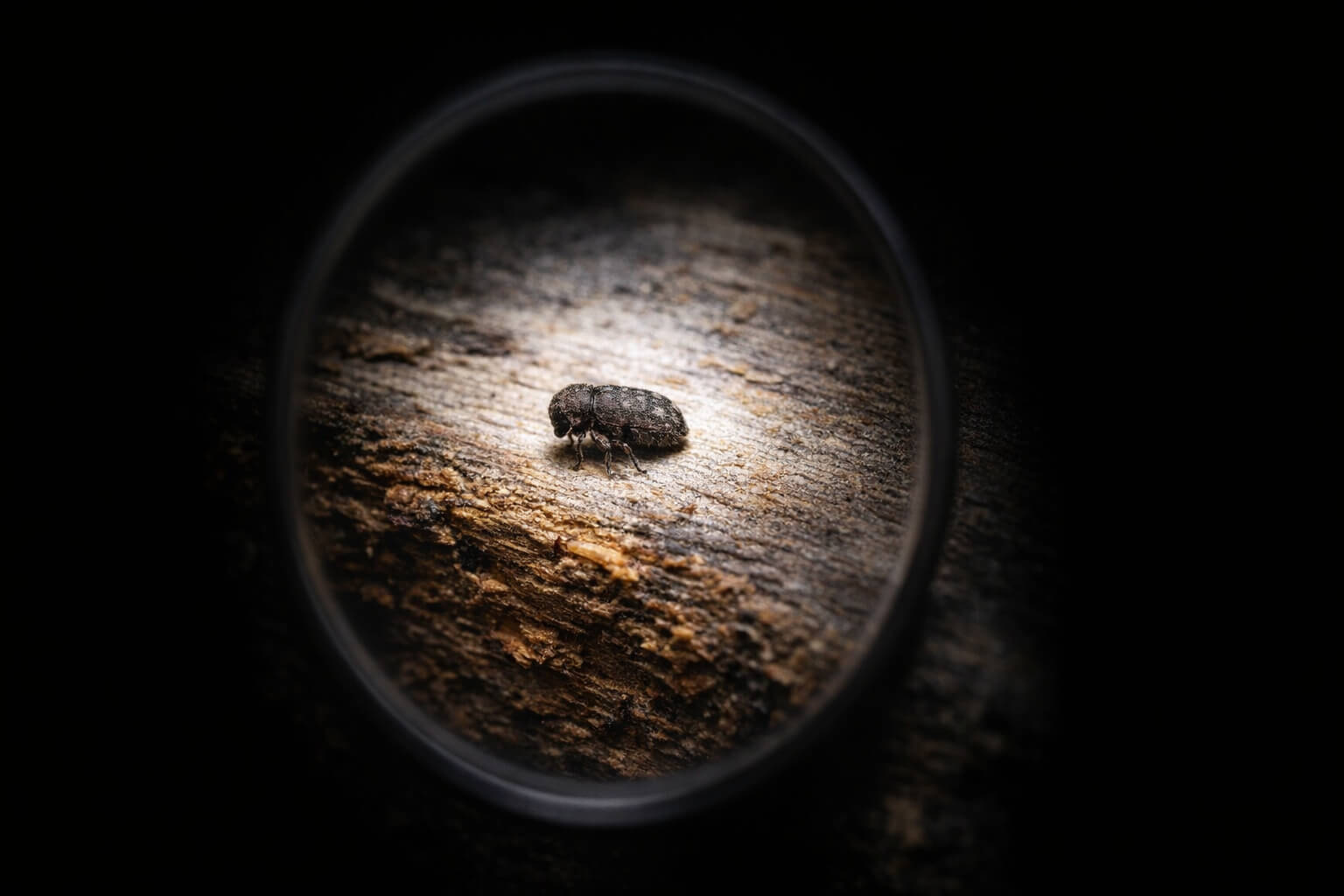
Flight holes also vary by beetle. Common furniture beetle usually leaves smaller round holes. Deathwatch beetle holes are typically larger, around 3mm, and the frass is more pellet-like.[2] If a survey lumps everything together as “woodworm” without identifying the likely beetle, that is not detailed enough for a buying decision.
Why seasonality matters when you are buying
Timing affects how much any survey can prove. Babergh says active outbreaks are often hardest to confirm outside the spring emergence period.[1] If you inspect a house in winter, you may be looking at old holes with no fresh evidence around them. That does not prove safety, but it does lower certainty.
That matters during conveyancing because a cautious report in February may be entirely reasonable. It may be impossible to confirm current emergence until the season changes. That does not make the house a bad purchase, but it does mean you need a specialist to explain what can be concluded now and what remains uncertain.
How woodworm differs from deathwatch beetle
You will often see deathwatch beetle mentioned in period-house discussions because it sounds dramatic. Sometimes it is. Often it is a sign that the building has had prolonged damp and local decay in old hardwood timbers.
Spelthorne distinguishes common furniture beetle from deathwatch beetle by hole size and frass type, which matters because the repair strategy changes with the diagnosis.[2] Deathwatch in historic oak beams deserves more caution than scattered common beetle holes in modern softwood skirtings. It does not always mean catastrophic failure, but it does justify a closer look at moisture, fungal decay and bearing ends.
Old flight holes are not a diagnosis. Activity has to be evidenced, not assumed.
When monitoring is smarter than guessing
If the evidence is unclear, the honest answer is sometimes to monitor rather than speculate. Babergh recommends monitoring where activity cannot be confirmed, rather than treating everything on assumption.[1] In practice, that can mean cleaning beneath suspect areas, laying a simple collection sheet, photographing frass build-up and checking again through the emergence season.
That works best when your survey finds old holes but no fresh dust, no live beetles and no obvious damp source.
During a purchase, though, monitoring has a limit. If the affected area includes hidden joist ends, roof members or historic beams, you may not have the luxury of waiting a year. In that case, your survey needs to move beyond “monitor and see” and tell you what risk you would be accepting if you proceed before certainty is available.
Why Damp and Building Defects Matter More Than the Beetles

Why woodworm is often a symptom of excess moisture
Woodworm is often not the first problem. It is the visible symptom of a building that has been holding too much moisture in its timber.
Babergh states that wood-boring insects are a symptom of excess damp.[1] That is the right lens for a buyer. Beetles do not appear in a vacuum. They thrive where timber has stayed damp enough, for long enough, to become vulnerable. If you only price the insect treatment and ignore the moisture source, you risk buying the cause as well as the symptom.
That is why woodworm so often turns up alongside fungal decay, staining, mould, defective rainwater goods and stale, under-ventilated voids.
The damp sources that should worry you most
The highest-risk moisture sources are the ones that keep feeding structural timber. Start with roof leaks, slipped coverings, failed flashings and overflowing gutters. Cadw’s guidance on historic roofs is blunt: do not wait for a visible leak, because small defects can lead to much larger repair costs if left unchecked.[3]
Then look at condensation. Wealden and East Riding both describe how moisture forms on cold surfaces in poorly ventilated spaces and supports mould growth.[4][5] In houses with cold roof voids, blocked eaves or heavy modern insulation but weak ventilation, loft timbers can sit in damp air for long periods.
Penetrating damp matters too. Manchester’s guidance links it to external defects such as damaged roofs, cracked walls and faulty rainwater goods, often showing as localised damp patches that worsen after rain.[6] If you see woodworm evidence near chimney breasts, gable ends or window heads, look outward as well as inward.
Why roof defects and poor ventilation often sit behind the problem
Roof spaces are classic trouble zones because they combine timber, limited access and hidden moisture. Old underfelt, blocked ventilation paths and small roof defects can create long-term damp conditions above your head without obvious ceiling staining below.
Cadw recommends checking roofs regularly, especially before and after winter and after high winds, because maintaining a sound, watertight roof is fundamental to the building’s health.[3] That is also woodworm prevention advice.
Poor ventilation below suspended timber floors can be just as important. If air bricks are blocked, external ground levels are too high, or voids are full of debris, moisture builds up around joist ends and wall plates. That is where local insect attack becomes a structural issue.
If you only treat the insect and leave the moisture source in place, you have not solved the real problem.
The period-property trap: cement, trapped moisture and poor breathability
Older buildings complicate the picture because modern repairs often trap water where the original structure was meant to breathe. West Suffolk warns that cement render, hard cement plaster, waterproof coatings and concrete floors can reduce evaporation and force moisture to accumulate elsewhere in historic fabric.[7]
That can shift damp into adjoining timbers, especially where beams are built into masonry or where sole plates sit near high external ground levels. West Suffolk also notes that true rising damp is often over-diagnosed in old buildings.[7] If a survey blames everything on rising damp without looking at gutters, roof details, condensation, ventilation and cement-based repairs, you should treat that with caution.
For a period house, breathability is not a heritage buzzword. It is part of how moisture leaves the building. When that balance is upset, woodworm may be one of the warning signs.
What a Woodworm Survey Should Actually Tell You
What a Level 2 survey covers — and what it misses
A standard Home Survey Level 2 is designed to flag issues, not fully diagnose them. It will often note visible beetle holes, damaged timber or signs of damp. That is useful, but it rarely tells you whether the infestation is active, what species is involved, how far the attack extends, or whether structural timbers are affected.
That is where purchases drift into trouble. You receive a cautious line in a survey, the lender asks for more information, and you are suddenly pricing a defect that no one has scoped.
A Level 2 survey also has obvious limits on access. It may not inspect enclosed floor voids, packed eaves, hidden beam ends or heavily boarded loft spaces. If the report mentions restricted access, treat that as a real limitation, not a legal footnote. What cannot be seen can still become your liability after completion.
What to ask for in a specialist timber and damp survey
A specialist survey should answer seven questions clearly.
First, is the infestation active, historic or uncertain? Second, what is the likely beetle type? Third, which timbers are affected? Fourth, is there a moisture source keeping the timber vulnerable? Fifth, is fungal decay present as well? Sixth, is structural repair needed? Seventh, what could not be confirmed because access was limited?
That survey should also link timber findings to the building envelope. Cadw’s roof guidance supports that whole-building approach, because defects in coverings and rainwater disposal often drive the timber problem below.[3] Babergh’s guidance supports monitoring where activity is uncertain rather than defaulting to blanket treatment.[1]
If your property is older, ask whether the surveyor understands conservation repair. Spelthorne’s guidance on timber-framed buildings emphasises retaining sound historic fabric and repairing in situ where possible.[2]
Red flags in survey language
Watch for phrases that sound certain but prove very little.
“Woodworm present” is not enough. Holes may be old.
“Recommend treatment throughout” is weak if no active evidence is recorded.
“Further investigation may be needed” is sometimes fair, but it should say why, where and what the risk is if you proceed without it.
You should also be cautious if the report contains no moisture readings, no discussion of ventilation, no comment on roof defects and no distinction between structural and non-structural timber. A useful survey gives you a buying decision. A vague survey just transfers the uncertainty onto you, and that usually means weaker negotiation and more post-completion risk.
Treatment Options, Costs and What to Expect

Surface spray vs structural intervention
Treatment should match the diagnosis. If the issue is local, active and limited to accessible timber, surface or paste treatment may be enough once the moisture source is corrected. Babergh favours paste over uncontrolled spray treatment in historic buildings and advises limiting treatment to active areas where possible.[1]
If structural timbers are damaged, chemical treatment alone is not a repair. You may need resin repair, timber splicing, local replacement or strengthening. In period houses, that work should preserve as much sound fabric as possible. Spelthorne supports minimum replacement and repair in situ rather than default removal.[2]
Typical cost ranges for common scenarios
Costs vary more by access and timber repair than by the insect itself. As a broad guide, a small local treatment to accessible non-structural timber may run from a few hundred pounds. Whole-loft treatment, if justified, may rise into the low thousands. Once scaffolding, floor lifting, concealed access or structural timber repair enter the picture, the cost can increase sharply.
A single decayed joist end repair is very different from several compromised beam bearings. Likewise, a simple loft treatment is very different from chasing a roof leak, improving ventilation and repairing oak beam ends in a listed house.
That is why you should resist lump-sum assumptions. Ask for the defect to be broken into three parts: moisture correction, timber treatment and timber repair. That gives you a better basis for budgeting and negotiation.
Why environmental control often matters more than chemical treatment
The cheapest long-term result usually comes from changing the timber environment, not saturating the building with chemicals. Lower the moisture, improve ventilation, stop rainwater ingress and remove trapped damp, and the conditions that allowed infestation become far less favourable.
Sound diagnosis beats blanket treatment every time.
This is especially true in older buildings. If damp persists because the roof is failing, the gutters overflow or cement repairs are trapping water, repeat treatment may become a cycle rather than a solution.
“Although the amount of historic timber that one beetle eats is small, over a period of a hundred years that damage begins to look more significant.”
— Diana Davis, Head of Conservation, National Museum of the Royal Navy. (nmrn.org.uk)
How Woodworm Affects Your Mortgage and Insurance

What mortgage lenders typically require
Most lenders do not reject a property simply because woodworm is mentioned. They usually want to know whether the issue is active, whether structural timbers are affected and what remedial work is required before or after completion.
The problem is uncertainty. If your survey says “possible active infestation” or “timber decay suspected” without scope, the lender may ask for a specialist report. That can slow the mortgage offer, but it can also protect you from borrowing against an unknown repair bill.
If the specialist report confirms historic attack only, many lender concerns disappear. If it confirms active infestation with a defined repair schedule, the lender may still proceed once the risk is quantified.
“… insist on a specialist report as a condition of the mortgage.”
— Charles Lewis, chartered surveyor at Fredericks Hearl and Gray. (theguardian.com)
Insurance and guarantee considerations
Buildings insurance is not usually there to fund pre-existing timber defects. If the house already has woodworm and decay before you exchange, you should assume that falls on you unless agreed otherwise in the transaction.
Guarantees matter, but only in context. A treatment guarantee is useful if it is transferable, specific and backed by a firm that still exists. It is less useful if there is no evidence of what was treated, whether the moisture source was fixed, or whether structural repairs were ever carried out.
You should also ask whether past treatment was chemical only or part of a broader damp and timber repair plan. The second answer is usually worth much more than the first.
How a professional report changes the lender conversation
A good report changes the tone from alarm to evidence. Instead of “woodworm noted,” the lender sees “historic infestation only,” or “active local attack in non-structural timbers,” or “repair required to two joist ends with no wider structural spread.”
That level of detail helps everyone. Your broker has something concrete to present. Your lender can assess risk. You can decide whether the house still stacks up financially.
The Renegotiation Playbook: Using Woodworm in Price Discussions

When and how to request a price reduction
You have the strongest case for renegotiation when the defect is active, the repair scope is defined, and the seller marketed the property without reflecting that cost. Your argument should be evidence-led, not dramatic.
Lead with the report findings. Separate treatment, moisture correction and timber repair into clear figures. If the problem is local and manageable, ask for a sensible reduction rather than trying to turn a modest repair into a crisis.
If the issue remains uncertain because access was blocked or structural members could not be checked, your best move may be to pause rather than haggle. Unknown scope is hard to price and easy for a seller to resist. It is also how you end up inheriting a much larger bill than the headline defect suggested.
Getting repair quotes before you negotiate
One quote is better than none. Two quotes are usually better than one. But the value is in the detail, not the number of quotations. You need a breakdown that shows what work is essential now, what work is precautionary and what assumptions were made about hidden areas.
If your house is older or listed, use a contractor who understands conservation repair. A cheap price based on unnecessary strip-out is not a saving if it damages historic timber and creates consent issues later.
What sellers are likely to accept — and what they will push back on
Sellers are more likely to accept a reduction for clear, evidenced repairs than for general worry about woodworm. They will usually push back on vague claims, inflated contingency sums and defects described without proof of activity.
You are in a stronger position if the specialist report links the issue to a defined moisture source and measurable timber repairs. You are in a weaker position if the survey only says “signs of woodworm noted, recommend treatment.”
If you need a clearer basis for your decision, we inspect the timber, trace the moisture source and set out the likely repair path in plain English. You get a firmer footing for negotiation, and you avoid guessing your way into somebody else’s damp problem.
Frequently Asked Questions
How much does woodworm treatment usually cost, and who normally pays when you are buying a house?
Woodworm rarely comes with one neat price because the real cost sits in the surrounding building work, not just in the insect treatment. What you pay depends on access, timber type, moisture conditions, and whether any structural repairs are needed. If the issue is limited to a few accessible non-structural timbers, treatment may stay modest. If your purchase includes hidden joist ends, damp roof timbers, oak beams, floor lifting, scaffolding or local rebuilding, the cost can move far beyond a simple treatment visit.
A practical way to understand the cost is to split it into three parts. The first is diagnosis: survey work, access checks and, sometimes, opening-up. The second is environmental correction: stopping leaks, improving ventilation, reducing condensation or removing trapped moisture. The third is timber work: local treatment, repair, splicing or replacement. That breakdown matters because you can easily focus on the treatment invoice and miss the more expensive part, which is often the building defect that allowed the attack in the first place.
Who pays is a conveyancing question before it is a technical one. Before exchange, almost everything is negotiable. If the defect was unknown to both sides, you may need to absorb some or all of the cost as part of your decision on value. If the seller knew about active infestation, failed repairs or concealed damp-related timber damage and did not disclose it properly, your negotiating position is stronger. If the work is urgent, clearly evidenced and properly priced, you can ask for a reduction, request repairs before completion, or insist that the defect is reflected in the agreed price.
The key is scope. If you know exactly what has to be diagnosed, dried, treated and repaired, you can price the risk rationally. If you only have a vague line in a survey, the money side stays blurred and the argument usually turns against you.
Can a mortgage lender refuse to lend on a house with woodworm?
Yes, a lender can refuse, but the more common outcome is a retention, a condition, or a request for more evidence. The important point is how the lender’s process works once woodworm appears on the valuation. If the valuer flags timber risk but cannot define its extent, the lender may hold back part of the mortgage advance until remedial works are completed and evidenced. That is a retention. In practice, it means your mortgage offer may exist on paper, but the money you need to complete is not fully available until the lender is satisfied.
This usually becomes a paperwork problem as much as a building problem. Your broker will often need to send the lender a specialist timber report, a schedule of remedial works, quotations, and sometimes confirmation that the works have been completed. If the property is older or the affected timbers are structural, the lender may also want clarification from the valuer that the building remains adequate security after the proposed repairs. That is why vague reports cause delays. They leave too many unanswered questions in the file.
Timing varies. A straightforward lender condition may only delay matters by a few working days if the report is clear and access is easy. If the lender asks the original valuer to revisit the case, or if there is disagreement between the valuer and the timber specialist, the delay can stretch much longer. That disagreement matters. A lender tends to follow its own valuer unless the specialist report directly addresses the concerns in language the valuer can rely on. If one report says “historic, local and non-structural” and the other says “active decay risk cannot be ruled out”, the lender will usually side with caution.
If woodworm appears in your survey, tell your broker early, ask what evidence the lender is likely to require, and make sure any specialist report answers the lender’s actual question: not whether holes exist, but whether the property remains sound security for the loan.
What should you do if the seller refuses access for a specialist timber inspection before exchange?
If the seller refuses access for a specialist timber inspection, you should treat that as information in itself. Sometimes the reason is harmless. The seller may be trying to avoid repeated visits, manage tenants, or keep the transaction moving. Sometimes, though, restricted access means you are being asked to commit to a property while a known area of risk remains untested. That shifts the balance of risk strongly onto you.
Your first step is to find out exactly what is being refused. There is a big difference between a seller declining intrusive opening-up and a seller refusing a non-destructive specialist inspection. If you are only asking for a visual timber and damp assessment with moisture testing and accessible inspection, refusal is harder to justify. Ask your conveyancer to raise the request formally through the solicitor channel rather than through the estate agent. That creates a clearer record and often gets a more serious response.
If access still is not granted, you have three realistic choices. You can proceed on the basis of uncertainty and price that risk into your offer. You can pause and insist that the seller provides their own up-to-date specialist report, ideally with photographs, scope limitations and evidence of any past repairs. Or you can walk away if the refused area involves structural timbers, active damp, or anything else that could turn into a major post-completion cost. What you should not do is treat lack of access as a minor inconvenience. In timber cases, hidden areas matter most because beam ends, sub-floor voids and enclosed roof zones are often where the serious defects sit.
If you still want the property, your best protection is to narrow the unknown as far as you can. Ask what was visible to the original surveyor, what was concealed, whether previous timber treatments were carried out, and whether any guarantees, invoices or repair records exist. If the seller wants you to proceed without access, you should assume that the uncertainty has value and price it accordingly.
What happens if the woodworm survey finds deathwatch beetle rather than common furniture beetle?
Deathwatch beetle is a more serious finding than common furniture beetle, but it does not automatically make the property unbuyable. What it does mean is that your investigation needs to go deeper and your repair assumptions need to become more cautious. With common furniture beetle, the issue is often localised to sapwood in softwoods and secondary timbers. With deathwatch, you are usually dealing with old hardwoods, longer-term moisture exposure and a stronger link to concealed structural locations.
That matters because deathwatch risk is rarely just about what you can see on the beam face. It tends to concentrate where timber stays damp and cannot dry properly, such as bearing ends built into masonry, enclosed beam sockets, old roof junctions and historically patched repairs. Those are exactly the places where strength matters most and where visual inspection can tell you the least. If your survey identifies deathwatch, the question is not simply “How many holes are there?” but “Which timbers are affected, where are the vulnerable ends, and how much sound core remains?”
Moisture history also changes the buying picture. Deathwatch usually points to a building that has had a prolonged moisture problem rather than a short, isolated defect. That may involve old leaks, trapped damp around lime-poor or cement-rich repairs, poor roof ventilation, or a combination of decay and insect attack acting together. If you only budget for treatment, you will almost certainly under-budget for the real scope.
There is also a conservation angle. If the affected timbers are original oak members in a listed or heritage building, repair choices become more controlled and more specialised. You may be looking at resin repair, splicing, local consolidation or carefully detailed replacement rather than routine strip-out. That can affect cost, timescale and consent requirements. If deathwatch appears in a purchase report, you need a repair strategy that is structural, moisture-led and conservation-aware, not just chemical.
Can woodworm come back after treatment, and how do you protect the property long-term?
Yes, woodworm can return after treatment, but repeat infestation usually tells you more about the building than about the chemical used. If the timber remains damp enough, new beetles can lay eggs again, even after earlier treatment. The real long-term question is whether your building stays dry, ventilated and stable once the initial work is finished.
Protection starts with knowing where to keep watching. Vulnerable areas are not just the timbers that were treated. They are also the adjacent untreated timbers that share the same environment: joist ends near external walls, roof members beside old valleys or chimney junctions, understairs voids, sub-floor timbers near blocked air bricks, and enclosed joinery in colder rooms. If one timber had the right conditions for infestation, the neighbouring timbers may have been close behind. That is why follow-up checking matters.
Seasonality matters as well. Spring and early summer are the most useful times to look for new emergence evidence. Autumn and winter are the most useful times to watch the moisture conditions that create future risk. After heavy rain, roof leaks and rainwater overflow show themselves more clearly. During colder months, condensation risk in lofts, corners and under-heated rooms becomes easier to spot. A sensible routine is to recheck susceptible areas at least seasonally for the first year after purchase, then as part of ongoing maintenance.
You should also think about how repairs alter airflow. New insulation, stored belongings in a loft, sealed fireplaces, covered air bricks and fitted cupboards against cold walls can all change how moisture behaves. Sometimes the building becomes more vulnerable after improvement works, not less, because drying pathways were reduced.
The safest mindset is this: treatment ends the immediate infestation, but maintenance prevents the next one. If fresh dust reappears, timber starts feeling softer, or a previously dry area becomes damp, treat that as a building warning sign rather than waiting for the insect evidence to build up again.
What do you do if a surveyor and a timber specialist disagree about how serious the woodworm is?
If a surveyor and a timber specialist disagree, do not pick the answer you like best. Work out why they disagree. In most cases, the conflict comes from scope, access or professional focus rather than from one of them being plainly wrong. A building surveyor may have seen only the accessible surfaces and flagged risk conservatively. A timber specialist may have inspected more closely but focused only on the affected timbers and not the wider structure. Those are different lenses, and they can produce different language.
Start by comparing the reports line by line. Are they describing the same timbers? Were they inspecting at the same time of year? Did one report rely on visible holes while the other included moisture testing, probing, or limited opening-up? Did one refer to structural significance and the other to infestation activity only? Often the apparent disagreement is really a mismatch in what each report was trying to answer. One may be saying, “I cannot rule out a serious issue.” The other may be saying, “I found no active evidence in the exposed timber.” Both statements can be true at the same time.
If the conflict affects your purchase decision, go back with focused questions rather than asking for broad reassurance. Ask each professional whether the affected timbers are structural, whether hidden ends remain unverified, whether moisture is still present, and what additional inspection would resolve the uncertainty. If one report recommends opening-up and the other does not, ask what exact risk the opening-up is meant to clarify. That helps you decide whether the extra investigation is proportionate.
You should also keep your conveyancer and broker aligned. Conflicting reports can derail both negotiation and mortgage progress if they circulate without explanation. What you need is not two competing opinions, but one reconciled position on risk, scope and next steps. If the disagreement cannot be narrowed, treat that unresolved conflict as part of the defect itself and make your decision on that basis.

