
 By
 April 7, 2026


Why rising damp makes ground-floor timbers the first place deathwatch beetle risk builds
Your ground-floor timbers face the highest deathwatch risk because rising damp affects the lowest masonry first, exactly where hidden structural timber sits.
Rising damp is a moisture route through porous masonry. Deathwatch beetle is a timber pest linked with old, damp, vulnerable hardwood. Ground-floor structural timbers sit where those two conditions meet. Joist ends, wall plates, soleplates and other low-level bearings are closest to ground moisture, often partly enclosed by masonry, and much slower to dry than visible timber higher in the building. That makes the ground floor more than just the bottom of the house. It is the part of the structure where damp can persist and timber can quietly become suitable for infestation, as New Forest National Park’s historic flooring guide makes clear.
A long-standing conservation principle captures the stakes neatly.
“Dampness promotes timber decay, the corrosion of metals and even structural collapse.” — Douglas Kent, Director of Technical & Research, SPAB SPAB: Control of Dampness technical guidance
That is why the risk is often hidden at first. Your floor surface may seem sound, while the trouble is building at the edges, in wall pockets, or beside sleeper walls where air movement is poor. Once rising damp or damp accumulation affects those areas, the timber nearest the wall faces the longest moisture exposure. In older houses, especially period and heritage properties, those timbers may also be original hardwoods, which is where deathwatch beetle becomes more relevant than generic woodworm advice suggests, a relationship explored in the PubMed study on deathwatch beetle host selection.
In Sussex, the pattern is easy to miss because many older homes carry layered alterations: raised paths, hard finishes over breathable materials, blocked air bricks and long-standing damp at wall bases. The ground floor becomes the first place rising damp influences the timber structure, and the first place deathwatch risk can take hold if nothing interrupts that chain. Poor sub-floor airflow can intensify that risk by slowing evaporation and prolonging damp conditions.
How rising damp reaches the ground-floor timbers deathwatch beetle prefers

Rising damp becomes a timber-risk problem when moisture in the wall base reaches low-level structural timbers that are hidden, cool and slow to dry.
Rising damp does not drench timber in the way a leak might soak a beam. Instead, moisture moves up through porous masonry by capillary action and accumulates at the base of walls and floor edges. If the building lacks an effective damp-proof course, if the DPC is bridged, or if outside levels have crept too high, the wall base can remain persistently damp. Any timber bearing into or sitting close to that masonry is then exposed to a moisture environment it was never meant to tolerate.
Ground-floor timbers are especially exposed because they are physically closest to the source. A first-floor joist is remote from the earth. A roof timber is higher, warmer and better ventilated. A ground-floor joist end or wall plate may sit in a cool masonry pocket, behind skirtings, or beside a wall base where evaporation is poor. That is why rising damp often becomes a timber problem at low level before it appears elsewhere in the structure, a point reflected in Spelthorne’s timber-framed buildings advisory leaflet.
How wall bases transfer damp risk into joist ends and plates
The most vulnerable point is the junction between damp masonry and embedded timber, because that is where moisture lingers and bearings lose resilience.
A joist end built into a wall does not dry like the rest of the joist. The visible span is exposed to room air. The hidden end sits in a darker, cooler pocket where damp masonry slows drying and encourages long-term moisture retention. The same principle applies to wall plates and soleplates at the base of old walls. If rising damp affects that wall base, the timber nearest it becomes the first part of the floor structure to move into a beetle-friendly condition.
Why poor sub-floor ventilation magnifies rising damp risk
Blocked air bricks and stale under-floor air do not create rising damp, but they stop ground-floor timber from recovering from it.
A suspended timber floor depends on airflow beneath it. If vents are blocked by paving, flower beds, render, debris or later alterations, moisture stays trapped in the void for longer. Damp wall bases stay damp. Sleeper walls stay cool. Timber bearings lose the chance to dry between wet periods. Then the ground floor becomes the most vulnerable part of the building because the building can no longer disperse moisture, as Communities NI’s ventilation technical note explains.
| Moisture route | Why it raises deathwatch risk at ground floor | What to inspect first |
|---|---|---|
| Rising damp in wall base | Keeps adjacent joist ends and plates damp for extended periods | Base of walls, damp line, salts, bearing points |
| Bridged or absent DPC | Allows low-level masonry to stay wetter than intended | External levels, render, paving, plinth detail |
| Buried or blocked air bricks | Prevents the floor void from drying out | Vent openings, sleeper-wall airflow, debris |
| Raised paths or flower beds | Increases moisture loading against low walls | Ground-to-wall height, vent clearance |
| Impermeable finishes | Trap damp at the timber-masonry junction | Cement render, hard pointing, sealed skirtings |
If you lift a floorboard near an external wall and the timber is darker at the edge than it is across the room, that is often the first sign that the ground floor is living in a different moisture pattern from the rest of the house.
How rising damp makes ground-floor timber conditions suitable for deathwatch beetle
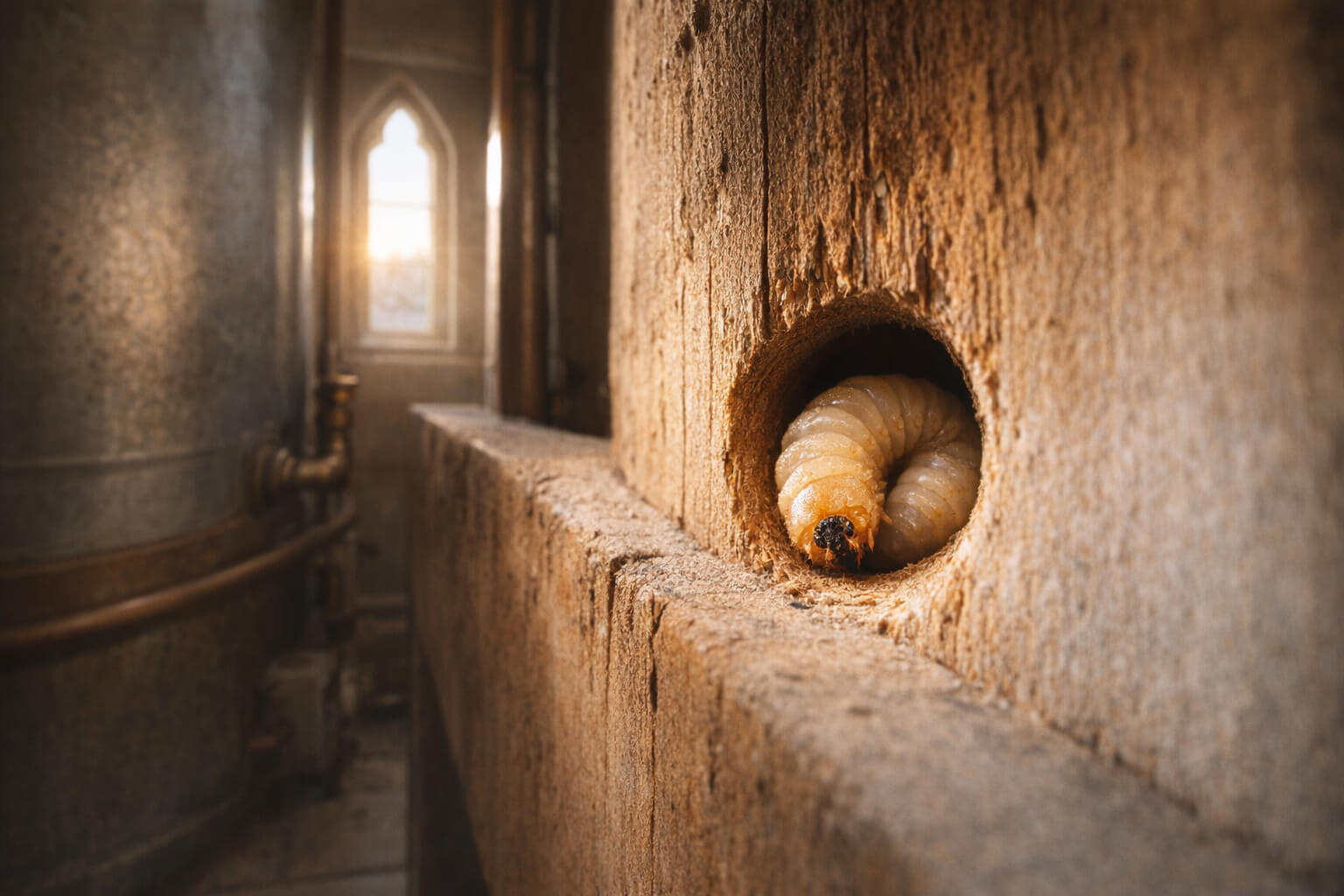
Ground-floor timber becomes attractive to deathwatch beetle when rising damp keeps it damp for long enough to alter the wood itself.
This is the link many articles blur. Deathwatch beetle does not usually start with clean, dry, healthy hardwood. It is associated with older timber already changed by damp conditions. At ground-floor level, rising damp is one of the main reasons that change can happen. The lowest masonry stays wetter. The adjacent timber stays cooler and damper. Over time, that timber loses some of its natural resistance and becomes far more vulnerable than the dry span you can see from above.
A practical account from a Sussex owner shows how quietly that change can reveal itself.
“We only lifted one board because the floor felt slightly springy, and that was where we found the joist end dark, soft and full of old holes.” — A period-property owner, East Sussex
You can often spot that shift before any obvious failure. The timber may feel softer at the bearing than along the middle. A surface that should feel hard may feel fibrous or friable instead. You press a screwdriver into a joist end beside the wall and it sinks farther than expected, while the rest of the joist still feels firm. That contrast tells you the ground-floor bearing has been living in sustained damp, not just a brief wet spell.
The moisture thresholds that separate low risk from high risk
Timber that stays dry is a poor host for decay and beetle activity; timber that stays damp moves into a very different risk category.
As a practical guide, timber below about 20% moisture content is generally considered unlikely to support decay fungi, while sustained moisture contents above that level increase concern. Once moisture rises into the high twenties, conditions associated with active decay become much more realistic. Some heritage guidance also notes that beetles can breed at relatively modest timber moisture levels, which is a useful reminder that ground-floor timbers do not need to look saturated to become biologically vulnerable.
That is why the ground floor needs close attention. Rising damp may look modest, yet still hold a timber bearing within the range where vulnerability increases year after year. If that persists in an old hardwood joist end or wall plate, the question is no longer just whether the wall is damp. It is whether the timber at the lowest level has become the sort of host deathwatch beetle exploits.
Why deathwatch beetle risk concentrates in the same ground-floor timbers rising damp has already weakened

Deathwatch beetle risk is highest where rising damp has already turned hidden ground-floor hardwood into a more suitable breeding environment.
The insect is not spread randomly through a building. It is far more likely to become established where long-term dampness has already affected timber quality, especially in older hardwood members. Research on Xestobium rufovillosum supports the link between the beetle and fungus-affected timber, and conservation guidance repeatedly ties deathwatch activity to damp or water-damaged hardwood. In an older building, the ground floor is where those conditions most often overlap because rising damp acts there first and the structural bearings are most concealed.
A specialist conservation view makes that dependency explicit.
“For the larvae to flourish, the heartwood is usually required to have been modified by fungal decay, making the timber more palatable.” — Robert Demaus, Partner, The Demaus Partnership Building Conservation Directory: Deathwatch beetle
What deathwatch beetle needs from a ground-floor host timber
The larvae need more than timber; they need wood that dampness has already made easier to feed on.
That is why original oak bearings can remain untouched in one area but vulnerable in another. Sound, dry oak has natural durability. Oak that has stayed damp against masonry for years is different in practical terms. Once its structure has altered, it becomes more attractive and more workable for the beetle’s life cycle. That is why deep old timbers and concealed bearings deserve careful attention: they can look substantial while long-standing damage is concentrated exactly where you cannot see it.
How to tell whether holes in ground-floor timber indicate current deathwatch risk
Old holes show past emergence, not automatic proof that rising damp is still supporting a live infestation now.
This distinction matters because period properties often contain historic insect marks that are no longer active. Standard deathwatch guidance advises looking for fresh frass, fresh-edged emergence holes and adult beetles in spring or early summer rather than assuming all holes are current. Deathwatch frass is also more pellet-like than the finer dust associated with some other insects. If your ground-floor timber is dry, no fresh material is present, and the holes are dark and worn, you may be looking at an old episode rather than an active one.
If, by contrast, you have fresh frass below a damp joist end, newer-looking holes and persistent low-level moisture near the wall base, the picture changes fast. Rising damp and deathwatch beetle are no longer adjacent issues. They are parts of the same ground-floor timber problem.
What a proper survey for rising damp and deathwatch beetle in ground-floor timbers should cover

A proper survey should confirm whether rising damp is present, whether ground-floor timbers are affected, and whether any deathwatch evidence is active or historic.
The inspection has to follow the route of risk, not just the visible symptom. First, the wall base and floor perimeter need checking for moisture patterns consistent with rising damp or damp accumulation. Then the survey should examine the low-level structural timbers most likely to be affected: joist ends, wall plates, soleplates and any timber near sleeper walls or external masonry. The aim is to establish whether the ground floor is genuinely the highest-risk zone in your building, and exactly which members are involved.
That method is most reliable when it starts with moisture rather than with the holes.
“We start with the moisture route, the wall base and the floor void, because if those stay damp, the same ground-floor timbers stay at risk.” — Our senior surveyor, Sussex Damp Experts
A useful survey also separates three questions that are often muddled together. Is the masonry damp? Is the timber weakened? Is the beetle evidence current? Those questions are related, but not identical. If you notice fine dust beneath a beam or skirting, it may be fresh frass, old debris shaken loose by movement, or simple disturbance dust. Only close inspection of moisture, timber condition and emergence evidence can tell you which.
Ventilation checks belong in the same process. The survey should look at air-brick clearance, cross-ventilation below the floor, external ground levels and later works that may have trapped damp at low level. In listed and period buildings, that context matters even more because inappropriate repairs can worsen the same ground-floor conditions that make deathwatch risk more likely.
Treating rising damp first — why ground-floor timber repairs fail if the damp source remains

You have to tackle rising damp and the low-level moisture burden first, or the same ground-floor timbers will stay at risk.
This is where expensive mistakes begin. If a joist end is repaired but the wall pocket remains damp, the replacement timber goes back into the same hostile environment. If insecticide is applied but the masonry and floor void stay wet, the condition that made the timber vulnerable remains in place. Ground-floor timber risk is controlled by changing the environment at the base of the building, not by treating one visible symptom in isolation, as Cotswold District Council’s fungal and insect attack guidance advises.
That means checking for bridged DPCs, high external levels, trapped moisture at floor edges, blocked vents and impermeable repairs that are slowing evaporation. Only when the damp source is reduced does it make sense to decide how much timber repair is necessary. Some joist ends may need local repair or support. Some wall plates may be partly retained if sound material remains. In heritage work, that approach is often preferable because it protects original fabric rather than replacing it by default.
Treatment for deathwatch beetle then becomes selective, not automatic. If the timber is dry and the evidence is historic, monitoring may be enough. If there is clear current activity, the order still matters: moisture first, environment second, timber stability third, insect-specific action after that. Otherwise the ground-floor risk simply recreates itself.
When to act on rising damp and deathwatch beetle risk in ground-floor timbers

You should act when rising damp, low-level timber change and possible beetle evidence appear together, because that combination makes the ground floor the highest-risk part of the building.
The clearest triggers are grouped ones, not single symptoms on their own. A damp wall base, a blocked or buried air brick, a soft joist end, a springy floor edge, fresh frass, fresh-edged holes or visible timber deterioration near a wall bearing all justify a closer look. A property sale is another sensible moment to act, because survey wording around rising damp and timber beetle can become costly if nobody identifies whether the risk is active, historic or localised.
If you own a period or listed property, earlier action is usually safer. Ground-floor timbers are often hidden, original and structurally important, so delay tends to narrow your repair options rather than improve them. The best time to intervene is while the problem is still concentrated at low level and before widespread section loss develops.
If you need a clear answer on whether rising damp is putting your ground-floor timbers at increased deathwatch risk, Sussex Damp Experts can assess the damp route, the floor void and the structural timber together. We focus on the lowest part of the building first, because that is where this problem usually begins and where the right diagnosis makes the biggest difference.
Frequently Asked Questions
How quickly can deathwatch beetle establish after rising damp begins?
You should think in years rather than weeks. Rising damp can start affecting low-level timber long before you see obvious damage, and deathwatch beetle usually becomes a realistic risk only after timber has stayed damp for long enough to become biologically altered. That means the danger often develops quietly, then appears to arrive “all at once” when holes, frass or softness finally become visible.
The timeline depends on three things: how persistent the moisture is, what timber species is present, and how enclosed the affected area is. A joist end in a cool wall pocket can remain damp through multiple seasons with very little outward warning. If the moisture source is intermittent and the timber dries properly between wet periods, the risk develops more slowly. If the wall base stays damp all year, the process accelerates. That is one reason buyers are sometimes surprised by adverse survey findings in houses that felt perfectly normal to live in.
A useful comparison is this. If your property has had a relatively recent damp event, such as a failed DPC detail or a change in outside ground level over the last year or two, the immediate concern is usually timber vulnerability rather than an advanced beetle life cycle. You may have time to investigate and correct the moisture route before serious insect pressure develops. By contrast, if a sale survey uncovers decades of low-level damp along a perimeter floor edge in an older house, the risk profile changes. In that scenario, the timber may have spent many seasons in the wrong moisture range, which makes historic infestation, current activity, or section loss much more plausible.
A better urgency question is not “How long have the beetles been there?” but “How long has the timber been living in the wrong environment?” By the time you see exit holes, the underlying damp condition may already be well established. That does not always mean severe structural loss, but it does mean delay is rarely neutral.
Practical urgency guide
| Situation | Likely urgency |
|---|---|
| Historic holes, dry timber, no fresh signs | Monitor and verify |
| Damp timber, no insect evidence yet | Investigate soon |
| Damp timber plus fresh frass or new holes | Prioritise survey |
| Springy floor edge or soft bearing | Prompt inspection |
If you already know you have rising damp at the base of external walls, it is sensible to treat ground-floor timber inspection as an early follow-up task, not something to leave until visible damage forces the issue.
Will insurance cover damage, and do you need listed building consent for repairs?
You should not assume either insurance cover or straightforward repair consent. Deathwatch beetle and damp-related timber decay often sit in a difficult category: insurers may regard them as maintenance-related rather than sudden accidental damage, while listed buildings may require consent for repairs that alter historic fabric or traditional details.
Insurance usually turns on cause, wording and evidence. If you are dealing with long-term damp, gradual deterioration or historic infestation, many policies will limit or exclude cover. If a claim follows a sudden insured event, such as escape of water that created acute timber damage, the position can be different. The problem is that many owners only check the policy after a survey has flagged timber concerns. By then, the key question becomes whether the loss is considered gradual, foreseeable or preventable.
Listed buildings add another layer. You may need consent if repairs affect original joists, floorboards, wall finishes, ventilation details, or the way timber is built into masonry. Even where consent is not formally required, conservation officers often expect like-for-like repair, minimal loss of historic material, and moisture control methods that do not create new problems elsewhere. Replacing whole runs of timber, inserting modern membranes, altering air-brick layouts or hacking off historic plaster can all raise heritage concerns.
Before you commit to works, check:
– Your buildings insurance policy wording on rot, insects and gradual deterioration
– Whether your property is listed or in a conservation-sensitive setting
– Whether the proposed repair changes original fabric or ventilation detail
– Whether your survey report clearly distinguishes active risk from historic evidence
If your house is listed, the safest route is to confirm the repair strategy before works begin. If your insurer is involved, keep dated photos, survey findings and moisture evidence together from the start.
What signs can you spot yourself before booking a professional survey?
You can carry out a useful first check yourself, but it should be a decision guide rather than a DIY diagnosis. The aim is to work out whether the situation is calm enough to monitor, or whether the pattern you are seeing is enough to justify a booked survey.
Start with timing. Spring is often the most informative period for insect-related observations because adult emergence is more likely to be noticed then, while winter and late autumn can be better for spotting persistent dampness, poor drying, and condensation in less-used rooms. If you only ever look during a hot dry spell, you may miss the conditions that make the ground floor vulnerable. A simple torch-and-mirror check around accessible vents, floor edges, understairs voids or cellar-adjacent spaces can tell you whether there are obvious warning patterns such as blocked airflow, stale damp air, loose debris build-up, recurring low-level decoration failure, or signs that a previous repair has trapped moisture.
What a visual check cannot do well is measure moisture accurately inside timber, distinguish old insect evidence from current activity with confidence, or assess concealed bearings inside masonry. That is where a professional survey changes the picture. We can test moisture, inspect sub-floor conditions in context, and separate one-off observations from a linked damp-and-timber problem. A homeowner inspection is good at spotting inconsistency. A professional inspection is good at explaining it.
Safe access matters. Looking at clear air bricks, accessible hatch openings, perimeter skirtings, cellar edges and visible floorboard lines is sensible. Forcing floorboards, probing concealed timbers, removing finishes in a listed building, or pushing tools into suspect areas is not. Those actions can damage evidence, disturb fragile material, or create avoidable consent issues.
Escalate from visual check to booked survey if you notice:
– The same low-level issue recurring through more than one season
– A property sale or purchase is underway
– Multiple warning signs cluster in one room or wall line
– Access is limited and the most important timber is concealed
– You are unsure whether earlier repairs changed ventilation or moisture movement
If your check leaves you with more questions than answers, that is usually the point to stop looking and start documenting.
Are upper floors ever at risk, or is this only a ground-floor problem?
Upper floors can be at risk, but when they are, the survey logic changes. The claim that ground-floor timbers are at highest risk applies specifically to rising damp. If you are finding timber problems higher in the building, you need to test a different moisture route rather than stretching the ground-floor explanation too far.
The most important exceptions sit around masonry features that behave differently from ordinary external walls. Chimney breasts are a common one. They can carry moisture from defective flashings, failed flaunching, disused flues, sulphate staining or long-term condensation inside blocked stacks. Timber ends built into chimney masonry can then deteriorate in a way that looks superficially similar to low-level damp damage but has a completely different cause. Parapet walls are another risk zone. They are heavily exposed to weather, often poorly detailed at the top, and can feed moisture sideways into embedded timber. Internal masonry stacks and party walls can also cause surprises if historic leaks, salts, cement repairs or trapped moisture have altered how they behave.
This matters during diagnosis. If beetle evidence appears in an upper-floor beam end, a good survey does not begin with “Is this rising damp?” It begins with “What moisture route makes sense at this height?” That may mean looking at roof coverings, gutter joints, chimney heads, flashings, hidden plumbing, insulation changes or condensation patterns in closed voids. In other words, the investigation becomes more local and defect-specific.
Upper-floor exceptions worth checking
– Chimney breast beam ends
– Parapet-adjacent joists
– Roof-space timbers near eaves
– Party-wall or stack bearings
– Timber near bathrooms or old plumbing runs
What changes in the survey approach
| Ground-floor suspicion | Upper-floor suspicion |
|—|—|
| Focus on wall base and sub-floor | Focus on local defect source |
| Check air bricks and ground levels | Check roof, flashings, stacks, pipes |
| Test low-level masonry moisture | Test localised moisture pattern |
| Expect concealed joist-end risk | Expect defect-specific damage zone |
So yes, upper floors can be affected. The key is not to mislabel that risk as rising damp when the building is pointing you toward a different moisture problem entirely.
When is the best time of year to survey or treat deathwatch beetle risk?
You can inspect for damp-related timber risk at any time of year, but spring and early summer are often the most revealing months for deathwatch beetle activity. That is when adult emergence is most likely to be noticed, which helps distinguish historic evidence from a current life cycle. Moisture patterns, however, can show themselves best in colder or wetter periods when the building is under more stress.
That means the “best” timing depends on your question. If you want to know whether low-level timber is damp, late autumn and winter can be useful because outside moisture loads are higher and ventilation weaknesses often show up more clearly. If you want the best chance of confirming active beetle emergence, spring is usually more informative. If you are buying or selling, you may not have the luxury of waiting for the ideal season, so the survey has to work with the conditions available.
A common real-world example is a winter mortgage survey that flags damp and possible timber risk in a period house. Winter is often an excellent time to see whether the wall base and floor void are struggling to dry, but it may be too early to confirm whether beetle emergence will occur in the coming season. In that case, the best approach is not to postpone everything. It is to diagnose the moisture route immediately, then decide whether a spring reinspection is needed to confirm biological activity. That phased approach gives you better evidence without wasting months.
Treatment timing also matters. There is little value in carrying out insect-focused work if the timber is still in a damp environment that will continue to support vulnerability. In practice, moisture diagnosis usually comes first, and any further treatment decisions follow from that. For some buildings, phased work is the sensible answer: confirm the moisture source in winter, correct ventilation and wall-base issues, then review timber condition again in spring.
Seasonal guide
– Winter: good for seeing damp stress and poor drying
– Spring: best chance of spotting fresh beetle emergence
– Summer: useful for reassessing how far timber dries
– Autumn: helpful for checking external maintenance before wet weather
If timing is flexible, aim to inspect moisture first and biological activity second. If timing is not flexible, a good survey should still tell you what can be confirmed now and what needs seasonal review.
How disruptive is a proper ground-floor timber survey in an occupied home?
A proper ground-floor timber survey is usually less disruptive than you may fear, but more involved than a quick visual visit. In most occupied homes, the work is selective rather than wholesale. The aim is to inspect the right places with the least opening-up needed to answer the key questions about moisture, timber condition and access.
In a straightforward house, the survey may begin with external checks, air-brick inspection, moisture assessment at wall bases, and a look at any accessible voids such as cellars, understairs areas or existing floor hatches. If access below the floor already exists, disruption can be modest. If it does not, one or two carefully chosen floorboards may need to be lifted in locations that are most likely to reveal the timber condition. That is very different from stripping an entire room. In furnished homes, the main disruption often comes from moving rugs, light furniture or stored items away from perimeter areas so the right spots can be reached safely.
Listed and period buildings can need a more cautious approach. Floorboards may be fragile, fixed in unusual ways, or significant in their own right. Decorative finishes may also limit where inspection is sensible. In those settings, a good survey is often slower and more conservative, because protecting fabric matters as much as answering the moisture question. If you are living in the property, dust control, careful lifting and clear reinstatement plans make a big difference.
What to expect on the day
– External inspection first
– Internal moisture and floor-edge checks
– Targeted access to voids or selected boards if needed
– Photos and notes of any exposed areas
– Reinstatement or temporary safe covering where agreed
What helps you prepare
| Helpful step | Why it matters |
|—|—|
| Clear floor edges and air bricks | Saves time and improves access |
| Flag past repairs or previous damp work | Gives the survey context |
| Confirm listed status before invasive work | Avoids inappropriate opening-up |
If you know the survey may involve limited lifting, plan for inconvenience rather than upheaval. In most cases, the purpose is precision, not disruption.

