
 By
By  October 15, 2023

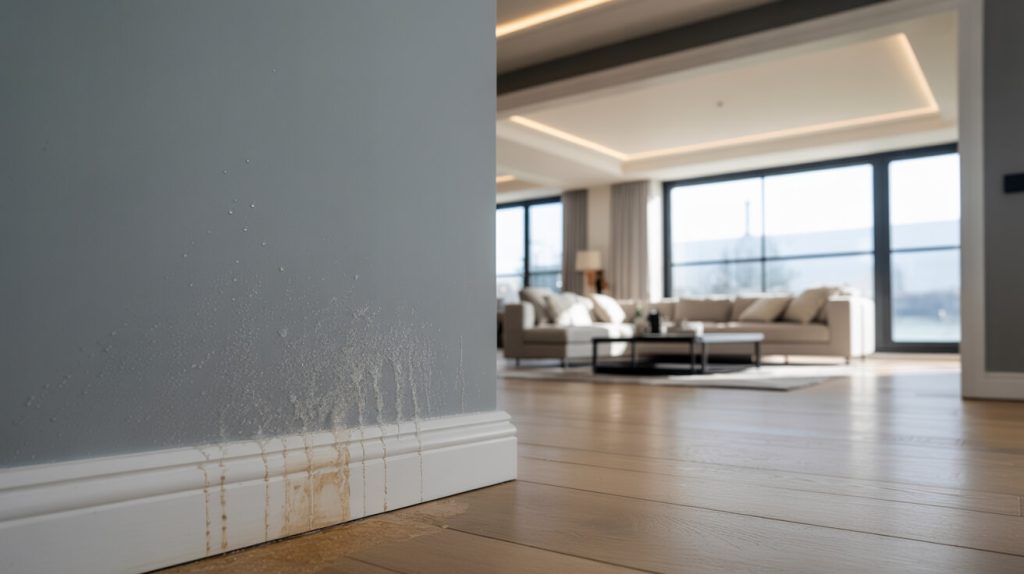
Recognising the Warning Signs
Identifying mushroom growth inside a property is not a curiosity—it’s a direct sign of systemic moisture imbalance and impending risk to your home, your business, or your reputation as a professional. Unlike surface-level damp, fungi mark prolonged, underlying moisture problems primed to accelerate both health and structural decline.
What Should Trigger Concern?
- Visible Outgrowth: Any mushroom, cluster, or mycelial web on walls, floors, or hidden voids demands immediate investigation.
- Persistent Odours and Damp: A musty environment hints at unchecked moisture, saturating construction materials, feeding spores, and setting the stage for colonies.
- Secondary Cues: Peeling paint, rotting timber, unexplained condensation, or repeated salt staining.
Ignored warning signs invite tomorrow’s renovation regret.
Proactive Detection—The Asset Owner’s Advantage
Years of cross-industry inspection data show that timely diagnosis prevents spiralling repairs and insulates property valuations against devaluation. If signs emerge, even in areas you rarely use—under stairs, behind units—thorough professional damp mapping should follow.
A single overlooked mushroom could prove decisive during your next mortgage survey or tenant audit. Securing a qualified inspection now will insulate your risk and position you as a proactive stakeholder in your asset or community.
What Causes Fungal Outbreaks Indoors and Why Do They Persist?
Damp Diagnosis Quiz
- 1 Location
- 2 Appearance
- 3 Timing
- 4 Pattern
- 5 Results
Most Likely Diagnosis
—
—
What Is This?
—
Recommended Next Steps
Confidence Breakdown
This quiz provides general guidance only. A professional survey identifies the exact cause and recommends the right treatment.
Book a Professional Diagnosis →Indoor fungi are opportunists, exploiting weaknesses in buildings where moisture and organic material remain unchecked. The root causes are rarely random, and they defy removal until every pathway is mapped and sealed.
The Typical Triggers and Why Standard Solutions Fail
- Chronic Leaks: From roof, plumbing, or unsealed flashings—especially pernicious in older stock or complex buildings.
- Failed Ventilation: Lack of air exchange in bathrooms, kitchens, cellars, or voids creates persistent humidity.
- DPC Compromise: Bridged or missing damp-proof courses allow ground moisture to ascend into vulnerable fabric.
- Substrate Vulnerability: When porous construction meets modern impermeable finishes, moisture becomes trapped—nourishing fungi for months unseen.
| Cause | Residue Symptom | Missed By DIY? | Common Location |
|---|---|---|---|
| Plumbing leak | Peeling, warp, fungi | Often | Bathrooms, kitchens |
| Blocked gutter | Salt stain, rot | Yes | Perimeter, attic |
| No airflow | Condensate, off-odour | Almost always | Internal voids |
| Bridged DPC | Efflorescence, fungi | Yes | Ground floor, walls |
Resilience Requires Root-Cause Correction
Applying off-the-shelf fungicides or repainting is akin to removing the thermometer during a fever. Only forensic-level moisture tracing halts the cycle of decay, especially in heritage assets where invasive interventions carry long-term risk.
Our thorough moisture surveys outmatch guesswork, saving clients money, safeguarding reputation, and earning compliance ticks from the first appointment.
Why Does Indoor Mushroom Growth Pose Legal, Financial, and Health Risks?

Fungal infestations are not legally ambiguous nor economically trivial; the moment mushrooms appear, you step into a zone of increased compliance exposure and asset risk.
Compliance and Documentary Risk
The Housing Health and Safety Rating System (HHSRS), Landlord & Tenant Act, and local authority mandates count visible fungi as actionable hazards. Missed mushrooms have turned renewals into void periods, audits into violation reports, and sales into drawn-out disputes. For buyers: mortgage lenders delay or deny funds when specialist surveys cite unresolved moisture or fungi.
Insurance, Sale, and Enforcement Impact
- Reduced Value: Fungal history depresses immediate and future valuations.
- Blocked Claims: Insurance and warranties become void where “neglect” or ongoing ingress is recorded.
- Surveyor’s Red Flag: Fungi move your property to the bottom of a buyer’s shortlist—sometimes permanently.
| Legal Issue | Typical Trigger | Stakeholder Impact |
|---|---|---|
| HHSRS Notice | Tenant complaint | Repairs, potential fines |
| Mortgage Refusal | Surveyor’s remark | Delayed/failed transaction |
| Insurance Voidance | Old claim, no fix | No payout, further exposure |
The Human Factor—Health and Identity
Allergies, asthma, and respiratory issues climb as indoor air becomes saturated with spores. For professional owners and agents, visible fungi speak louder than any maintenance claim—your identity as a trusted stakeholder rests on immediate, expert response.
Regulators, buyers, and tenants alike read your seriousness in how swiftly and decisively you resolve even a minor fungal crisis.
How Do Professionals Diagnose and Trace Mushroom Growth Effectively?

True remediation begins with the kind of full-spectrum assessment you cannot approximate with store-bought kits or visual appraisals. Each missed hiding place or moisture path extends the risk window, damaging trust and increasing costs.
Procedural Depth Sets Professionals Apart
- Baseline Mapping: Every survey starts by recording visible symptoms, RH levels, and wall/floor moisture readings. This provides a snapshot for both insurance and compliance.
- Forensic Instrumentation: Thermal imaging, borescopes, and surface mapping reveal cold bridges, vapour traps, or capillary ingress excluded by casual checks.
- Substrate Analysis: Material compatibility is assessed—impermeable finishes over lime, for example, often block natural drying and encourage fungal cycles.
A survey that can’t defend itself in court or to a buyer isn’t worth your money.
Documentation and Regulatory Proof
Findings align with PAS2035 and BS6576—providing you with reporting that stands up to lenders, buyers, and the most rigorous property managers. For heritage or listed structures, all recommendations are conservation-led, guaranteeing future compliance rather than short-term suppression.
Choose robust, governed investigation that converts discovery into a defendable, actionable plan.
Where Do Recurring Indoor Fungal Problems Persist and How Are They Overcome?

New growth months after clean-up isn’t a field failure—it means your last fix left some piece of the puzzle unsolved. Fungi are notorious for exploiting micro-environments most checklists miss.
Hidden Risks and Recurrence Zones
- Basements and Crawlspaces: Chronic humidity and poor access make these rich habitats for long-term outbreaks.
- Interfaces and Voids: Wall/floor junctions, behind fixed units, or within suspended floors.
- Hybrid Construction: Where porous substrates (lime, timber) meet modern, impermeable layers.
Incorrect repairs—such as applying cement render to heritage walls or blocking original vents—trap more moisture and set up cycles of return.
The Precision Approach to Lasting Remediation
Success means every pre-condition for fungi is mapped and neutralised, all repairs are breathable and reversible where needed, and aftercare plans are set from day one.
An expert-led assessment and remediation plan is insurance against chronic cycles of loss—delivering peace of mind (and easy compliance) for years to come.
How Are Mushrooms and Fungi Safely Removed and Underlying Causes Fixed?

Eradication is not a one-step spray—it is a system of care, precision, and ongoing diligence. Each action must be safe, documented, and engineered to avoid recurrence.
Stepwise, Evidence-Driven Action
- Owner Safety: Area is isolated, PPE enforced.
- Fungi Removal: Physical extraction, careful surface cleaning.
- Chemical Cleaning: Specified fungicides, never off-label or fabric-damaging.
- Targeted Drying: Dehumidifiers, airflow, and checks for residual condensation.
- Root Mitigation: All moisture ingress—leaks, bridges, fabric faults—are addressed with substrate-appropriate methods.
- Independent Verification: Post-removal, all metrics (humidity, visible surface, air quality) must return to safe thresholds.
Limits of DIY
Some situations—extensive outbreaks, heritage/listed fabric, or legal/property sales—demand a certified survey and regulated contractor. For those, Sussex Damp Experts provides evidence, remediation, and paperwork that gives you the ability to stand in front of lenders or councils with confidence.
Can Preventative Strategies Guarantee a Fungi-Free Property Long-Term?

Long-term security is not luck. Lasting prevention is built on systemized, cyclic inspection and property stewardship calibrated to the character of your site.
Prevention Matrix and Tech-Driven Controls
- Maintain <60% humidity throughout living and working zones—with portable or installed dehumidification as required.
- Leak and ingress detection: Regular testing, especially after rainfall or freeze-thaw cycles.
- Substrate management: Always use breathable, reversible applications for heritage or traditional properties.
- Sensors and Digital Logging: Place wireless humidity/logging in rare-use spaces to catch trends before an outbreak occurs.
// Table: Preventive Strategies Overview
| Prevention Method | Action Frequency | Ideal Context | Outcome |
|---|---|---|---|
| Humidity Monitoring | Continuous/logged monthly | All buildings | Early warning, reduced risk |
| Leak/Ingress Inspection | Quarterly or post-weather event | Older/multi-unit/heritage | Finds silent breeding grounds |
| Regulated Re-plaster | On damage/renovation | Heritage, listed, all | Stops DPC bridging/compatibility |
| Sensor Tech Adoption | Annual+ | Commercial, large homes | Data-driven maintenance |
When to Trust a Proactive Plan
Annual reviews, digital logs, and expert checkups close every gap and keep the system (and your compliance) strong. Acting only when mushrooms appear cedes ground to the problem—you set the standard by monitoring before risk emerges.
Book Your Free Consultation With Sussex Damp Experts Today
Every stakeholder understands: deterioration is a story best stopped at the start. Sussex Damp Experts bridges insight and action with regulated, defendable, and property-specific solutions, aligning your assets with lender, buyer, or tenant expectations.
Ready to transform uncertainty into robust protection?
- Secure a PAS2035-graded assessment for your site and status—qualifies you for sale, insurance, or tenancy support on day one.
- Audit-grade documentation—position your business, home, or portfolio above regulatory or surveyor challenge.
- Elite Preventive Care—digital monitoring, compliance upgrades, and heritage-safe remediation on your timetable.
- Collaboration that counts—see why local authorities, agents, and heritage trusts rely on us for the highest bar in building resilience.
Step forward. Book your property consult, and take your place among asset owners trusted for stewardship, not short-termism.
Frequently Asked Questions
What Are the Unmistakable Warning Signs of a Damaging Damp or Indoor Mushroom Problem?
A single odd smell or a faint patch of fungal growth can signal a deeper property threat—one that quietly erodes your structure, reputation, and asset value. Mushrooms never appear on a whim; they indicate a persistent moisture route—one that other symptoms often foreshadow.
How Early Clues Escalate Into Hidden Crisis
- Musty odours: What seems like stale air is usually active fungal or bacterial growth, especially in under-ventilated spaces.
- Peeling paint or bubbling plaster: These visual cues signal chronic dampness working behind finishes and coatings.
- Condensation on windows and walls: Regular moisture buildup means relative humidity is already supporting fungal colonisation.
- Warped wood or floor buckling: This is your substructure’s distress signal—damage is underway beneath the surface.
- Visible mushrooms or strange outgrowths: Fruiting bodies only emerge after hidden mycelium has feasted on timber, wallpaper, or insulation, breaking out under the right conditions.
The pattern is never isolated. Each symptom is a potential entry point for structural decay, failed compliance checks, or rising health risks for any occupant. When you’re responsible for a property’s health, every overlooked sign increases risk. Act early: a comprehensive assessment uncovers issues before they inflate costs—giving your maintenance budget and your peace of mind a fighting chance.
Be the property owner, manager, or agent who catches downstream problems while they’re still upstream. When early risk is mapped and solved, others recognise you as a proactive, trusted steward of your space.
What Drives Fungal Outbreaks Indoors—and Why Do Some Properties Always Seem to Relapse?
Hidden moisture and poor airflow act as the stage crew for every indoor mushroom appearance; the performance is just the final act. These outbreaks appear relentless because surface cleaning battles only the symptoms, never the actual cause.
The Root Causes That Feed Recurrence
- Leaky plumbing and hidden water ingress: Every undetected drip, crack, or seal failure feeds long-term damp.
- Bridged or missing damp proof courses: Ground moisture moves up into vulnerable walls and floors unchecked.
- Blocked gutters and failed drainage: Runoff saturates building perimeters, finding new entryways every storm.
- Inappropriate material upgrades: Modern impermeable finishes over heritage construction trap legacy moisture in fatal ways.
- Persistent condensation: Everyday cooking, breathing, or unvented tumble driers keep indoor humidity above mould-growth threshold—ideal for fungus.
- Unventilated voids and subfloors: Basements, crawlspaces, and air bricks blocked by dust, paint, or repairs silently multiply risk.
| Cause | Hides In | Result |
|---|---|---|
| Plumbing leaks | Walls, subfloors | Repeating wet patches, masked by repairs |
| Faulty DPC or bridging | Old walls, extensions | Intractable rising damp, mushrooms at skirting |
| Blocked gutters | Eaves, sills | Perimeter moisture, fungi in ticks and those spots |
| Modern coating on old render | Heritage walls | Dry rot/fungus behind “perfect” painted surface |
| Chronic high humidity | All rooms | Sporadic outbreaks, sneakily recurring |
Recurring problems are systems issues. Lone fixes are almost always doomed to fail. Efficient, lasting control demands holistic diagnosis—mapping moisture, airflow, and repairs as one ecosystem, not as isolated jobs, because mushrooms indoors signal hidden damp why urgent action beats surface fixes. Here, precision is everything. Sussex Damp Experts design their interventions to stop issues properly—not mask them until next season.
Secure your standing as the discerning caretaker who refuses repeat cycles. You establish your value by solving root causes: success is measured in years, not months.
Why Does Indoor Mushroom Growth Create More Than Just a Maintenance Headache?
Mushroom outbreaks in your property drag quiet but lasting consequences—especially for professionals managing tenant safety, asset value, or regulatory compliance. Every missed or mishandled outbreak is a ticking liability and a reputational risk waiting to surface.
The Domino Effect: Legal, Financial, and Health Ramifications
Compliance and Enforceability:
- Landlords, agents, and property managers face HHSRS enforcement, improvement notices, or even prosecution if actionable damp or fungi are not rectified.
- Failed mortgage surveys caused by visible mushrooms or secondary signs routinely stall or void property transactions until certified remediation is complete.
Insurance and Asset Value:
- Insurer payout exclusions for untreated damp or repeat fungal history are standard. Even a single documented outbreak can impact future cover.
- Documented surveyor notes or sale delays can reduce asset value 5–10%, or longer-term voids can grow into chronic loss.
Health and Duty of Care:
- Respiratory issues, asthma, and severe immune stress are linked to fungal spore exposure, with heightened risk in properties housing children, elderly, or immunocompromised.
- The silent spread of mycelium can destroy timber integrity, spark electrical fires, and force removals exceeding any quick-fix repair.
| Risk Type | Who’s Impacted | Consequence |
|---|---|---|
| Legal/HHSRS | Landlords, agents | Enforcement, loss of licence, fines |
| Financial/Survey | Sellers, investors | Sales stalled, asset value reduced |
| Insurance | All owners | Payout denial, premium increase |
| Health (air quality) | All occupants | Serious medical claims, liability |
“Care is proven by how you manage hidden risks, not just visible symptoms. Prove your standing as a compliant, reliable property leader—start each new risk year audit-ready, not playing catch-up.”
How Do Professionals Map, Diagnose, and Neutralise Fungal and Damp Problems for Good?
Relying on surface-level observation is costly—fungi and damp rarely respect what you see, only where water can go or linger. Advanced professionals approach your property like a forensic lab, not an art project.
The Forensic Process: Turning Clues Into a Secure Plan
Survey & Visual Mapping: Knowing what to ignore is as vital as spotting outliers. Experienced eyes connect tiny cues—salt blooms, warped trims, spalled brickwork—that untrained inspectors overlook.
Instrument-based Detection: Non-invasive tools like moisture metres, infrared thermography, and hygrometry uncover deep-seated moisture and condensation patterns invisible to touch or sight.
Invasive Sampling & Analysis: Where necessary, expert surveyors employ borescope inspections, salt content analysis, or controlled sampling to uncover decay or mycelial presence within wall/floor depths—especially important for heritage properties.
Data-backed Reporting:
- You receive certificated findings mapped to UK and insurance standards—meeting requirements for sales, lettings, and compliance audit.
- Heritage/Listed premises get conservation-compliant approaches, with minimal impact and documentary proof.
Good professionals don’t just hand you a report. They hand you peace of mind, a ready-to-submit proof set for lenders, agents, or compliance authorities. Sussex Damp Experts lead the field in mapping, reporting, and remedying at every level—from private dwellings to historic landmarks.
Where Do Damp and Fungal Problems Hide, and How Can You Banish Them Forever?
After visible fungus is removed, most properties still hide ticking time bombs—zones built into their DNA where water accumulates, air stagnates, and problems restart. Pinpointing and neutralising these is your ticket to building a truly resilient asset.
The Real Problem Zones
- Basements, sub-floor voids, and crawlspaces
- Wall-floor interfaces, unventilated cabinets and pantries
- Behind skirting, plasterboard, or furniture pushed to cold walls
- Expansion joints in large or older buildings, especially those with mixed modern/heritage fabric
- Under cracked render or hidden behind superficial “fixes”
Scenario:
A school caretaker uncovers mushrooms in a little-used closet. The first team spray-cleans and repaints. Three months later, after a sudden leak and a heatwave, mushrooms engulf an entire subfloor—forcing emergency closure. The original fix failed because the root cause and hidden spread were never checked.
| Hideout Zone | Typical Cause | Solution Tier |
|---|---|---|
| Subfloor/Void | Condensation, DPC bridging | Ventilation, piped repairs |
| Party walls | External water ingress | Render, cavity investigation |
| Cabinets/Sills | Ambient moisture, blocked vents | Localised dehumidification |
| Heritage fabric | Modern non-breathable blocks | Conservation assessment |
Securing your standing as a leader means not just eliminating what you see. Lock down the zones where damp and fungi thrive. Sussex Damp Experts provide both detection and elimination protocols, complete with reporting documents for stakeholder or regulatory proof.
What Is the Process for Safe Removal and Lasting Elimination of Mushrooms and Damp?
Eradication is never a matter of bleach and paint. Safe remediation is engineered—combining swift containment, expert removal, and robust aftercare to keep future outbreaks at bay.
Stepwise Secure Removal System
- Isolate the Area: Prevent spore and moisture migration with proper barriers.
- Personal Protection: Use PPE during removal—airborne spores can linger for days.
- Physical Removal: Remove all visible fungus and all infested substrate (timber, underlay, or plaster).
- Measured Drying: Apply dehumidification and heat as tracked by monitoring, never guessing.
- Root Cause Repair: Trace and remedy water ingress, poor insulation, or ventilation failure.
- Certification & Monitoring: Receive compliance-grade, insurance-suitable proof with recommendations for periodic re-checks.
Limits of DIY:
Minor outbreaks on non-essential surfaces may respond to home care, but anything recurring, affecting vulnerable populations, or within heritage/commercial assets needs certified intervention.
“By insisting on detailed remediation and securing your repairs, you’re recognised as an asset protector—not a crisis responder.”
Sussex Damp Experts deliver fixed-fee, chain-of-custody remediation, from first assessment to full regulatory sign-off. No surface-rush, no technician guesswork.
Can You Guarantee That Fungal and Damp Outbreaks Never Return?
Permanent peace of mind isn’t a hope—it’s a system. Resilience starts with precise diagnosis, advances through targeted engineering, and endures through ongoing care.
Building in Lasting Defence
- Maintain <60% humidity with monitored, connected ventilation.
- Upgrade drainage, DPC, and moisture barriers to current best standards—integrated into your specific property type and use.
- Secure compatibility for all repairs—using breathable finishes where instructed, especially for historic assets.
- Adopt periodic property ‘MOT’ checks, using both expert visits and digital monitoring.
- Run compliance checks before every new tenancy, sale, or after major repairs.
| Prevention Layer | Tool or Routine | Recurrence Reduction |
|---|---|---|
| Humidity logging | Digital / sensor | Early warning |
| Proactive repair | Annual check, on leak | Avoids escalation |
| Heritage compliance | Conservation guidance | Sustains value |
| Insurer alignment | Documented repairs | Maintains coverage |
The property market, council authorities, and tenant associations all elevate asset custodians who prevent, not just react. Your asset becomes the benchmark others strive for. Sussex Damp Experts help you claim that position—delivering ongoing programmes designed to keep both value and compliance strong, year after year.

