
 By
By  May 20, 2023


How Can You Accurately Assess and Understand Your Flood Risk?
A home’s exposure to flooding is neither obvious nor uniform—it’s a moving target influenced by local climate shifts, previous interventions, and unnoticed construction flaws. Homeowners, landlords, and managers must start by mapping flood risk as a property-specific variable—not as a postcode average or insurer guess. A single oversight in risk appraisal can mean the difference between a dry, insurable property and months of costly remediation.
What Steps Determine If You Are Truly at Risk?
- Start with official sources: Use Environment Agency and local authority digital risk maps to establish baseline likelihood.
- Examine your property’s history: Trace incidents—historic claims, local alerts, neighbouring floods—that may not appear in official data.
- Request a physical risk assessment: Only licenced specialists can combine GIS overlays, moisture readings, and substrate checks to uncover risks missed by paper surveys.
- Audit your maintenance record: Non-serviced drainage, blocked gullies, and ignored cracks can escalate even minor local flooding into major loss.
- Review insurer and lender feedback: Mortgage and coverage terms often contain hidden requirements or flags—act on them, not after denials or premium hikes.
Flood risk is less about geography and more about details—baseline maps never tell the whole story.
What Variables Most Change Your Flood Profile?
A single change—a basement conversion, new drive, or neighbour’s extension—can change water routes overnight. Monitor:
- Land slope, recent developments, or hard landscaping
- Increased built environment density in your area
- Substrate type: brick, stone, timber, slab presence
What Factors Make Properties Structurally and Legally Vulnerable to Flooding?
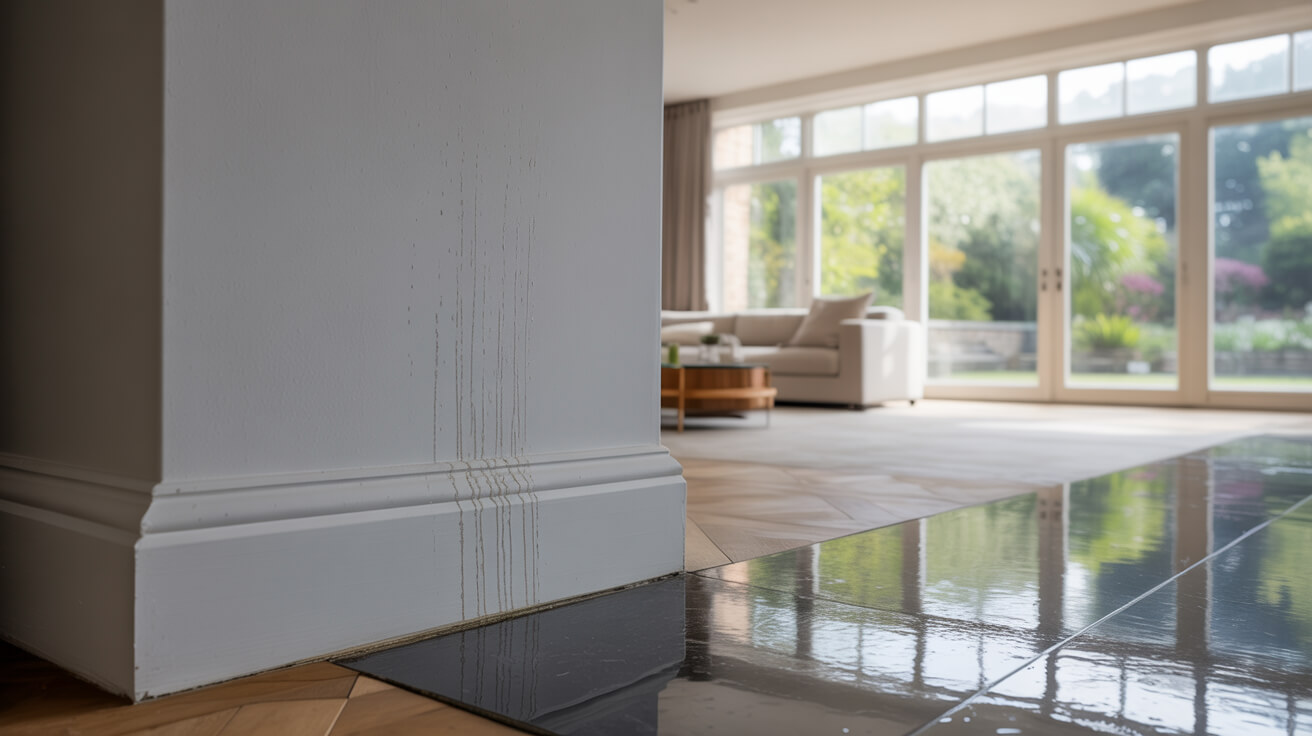
Surface impressions deceive. Legally, your property becomes riskier with every missed upgrade, every legacy repair, and every ill-fitted “fix”—particularly for landlords, portfolio holders, and heritage owners. Vulnerability is about more than leaky roofs or old windows. Law, compliance, and physical reality create a perfect storm when ignored.
What Are the Most Overlooked Structural Weaknesses?
- Service penetrations: (utility pipes, cable runs, metre boxes): Each is a ready-made ingress during surface or foul floods.
- Cavity or solid wall junctions: Repairs using incompatible mortars, non-breathable renders, or plastics seal in problems.
- Cellars, basements, or subfloor voids: Floodwater moves through unexpected routes—vertical ducts, wall voids, or poorly capped risers.
- No insulation or breathable barrier: Historic and heritage builds often lack modern flood resilience.
Most insurance disputes trace back to missing or illegal interventions. Compliance lapses cost far more than professional upgrades.
What Legal or Compliance Issues Amplify Property Vulnerability?
Landlords failing HHSRS or Decent Homes criteria face enforcement, claims, and empty houses. Lease/portfolio managers deal with split responsibilities—missed upgrades mean legal and financial liability. Heritage and listed asset owners must validate consent on every intervention: inappropriate tanking or occlusive waterproofing can void approvals and result in forced, costly reversals.
Vulnerability Scan Checklist
| Structural risk | Legal risk | Compliance step | Who’s responsible |
|---|---|---|---|
| Untested drainage | HHSRS breach | Annual inspection | Owner, landlord |
| Legacy repairs | Planning | Documented survey | Owner, agent |
| Incompatible wall | Listed building | Specialist approval | Owner, portfolio mgr |
| Service entry gaps | Insurance void | Pro survey/upgrade | Owner, landlord |
Take control: Schedule vulnerability scans in windowed cycles (pre-renewal, pre-sale, post-upgrade) and document every change for audit, sale, and insurance reviews.
What Are the Most Effective Solutions for Flood-Proofing Homes?

Flood resilience is not one-size-fits-all—wrong upgrades can irreversibly trap moisture, cause hidden rot, or void compliance. The most effective solutions marry science (BSI, PAS1188), local expertise, and tailored, case-driven installation.
Certified Solutions That Work
- Permanent and removable airbrick covers: Block common shallow ingress routes; choose BSI Kitemark for insurance eligibility.
- Flood doors: These are more than off-the-shelf swaps; installation specs must match wall/floor details and certification is essential for claims.
- Internal resilience upgrades: Mould-resistant plasters, waterproof skirting, and raised power outlets help you bounce back, not just block water.
- Sump pumps and backflow protection: Rapid discharge systems installed beneath or beside vulnerable slabs stop invisible seepage from accumulating.
- Breathable wall treatments: Only use products proven not to trap water behind modern or heritage fabric.
Comparative Table: Resilience and Resistance Measures
| Solution | Best for | Prevents or Recovers? | Insurance-compliant? |
|---|---|---|---|
| Airbrick Cover | All homes/ages | Prevents | Yes (if certified) |
| Flood Door | Ground floor | Prevents | Yes |
| Sump Pump | Cellar/slab/basements | Recovers | Yes |
| Wall Sealant | Heritage/solid wall | Both | Conditional |
Lasting security is a product of product fit, science-based installation, and independent checks—not ‘quick fix’ kits from the DIY aisle.
Why Compatibility and Certification Matter
Unverified products void insurance or become safety risks if water finds another route. Demand documentation for every installed product and system; if a solution can’t be certified, it’s a false economy.
Personalised selection: Use certified, regionally validated products and demand visible proof of all interventions. Want specifics for your build type? Access our compliance-mapped product guides.
Why Should You Choose a Certified Professional for Flood Risk Assessment and Installation?

The DIY shortcut is a myth; unlicensed, poorly-documented works cost more in claims, stress, and operational downtime than any up-front survey ever could. Regulator, lender, and insurer expectations all align behind one truth: only documented, expert evidence is taken seriously.
The Professional’s Delivery—Beyond Installation
- Technical audits: From GIS scans to subfloor probes, professionals surface invisible risk points before they become threats.
- Stepwise documentation: Every action is tracked, certified, and formatted for lender, insurance, and council review.
- Regulatory cross-check: All plans and upgrades align with BS6576, PAS2035, and HHSRS—with heritage compliance mapped for listed property.
- Aftercare assurance: Maintenance schedules, future upgrades, and compliance reviews are embedded from day one.
A claim or upgrade request with documented proof carries authority. DIY fixes without evidence are at the mercy of anyone—insurer, council, or buyer—who wants to say ‘no.’
The Cost of Getting It Wrong
Missed checks, improper tanking, or “universal” barriers often introduce secondary risks. Cases abound of property owners denied claims post-flood, or forced to remove non-compliant materials from protected homes. Only a certified survey, tailored plan, and managed instal deliver universal security.
Ready to get audit-proof? Start your journey with a certified assessment and receive tailored, property-specific compliance documentation.
Where Are Flood Defence Measures Most Critical for Your Property?

Blind instals don’t protect—they expose new entry points. To shield your investment—and maintain compliance—map your defence to the failure modes that matter for your build.
Mapping the Real-World Entry Points
- Airbricks and horizontal vents: Easy to overlook, essential to defend.
- Thresholds and doorways: Poor fits and ill-matched upgrades create bypasses.
- Utility/service holes: Cables, pipes, metres—each a risk if uncapped.
- Wall/floor joins and slab abutments: Structural movement or legacy repairs often create invisible water pathways.
Example site analysis:
- For a timber-frame cottage, the focus is on historic brick and vent interfaces.
- In a 1990s extension, the new slab may be sound—but retro services and recycled bricks become weakpoints.
Failure Analysis Table
| Entry Point | Typical Cause | Effective Solution | Compliance Needed |
|---|---|---|---|
| Airbricks | Low site grade, open vent | Cover/replace (certified) | Yes |
| Door/Threshold | Uneven fit, raised paving | Instal flood door/barrier | Yes |
| Service Penetration | Unsealed cable/pipe hole | Gland/foam/pro plug | Yes |
| Slab/Wall Juncture | Structural move, old repair | Flexible tanking, pro audit | Yes |
Ongoing Audit—Not “Once and Done”
Audit and maintain each instal every 12–24 months. Regulations change, and insurance/council acceptance shifts with guidelines and standards.
It isn’t the flood you see coming that does the harm—it’s the gap you never logged or maintained.
Book an on-site entry point survey: Protect every ingress and lock in compliance and claims coverage.
When Is the Best Time to Implement Flood Resilience Upgrades?

Timing matters—pre-incident upgrades unlock everything from lower premiums to grants. Post-flood actions are not only costlier; they often miss eligibility periods, reducing the value and reach of upgrades.
Upgrade Today or Pay After
- Insurance renewal: Most providers reward upgrades that pre-date the new policy cycle.
- After council/local alert: Funding is typically time-limited after events.
- During property transfer: Pre-sale upgrades carry value, ease, and documentation for buyers and conveyancers.
- Heritage/consent cycles: Periodic reviews open the funding or authorisation window.
Funding cycles table:
| Opportunity | Typical Trigger | Deadline to Act | Benefit Available |
|---|---|---|---|
| Insurance discount | Renewal notice | New cycle start | Lowered premium |
| Government/local grant | Flood alert/event | 3–6 months after | Cash for upgrades |
| Mortgage/letting milestone | Sale/tenancy | Pre-completion | Legal compliance fast |
Floods cost more after the fact—and every day you wait, your eligibility, premium, or resale value erodes a bit more.
How to Capture the Advantage
Schedule upgrades around insurance, council, or lender cycles; maintain compliance logs. Opportunities can vanish; funds and incentives go to the fast, not the hesitant.
Preempt future risk: Use our funding tracker and upgrade timing guide for both urgent and cyclical works.
How Do Flood Protection Standards, Insurance, and Compliance Intersect?

Your asset’s security is governed by proof, not assertion. Insurers, councils, and buyers all want one thing: certified, documented intervention. Local authorities may deny letting or licencing; buyers devalue or walk away from uncertified homes; insurance refuses claims if works lack evidence.
The Compliance-Insurance Matrix
- BS6576, PAS2035, HHSRS: These are not just acronyms. Each represents requirements that, if unmet, block or delay claims, sales, or tenancies.
- PCA/BSI Kitemark products: Installation and maintenance history is essential; missed intervals or non-certified upgrades void claims.
Compliance-Requirement Table
| Standard/Product | Insurer/Regulator | Document Required | Expiry/Audit Cycle |
|---|---|---|---|
| Flood door (Kitemark) | Most insurers | Cert + survey + instal | 3–5 years |
| Wall render/Sealant | Council/heritage | Pro survey + consent | 1–2 years |
| Sump pump | Insurer/council | Installation + test logs | 1 year |
The Risk of Missing Standards
Failing an insurance, mortgage, or authority check means delays, cost, or lost livelihood. Compliance logs and upgrade audits certify your investment and reputation for the long haul.
In today’s compliance world, ‘show the log’ matters more than ‘show the work’—attestation trumps intent.
Ready your compliance pack now: Download templates and booking documentation for instant proofs at every tenancy, sale, or renewal.
Book Your Free Consultation With Sussex Damp Experts Today
Flood resilience is built on facts, not hope. Sussex Damp Experts deliver measured, compliance-proven, and insurer-ready assessments, installation, and aftercare—whatever your property type or portfolio size.
Your advantages:
- PCA, BSI, and PAS2035 certified team on every site.
- Reports and product documentation that unlock insurance, grants, and resale bonuses.
- Heritage-compatible, environmentally appropriate interventions for historic assets.
- Portfolio-grade compliance and audit tools for landlords, managers, and commercial clients.
- Free, actionable assessment that aligns your needs with every available advantage.
You can let the next alert dictate your action—or you can become the one your peers call to ask ‘How’d you get ahead?’
Book now and become the property owner, manager, or stakeholder who leads—not follows—when it comes to flood resilience.
Frequently Asked Questions
How Can You Accurately Assess and Understand Your Flood Risk?
Flood risk isn’t a line on a map; it’s a moving target shaped by topography, local history, and the unspoken weaknesses of your property. Relying on postcode averages or generic assertions leaves you exposed to surprises—insurance refusals, lost sale momentum, or structural regret after an unexpected downpour. The critical question is not, “Is my area susceptible?” but rather, “Has my home’s unique story—materials, drainage, prior incidents—been decoded and documented?”
Why Most Risk Assessments Miss What Matters
Property-level risk mapping demands synthesis: Environment Agency or SEPA flood overlays, council archives, survey and incident files, and—most persuasively—on-site diagnosis that helps catch damp before disaster spot hidden clues and protect your property by identifying everything from bridged DPCs to under-specified drainage. Digital tools catch only so much; heritage cellars, composite slabs, undrained extensions, or historic repairs can redirect stormwater in minutes. When seasoned damp experts use moisture profiling, borescope checks, and substrate testing, vulnerability is made explicit—long before insurance trouble or actual water arrives.
- Combining multiple data sources: is fundamental.
- On-site expertise: often trumps digital models.
- Insurers now request full-site risk evidence: before discounts or claim approvals.
Real-World Scenario
A house only one street removed from a floodplain had no visible issues—until a blocked rear drain compounded by modern landscaping sent water under thresholds, bypassing every digital risk estimate. Only a tailored site assessment caught the cause before thousands in repairs and litigation.
True resilience begins where generic indices end: in the granular detail of your own plot and brickwork.
Elevate Your Position
Anchoring your decision with a Sussex Damp Experts survey means you aren’t buying peace of mind—you’re securing hard evidence for every insurer, lender, or council, and prequalifying for resilience grants that generic surveys miss.
What Factors Make Properties Structurally and Legally Vulnerable to Flooding?
Invisible risk rarely waits until you expect it. Most insurance denials or failed compliance audits trace back to unaddressed technical or legal vulnerabilities—gaps that amplify minor flaws into catastrophic aftermath. The myth that period properties, new-builds, or “never-flooded” homes are immune is consistently disproven every audit cycle.
Physical Weak Points and Regulatory Landmines
Flood fails find three openings:
- Missed penetrations: Unsealed service ducts, metre access, classic vent or airbrick misalignment, or low walls after landscaping changes.
- Material mismatches and legacy repairs: Lime swapped for cement, paint that traps interior moisture, bridged DPCs or under-spec’d tanking after utilities retrofits—each can trap or channel water invisibly until major damage reveals itself.
- Skipped compliance updates: When landlords let HHSRS, damp, or PAS2035 survey cycles lapse, or commercial owners let leasehold documentation slip, every missed window is a legal (and financial) tripwire.
Case-in-Point
After a council-ordered risk review, a landlord discovered previous tenant works had inadvertently bridged the DPC—a fix made years before, but which let water and liability rise together. Compliance is not a checkbox; it’s an ongoing shield.
| Vulnerability Type | Common Examples | Prevention Anchor |
|---|---|---|
| Service penetrations | Pipes, cable runs, subfloor voids | Accredited survey, verified seal |
| Material misalignment | Cement over lime, plastic over brick | Historic-aware remediation |
| Lapsed compliance | Expired HHSRS, PAS2035, or audit trail | Scheduled expert cycle, pro docs |
A single missed inspection or unlabeled upgrade isn’t just oversight; it’s a future deduction on asset value, and a silent invitation to insurer refusal.
Futureproof Your Compliance
The gravity of ongoing documentation and expert review is always ascending—well-managed paperwork, proactive upgrades, and professional site chains empower you to claim, sell, let, or defend any property class, on your own timeline.
What Are the Most Effective Solutions for Flood-Proofing Homes?
The dominant misconception is that more gear equates to better resilience. The truth: Only precisely specified, audited, and expert-placed flood defence systems convert risk into secure value. Failure to differentiate resistance (blocking ingress) from resilience (making clean-up fast, cheap, and less traumatic) is what costs most owners and managers both sleep and equity.
Key Solutions By Category
| Solution Type | Use Case | Key Feature | Regulatory Flag |
|---|---|---|---|
| BSI Kitemark airbrick cover | All property types | Rapid barrier on warning | Insurer-preferred |
| Flood doors | Ground/threshold entry | Subtle, year-round defence | Audit-required for grants |
| Sump pump | Basements, heritage, terraces | Active water expulsion | Specialist instal needed |
| Passive membrane/sealant | Heritage or listed properties | Breathability, discretion | Consent often required |
| Internal uplifts (plaster, sockets) | Any flood-prone building | Fast recovery, safety | Documented for compliance |
Solution Framing
Effective protection never throws up barriers in the dark. It begins with a risk-aware plan, builds on certified product choice, and is mapped to actual water behaviours at your property—not someone else’s.
- Audit trail matters as much as product.:
- Maintenance windows and compliance logs are integral to the system—not afterthoughts.:
Any upgrade that can’t pass a post-flood insurer review or local officer walk-through adds cost, then nullifies it in the claim.
Take Ownership of Defences
Ask Sussex Damp Experts for a combined diagnostic-plus-spec survey. Every solution is mapped both to your local reality and to insurer, grant, and compliance thresholds, equipping you not just for the next flood, but for your next auditor or buyer.
Why Should You Choose a Certified Professional for Flood Risk Assessment and Installation?
False confidence is a cost multiplier—DIY instals and non-certified assessments are the root cause behind the majority of insurance refusals, claim delays, and compliance breaches documented in recent flood events. Engineers tasked with reconstructing failure cases cite the same root cause: missing or invalid proof of professional, context-matched installation.
When Expertise Makes the Difference
A certified professional isn’t just a product technician; they validate substrate, check for invisible risk points, align every action with HHSRS, BS 6576, PAS2035, or grant requirements, and audit their own trail. When the work is challenged by an insurer, buyer, or council, the traceability determines if protection was an asset—or a retroactive liability.
Key checklist points every professional delivers:
- Certified risk assessment using calibrated tools and knowledge of regional vulnerabilities
- Tailored product and procedure, never a one-size ‘quick fix’
- Regulatory compliance documentation (vital for letting, grant, or insurance approval)
- Immediate, scenario-specific maintenance plan
The Stakeholder’s View
Every gap in documentation is a future deduction from insurance, asset, or reputation.
When only certified records and expert installation will satisfy your next claim, sale, or upgrade cycle, lock in reliability with our accredited team.
Where Are Flood Defence Measures Most Critical for Your Property?
Most failures start at unexpected entry points: stormwater finds the path of least resistance—so why defend only the obvious? Upgrades misapplied to “likely” areas (main door, yard gate) are bypassed quickly when schedule stress or partial audits miss details.
Critical Weak Spots
- Airbricks and horizontal vents – Easy to overlook; even one open leaves the rest moot.
- Services and metre boxes – If not pressure-sealed, these act as silent underground water highways.
- Below-pavement or garden cuts – Landscaping and forgotten grates routinely redirect surface runoff.
- Basement or subfloor voids – Water seeps horizontally or upward, evading traditional installed barriers.
A Scenario to Illustrate
A Victorian terrace with a modern extension passed a compliance audit—the main threshold and vent were upgraded, but a side wall airbrick, one inch above soil, failed to seal. The next heavy rain bypassed every main barrier, spilling into flooring and triggering loss adjustment. The remedy? Holistic placement, guided by integrated diagnostics and documented validation.
| Critical Placement | Common Miss | Result if Untreated | Long-term Fix |
|---|---|---|---|
| Airbrick or vent | Above garden grade | Bypass of all barriers | Certified cover |
| Subfloor void/service run | Unsurveyed retro fit | Hidden saturation | Plug/reseal by expert |
| Old metre access | Retrofit incomplete | Flash-flooding, surcharge | Audit + replace/upgrade |
A holistic, site-specific survey is protection against predictable disappointment and audit failure.
Request a Sussex Damp Experts full-site installation audit: litigation, asset value, and everyday peace follow.
When Is the Best Time to Implement Flood Resilience Upgrades?
The window to act is always closing—and cost, eligibility, and future value are functions of timing, not intent. Owners who delay upgrades wait out grant windows, miss insurance discounts, and lose the bargaining leverage of being ahead of regulation or claim cycles.
Timing Triggers
- Insurance renewal: – Providers reward proactive work, but only if verified and dated before cycle resets.
- Property sale or purchase: – Compliance and resilience documentation eases or blocks deals, flags, or adjustment demands.
- Council, grant, or enforcement deadlines: – Many grants or pre/post-flood upgrades are only available for limited periods after local events.
Beyond compliance, timing is about certainty and opportunity. Waiting until urgent means paying the maximum for the minimum value.
| Event Type | Why Upgrade Now? | Value Secured |
|---|---|---|
| Insurance renewal | Prevent premium hikes | Lower cost/claim speed |
| Sale/refurb milestone | Strengthens negotiation | Higher asset value |
| Council/grant window | Unlocks partial public funding | Cost offset, lower risk |
Decision Principle
Act at a pace you dictate, not at one set by insurers or auditors watching your compliance clock.
Book an eligibility check—ensure your investment is timed for optimal value, not a crisis.

