
 By
By  February 21, 2023

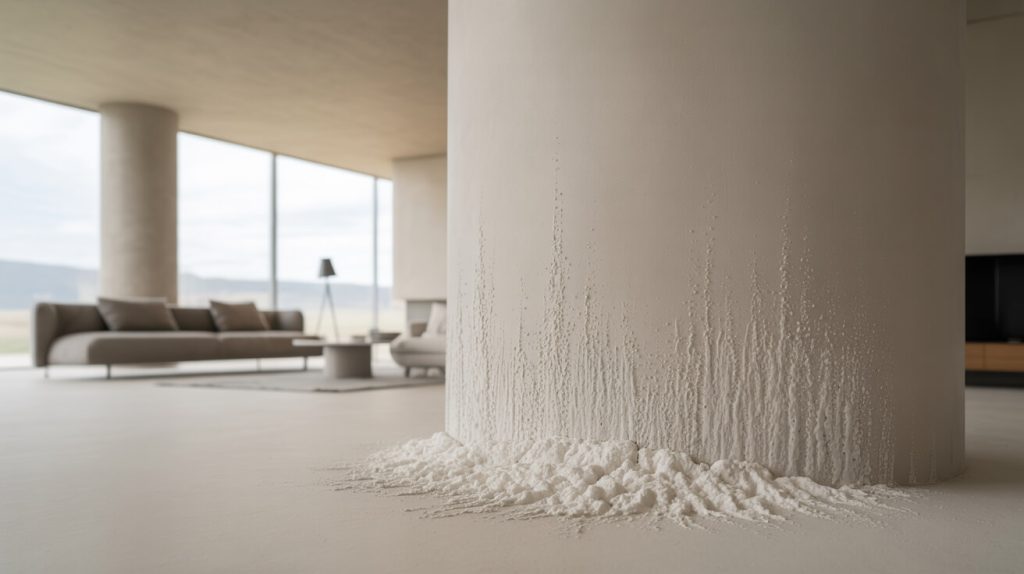
What Is Efflorescence and Why Does It Matter?
Efflorescence—those bright white, powdery deposits suddenly appearing on internal walls, brick, or masonry—signals that water is moving through your property’s structure, pulling salts to the surface. For many homeowners and property decision-makers, this isn’t just an aesthetic concern. Efflorescence is often your earliest warning that underlying moisture is on the move, potentially establishing damaging routes that will later manifest as rising damp, failed plaster, or mould.
Efflorescence as a Diagnostic Signal
Mineral salt residues form when soluble salts migrate with water and are left behind as moisture evaporates from the surface. The critical question is: when is efflorescence routine, and when is it a red flag? In the context of historic Sussex properties with mixed wall constructions, complex ground conditions, and variable drainage, efflorescence must never be outright ignored.
Key diagnostic truths:
- Brief salt emergence after new construction or heavy rainfall can often be benign, vanishing as brickwork or mortar dry and the salts are brushed away.
- Persistent or spreading patches—especially at floor level, across multiple rooms, or after every wet season—strongly suggest structural moisture challenges requiring evaluation.
- When efflorescence co-occurs with soft, crumbly plaster, peeling paint, or cold-wet wall sensation, the risk of active damp rises dramatically.
| Efflorescence Context | Typical Meaning | Action Implication |
|---|---|---|
| New brickwork/concrete | Post-build drying, low urgency | Monitor, brush clean |
| Recurring after cleaning | Ongoing moisture ingress | Investigate further |
| Accompanied by failing finishes | Likely internal damp | Call for expert diagnosis |
| Present on interior partitions | Unusual—may be leaks, plumbing | Assess promptly |
When you see salts in locations or contexts beyond normal drying, it becomes a mission for targeted damp diagnosis, not cosmetic cleaning.
Most problems in property begin long before you ever see a stain. White salts are the first thing the building says when it wants you to listen.
Ownership isn’t about reacting to disaster. It’s about reading signs before value escapes through your walls. Identifying efflorescence correctly sets you up to intercept structural risk before it becomes irreversible.
Why Can Efflorescence Be Mistaken for Severe Damp?
Damp Diagnosis Quiz
- 1 Location
- 2 Appearance
- 3 Timing
- 4 Pattern
- 5 Results
Most Likely Diagnosis
—
—
What Is This?
—
Recommended Next Steps
Confidence Breakdown
This quiz provides general guidance only. A professional survey identifies the exact cause and recommends the right treatment.
Book a Professional Diagnosis →It’s common for property owners, even professionals, to conflate efflorescence with severe forms of damp or even mould, launching a costly cycle of unnecessary remedial work. Their appearance can trigger anxiety, but superficial similarities often hide different causes—and consequences.
Diagnostic Confusion: Salt vs. Damp vs. Mould
Efflorescence’s resemblance to tide marks or the early stages of black mould can lead to rapid misdiagnosis. Untrained observers (or even rushed trades) frequently prescribe expensive treatments—DPC injection, tanking, replastering—without isolating the underlying source.
Common error chains
- Over-treating surface salts with non-breathable paints or physical barriers, which traps further moisture and escalates underlying damp.
- Failing to distinguish fluffy, crystalline salt (efflorescence) from fuzzier mould, missing the opportunity for simple preventive action.
- Springing for aggressive chemical or structural interventions in listed buildings where vapour-permeable solutions or passive observation is required.
Scenarios often leading to wasted budget:
- Absence of moisture metre or salt testing means you’re guessing at the cause. The most expensive repairs are those made on guesswork.
- Confusing water marks from condensation with persistent salt tracks from rising or lateral damp.
- Landlord or agent assuming all wall damage is condensation-related, missing embedded leaks or substrate decay.
Table: Visual/Behavioural Differences
| Symptom | Efflorescence | Rising Damp/Mould |
|---|---|---|
| Texture | Powdery/crumbly salt | Wet, slimy, or furry |
| Progression | Returns after cleaning | Spreads unless source fixed |
| Colour | Bright white | Brown, green, black |
| Odour | None | Musty or earthy |
Never let a wall’s first whisper of trouble be mistaken for a full-blown warning. Decisive action comes from precise understanding.
The discipline is in the diagnosis. Learn to tell the difference, and your next decision can protect your investment instead of compounding its risk.
Where Does Efflorescence Appear Most and What Does It Signal?

Efflorescence’s distribution across a property is as critical as its appearance. Where and how salts emerge reveals a matrix of vulnerabilities within your structure.
Key Locations and Underlying Threats
- Salts streaking along skirting or baseboards nearly always tie back to ground moisture, failed or bridged DPC, or external drainage failures.
- Chimney breasts in period properties often display salts due to historic soot, chimney-capping changes, or poor ventilation.
- Bay windows, door reveals, and returns in cavity wall homes. These construction details often introduce unbroken bridges for capillary action.
- Basement and cellar walls, where boundary permeability and hydrostatic pressure mean salts might forecast deeper, more persistent ingress.
For buyers and managing agents:
Pay special attention to multiple/recurring patches, new spots after flooring/plaster works, or any spread across party or partition walls not exposed to the elements. These patterns strongly suggest internal plumbing or roof-related ingress—harder and more expensive to address.
| Location Pattern | Typical Risk Source | Urgency |
|---|---|---|
| Low wall, multiple rooms | Groundwater, DPC issues | High |
| Ceiling or high wall | Roof leak, plumbing | High |
| Chimney breast | Soot/salt migration, cap errors | Medium |
| Behind furniture | Cold bridging, missed airflow | Medium |
A single patch speaks to chance. A pattern narrates a risk. Learn the language of your property before costs escalate.
Sussex Damp Experts leverage moisture mapping and environmental context to decode these signals. It lets you focus resource where it matters most—removing guesswork and making every repair count.
When Should Efflorescence Raise an Immediate Red Flag?

There’s a threshold where efflorescence is no longer just an early sign but a clear warning: sustained moisture is now a structural or compliance risk.
Critical Triggers Demanding Immediate Action
- Efflorescence reappears within days or weeks after a clean.
- Recurrent output is the fingerprint of an unresolved water pathway.
- Plaster or paint adjacent to efflorescence softens, bubbles, or flakes away.
- Surface breakdown means salts are breaking bonds internally; urgent substrate investigation is due.
- Salt marks moving up from floor or expanding across several surfaces.
- Systemic groundwater rise, failed DPC, or broader hydrostatic issues must be reviewed, especially for commercial, portfolio, or multi-tenancy environments.
- Surveyor, agent, or tenant flags in a report/survey.
- Inaction can lead to mortgage retentions, tenancy compliance investigations (HHSRS/FFHH), or insurance reviews.
| Trigger Cluster | Why It Demands Action |
|---|---|
| Fast recurrence | Active ingress |
| Substrate breakdown | Systemic moisture damage |
| Multiple locations | Systemic property or drainage issue |
| Official report/flag | Compliance/valuation at stake |
Proactive ownership isn’t about avoiding repair. It’s about acting at the first, actionable sign—before cost replaces control.
We arm you with actionable diagnostics, compliance-grade reporting, and a plan engineered around the real water routes, not routine fixes.
How Can Accurate Testing Distinguish Efflorescence from Damp?

Effective remediation depends on knowing what you’re truly dealing with. Relying on visuals or touch alone leaves room for error—and budget loss.
Tools and Process for Precise Diagnosis
- Moisture metre analysis: exposes the distinction between dry-surface salts (often benign) and deep substrate moisture (urgent).
- Salt testing: (nitrate/chloride identification) clarifies if rising damp or condensation is present.
- Infrared/thermal imaging: tracks sub-wall or cavity moisture invisible to the naked eye.
- Historic mapping: —document salt/deposit evolution over weeks to spot chronic patterns.
Table: Diagnostic Tools and Their Use
| Tool | Use Case | Action Path |
|---|---|---|
| Moisture metre | Surface vs core damp | Escalate for persistent core moisture |
| Salt test kit | Distinguish salt type/source | Identify rising damp |
| Infrared imaging | Find cold/hidden ingress | Structural/hidden repair route |
A guessing game with walls leads to chequebook pain.
Our expert process combines all of these, forming a foundation for decisions that stick and solutions that last. Your property’s unique story guides which tool, test, or intervention chart will protect its value best.
What Are the Legal, Health, and Financial Risks of Neglecting Efflorescence?

Treat efflorescence as an early audit—a call to accountability. Delay or misinterpretation brings consequences beyond cosmetic repair, affecting legal liability, tenant safety, asset value, and compliance status.
What’s at Stake When Efflorescence Is Ignored?
Legal and compliance stakes
- For landlords/managers, outstanding tenant complaints can trigger HHSRS letters, enforcement from local councils, or citation under the Landlord and Tenant Act.
- Unchecked efflorescence may breach Building Regs Part C or violate PAS2035 standards in retrofitted or heritage properties.
Financial and asset risks
- Minor surface salts left unaddressed often cascade to larger-scale plaster/finish failures. These demand not just cosmetic repair but deep substrate, DPC, or even external drainage overhaul.
- Persistent listings of salts on property surveys may cause lenders to refuse or retain funds, delaying transactions and driving down property value.
- Insurance claim refusals become possible where negligence in dealing with known water markers is established.
Health and occupancy impacts
- Once moisture persists, airborne allergens, mould spores, and latent health risks trigger for vulnerable occupants and tenants, precipitating further complaints, regulation, or litigation.
Every unsolved salt line can eventually draw a compliance line in the sand.
Our compliance-aligned approach and full documentation—the baseline Sussex Damp Experts standard—mean you’re protected on paper, in practice, and in the eyes of all stakeholders.
How Can Efflorescence Be Prevented and Managed in All Property Types?

Prevention isn’t a single action; it’s a system. Robust efflorescence management requires understanding the property’s fabric, typical moisture routes, and environmental context.
A Proactive Management System
Regular Monitoring and Scheduled Inspections
- Annual substrate and surface audits minimise missed onsets, especially at seasonal changeover or after significant weather.
Drainage and Moisture Control
- External ground-water management, gutter and downpipe health, and slab drainage are foundational.
Material Compatibility and Repairs
- Specify only breathable, substrate-compatible plasters or paints for susceptible sections; lime-based products in heritage or listed sites.
- Avoid repair shortcuts that introduce or trap water (non-breathable paints, improper tanking, unplanned joinery/plaster contact).
Environmental Control
- Track and adjust ventilation or dehumidification where persistent airborne moisture exists.
Portfolio and Multi-Property Solutions
- For agents/distributors, consider wireless moisture monitoring to spot systemic issues before tenants or surveyors do.
Prevention scales with insight. What you catch early, with the right system, never dominates the budget line.
With Sussex Damp Experts, every plan and scheduled inspection is engineered for your building’s unique risks—with compliance, standards, and long-term trust embedded from the outset.
Book Your Free Consultation With Sussex Damp Experts Today
Now is the moment to own your property’s outcome. Don’t wait for salts to announce the next repair cycle or for a surveyor’s report to lock your funds and options. Secure an expert assessment, actionable plan, and compliance-first documentation—whether you’re an owner, manager, agent, or buyer.
The mark of real stewardship isn’t in patching walls—it’s in being the one who saw and solved the problem before it defined your investment. Trusted by owners, agents, and commercial leaders across Sussex, Sussex Damp Experts keeps structural risk, compliance, and peace of mind on your side.
Frequently Asked Questions
What Is Efflorescence and Why Does It Matter?
Efflorescence is more than a cosmetic nuisance—it’s a visible symptom that water is infiltrating your property’s fabric and pulling salts to the surface. When these white, powdery deposits show up along brickwork, stone walls, or plaster, they’re sounding the first silent alarm: moisture is on the move, and with it, a real risk to your asset’s lifespan, value, and compliance.
Why Salt Means More Than Stains
Consider efflorescence as your property’s early warning system. Moisture travels unseen routes: through defective pointing, bridging in failed damp-proof courses, or condensation hidden by heavy furniture. These salts surface before damage—like plaster decay, timber rot, or rising damp—emerges. Most new property owners, landlords, or managers underestimate what a patch of salts means until they see the repair bill or face a mortgage retention.
Common Efflorescence Hotspots
| Location | Typical Cause | Importance |
|---|---|---|
| Ground-floor bricks | Rising damp, DPC bridges | High |
| Chimney breasts | Soot salts, rain entry, damp flues | Moderate |
| Basements/cellars | Hydrostatic pressure, drainage | Very High |
| Window returns | Condensation, bridge, leaks | Medium |
When efflorescence recurs, spreads, or is coupled with musty odours, clammy surfaces, or soft plaster, it’s time to treat it as an operational risk. “Brush it off and hope” is not a strategy—precision damp diagnosis and moisture mapping are, especially if value, sale, or compliance are on the line.
Visible salts are water’s way of showing you the shortest path to your next major repair.
Why Can Efflorescence Be Mistaken for Severe Damp?
Efflorescence’s innocent look invites trouble. Mistaken as harmless, it gets painted over; mistaken for severe damp, it often triggers overzealous—and misapplied—repair schemes. The price of confusion is paid in wasted budget, failed treatments, or overlooking deeper decay.
The Danger of Visual Diagnostics
Simply wiping or painting over salts ignores the underlying moisture, and mistaking them for unsalvageable “rising damp” can fast-track unnecessary DPC injections or inappropriate tanking, especially in heritage or lime-rich properties. Equally problematic, confusing efflorescence with early black mould or condensation often sends landlords and managers down a spiral of superficial fixes, avoiding the slow, methodical process that would actually restore asset integrity.
Mistakes That Cost Twice
- Painting without moisture control nearly always ensures future breakdown and extra cost.
- Relying on touch or visual cues can invite compliance breaches if the wrong standards are used (see BS6576 and PAS2035 for proper sequence).
- Over-treating with chemicals or impervious plasters can wreck the breathability of heritage substrates—undoing years of preservation in a single job.
A property owner in Brighton once ignored recurring salts in their bay window, thinking they’d “fix it later.” After another winter, plaster had collapsed and replacement costs quintupled—while a buyer’s survey forced the sale below market. Sussex Damp Experts’ reports routinely clarify these issues, turning expensive confusion into decisive action.
Where Does Efflorescence Appear Most and What Does It Signal?
Efflorescence prefers the routes moisture loves best: lower walls, edges of basements, cold spots behind furniture, and especially any break in fabric around windows, doors, or chimneys. Its distribution is your blueprint to where your structure is most vulnerable.
Reading the Map Your Walls Draw
- Basement/cellar walls: Persistent efflorescence signals hydrostatic pressure, meaning underground moisture is finding a path inside. This is never just a cosmetic problem.
- Chimney breasts: Even unused chimneys can wick salts if not capped and ventilated—salts in these locations often mean internal rain penetration or unresolved flue condensation.
- Low internal walls/arches: A linear, floor-level bloom maps directly to rising damp or failed DPC, and its spread is your countdown to wider decay.
Invisible to tenants, some landlords discover too late that persistent salt blooms have triggered housing fitness complaints or HHSRS actions. For housing associations or those with larger portfolios, efflorescence can become a ticker-tape parade of avoidable maintenance letters and missed profit.
When your structure’s visual cues form a clear pattern, don’t rationalise them away. See them as your cue to seize control—risk migrates quickly from cosmetic to structural in the damp-prone ecosystems of East Sussex.
When Should Efflorescence Raise an Immediate Red Flag?
Salt that keeps returning after cleaning, spreads to new walls, or suddenly appears alongside peeling paint, musty odours, or crumbling plaster is every property owner’s cue to escalate. These aren’t stains: they’re a sign water is pushing relentlessly inside, breaking down what stands between your property and the elements.
Immediate Escalation Signals
- Rapid salt return after cleaning is proof positive of unresolved ongoing ingress.
- Salts on high walls or ceilings can spotlight hidden leaks from rooms above or roof voids.
- Any salt mapped with failing substrate—crumbling plaster, timber deformation—shows the problem has graduated from surface to structure.
| Red Flag | Next Step |
|---|---|
| Salts + soft plaster | Moisture mapping & invasive inspection |
| Multi-room/new site spread | System check: DPC, ventilation, leaks |
| Noted by surveyor/tenant | Full compliant damp survey, documentation |
“A letting agent whose managed property showed salts after every wet spell finally saw their ongoing insurance costs fall the year they switched from ad-hoc repairs to our structured damp protocol.”
Every unexplained occurrence, especially those flagged in surveys or by regulators, is an opportunity. Respond now to achieve decisive positioning and turn potential compliance liabilities into operational wins.
How Can Accurate Testing Distinguish Efflorescence from Damp?
Proper diagnosis isn’t optional—it’s the bridge between recurring costs and building trust with every stakeholder, from tenants to surveyors. Visual checks won’t tell you the salt’s story; you need moisture metres, salt-specific chemical tests (nitrate, chloride/sulphate for rising damp), and historic pattern assessment.
Elevating Your Diagnostic Standard
- Moisture Metre Readings: Surface-only moisture can indicate cosmetic salts, but high core readings signal deeper trouble.
- Salt Kits: Quick swab tests reveal which salts are present—nitrates mean ground moisture, while chloride/sulphate suggests condensation or external ingress.
- Thermal Scanning: Uncovers sub-surface wet spots invisible to touch or eye—critical for pre-purchase, compliance, and due diligence.
- Chronological Mapping: Track appearances over days, weeks, or seasons. Recurring, unpredictable salt blooms nearly always point to a missed exception in build fabric or drainage.
When a client in Lewes scheduled our “Forensic Damp Assessment,” we captured historical, chemical, and atmospheric data. They closed a mortgage with zero retentions, bypassed years of prior confusion, and finally rescued value that seemed lost.
| Test Type | Salt Source Detected | Strategy Triggered |
|---|---|---|
| Moisture Metre | Internal/Substrate | Further inspection |
| Salt Analysis | Ground/Surface | Fix source/root cause |
| Thermal Imaging | Hidden leaks | Open up, repair route |
| Recurrence Log | Systemic attack | Systemic intervention |
Don’t pay for cleaning and repainting that solves nothing. Demand professional proof at the moment your instincts — or your walls — tell you something’s off.
What Are the Legal, Health, and Financial Risks of Neglecting Efflorescence?
Ignore efflorescence at your peril. Persistent salt blooms are cited in everything from HHSRS enforcement to surveyor retentions, insurance denials, and even failed property transactions. Mortgages held back, tenancies frozen, insurance voided—the costs multiply behind the scenes.
Neglect and Its Real-World Cascades
- Legal: Landlords and agents exposing tenants to avoidable moisture risk face housing compliance audits, council enforcement, and bigger repair liabilities under FFHH and Building Regs Part C. Misdiagnosis or band-aid repairs in heritage structures risk permanent listing value loss.
- Health: While efflorescence itself is non-toxic, it’s a bellwether for conditions that breed black mould, allergens, and respiratory threats, attracting scrutiny from environmental health officers and insurers alike.
- Financial: Recurring salts mean behind-the-scenes saturation, inflating structural repairs. Sellers find surveyors anchoring price or demanding enforceable repairs; buyers risk catapulting minor fixes into major cap-ex budgets.
| Neglect Impact | Stakeholder Effect | Regulatory Trigger |
|---|---|---|
| Persistent salts | Value loss | Surveyor/council escalation |
| Unfixed damp source | Tenant/occupant | HHSRS/insurance audit |
| Heritage malrepair | Investor/owner | Historic England review |
A commercial owner in Worthing ignored salt blooms for two years. By the time the repair order landed, repair costs were 6x the original quote, and tenancy churn had slashed building income. That only ended once our certified diagnosis and guarantee were in place.
Take ownership early; your status in the eyes of lenders, tenants, agents, or local authorities is defined by what you do when the building first talks back.

