
 By
 April 1, 2026


When Deathwatch Beetle Damage Leads to an Insurance Claim
The call came on a Wednesday afternoon. A homeowner in Lewes had just had a builder in to investigate a soft patch of floor beside a ground-floor window. The builder lifted a floorboard and found a main joist — an original oak timber dating to the early eighteenth century — riddled with exit holes and powdery bore dust. The homeowner’s first call was not to a timber specialist. It was to their home insurer.
That call is understandable. Repairs to a significant structural timber can cost several thousand pounds, and the instinct to reach for the insurance policy is entirely rational. For most UK homeowners with standard buildings insurance, however, the outcome is the same: the policy does not cover deathwatch beetle damage, and the repair bill lands with the property owner.
The standard answer is no — but the full picture is more useful. There are specific circumstances in which a beetle-related claim can succeed: partial claims under accidental damage cover, specialist policies for listed and heritage buildings, and structural warranty provisions on newer homes. Knowing where those exceptions are, and how to present a claim to take advantage of them, is the practical intelligence most homeowners need.
Why Standard Insurance Excludes Beetle
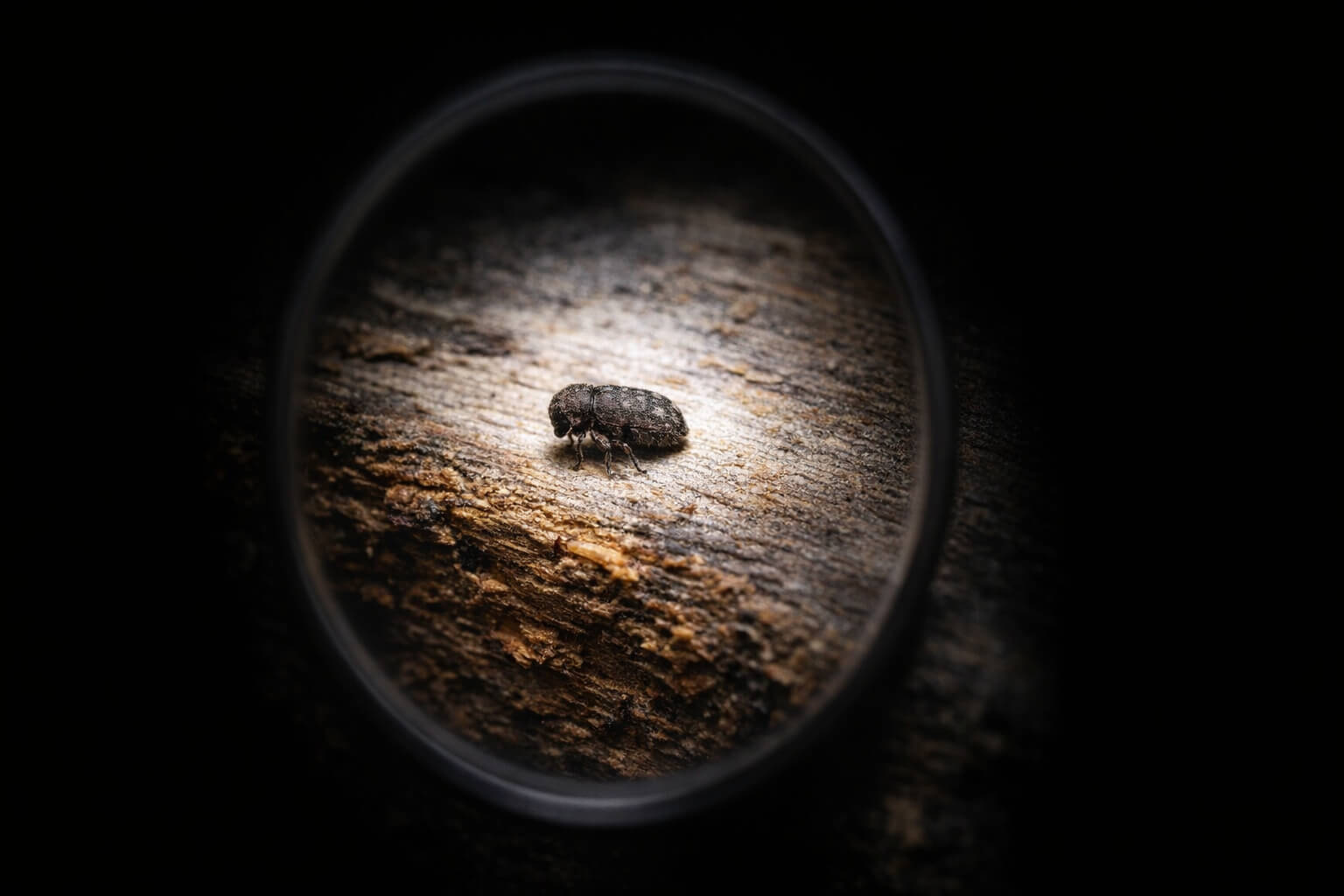
Buildings insurance is designed to protect against sudden, unforeseen events — storm damage, burst pipes, fire, and subsidence. It is not designed to cover the gradual processes that affect a property over time. Deathwatch beetle infestation is precisely that: a slow-developing condition that can take years or decades to produce visible structural impact.
The mechanism of exclusion appears under one or more of the following clause types:
- Gradual deterioration: damage that occurs progressively over time, rather than suddenly
- Wear and tear: physical degradation that is a natural consequence of age
- Maintenance exclusion: damage attributable to failure to maintain the property
- Pest and vermin exclusion: explicit exclusion of damage caused by insects, vermin, or other pests
The Association of British Insurers frames buildings insurance as cover for insured events, not routine maintenance or long-term deterioration. The ABI’s guidance on home insurance products and exclusions makes clear that gradual damage falls outside the scope of standard cover. Deathwatch beetle — establishing in damp, decayed hardwood and developing over years — fits every one of those exclusion categories simultaneously.
Specific insurer positions reflect this uniformly. LV= treats woodworm damage as gradual deterioration. Direct Line explicitly excludes rot, fungus, woodworm, beetles, moths, and insects. Aviva states that damage caused by pests is not usually covered.
“In our experience, most homeowners are surprised to discover just how broadly the gradual deterioration clause is applied. Deathwatch beetle isn’t treated differently from a leaking gutter — both are maintenance issues in the insurer’s view, regardless of the remediation cost involved.”
— Sussex Damp Experts senior surveyor
The Financial Ombudsman Service confirms this pattern. In DRN-2725481, FOS did not uphold a woodworm-related claim, finding the policy wording did not extend to the damage presented. In DRN5242441, FOS supported an insurer’s decision to decline a claim where wet rot and woodworm had compromised the timber prior to the triggering event. Homeowners who feel a decision was unfair can use the FOS complaints process for buildings insurance after the insurer’s eight-week internal period has elapsed.
The starting position is clear: treatment costs, survey fees, and repair of timber directly damaged by beetle are standard exclusions under most UK policies.
The Consequential Damage Exception

The exclusion of beetle damage itself does not automatically exclude everything that follows from it. This distinction — between the beetle as cause and the structural consequences as outcome — is where a valid claim becomes possible.
Consider what deathwatch beetle damage actually produces in a structural timber. The beetle weakens the internal cellular structure of oak beams, joists, and rafters over years. If that weakening progresses to the point where a joist fails and a ceiling collapses, the collapse event itself may be covered under the buildings policy as accidental damage — even though the beetle that caused the weakness is not.
This is the consequential damage exception, and it turns on two factors:
- Whether the policy includes accidental damage cover (frequently an optional add-on rather than a standard inclusion)
- Whether the insurer accepts that the immediate loss event — the collapse, the structural failure — was itself sudden and unforeseen, even if its underlying cause was gradual
| Scenario | Likely Coverage Position | Notes |
|---|---|---|
| Beetle treatment costs | Not covered | Excluded as gradual deterioration / pest damage |
| Specialist survey to identify damage extent | Not covered | Diagnostic cost, not an insured loss event |
| Replacement of beetle-damaged timber (routine) | Not covered | Direct repair of pest-damaged fabric |
| Ceiling collapse caused by beetle-weakened joist | May be covered | Consequential, sudden event — accidental damage provision |
| Floor failure via beetle-compromised subfloor | May be covered | Depends on policy wording; loss event must be sudden |
| Damage to contents from structural collapse | May be covered | Separate contents policy; check pest exclusions |
The operative clause to look for is accidental damage cover — and specifically whether it contains its own pest or gradual-damage carve-out. Some policies include accidental damage as a headline feature but define it in a way that still excludes loss where the ultimate cause was a pest. The Insurance Act 2015 reinforces the importance of full disclosure when arranging cover on a property where timber condition may be a known issue; the full text of the Act is available on legislation.gov.uk.
“We had a sitting-room ceiling come down in a Victorian terrace near Brighton. The homeowner had accidental damage cover, and the insurer did contribute to the replastering and decoration — but not to the joist repair itself, which was the beetle damage. Separating the two costs in the claim was the key.”
— A homeowner in Sussex
If you are pursuing this route, a specialist timber survey report is essential. It needs to establish clearly what the condition of the affected timber is, whether the failure event was sudden, and what the respective costs are for the consequential damage versus the underlying pest-related repair. A surveyor qualified to the Property Care Association’s Certificate in Surveying Timber Defects and Dampness in Buildings (CSTDB) level will produce a report structured to support exactly this kind of claim.
Listed Building and Specialist Policies

Standard home insurance is written for standard homes. Grade I and Grade II* listed buildings — and many Grade II properties — are not standard homes. Their construction, repair requirements, reinstatement values, and risk profiles are different enough that specialist insurers have developed products specifically for the heritage market.
Listed building policies from providers such as Ecclesiastical, NFU Mutual, and specialist brokers in the heritage insurance market often carry broader coverage terms than standard policies. The specific areas where coverage may differ include:
- Reinstatement on a like-for-like basis: specialist policies may cover traditional materials, lime mortars, handmade brick, and oak replacement timbers
- Timber pest coverage: some specialist policies include damage caused by timber-boring insects within broader fabric protection clauses
- Conservation consultant fees: specialist policies may cover heritage specialist consultation as part of a valid claim
This does not mean that all listed building insurers cover deathwatch beetle. The distinction varies by policy and provider. Read the specific policy wording carefully and, where a claim may be possible, raise it in writing with the insurer.
| Policy Type | Beetle Damage (Direct) | Consequential Collapse | Reinstatement Standard |
|---|---|---|---|
| Standard buildings insurance | Excluded | Possibly covered (accidental damage) | Modern equivalent |
| Specialist listed building policy | May be included (check wording) | More likely covered | Like-for-like traditional |
| High-net-worth / Aviva Signature | Check for enhanced pest provisions | Likely covered | Often like-for-like |
| Home emergency add-on | Emergency pest attendance only | Not applicable | Not applicable |
One further point for listed building owners: Listed Building Consent is required where works would affect the character of the listed structure — which replacement or repair of significant structural timbers almost certainly will. Contact the conservation officer at the local planning authority before work begins; early engagement reduces both delay and the risk of an inappropriate repair being refused retrospectively.
“Period property insurance is one of the few areas where reading the policy schedule carefully genuinely changes the financial outcome. We’ve seen homeowners with heritage policies recover costs they assumed were entirely their liability.”
— Mark Sherrington, heritage building specialist
NHBC Warranties and New-Build Coverage

Deathwatch beetle is almost exclusively a problem of old hardwood timber — oak particularly — in buildings constructed before the mid-twentieth century. The beetle requires mature, partially decayed hardwood to establish, and new-build properties use modern engineered timber, softwood joinery, and preserved structural lumber that does not present the same risk.
Two scenarios are worth addressing for completeness.
First, a new-build with oak structural features — exposed beams or structural oak in a barn conversion — can in principle support deathwatch beetle if those timbers arrive on site already infested or if post-construction moisture conditions favour establishment.
Second, where a structural timber defect is identified within the NHBC Buildmark warranty period, the warranty may provide a route to remedy. The NHBC Buildmark warranty covers structural defects for ten years from build completion. Beetle infestation would typically be assessed as a maintenance issue rather than a construction defect, unless the timber was demonstrably compromised at the point of supply.
For most new-build homeowners, deathwatch beetle is not a realistic risk. For those with barn conversions or heritage restorations carrying NHBC cover, the warranty terms should be read carefully and the NHBC contacted directly.
How to Present a Claim for the Best Outcome

If there is a plausible claim to be made — whether under consequential damage, accidental damage, or a specialist policy — the way the claim is presented significantly affects its outcome. Insurers and loss adjusters assess claims on the basis of the information they receive. A poorly framed claim, without supporting evidence, is more likely to be declined on the most convenient exclusion available.
The following approach maximises the chances of a fair assessment:
Commission a specialist survey first. Before contacting the insurer about a potential claim, get a written survey report from a qualified timber and damp specialist. The report should confirm the species (deathwatch beetle, not generic woodworm), the extent and location of affected timbers, the structural assessment, the moisture conditions that contributed, and a breakdown of costs — distinguishing clearly between treatment, repair of beetle-damaged fabric, and repair of consequential damage.
Frame the claim around the consequential event, not the beetle. If a joist has failed or a ceiling has come down, open the claim on that event. Provide the date of discovery, photographs, and the survey report. The beetle is context; the structural failure is the claim.
Request written reasons for any exclusion. If the insurer declines, ask for the specific policy clause under which the claim is excluded, in writing. This is your starting point for a complaint or an FOS referral.
Use the FOS complaint process if the decision is incorrect. The Financial Ombudsman Service offers a free adjudication service for consumers. If you believe the insurer has misapplied the policy wording — declining a consequential-damage claim by mischaracterising it as a pest-exclusion claim — the FOS complaint process is the appropriate next step after the eight-week internal complaint period.
A specialist survey report from Sussex Damp Experts typically costs between £400 and £650, with heritage-grade reports for listed buildings running from £850 to £1,450. That cost is proportionate against a potential claim for structural repair that may run into several thousand pounds, and the report provides the evidence base that makes the difference between a declined claim and a successful one.
Frequently Asked Questions

Does Home Insurance Cover Deathwatch Beetle?
Standard UK buildings insurance does not cover deathwatch beetle. The damage is excluded under gradual deterioration, wear and tear, and pest exclusion clauses found in most standard policies. Some specialist policies for listed or heritage buildings may include timber pest coverage; that depends entirely on the specific policy wording.
Why Is Beetle Excluded From Standard Insurance?
Deathwatch beetle causes damage gradually — over years, not hours. Standard buildings insurance is designed for sudden, unforeseen events such as storm or fire. Gradual deterioration, maintenance issues, and pest damage fall outside the scope of what standard policies are built to cover, regardless of the eventual repair cost.
Can I Claim for Structural Damage Caused by Beetle?
You may be able to claim for consequential structural damage — such as a ceiling collapse or joist failure — if your policy includes accidental damage cover and that event was sudden and unforeseen. The beetle infestation itself would still be excluded, but the cost of repairing the consequential damage may qualify. A specialist survey report is essential to separate those costs clearly.
Do Listed Building Policies Cover Beetle?
Some specialist listed building insurance policies do include timber pest coverage, either as a standard provision or an optional extra. Standard policies — even those on listed buildings — typically do not. The only way to know is to read the policy schedule and, if in doubt, raise the question in writing with the insurer before a claim arises.
Does My NHBC Warranty Cover Beetle in a New Build?
An NHBC Buildmark warranty covers structural defects for ten years from build completion, but beetle infestation developing after handover would typically be assessed as a pest or maintenance issue rather than a construction defect. Coverage is unlikely unless the timber was demonstrably infested at the point of construction. Contact NHBC directly to have your specific circumstances assessed.
How Should I Present a Beetle-Related Insurance Claim?
Commission a qualified specialist survey before contacting your insurer. Frame the claim around the consequential structural event — the collapse, the failure — rather than the beetle itself. Ask for written reasons if the claim is declined. If the insurer misapplies the policy wording, the Financial Ombudsman Service provides a free adjudication route after the eight-week complaint period.
What Comes Next
Deathwatch beetle does not resolve itself, and the costs of delayed treatment rise as structural timbers weaken further. Standard home insurance will not fund the work in most cases — but understanding where exceptions exist, and building the evidence to support a claim where one is possible, is the starting point for making informed decisions about your property.
Book Your Consultation With Sussex Damp Experts to commission a specialist survey that will assess the extent of the infestation, the structural condition of affected timbers, and the moisture conditions that need to be resolved — with a written report structured to support any insurance claim or warranty enquiry you are pursuing.

