
 By
 April 1, 2026


Treatment kills beetles but does not rebuild timber
No. Deathwatch beetle treatment does not restore structural integrity by itself. If you have just been told a beam or joist is infested, that answer can feel brutal, but it is the honest one. Treatment can stop active infestation; it cannot replace lost timber fibres, rebuild a weakened bearing end, or prove that a member is still safe to carry load. That gap between “beetles dead” and “timber safe” is where the real risk sits, which is why treatment must be followed by structural assessment and, where needed, repair or reinforcement, as TRADA’s guidance on structural timber assessment makes clear TRADA.
Does deathwatch beetle treatment restore structural integrity to damaged timber?
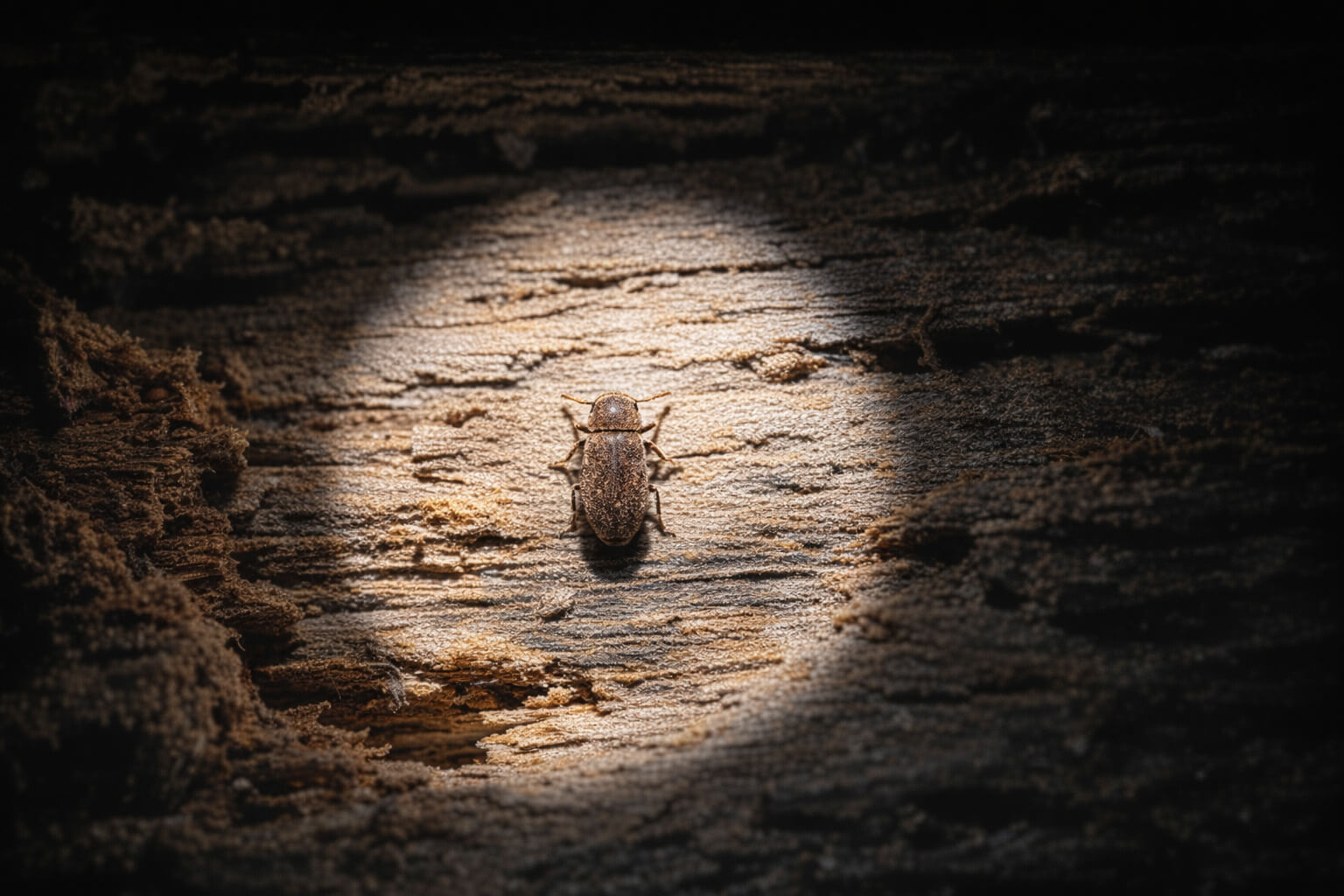
Deathwatch beetle treatment stops active attack, but structural integrity returns only when enough sound timber remains or the member is repaired.
If you are standing in a loft staring at peppered flight holes, or reading a survey that suddenly mentions deathwatch beetle, the tempting thought is simple: treat it and move on. The problem is that treatment is a biological fix, not a structural one. The safe sequence is simple: stop the infestation, assess what sound timber is left, then decide whether repair, reinforcement, or replacement is needed.
Treatment, repair and replacement are different jobs
Treatment deals with the insect. Repair deals with strength. Replacement deals with timber that cannot safely stay in service. Those are separate decisions, with different costs, risks and conservation consequences.
| Decision | What it changes | What it does not change |
|---|---|---|
| Repair / reinforcement | Restores or supplements strength | Whether active infestation is still present |
| Replacement | Removes badly damaged timber entirely | The need to solve damp and prevent recurrence |
A beam can be treated but still unsafe, or untreated yet structurally adequate if the infestation is old and no active risk remains. Old holes are evidence, not a structural verdict.
What structural integrity means in your building
Structural integrity means the timber still has enough sound wood, in the right places, to carry load safely. For a joist, that means resisting bending. For a beam end in masonry, it means sound support. For a truss, it means members and joints still work together as a load path.
So the key question is not, “Has it been treated?” It is, “How much sound timber is left where it matters most?” SPAB’s timber frame guidance recommends understanding the frame, inspecting the joints, and avoiding needless replacement until the condition is properly understood SPAB.
Why can deathwatch beetle damage become structurally serious in old timber?

Deathwatch beetle can weaken load-bearing hardwood because larvae tunnel inside damp, fungus-modified heartwood rather than only superficial surface timber.
What makes deathwatch beetle unnerving is where it appears: older, often valuable hardwood timbers in buildings you cannot casually strip out and replace. In practice, that means damage can affect beams, joists and truss members that carry the building, not just surface wood.
The moisture–fungus–beetle chain
The chain usually starts with damp. A leaking roof, poor ventilation, or a beam end buried in wet masonry can keep moisture levels high. Fungal activity then alters the timber, making it more suitable for larvae. Over time, larvae tunnel internally and remove section you may not see from the surface.
Cadw’s roof guidance makes the wider point clearly: keeping the building watertight is basic protection for the whole structure, and small moisture failures can quietly create the conditions for major timber decay and infestation Cadw.
Why older beams and joists are vulnerable
In period buildings, the affected timbers are often large, load-bearing hardwood members: oak beams, truss elements, lintels, or joist ends built into masonry. Damage in the middle of a visible face may be manageable. Damage at a bearing end, tenon, or scarf joint is far more serious.
Research on historic buildings also shows how trapped moisture increases risk. When repairs or retrofits stop older structures drying as intended, timber can become more vulnerable to fungal change and insect attack.
Why visible holes can mislead you
Flight holes tell you beetles emerged. They do not tell you how much sound timber is left. You can have many old holes and still retain a useful structural section, or relatively few visible signs hiding deep internal tunnelling.
“The damage will usually be historical and rarely requires treatment.” — Dr Brian Ridout, Managing Director, Ridout Associates; adviser commissioned by English Heritage on timber decay Building Conservation
Research on historic oak supports that caution. Surface evidence is not a reliable substitute for understanding internal loss, which is why old timbers need to be read like evidence, not scored by appearance alone.
A recognition moment
If you lift your torch across an old oak beam below a roof leak, the face may still feel hard and dry while the buried end is soft, crumbly or hollow. That is the pattern that catches people out. The beam looks acceptable until you test the point where it actually transfers load.
“We thought treatment would close the issue, but the real shock was learning the beam end had already lost the strength it needed.” — a listed farmhouse owner in Sussex
How is structural loss in beetle-damaged timber actually assessed?

Residual strength is assessed from sound timber left, damage location, joint condition and loading, not from surface holes alone.
This is where guesswork has to stop. You need more than a visual impression and more than a treatment quote. Proper assessment asks four things at once: is the attack active, are damp conditions still present, how much timber has been lost internally, and what structural job does that member perform?
First checks: activity, moisture and structural role
You first need to separate active attack from historic evidence. Fresh frass, recent emergence, damp conditions, and new signs in season matter more than old holes. Then you need to establish whether the timber is structural. A lightly affected trim piece is very different from a principal joist, beam or truss member.
If your surveyor points to a dusty patch beneath a beam, that detail matters. Fresh gritty frass in season tells a different story from old, compacted debris that has sat undisturbed for years.
Visual inspection, probing, and close attention to joints matter because a frame’s integrity depends heavily on connection details, not just the broad timber faces.
How specialists look inside the timber
Probing tests softened zones. Hammer sounding can suggest hollowness. Moisture mapping shows whether the environment still supports infestation or decay. Micro-drilling or resistograph testing helps map voids and denser sound zones. Endoscopy allows targeted internal viewing through small access points.
| Method | What it shows best | Main limitation |
|---|---|---|
| Probing / hammer sounding | Soft zones, hollow-sounding areas, suspect ends | Local and interpretive, not a full internal map |
| Moisture mapping | Whether damp conditions remain | Does not measure strength directly |
A useful rule is simple: a beam is judged by the sound wood left where it matters, not by the number of holes you can count.
“The structural integrity of the timber should always be checked.” — Robert Demaus, structural timber consultant, Building Conservation Directory Building Conservation
Why joints, bearing ends and load path matter most
Timber often fails at the details. A joist end in damp masonry may lose section exactly where it bears. A tenon may be weak inside a joint that looks fine from outside. A truss member may still look heavy enough but no longer transfer force properly because the connection zone has been compromised.
Conservation guidance makes the same point: understand the frame before intervening, and read structural significance before deciding on treatment or replacement.
What does deathwatch beetle treatment actually do — and what does it not do?

Deathwatch beetle treatment targets active insects and recurrence risk, but it does not rebuild lost section or certify structural adequacy.
This is where many decisions go wrong. Once treatment has been recommended, it is easy to hear that as a full solution. It is not. Treatment controls the biological problem and helps reduce recurrence, but structural restoration is a separate question.
Environmental control comes first
If damp remains, the cause remains. A leaking roof, blocked gutter, poorly ventilated void, or wet masonry pocket can keep timber vulnerable to future attack and ongoing decay. Drying the situation is often more important than applying chemicals.
Prompt maintenance and moisture control protect the whole building, not just the affected timber.
Chemical and localised treatment options
Depending on access and heritage sensitivity, treatment may involve surface-applied insecticide, local gels or pastes, boron-based products, or targeted injection. Heat treatment is sometimes proposed, but large historic timbers are difficult to heat effectively through the full section.
If you own an older property, that matters. The timber you most want to preserve is often thick, irregular and buried in awkward details, which makes blanket assumptions about treatment less reliable.
Heat sterilisation in large oak members is not straightforward, which matters because those are often the very timbers you most want to preserve.
What treatment cannot do
Treatment cannot put fibres back. It cannot stiffen a springy floor, rebuild a softened bearing end, repair a failed joint, or sign off structural safety. If section loss has changed the load path, the structural question stays open until it is assessed and, if needed, repaired.
A sprayed beam may therefore be biologically stable and still structurally doubtful. A dry beam with historic holes may need no treatment at all but still deserve checking if it carries important load.
When is treatment alone enough — and when is it not?

Treatment alone is enough only when attack is limited, moisture is corrected and the remaining timber still carries load safely.
This is usually the point you want a straight answer. Can you stop at treatment, or are you stepping into repair work as well? Treatment-only cases do exist, but they are narrower than many people assume.
When treatment alone may be enough
Treatment-only is more plausible when attack is localised, residual section remains strong, joints and bearings are sound, and the moisture source has been resolved. You also want no meaningful deflection, sag, crushing, or sign that the member is already struggling.
If your loft beam has old holes, dry timber, no fresh frass in season, and firm ends under probing, monitoring or limited treatment may be enough. In that case, the structure may be carrying a memory of old attack rather than suffering active structural decline.
When treatment alone is not enough
Treatment alone is not enough where the affected member is a principal beam, joist, truss, or lintel and the damage is concentrated at supports or joints. It also falls short where damp persists, fungal decay is present, or testing shows large internal voids.
If your floor joist disappears into a damp wall and the end breaks away under probing, the problem is no longer just biological. The bearing is already compromised. If your staircase feels bouncy above that area or a floor line has started to dip, the stakes are higher still.
A simple traffic-light rule
- Green: historic signs, dry timber, sound ends and joints, no movement
- Amber: active signs or moderate damage, but section still likely adequate after testing
- Red: soft bearing ends, major voiding, visible sag, joint weakness, combined damp and decay
Surface appearance can understate internal damage, so “it doesn’t look too bad” is not a safety test.
Another recognition moment
If your listed oak beam still has a strong outer shell but testing shows local internal loss near one end, treatment may still be part of the answer, but only alongside a repair that restores support while keeping as much original timber as possible.
How can damaged timber be repaired or reinforced before full replacement is needed?

Structural capacity can often be restored with targeted repair, splicing or reinforcement before full timber replacement becomes necessary.
Hearing the word “repair” can make it sound as though wholesale replacement is coming. Often it is not. In older buildings, the better route is usually conservation-led: keep as much sound original timber as you safely can, and strengthen only where the evidence says you must, as Spelthorne Borough Council’s repair guidance recommends Spelthorne Borough Council.
Repair-first thinking
Repair in situ is often possible when damage is local. Matching timber can be scarfed into the weakened area. Joists can sometimes be doubled up or sistered. Bearings may be rebuilt or supported with discreet steel details. Joints can be tightened or locally reconstructed where enough sound timber remains.
That matters if you are trying to protect both safety and character. You may not need to lose an entire visible beam just because one end has failed.
Conservation practice supports this approach: retain what is sound, and strengthen only as much as needed to make the structure work again.
Common methods and what they are for
| Repair method | Best use | Main limit |
|---|---|---|
| Scarf / splice repair | Localised end or section loss | Needs enough sound timber to connect into |
| Sistering / doubling-up | Floor joists and some beams | May affect build-up, levels or access |
| Concealed steel / brackets | Weak bearings, joints, local reinforcement | Needs careful heritage detailing |
Resin consolidation sometimes has a role, but it is not a default cure for structural deathwatch damage. In heritage work especially, it needs careful judgement.
When partial replacement becomes necessary
Partial replacement becomes more likely when the weak zone is too extensive for a reliable local repair, the joint geometry has been lost, or the support area has failed so badly that little sound timber remains to anchor into. Full replacement is the last step, not the first, but sometimes it is the only honest option.
Severely damaged timber may need to be cut back and renewed, while still following the wider principle of minimum necessary replacement.
Listed building implications
If your property is listed, structural necessity does not remove heritage obligations. The repair may need to preserve visible fabric, match species and detailing, and satisfy conservation officers that the work is proportionate.
Historic-building guidance repeatedly favours like-for-like and minimal intervention, which is why repair design should be both structurally credible and conservation-aware.
How do you verify structural safety after treatment or repair?
Structural safety is verified by reassessing moisture, residual section, movement, bearings and repair performance after treatment or strengthening work.
This is the quiet stage, and it is easy to rush past it. The chemicals have been applied. The repair looks neat. The room is boarded back over. But none of that proves the timber is now safe. You still need evidence that moisture is controlled, activity has stopped, and the repaired or retained member is behaving properly in service.
What post-treatment verification should include
You want moisture checked again. You want to know whether any fresh frass appears in season. You want repaired ends, brackets, or sistered members inspected to confirm they are transferring load as intended. You also want to know whether there is continuing sag, twist, joint opening, or crushing at supports.
If your floor feels firmer, that is encouraging. It is not enough on its own. Verification is about evidence, not relief.
Signs your timber is safe to retain
The strongest signs are practical: dry or drying conditions, no new activity, firm bearings, stable joints, and no worsening deflection. If reinforcement or repair has been specified, it should be inspected and supported by structural judgement, not informal reassurance.
Red flags that mean the real problem is still open
Fresh frass after treatment, persistently wet timber, worsening movement, or discovery of deeper voids all suggest the original scope was incomplete. In that situation, replacement may become the safer answer because the building has revealed a larger structural problem than first understood.
That cautious approach fits wider heritage repair guidance: intervene as little as possible, but enough to make the building safe and durable.
What should you do next if your Sussex property has deathwatch beetle damage?
Your next step is a joined-up timber survey that checks activity, moisture, residual strength and repair options before any blanket treatment.
If you are looking at an old beam, joist, or truss and wondering whether treatment is enough, the right next move is diagnosis, not panic. You need a survey that answers the real question in order: is the attack active, why did it happen, what timber is left, and what is the least invasive way to make it safe again.
The order that protects your building and your budget
Start by confirming active versus historic attack. Then trace the damp source. Then establish whether the timber is structural. Only after that should you move to residual-section assessment, repair design, and any targeted treatment. If the property is listed, bring the conservation issue in early.
That order helps you avoid the classic mistake: paying for treatment that kills insects while leaving the structural question unanswered.
How we approach it
At Sussex Damp Experts, we treat deathwatch beetle as both a timber problem and a building-moisture problem. We assess signs of activity, map the damp conditions that allowed attack, and separate three outcomes: timber that can be retained, timber that needs repair or reinforcement, and timber that has crossed the line into replacement.
“Our job is to separate insect activity from structural risk: first we confirm whether the attack is active, then we establish whether the timber can still do its job safely.” — Senior Timber Surveyor, Sussex Damp Experts
Your next step
If you need to know whether your timber is merely treated or actually safe, ask for a specialist survey that looks at moisture, infestation, and structural significance together. Sussex Damp Experts can help you move from guesswork to a clear repair decision, so you know whether you need monitoring, targeted treatment, structural repair, or replacement.
Frequently Asked Questions
How much does deathwatch beetle investigation and repair usually cost in the UK?
The honest answer is that the cost range is wide because you are rarely paying for one thing. You are usually paying for some combination of inspection, opening-up, monitoring, treatment, structural design, repair work, and making good afterwards. A simple survey with moisture readings and limited probing may be a few hundred pounds. Once you add specialist access, micro-drilling, scaffold towers, lifting floorboards, opening boxed-in beam ends, or engineer input, the figure can move into the low thousands. Actual structural repairs can then range from a modest localised joist-end repair to a five-figure project if multiple principal timbers, ceilings, finishes or listed-building constraints are involved.
What catches many owners out is not the timber work itself, but the associated costs. If you need scaffold, plaster repairs, joinery removal, decorator redecoration, lime plaster reinstatement, or a conservation officer-approved repair detail, the total project sum rises quickly. A “cheap treatment quote” can therefore be misleading because it often excludes the cost of finding the true extent of damage and putting the building back together properly. One common trap is a low quote for spraying alone that says nothing about opening up beam ends, temporary propping, engineer calculations, or repairing ceilings and floors after access works. The treatment price looks attractive, but the real project cost may be several times higher.
A useful way to budget is to think in layers:
- Diagnosis layer: survey, access, testing, engineer review
- Intervention layer: treatment, local repairs, propping, timber works
- Recovery layer: making good, decoration, access removal, follow-up checks
If you are buying a house, ask for the estimate to separate infestation control, structural work, and reinstatement. If you already own the property, ask for a phased scope showing what is urgent, what is optional, and what depends on opening up hidden areas. That gives you a more realistic budget and makes it much easier to compare quotes that might otherwise look wildly different.
How long does the whole process take, from survey to knowing the timber is safe?
In straightforward cases, the timeline can be measured in weeks. In more complex or heritage-sensitive cases, it can stretch into months. The big variable is not usually the treatment itself. It is access, drying time, permissions, and whether the first inspection reveals deeper hidden damage.
A simple private house scenario might look like this: an initial survey in week one, targeted opening-up and further checks in week two, treatment or local repair shortly after, then a follow-up review once the timber environment has stabilised. If the issue is mainly local and the property is dry, that can move quickly. If the property is wet, listed, occupied, or full of concealed structural timber, the programme slows down. You may need time for scaffold, contractor coordination, listed building consent, engineer drawings, or dry-down after fixing a leak.
The monitoring stage is the part most people underestimate. After treatment, you often need at least one full emergence season to confirm the infestation has stopped. In some cases, two seasons. That means you may not get a definitive “all clear” for twelve to twenty-four months after treatment, even if the structural repair work itself is finished much sooner. During that period, you might use emergence traps, visual checks, dated photographs, and targeted inspections to track what is happening.
For a listed building with multiple affected timbers, the realistic timeline from first survey to final sign-off might look like this:
| Phase | Typical duration |
|---|---|
| Initial survey and access | 1–3 weeks |
| Opening-up, testing, engineer review | 2–6 weeks |
| Consent and approvals (if listed) | 4–12 weeks |
| Treatment and repair works | 2–8 weeks |
| Monitoring and sign-off | 12–24 months |
So the short answer is: the physical work may take weeks, but confidence that the timber is genuinely stable often takes one to two emergence seasons.
How do you prove to a buyer, lender or insurer that deathwatch beetle is no longer active?
You prove it with evidence, not reassurance. A buyer, lender or insurer will usually want a clear paper trail showing what was found, what was done, and what has happened since. A verbal statement that “it was treated a while ago” carries very little weight. A file with dated surveys, photographs, treatment records, moisture readings, repair specifications and follow-up inspections is far more persuasive.
The most useful evidence pack usually includes:
- the original timber or building survey
- a plan marking affected timbers and locations
- treatment records with dates and product details
- repair invoices and any structural design information
- dated photographs before, during and after works
- follow-up inspection notes covering at least one emergence season
- records of moisture correction, such as roof repairs or drainage work
For a buyer, the key issue is confidence. For a lender, it is risk. For an insurer, it is whether the matter is historic, ongoing, or likely to create a future claim. Those audiences do not all need the same level of detail, but they all respond better to a documented sequence than to a loose summary. If a mortgage valuation flags historic beetle damage, a lender may ask for a specialist report confirming there is no evidence of active infestation and that any necessary repairs have already been completed. If you cannot provide that, the lender may impose a retention or ask for additional reports before releasing funds.
If you own a period property, start keeping records even before the work begins. Save the first survey, keep labelled photos, and file all invoices together. If fresh concerns arise years later, that archive can save you from repeating invasive investigations. If the evidence trail is weak, the next surveyor may assume the worst. Good records do not just help the next sale. They protect your position whenever another party wants proof that the problem is understood and under control.
What happens if deathwatch beetle is found during a property survey before purchase?
It depends on the severity, the property type, and your risk appetite. Finding deathwatch beetle in a pre-purchase survey is not automatically a reason to walk away, but it does change the negotiation and the due diligence you need before committing.
The first thing to establish is whether the infestation is active or historic. Many older oak-framed buildings have had deathwatch beetle at some point in their history. Flight holes alone do not prove current activity. What matters is whether there is fresh frass, recent emergence evidence, or other signs that activity is current rather than long dead. A specialist timber survey can often narrow that down with reasonable confidence, though some cases still need short-term monitoring or limited opening-up.
If the infestation appears historic and the timber is structurally sound, the main issue may be risk allocation rather than immediate works. You might proceed with the purchase but budget for follow-up inspections, environmental improvements, or local repairs that the general survey could not price accurately. If the infestation is active or the condition remains uncertain, you need more than a treatment quote.
Before you exchange, try to get three things:
- A specialist timber opinion on activity and extent
- A repair estimate that separates treatment, access, structural work and making good
- A lender position if finance is involved, especially if the valuation mentions infestation
That third point matters. Some lenders will proceed once they see a specialist report. Others may hold back part of the loan until work is complete. If the property is listed, your timeline may also be affected by heritage approvals, which can influence whether you ask for a price reduction or want the seller to complete work first.
The worst outcome is relying on a vague survey sentence and discovering later that “evidence of beetle attack” actually meant concealed structural work, access costs, and months of disruption. The best outcome is using the finding properly: as a prompt to investigate, price the risk, and negotiate from evidence rather than fear.
Is deathwatch beetle notifiable, and what legal or transactional obligations can fall on you?
Deathwatch beetle is not a notifiable pest in England or Wales. There is no formal duty to report it to a government body, and no law saying you must treat every infestation. The real obligations sit elsewhere: property sales, lender requirements, structural safety, listed status, and the accuracy of what you disclose when questions are asked.
If you sell a property and know there is active infestation, concealed damage, or unfinished repair work, you move into disclosure territory. In practice, the issue often appears through the TA6 Property Information Form, survey follow-up questions, or direct enquiries from the buyer’s solicitor. If you minimise or conceal a known problem and the buyer later discovers evidence that you knew more than you admitted, the dispute may become one of misrepresentation rather than pest control. That is why clear documentation matters. It is safer to disclose the condition, explain what investigation has been done, and provide records than to hope old flight holes go unnoticed.
There are also differences between regimes that owners often blur together:
- Listed Building Consent deals with effects on historic character
- Building Regulations / Building Control deal with structural work and compliance
- Lender conditions deal with mortgage risk
- Insurance requirements deal with claims and proof
Those systems overlap, but they are not the same thing. You can have structural works that building control wants to inspect even if listed consent is not required. You can have a listed building issue even when no insurer is involved. You can also face a mortgage retention where no legal breach exists at all.
If you are in dispute territory, paperwork becomes protection. Keep reports, quotations, emails, photos and dated notes of conversations. If you are uncertain whether a repair needs approval, ask before work starts. That may feel slower, but it is much safer than defending unapproved work, a collapsed sale, or a lender challenge later.
Can you treat deathwatch beetle yourself, or is professional treatment always necessary?
You can buy timber treatment products yourself, but that does not mean a DIY approach is always sensible, safe, or accepted by the people who matter. The more useful question is not “Are you allowed?” but “What can you realistically achieve, and what evidence will you have afterwards?”
DIY products are usually sold for straightforward wood-boring insect treatment in accessible timber. Labels often assume you can brush, spray or inject a defined area with reasonable access, clean surfaces and limited thickness. Deathwatch beetle cases are often the opposite: old oak, awkward roof spaces, enclosed beam ends, decorative finishes, hidden cavities, and uncertain structural importance. Even where a product is legally available to you, the application conditions may not match the building in front of you.
The practical problems are usually these:
- Access: you may not be able to reach the affected area without lifting floors, removing finishes or working from scaffold
- Safety: roof voids, confined spaces and unstable floors are poor places for untrained chemical use
- Compatibility: sprays, gels or pastes may stain finishes, affect surrounding materials, or be unsuitable near occupied spaces
- Proof: a future buyer or lender may attach little weight to “I treated it myself” without reports, product data and follow-up evidence
There is, however, a sensible middle ground. You can often do useful non-treatment tasks yourself: cleaning loose debris, improving ventilation where appropriate, keeping records, checking for new staining after rain, or setting up a photo log. Those actions help you understand the pattern without pretending you have solved it.
A good rule is this: DIY observation is often useful; DIY treatment is only defensible when the timber is accessible, non-sensitive, clearly non-structural, and you fully understand the product and the risks. Once structural oak, listed fabric, hidden cavities, lender scrutiny or significant access issues enter the picture, you need a more formal route. That is why we usually start by defining what your building actually needs before anyone reaches for chemicals.

