
 By
 March 31, 2026


One Set of Holes, Two Very Different Problems
You have found small holes in timber, searched online, and ended up with two names that sound interchangeable. They are not. In East Sussex, we regularly inspect homes where ordinary common woodworm has been mistaken for deathwatch beetle, and older deathwatch conditions have been dismissed as “just woodworm.” The difference affects how seriously you need to take the finding, what work is sensible, and whether any treatment is needed at all.
The common furniture beetle, Anobium punctatum, is the most commonly encountered wood-destroying insect in UK buildings, while deathwatch beetle, Xestobium rufovillosum, is a different insect with different habitat needs and different implications (PCA Code Of Practice). Timberwise notes that deathwatch is one of several UK wood-boring insects commonly grouped under the catch-all label “woodworm,” and gives adult sizes at about 4mm for common furniture beetle and about 7mm for deathwatch beetle (Timberwise).
“The Deathwatch Beetle is one of a number of wood boring insects that are found in the UK, which are commonly classed as ‘Woodworm’.” — Timberwise Editorial Team, Timberwise
Most exit holes found in homes are from common woodworm, often in softwood roof timbers, floorboards, joinery, or furniture. Deathwatch beetle is more selective. It is associated with older hardwoods such as oak and elm and, in many cases, with timber already weakened by long-term damp and fungal decay.
That is why the real question is not only, “What insect made this hole?” It is also, “What insect, in what timber, in what condition, and is it still active?” Get the diagnosis wrong in either direction and you either pay for unnecessary treatment or miss a moisture-led structural defect.
How to Identify Deathwatch Beetle vs Woodworm

The quickest useful distinction is this: common woodworm typically leaves smaller holes in softwood or sapwood, while deathwatch beetle usually leaves larger holes in older hardwood, with coarser frass and a stronger link to damp-decayed timber. Hole size helps, but a sound diagnosis combines hole size, frass, timber species, location, and evidence of current activity.
BPCA gives common furniture beetle exit holes as about 1–2mm and deathwatch exit holes as about 2–3mm, with some sources citing larger deathwatch holes up to 4–5mm. It also notes that adult emergence is most apparent from spring into early summer, which is why fresh signs are easier to assess then (BPCA PestWatch).
Exit Hole Size
Hole size works best as a first filter, not a verdict. If the holes are clearly tiny and scattered across softwood boards, roof timbers, or joinery, common woodworm is more likely. If they are noticeably larger and in old oak or elm, deathwatch becomes more plausible.
Paint, abrasion, cleaning, and repeated emergence can all distort a hole. A worn 2mm hole in painted timber can look larger than it started, and a dirt-filled hole can look smaller. That is why site context matters more than a ruler on its own.
Frass Texture
Frass often tells you more than the hole because it reflects both the insect and the timber it has been feeding in. English Heritage describes deathwatch frass as large, rounded pellets about the size of a small pinhead that roll when moved, unlike the finer, grittier waste more typical of common woodworm (English Heritage Fact Sheet No. 3).
“Emergence holes in wood. Old holes will look dark and dirty. Frass pellets are round and large [the size of a small pinhead] and will roll around when moved.” — English Heritage Conservation Team, English Heritage
If you brush dust onto white paper, common woodworm frass usually looks like fine grit. Deathwatch frass is coarser, pellet-like, and more mobile. Fresh frass matters more than old debris trapped in cracks.
What Fresh Activity Looks Like
Fresh activity usually shows as pale, clean-edged holes and new frass below the timber. Old debris can still drop from historic holes when timbers are disturbed, so one loose patch of dust proves very little. The more useful sign is recurrence in the same place after cleaning.
SPAB puts the distinction well:
“Active outbreaks are identified by sharp-edged holes, not worn rounded ones, fresh-looking bore dust, interiors the colour of freshly cut timber.” — SPAB, Society For The Protection Of Ancient Buildings
Why One Clue is Never Enough
A good identification uses several markers together.
| Marker | Common Woodworm | Deathwatch Beetle |
|---|---|---|
| Exit Holes | Usually 1–2mm, round | Usually 2–3mm, sometimes larger |
| Frass | Fine, gritty, smaller pellets | Larger, bun-shaped pellets that roll |
| Typical Timber | Softwood and hardwood sapwood | Older hardwood, often oak or elm |
| Usual Setting | Roofs, floors, joinery, furniture | Structural beam ends near damp masonry |
In practice, a 2mm hole in softwood skirting is not the same finding as a 3mm hole in an old oak beam socket. If you cannot measure precisely, the timber type and location often tell you more than the hole itself.
Where Each Species Usually Turns up in a Building
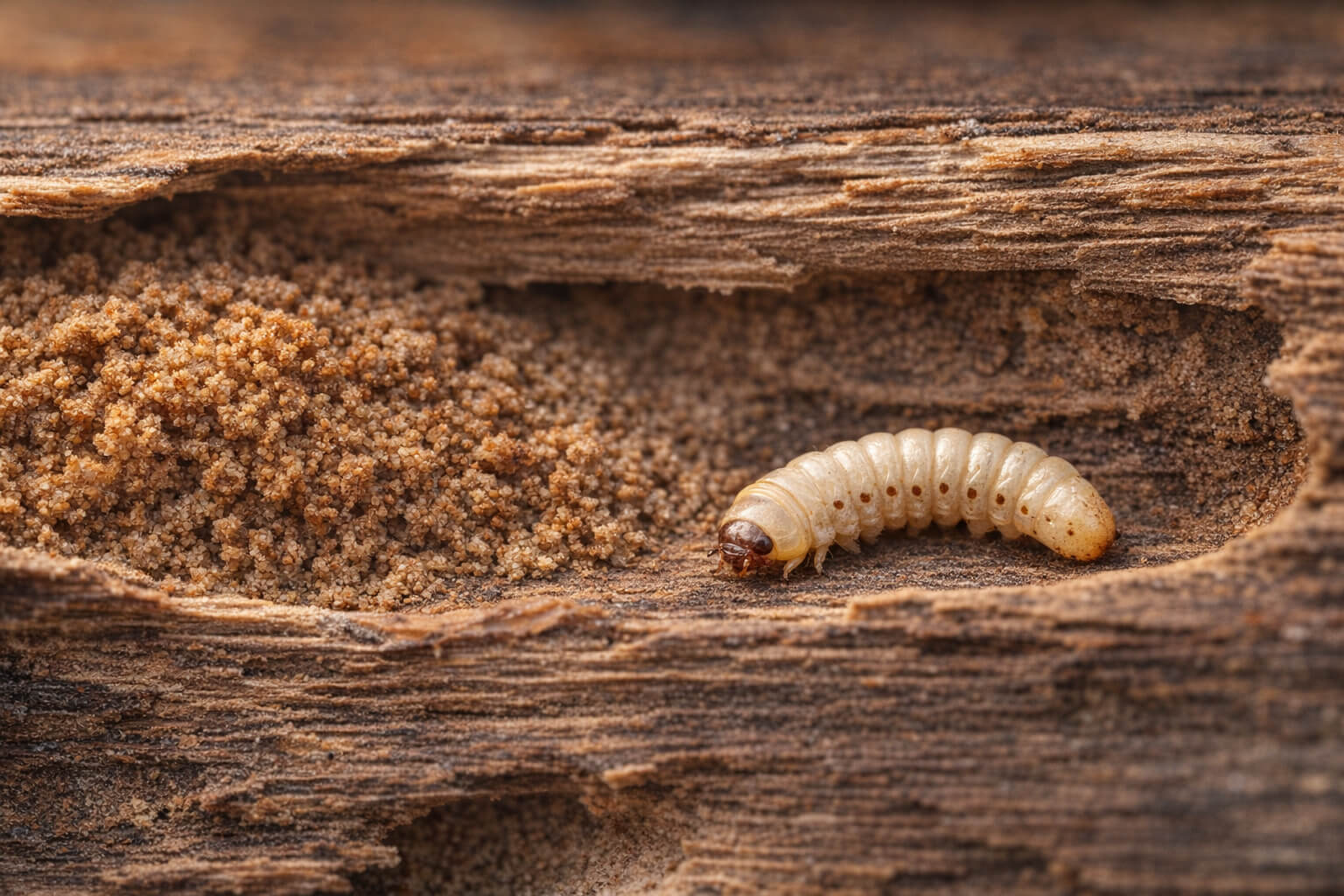
Location often gives the answer before hole size does. Common woodworm usually appears in ordinary domestic timbers that contain sapwood. Deathwatch beetle is far more associated with older hardwood structural members, especially where damp and fungal decay are already present. Softwood loft timbers tend to point one way; damp oak beam ends built into masonry tend to point the other.
Common Woodworm Habitats
Common woodworm is the insect most people mean when they say “woodworm,” and it turns up in visible, everyday timbers such as:
- Softwood roof timbers and loft boards
- Floorboards and joists with sapwood present
- Joinery such as skirtings, stairs, and door frames
- Furniture and stored timber in garages or outbuildings
This broad habitat range is one reason it is reported so often.
Deathwatch Beetle Habitats
Deathwatch beetle is more selective and more tied to building condition than to timber alone. Typical settings include:
- Old oak or elm structural members
- Beam ends built into damp external walls
- Timbers at masonry junctions with poor air movement
- Concealed structural zones where fungal decay is already present
English Heritage and SPAB are useful examples here because both address deathwatch in historic timber rather than in ordinary modern joinery. Churches and other ecclesiastical buildings are the textbook setting because they often retain large historic hardwood members and long-term moisture pockets.
Why Timber Species and Location Matter
If you know the timber is softwood, the odds shift strongly toward common woodworm. If the affected timber is old oak carrying load at a wall junction, deathwatch becomes much more credible. That is also why a diagnosis from a single photo is weak. The same visible symptom means very different things depending on whether it is in a roof batten, a floorboard, or a principal beam.
How to Tell Active Attack From Historic Damage

Many beetle holes in older properties are historic rather than active, so the presence of holes alone is not a reason to spray or replace timber. Current activity is usually suggested by fresh frass, pale sharp-edged holes, and dust that returns after cleaning. Old damage tends to show dark, worn openings and no continuing debris.
Signs of Current Activity
The most useful signs are the ones that repeat. Clean the area, photograph it, then recheck during the emergence season.
Useful indicators include:
- New frass appearing below the same timber
- Pale hole interiors with crisp edges
- Repeated dust fall after careful cleaning
- Damp, softened, or decayed timber around the attack
- Adult emergence during the warmer months, especially spring to early summer
That last point matters because timing can help. If fresh debris appears in April, May, or June, it deserves more weight than dust found once in mid-winter after building work.
Signs the Damage May Be Old
Historic damage usually looks dirtier and less distinct. Holes may be darkened, rounded, painted over, or partly filled. The timber may still be firm when lightly probed, with no new debris below.
SPAB’s approach is useful in old buildings because visible holes often outlast the infestation itself by many years. That is why a loft full of old flight holes is not automatically an active problem and not automatically a treatment job.
When Monitoring is Reasonable
Monitoring is often enough when timber is dry, firm, and non-structural, and when no fresh frass appears after cleaning. A simple plan works well:
- Vacuum or brush the area clean
- Take date-stamped photos
- Recheck through the emergence season
- Watch for repeated dust in the same place
Monitoring stops being sensible when the timber is structural hardwood, visibly damp, or already decayed. At that point, the issue is not only infestation but condition.
What Deathwatch Beetle Can Mean Financially

The financial difference between common woodworm and deathwatch beetle is rarely the insecticide alone. The lower end of the scale is usually inspection, limited treatment, or no treatment at all where the attack is old. Costs rise when the finding leads to opening up, moisture diagnosis, decay repair, and work to structural hardwood.
Checkatrade’s current guide gives a woodworm survey at roughly £80–£250, average domestic treatment at about £500–£1,000, and treatment to a three-bedroom loft at roughly £400–£900 (Checkatrade Cost Guide).
| Cost Layer | Typical Scenario | Indicative Cost |
|---|---|---|
| Survey | Inspection and written report | £80–£250 |
| Local Treatment | Limited accessible area | Low hundreds |
| Average Domestic Treatment | Broader but straightforward woodworm work | £500–£1,000 |
| Loft Treatment | Three-bedroom house loft | £400–£900 |
Those figures help frame the lower end of the problem. Deathwatch becomes expensive when it is a symptom of a wider defect: damp beam ends, fungal decay, difficult access, specialist carpentry, or structural input. In those cases, costs can run into several thousand pounds, not because deathwatch has a magic price tag, but because the repair scope is larger.
The key budgeting question is not, “How much does deathwatch treatment cost?” It is, “What condition is the timber in, what caused that condition, and what has to be opened up or repaired?”
What Happens With Insurance, Listed Buildings, and Conveyancing

These issues change the practical consequences of beetle findings. Insurance often excludes gradual deterioration. Listed buildings may need consent before historic fabric is altered. During a sale, buyers and surveyors usually want clarity on activity and timber condition, not immediate replacement.
Insurance and Policy Reality
Most standard home policies typically exclude gradual deterioration such as rot, decay, or insect attack. That means you should not assume cover, especially where the underlying cause is long-term dampness or neglected maintenance. The sensible step is to read the wording of your own policy before budgeting on an insurance claim.
Listed Buildings and Historic Timber
Listed buildings need a more careful approach because the timber may itself be part of the building’s significance. GOV.UK states that listed building consent is required for works that affect a listed building’s character as a building of special architectural or historic interest (Listed Building Consent Overview).
That matters because the right response is often repair and moisture control, not wholesale replacement. In period buildings, aggressive strip-out can destroy historic fabric without solving the damp conditions that allowed the problem to develop.
What Buyers, Sellers, and Surveyors Usually Need
During conveyancing, beetle evidence often leads to a request for a specialist timber report rather than an assumption of major works. Buyers want four things clarified:
- Which insect is most likely present
- Whether there is evidence of current activity
- Whether structural timber is affected
- Whether repair, treatment, or monitoring is justified
That moves the conversation away from alarm and toward an evidence-based scope of work.
How Treatment Differs Between Woodworm and Deathwatch Beetle

Treatment differs because the underlying problem differs. Inactive common woodworm in dry, sound timber may need no treatment beyond monitoring. Active deathwatch beetle usually needs a wider process: confirm activity, identify the moisture source, assess fungal decay, check whether the timber is load-bearing, and then decide on targeted treatment or repair. Moisture first, chemistry second.
When No Treatment May Be Needed
Not every hole deserves insecticide. In dry, firm timber with no fresh frass and no recurring signs, monitoring is often the better option. That is restraint, not neglect. Old buildings commonly carry visible holes from infestations that died out decades ago.
Why Moisture Control Comes First
Deathwatch beetle is strongly linked to damp-decayed hardwood, so if you do not address the moisture source, you have not addressed the condition that made the timber vulnerable. Common causes include:
- Leaking roof coverings or flashings
- Blocked or overflowing gutters
- Trapped condensation in poorly ventilated voids
- Earth or render bridging at wall bases
- Beam ends sealed into impermeable repairs
In traditional buildings, breathability matters. Dense cement repairs and non-breathable coatings can trap moisture at exactly the masonry junctions where decay and beetle activity persist.
When Structural Repair Enters the Plan
Structural repair becomes part of the job when decay or insect damage has reduced the timber’s capacity, not because holes are visible on the surface. A sound beam with scattered old flight holes is very different from a softened beam end disappearing into wet masonry.
A proper assessment may include probing, moisture readings, and opening up concealed ends where needed. In heavier infestations, surface appearance can seriously understate what is happening at the bearing end.
BPCA’s caution on treatment limits is important here:
“Brush-on and spray-on treatments may destroy eggs and young larvae as they hatch but are doubtful against older larvae tunnelling well below the timber surface.” — BPCA, British Pest Control Association
Why Spray-only Solutions Often Miss the Real Problem
Spray-only work can look decisive while leaving the main defect untouched. If the timber is still damp, still decayed, or still built into a wet wall, the building condition remains the issue. That is why old-building guidance from organisations such as SPAB focuses on diagnosis and repair rather than indiscriminate spraying.
When to Call a Specialist Timber Surveyor
You should call a specialist promptly when the finding is in structural hardwood, when fresh debris keeps returning, when damp or fungal decay is visible, when the property is listed, or when a sale depends on a clear written opinion. In those situations, naming the insect is only part of the job.
Situations You Can Monitor
Monitoring is usually reasonable when all of the following apply:
- The timber is non-structural or minor
- The timber appears dry and firm
- No fresh frass returns after cleaning
- The holes look old, dark, and worn
- No sale, purchase, or listed-building decision depends on the outcome
Situations That Need a Survey Promptly
A survey is sensible sooner rather than later when:
- Holes are in oak, elm, or other hardwood structural members
- Frass keeps reappearing in the same place
- You can see damp staining, fungal growth, or softened timber
- The attack is near a beam end, wall plate, or joist bearing
- The building is listed or part of a heritage repair project
- A buyer, seller, lender, or surveyor needs a report
“It is essential that the surveyor identifies and understands the type and extent of the infestation before deciding control measures.” — PCA, Property Care Association
A good specialist should assess insect type, activity, timber species, structural role, moisture source, and any hidden decay. That is the difference between a useful survey and a guess based on hole size.
Book a Moisture-led Timber Survey Before You Treat or Replace Anything
A moisture-led timber survey gives you a clearer answer than a guess based on holes alone. Sussex Damp Experts can identify the likely insect, assess whether activity is current, check the moisture conditions supporting it, and separate timber that needs monitoring from timber that needs treatment or repair. If you are dealing with suspected deathwatch beetle, a listed property, or a sale where the finding needs to be explained in writing, start with evidence before chemicals or replacement. Book a consultation with Sussex Damp Experts for a practical written recommendation you can use.
Frequently Asked Questions
The questions below go beyond the article’s main diagnosis and treatment sections and focus on practical homeowner decisions that often come up before, during, and after a timber survey is booked.
Can Photos Reliably Identify Woodworm or Deathwatch Beetle?
No, photos are useful for screening but are not reliable enough on their own to confirm whether you have common woodworm, deathwatch beetle, or only old damage.
What Photos Can Do Well
Good images can help a surveyor decide whether a visit is worth prioritising and what tools to bring. They are most useful when they show:
- the timber in context, not just one close-up hole
- a size reference such as a millimetre ruler
- loose dust beneath the timber, if present
- the surrounding material, such as plaster, masonry, or roof lining
- signs of damp staining, fungal growth, or cracking nearby
That can be enough to sort cases into “likely historic,” “needs on-site inspection,” or “urgent because structural/damp-related.”
What Photos Usually Cannot Confirm
The main problem is that photographs flatten detail. They rarely show pellet shape accurately, and they cannot test timber hardness, moisture, or internal condition. Research gaps also matter here: there is no widely adopted published photography standard for homeowner identification, and no calibrated photo method that makes hole sizing definitive from an image alone.
| Photo Limitation | Why It Matters |
|---|---|
| No scale or poor angle | Hole size becomes guesswork |
| Flash glare | Frass texture looks smoother than it is |
| Tight crop | You lose timber type and location context |
| Painted or dirty surfaces | Old and new holes become harder to separate |
| No moisture reading | You cannot assess whether conditions still support infestation |
How to Make Photos More Useful
If you are sending images before a survey, take three sets:
- Wide shot of the whole room or roof area
- Mid-range shot showing the timber’s role, such as joist, beam end, or floorboard
- Close-up with scale taken face-on in natural light if possible
Do not poke holes with tools to “show depth,” and do not brush away all dust before photographing. A photo-led screening opinion can save time, but it should not be mistaken for a full diagnosis when species, activity, or structural risk are uncertain. See “How To Identify Deathwatch Beetle Vs Woodworm” above for the core physical clues.
What Evidence Should You Collect Before Booking a Survey?
You should collect simple, non-destructive evidence before booking a survey because it helps the inspector judge urgency, target the right areas, and avoid charging you to rediscover details you could have documented in five minutes.
The Most Useful Evidence to Gather
The best homeowner evidence is not technical; it is organised. Try to record:
- Location: room, floor level, loft, cellar, beam end, skirting, furniture, or roof slope
- Date first noticed: especially if dust appeared recently
- Recent changes: leaks, condensation, plumbing work, roof defects, or damp patches
- Repeat signs: whether dust returns after careful cleaning
- Photos: wide, mid-range, and close-up shots with a scale reference
- Access notes: whether the area is exposed, boxed in, carpeted over, or behind stored items
If you own a basic moisture meter, you can note readings, but do not treat that as definitive diagnosis. One reading only tells part of the story.
A Simple Evidence Pack
| Item | Why It Helps |
|---|---|
| Photo set with scale | Speeds first review |
| Short written timeline | Distinguishes new concern from long-standing defect |
| Room-by-room list | Prevents “whole house” assumptions |
| Notes on leaks or damp | Helps link insects to moisture sources |
| Sketch plan or marked photos | Shows whether signs cluster in one zone |
What Not to Do Before the Visit
Do not make the evidence worse by “tidying up” too aggressively. Avoid:
- vacuuming every trace of bore dust from the area
- painting, filling, sanding, or waxing over holes
- spraying aerosol insecticides
- lifting boards or cutting into beams unless advised
- assuming identical holes in different rooms come from one infestation
A basic woodworm survey may cost roughly £80–£250, so a tidy evidence pack can make that visit more focused and more useful. It also helps if the inspector needs to compare one area with another rather than treating the entire property as a single defect. See “When To Call A Specialist Timber Surveyor” above for the thresholds that turn those observations into a proper inspection.
Does Fresh Frass Always Mean Live Infestation?
No, fresh-looking frass often suggests recent insect activity, but it does not always prove a live infestation is still present at the moment you find it.
Why “fresh Dust” Can Mislead
Frass can be newly deposited by emerging adults, but it can also be old material shaken loose by vibration, cleaning, building work, slamming doors, loft traffic, or seasonal movement in dry timber. In older buildings, dust can sit inside galleries for years and spill out later without any current feeding.
That is why one sighting of pale dust is a warning sign, not a complete answer.
| Possible Cause Of Dust | What It Means |
|---|---|
| Repeated new deposits below the same area | Stronger evidence of current activity |
| One-off spill after disturbance | Could be historic material |
| Dust appearing during known emergence season | More suspicious |
| Dust with no sharp-edged new holes | Ambiguous, needs context |
| Dust in damp structural hardwood | Higher concern than dust in old furniture |
How to Test Whether it is Truly “fresh”
A practical approach is to create a clean baseline and then recheck:
- gently clean loose dust from beneath the affected area
- photograph the timber and the cleared surface
- note the date and weather/season
- recheck after a short interval, then again during the main emergence period
- compare whether dust has reappeared in the same place
For deathwatch beetle, spring to early summer is the most informative window, with BPCA recommending April to June as the best survey period. That does not mean signs outside that window are irrelevant; it means repeat observations in-season are more meaningful.
What Else Should Be Checked Alongside Frass
Frass is strongest when it matches other evidence:
- moisture or damp staining
- timber softness or decay
- audible tapping claims supported by physical signs
- recent emergence holes with clean edges
- species-appropriate timber and location
So treat fresh frass as a prompt to document and investigate, not as automatic proof that timber is actively being eaten today. See “How To Tell Active Attack From Historic Damage” above for the baseline activity checks.
How Quickly Should You Act After Finding Beetle Holes or Bore Dust?
You should act promptly, but not every hole is an emergency; the right speed depends on whether the signs are new, whether structural timber is involved, and whether damp or decay is present.
A Practical Triage Rule
The fastest way to think about it is by category:
| Situation | Recommended Timing | Why |
|---|---|---|
| Dust from a structural beam, joist, or roof timber with damp nearby | Within days | Could indicate an active moisture-led problem |
| Suspected deathwatch signs in old hardwood | Within 1–2 weeks | Best assessed before evidence is disturbed |
| New dust in ordinary joinery or furniture | Within 2–4 weeks | Important, but usually less urgent structurally |
| Old holes only, no dust, dry timber | Monitor and plan routine inspection | Often historic rather than urgent |
When to Escalate Faster
Book help sooner if any of these apply:
- the timber carries load, such as beam ends or main joists
- there is visible rot, softness, or sagging
- the area has had roof leaks, plumbing leaks, or chronic condensation
- you are buying or selling the property and need a documented opinion
- the infestation appears in more than one building zone with different timber types
The reason speed matters is not that all beetle damage spreads overnight; it is that moisture and decay can continue quietly while people focus only on the holes.
When Waiting Briefly is Reasonable
A short monitoring period can be sensible when:
- the timber is dry and sound
- holes look old and dirty
- there is no repeating frass
- the area is clearly non-structural
- you are waiting for the better survey window in spring or early summer
For suspected deathwatch cases, April to June is particularly useful because adult activity is more apparent then. That can make the inspection more conclusive and avoid treatment based on weak evidence gathered at the wrong time.
So, respond quickly enough to preserve evidence and rule out damp-led structural issues, but do not assume every old hole needs emergency spraying. See “When To Call A Specialist Timber Surveyor” above for the practical escalation points.
What Can a Specialist Surveyor Confirm That a Treatment Quote Cannot?
A specialist surveyor can usually confirm far more than a treatment quote because their job is to diagnose the problem first, not start from the assumption that chemical treatment is the answer.
The Key Difference in Scope
A treatment quotation often focuses on price and area to be treated. A specialist timber survey should look wider and ask whether treatment is needed at all, whether the species identification is secure, and whether damp or fungal decay is the bigger issue.
| Question | Specialist Surveyor | Treatment Quote |
|---|---|---|
| Is the insect identification robust? | Usually yes, with timber context | Sometimes only provisionally |
| Is the attack active or historic? | Core part of diagnosis | May be assumed from visible holes |
| Is there a moisture source? | Investigated | Not always central |
| Is the timber structurally significant? | Assessed or referred onward | Often outside quote scope |
| Is “monitor only” a valid outcome? | Yes | Less commonly emphasised |
What a Better Survey Can Add
A proper survey may include:
- area-by-area mapping rather than a whole-house label
- moisture profiling
- checking for fungal decay associated with beetle risk
- identifying whether damaged timber is sapwood, heartwood, softwood, or hardwood
- advice on access, opening-up, or structural engineer input if needed
In heavy infestations, the PCA Code of Practice also supports checking the internal condition of timber, not just the surface evidence. That matters because surface holes can understate or overstate the true condition.
Why This Matters Financially
An independent diagnosis can save money in two directions:
- it may stop you paying for unnecessary treatment of historic holes
- it may reveal that the real cost lies in moisture correction or timber repair, not insecticide
Typical woodworm survey pricing in the research sits around £80–£250, while specialist timber treatment labour rates often fall around £30–£70 per hour. Paying first for diagnosis is often cheaper than paying for the wrong works and then paying again to fix the actual defect.
The point is not that treatment firms are unhelpful; it is that diagnosis and treatment are different functions, and the best outcome usually starts with the first one. See “How Treatment Differs Between Woodworm And Deathwatch Beetle” above for why the remedy depends on the diagnosis.
What Mistakes Most Often Lead to Unnecessary Treatment?
The most common mistakes are assuming holes automatically mean active infestation, treating the whole property as one problem, and using spray treatment before the moisture and timber context have been properly checked.
The Costly Mistakes to Avoid
These are the patterns that most often lead to overspending:
- Treating old holes as live attack: exit holes can remain visible for decades
- Relying on one clue only: size, dust, or timber type alone can mislead
- Ignoring moisture: if damp persists, treatment alone may not solve anything
- Accepting blanket treatment areas: one affected zone does not prove the whole house needs spraying
- Covering evidence too early: filling, sanding, varnishing, or repainting can remove useful clues
- Confusing furniture damage with structural risk: not all infestations have the same consequence
A Better Decision Filter
| Mistake | Better Alternative |
|---|---|
| “Holes = active” | Check for repeat evidence over time |
| “One room has it, so treat all rooms” | Map affected areas separately |
| “Spray first, ask later” | Diagnose species, moisture, and structural role first |
| “Any contractor can confirm deathwatch” | Use a surveyor experienced with older timber |
| “More chemical means more certainty” | Start with evidence, not volume of treatment |
One Important Deathwatch-specific Trap
With deathwatch beetle, a particularly expensive error is believing a routine surface spray is a complete solution. Research guidance notes that surface spray insecticide is unlikely to kill older larvae deep in the timber, especially where hardwood, decay, and moisture problems sit behind the visible signs. In that situation, the chemical bill can become a distraction from the real repair scope.
A practical homeowner rule is to pause before authorising works and ask three questions:
- What is the evidence it is active?
- What is the moisture source, if any?
- Which exact timbers need action, and which do not?
If those answers are vague, you probably need a better diagnosis rather than faster treatment. See “What Deathwatch Beetle Can Mean Financially” above for how misdiagnosis turns into unnecessary spend.

