
 By
 March 24, 2026


Deathwatch Beetle Treatment Cost in the UK: Quick Answer
Deathwatch beetle treatment in the UK can start in the high hundreds, but repair work, access and heritage constraints often push totals into the thousands.
If you have just seen “deathwatch beetle” in a survey report, you are probably not asking about entomology. You want to know whether this is a manageable bill or the start of a major repair project. Generic woodworm guides often quote £500 to £1,000 for treatment, but deathwatch beetle usually costs more because the real total is often driven by decayed hardwood, structural repair, moisture correction and listed-building constraints, not just insecticide. That is why a small localised job may stay below £1,000, while a listed-house beam repair can sit around £3,000 to £4,000, and larger conservation-led works can move beyond £7,000.
A practical way to price it is as a ladder, not a single figure:
- Survey and diagnosis: often £250 to £350 for a specialist timber survey, sometimes more if reporting, access or heritage detail is complex
- Local chemical treatment: roughly £150 to £500 where the timber is exposed, limited and genuinely active
- Deep treatment plus local repair: often £500 to £2,000+ once drilling, paste, opening up and making good are involved
- Repair-led heritage work: commonly the point where totals jump into the thousands, because access, timber retention and paperwork start to dominate (Cuckfield Parish Council agenda, 2018)
That treatment-cost-versus-project-cost distinction is what most guides miss. Deathwatch beetle is strongly associated with decayed hardwood, and heritage guidance warns against assuming every old hole needs blanket spraying. In many period properties, you are pricing a building-fabric problem that happens to include an insect, not a simple pest-control visit (Spelthorne Borough Council timber-framed buildings leaflet).
The real-world figures show why. One heritage repair to an old lychgate affected by historic deathwatch-related decay was costed at £2,709 plus VAT. Another planning-linked schedule allowed £4,415.50 for preservative treatment and new timberwork, plus £441.55 for coordination and a £7,500 contingency for further uncovered work (Cuckfield Parish Council agenda, 2018; Planning schedule, 2025).
What You Usually Pay for First: Survey, Diagnosis and Activity Checks
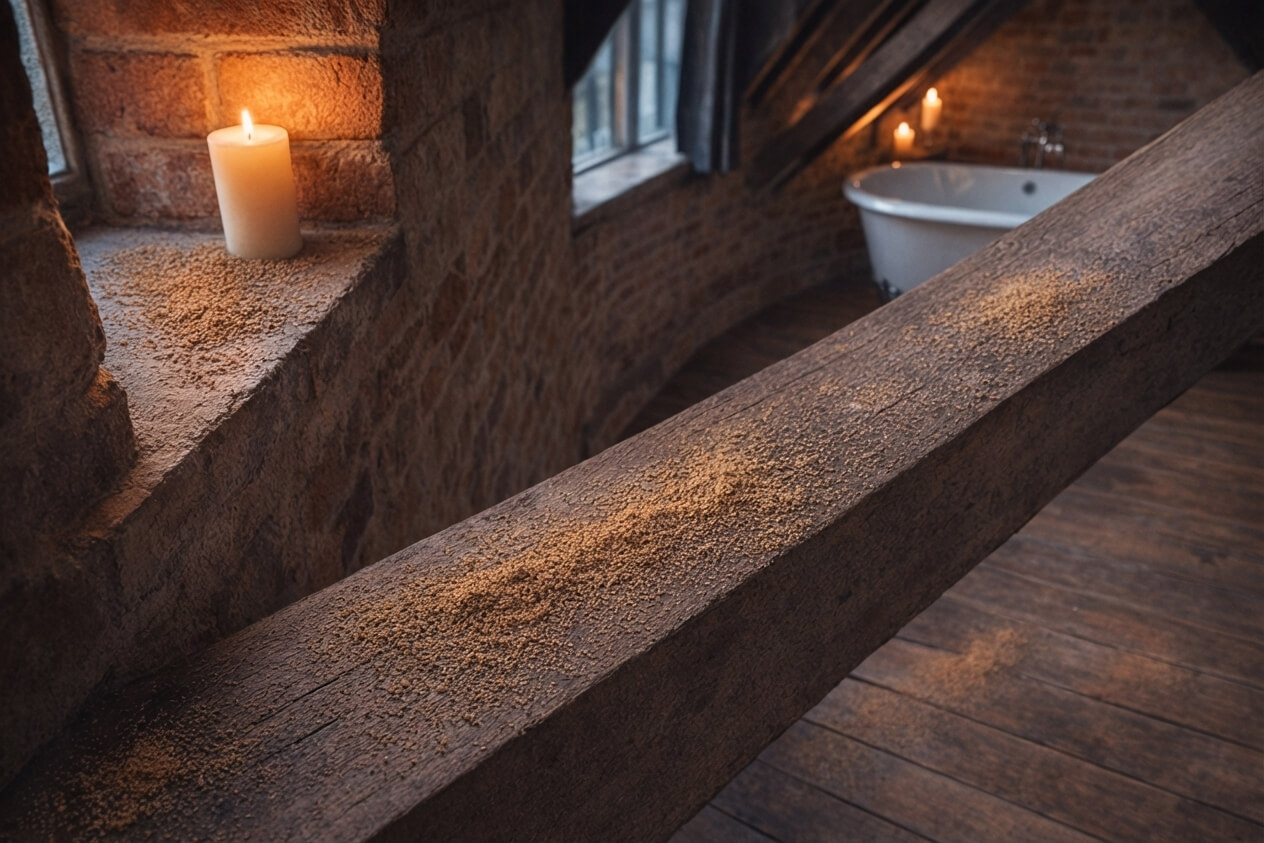
Before you can price deathwatch beetle properly, you usually need a specialist survey that confirms activity, moisture source and timber condition.
That first survey fee can feel irritating when you already know something is wrong. In practice, it is often the cheapest part of the whole job because it tells you whether you need treatment at all, whether repair is the bigger issue, and whether the real cost sits in the timber, damp or paperwork. Market context commonly places a specialist timber survey in the £250 to £350 range, with higher costs where access, listed status or detailed reporting are involved.
What a proper survey should confirm
A proper deathwatch survey should do more than note “holes seen”. It should identify the likely insect, assess whether attack appears active or historic, check timber species and condition, look for decay or fungal softening, record moisture conditions and say whether the timber is structural, secondary or decorative. Deathwatch beetle is associated with decayed hardwood, especially old oak, and timber free from decay is much less likely to be under active attack (Wood-Destroying Insects Manual).
If your surveyor has mentioned principal oak beams, that detail matters. Spelthorne’s heritage guidance notes that deathwatch often attacks the heartwood of old timber and may leave sections of apparently sound wood within, so crude visual judgement can be misleading (Spelthorne Borough Council timber-framed buildings leaflet).
Why the moisture source matters more than the holes
Deathwatch beetle is not just a treatment problem. Technical and academic guidance keeps coming back to the same point: decay, dampness and long-term building conditions are what make timber vulnerable in the first place. If the moisture source stays, you can pay for treatment and still keep the conditions that allowed attack (Cardiff University proceedings).
That is why a survey should track the wider picture. You may have leaking gutters, damp beam ends, blocked ventilation, cement repairs trapping moisture, or fungal decay softening embedded timber. If that condition remains, the holes are only the visible part of the iceberg.
Active infestation versus old damage
You have probably already seen the stressful version of this. Your survey says “possible deathwatch beetle to principal oak beams”, and suddenly you are trying to work out whether you have a £300 survey issue or a £5,000 repair issue.
This is where old buildings get overtreated. SPAB warns that historic timbers are often sprayed unnecessarily when properties change hands, because old flight holes are mistaken for live infestation. Old holes prove past attack. They do not prove current activity.
Seasonal timing can help. Technical guidance on wood-destroying insects notes that monitoring and inspection are most useful when adult emergence is expected, because fresh flight holes, recent frass and new activity are easier to distinguish from old damage then (Wood-Destroying Insects Manual).
Treatment Methods and What Each One Costs

Chemical spray alone rarely solves deathwatch beetle because the real cost often sits in deeper treatment, timber repair and access.
When you compare methods, ask what each one is really buying you. Some products kill exposed insects. Some reach further into thicker timber. Some are reserved for wider or concealed problems. And some “treatment” quotes are really repair quotes with a chemical line attached. That is why two prices for the same property can look worlds apart.
| Method | Typical UK cost range | Best used when |
|---|---|---|
| Surface spray / brush-on | £150–£350 | Small, exposed, localised areas where timber is accessible |
| Deep gel / paste / injection | £500–£1,500+ | Active infestation in thicker or more valuable timbers |
| Fumigation / fogging | £500–£1,000+ | Severe, widespread cases; now relatively uncommon domestically |
| Heat treatment | Quote-led, usually premium | Specialist cases where chemical-free treatment is preferred |
| Localised resin repair / splicing | £1,500–£4,000+ | Historic or listed timber where retention matters |
| Timber replacement / major repair | £3,000 to £7,000+ | Structural decay, hidden damage or conservation-led works |
Surface spray and brush-on treatment
Surface insecticides are usually the cheapest line in any quote, which is why they are often over-sold. Generic UK guides commonly place small spray treatments in the £150 to £350 bracket. That can be reasonable for minor, accessible wood-boring insect work, but deathwatch beetle is rarely the ideal candidate for a simple spray-only answer.
The problem is depth. Technical guidance on wood-destroying insects warns that older larvae may sit well below the timber surface, where shallow treatment is less reliable. If a quote looks unusually cheap, check whether you are buying meaningful treatment or just a visible application (Wood-Destroying Insects Manual).
Deep gel, paste and injection treatment
This is often the more realistic chemical option. Deep-penetrating gels, pastes and injections are used where thicker hardwoods, principal beams or deeper galleries make surface reach less useful. Smaller jobs often start in the high hundreds and rise as beam count, access and opening-up increase.
This is also the point where treatment cost starts turning into project cost. Once timber ends need exposing, holes need drilling, finishes need protecting and return visits are required, the product itself stops being the expensive part.
Fumigation and heat treatment
Fumigation appears in generic woodworm guides at roughly £500 to £1,000, but that number can be misleading for deathwatch beetle because whole-property work adds preparation, disruption and temporary vacancy. It is not the default answer for most domestic heritage jobs.
Heat treatment is more specialist and usually quote-led. It can suit some projects, especially where chemical use is a concern, but it is not a universal shortcut. If it is proposed, you need a clear explanation of why it suits your timber, how the heat will be controlled and how adjacent fabric will be protected.
Repair-led work is often the real cost centre
This is the point many owners do not expect. If the timber is listed, visible or structurally important, repair can quickly outweigh treatment. One heritage example for deathwatch-related lychgate repair came to £2,709 plus VAT. Another schedule allowed £4,415.50 for preservative treatment and new timberwork, plus £441.55 for coordination and a £7,500 contingency for what might be uncovered once work began (Cuckfield Parish Council agenda, 2018; Planning schedule, 2025).
“We didn’t have the money to do harm by changing things we didn’t yet understand.” — Claire Fear, conservation architect
If you take one lesson from this section, make it this: deathwatch treatment may trigger the job, but repair scope usually decides the bill.
Why the Property Often Costs More Than the Beetle

Your property type changes the bill faster than the infestation itself, because structure, access and historic fabric drive labour and risk.
A small modern loft with open access is one pricing world. A Grade II cottage with oak beams buried into damp masonry is another. The beetle may be the same. The project is not.
| Property type | Likely scope | Typical cost range |
|---|---|---|
| 1-bed flat or small loft area | Survey + localised treatment | £500–£1,500 |
| 2-bed terrace | Survey + targeted treatment + minor making good | £1,000–£2,500 |
| 3-bed semi | Wider treatment, opening up, local repair | £1,500–£3,500 |
| 4-bed period house | Multiple timbers, access, repair-led scope | £3,000–£6,000 |
| Grade II listed cottage | Heritage methods, beam repair, paperwork | £3,000–£7,000+ |
| Large listed farmhouse or barn | Extensive repair, hidden decay, staged works | £7,000+ |
Modern accessible areas stay cheaper
If the affected timber is exposed, dry, secondary and easy to reach, costs can stay closer to the treatment end of the scale. That is why generic woodworm pages feel partly relevant. They are often modelling open loft timbers in non-listed houses with simple access and limited making good.
Period homes push you into repair-led pricing
Older houses cost more because the important timbers are rarely visible in full. They disappear into ceilings, walls, beam pockets and floor edges. You may need selective opening up, temporary support and phased repair before the real condition is even visible. Academic work on historic fabric points repeatedly to the link between moisture, fungal decay and timber vulnerability, which is why visible beetle evidence is often only the first clue (Cardiff University proceedings).
Listed and heritage buildings change the method
If your surveyor has mentioned a listed beam, a church lychgate, a timber frame or principal oak members, you are no longer in generic woodworm territory. Simpler listed-house beam fixes often land around £3,000 to £4,000. Larger conservation-grade programmes can move beyond £7,000 once repair sequencing, access and approval requirements build up.
That does not mean every listed property is a crisis. It means the property itself starts dictating the method. If original oak must be retained, lime finishes protected and the repair method documented, you are paying for time and judgement, not just chemical.
Listed Buildings and Conservation: The Costs Most Guides Leave Out

Listed building consent in England has no application fee, but heritage advice, method statements and slower working methods still add cost.
This is one of the biggest gaps in the current search results. Plenty of pages will tell you what a spray costs, then ignore the fact that your property may need conservation input before anyone touches a principal beam. Planning Portal says there is no fee for a listed building consent application in England, and the usual determination period is 8 weeks once the application is valid. Historic England also says like-for-like repairs should be considered first and do not typically require consent.
When consent may be needed
If works affect the character or special interest of the listed building, consent may be required. That can apply to structural timber repairs, replacement, opening up historic fabric and changes to finishes. That matters early because it changes not just the method but the programme.
What still costs money when the application is free
You may still need measured drawings, a heritage statement, a method statement, consultant input or pre-application advice. Published council examples show that pre-app advice can still cost money, including around £105 in East Cambridgeshire and £170 to £270 in Gloucester, depending on route and detail.
You can probably picture the trap. You are buying a Grade II cottage. One quote looks reassuringly cheap. Then you notice it excludes access, plaster reinstatement, heritage paperwork and any allowance for conservation comments. It is not really cheaper. It is just incomplete.
“Stave off decay by daily care.” — William Morris, founder of SPAB
Restricted access, delicate finishes, scaffold design and, in some roof spaces, ecology constraints can also slow the job down. Again, treatment cost is one line; project cost is the real total.
What Pushes the Price Up (and What Keeps It Down)

The cheapest quote often excludes access, making good and moisture correction, which is why similar treatment prices can hide very different totals.
If you want to understand price properly, stop looking at the insect first. Look at the timber, then the building, then the route in.
What pushes the price up
The first driver is access. Visible timber is quicker. Timber buried behind plaster, flooring, panelling or loft clutter is not.
The second is decay severity. With deathwatch, the issue is not just whether the insect is present. It is how much sound timber remains, whether beam ends have softened and whether local repair can retain the member or replacement is unavoidable (Wood-Destroying Insects Manual).
The third is moisture correction. If leaking gutters, masonry moisture or poor ventilation are still feeding the problem, the quote should show how that will be dealt with or clearly separate it as related work.
The fourth is making good. A quote that includes drilling and paste but not plaster repair, joinery reinstatement, decoration or floor lifting is not a full project quote.
The fifth is heritage control. Listed interiors, visible oak and multi-stage approvals all slow the pace. That is normal. Care takes time.
“We had to do what was absolutely essential to keep the building standing.” — Jo O’Hara, project lead, former Somerset Council
What helps keep the price down
Costs usually stay lower when the issue is found early, the timber is accessible, the decay is local rather than widespread and the moisture source is simple to fix. Bundling related works can also help. If a ceiling is already being opened for repair, it can be cheaper to inspect, treat and repair in one coordinated stage than in separate visits.
Careful diagnosis saves money too. Heritage guidance keeps returning to the same rule: retain what is sound, repair what is recoverable and do not replace or spray more than the evidence supports (Spelthorne Borough Council timber-framed buildings leaflet).
How to Compare Quotes Without Getting Caught Out

You avoid overpaying when you compare diagnosis, scope, exclusions and guarantees line by line rather than chasing the lowest headline figure.
A proper quote should tell you what has been identified, what is assumed, what is included and what sits outside the number. If it does not, you are not comparing like with like.
What a proper quote should include
Look for these basics:
- likely insect identified, with a reason
- active or historic attack stated clearly
- timber condition and structural importance noted
- moisture source addressed or separately flagged
- treatment method justified, not just named
- repair scope identified, including what will be retained
- access, opening up and making good included or excluded
- guarantee terms and follow-up visits explained
- listed-building assumptions made explicit where relevant
If you are comparing specialist firms, PCA alignment or similar standards can be useful. It should never replace a clear scope.
Red flags that usually mean trouble later
Be wary of quotes that jump straight from “holes seen” to “full spray treatment recommended”. Be wary of very low prices on important oak beams. Be wary of anything vague about access, damp or repairs.
This is one area where Sussex Damp Experts takes a deliberately survey-led approach. We separate what the beetle needs from what the building needs, so you can budget for the real job rather than the cheapest-looking line item.
Next Steps: Getting a Deathwatch Beetle Survey
You get the clearest route to a fair price when you start with a survey that separates active attack, hidden decay and heritage constraints.
If you are already collecting prices, the smartest next step is usually not to ask for “treatment cost” in the abstract. Ask for a survey-led scope instead. That gives you three decisions, not one: whether treatment is needed, whether repair is needed and whether consent or heritage detail will affect the programme.
If your property is listed, period or structurally sensitive, that clarity matters even more. You do not need the cheapest number. You need the right one.
At Sussex Damp Experts, we assess the timber, the moisture conditions, the repair need and the conservation context together. That leaves you with a properly scoped quote and a clear next move. You will know whether you are dealing with a small treatment job, a repair-led project or a case where monitoring is enough for now.
If you want a realistic deathwatch beetle cost for your property, start with a specialist survey. We will confirm what is active, what is historic, what is driving the risk and what it will actually take to put it right.
Frequently Asked Questions
How long does deathwatch beetle treatment usually take?
Deathwatch beetle treatment can take anything from a single working day to several months, depending on whether you need diagnosis only, treatment only, or repair-led follow-on work. The shortest jobs are usually limited, accessible and already well understood. The longest involve concealed timber, staged repairs, drying time, occupied rooms, or listed-building approvals. If you are trying to plan around a purchase, tenancy, or renovation schedule, it helps to separate the process into booking, survey, reporting, treatment, and any later repairs rather than asking for one headline timescale.
A typical specialist survey may be booked within a few days to two weeks, depending on demand. The inspection itself often takes 1 to 3 hours, and a written report may follow in 3 to 7 working days, sometimes longer if the timber is extensive or the property is listed. Access preparation can add another day or two if loft hatches, floor voids, or boxed-in beams need clearing. A straightforward treatment visit to two accessible rooms may then take half a day to one full day, with treated areas often left undisturbed for several hours to 24 hours depending on the product used and ventilation. By contrast, if you are dealing with beam ends in a listed cottage, the timeline changes completely. Opening up finishes, obtaining conservation input, sequencing joinery repairs, and letting affected areas dry can easily turn the programme into several weeks, even before decoration is put back.
Before you book, ask three practical questions. First, does the quoted timescale cover only the treatment visit, or also the survey, report and making good? Second, what access is assumed? Third, what would delay the job: hidden decay, moisture readings, occupier access, or heritage approvals? If you get clear answers at the start, you can plan realistically instead of mistaking “one day on site” for “finished in one day”.
How long does deathwatch beetle treatment last?
Deathwatch beetle treatment can remain effective for many years, but the useful life of the treatment and the safety of the timber are not the same thing. That distinction matters. A chemical may still be present in the timber while the surrounding building condition gets worse, or a treated area may stay stable while an untreated concealed section becomes the next weak point. So when you ask how long treatment lasts, the better question is: how long will your timber stay low-risk if you maintain the building properly?
In practical terms, you should think in terms of an inspection rhythm rather than a one-off cure. A sensible pattern for most older homes is a visual check every year, plus an extra look after major leaks, blocked gutters, or prolonged condensation problems. Pay particular attention to beam ends built into external walls, poorly ventilated loft corners, roof voids above bathrooms, and any timber close to chimney breasts or valley gutters. Those are the places where moisture problems can go unnoticed longest. Signs worth acting on include new powdery frass, fresh-looking holes with sharp pale edges, staining that has spread since the last inspection, or timber that now feels softer under light probing than it did before. None of those signs automatically means treatment has failed, but they do mean the risk picture has changed.
It also helps to separate lasting protection from lasting paperwork. A treatment may perform well for years, while a guarantee lasts only as long as its conditions are met. Some guarantees are transferable; others are not. Some require no ongoing action; others are weakened by excluded areas or damp-related clauses. Your safest approach is simple: ask what inspections are recommended at 12 months, then annually after that, and keep a record of leaks, repairs, and ventilation changes. That way you are not relying on memory when a surveyor, buyer, or insurer asks what happened next.
Can you treat deathwatch beetle yourself?
DIY deathwatch beetle treatment is rarely a good first move when the timber is structural, historic, hidden, or already linked to decay. A shop-bought product may be fine for a small piece of exposed non-structural timber in a shed or outbuilding, but it is a poor substitute for diagnosis in an old house. The main risk is not simply that the product will “not work”. The bigger risk is that you will treat the wrong area, misread old damage as active infestation, or miss deeper decay behind the visible face of the timber.
There are, however, useful things you can do yourself before you pay for a survey. You can photograph holes with a ruler or coin for scale. You can note where the timber sits: loft joist, floorboard edge, stair string, beam end, lintel, or visible oak beam. You can look for fresh frass beneath the area and note whether it reappears after cleaning. You can clear stored items away from loft hatches and beam lines so inspection is easier. You can also tackle obvious building defects such as overflowing gutters, blocked vents, or heavy condensation in adjacent rooms. Those steps are genuinely helpful because they improve access and preserve evidence without changing the timber itself.
What you should not do is start drilling, injecting, boxing in, sanding, painting over suspicious areas, or spraying principal oak beams and then assuming the matter is solved. A common mistake is this: you see holes in an old beam, buy a surface spray for £30 to £80, and feel reassured because the timber now smells “treated”. Weeks later, a specialist finds the holes were historic and the live risk sits in a damp beam end hidden in the wall pocket. Another mistake is the opposite: you spray visible timber and delay urgent structural repair. If the timber supports a floor, roof, stair, or major opening, professional assessment becomes non-negotiable very quickly.
Does house insurance cover deathwatch beetle treatment?
House insurance usually excludes deathwatch beetle treatment when the problem is classed as gradual deterioration, infestation, rot, or poor maintenance. That is the broad rule, but the detail matters. Many policies separate the insect itself from the event that allowed damage to spread. So the treatment bill may be excluded, while a sudden insured event nearby could still trigger part of a claim. You should never assume “not covered” without reading the wording and asking the insurer directly.
Start by checking both the schedule and the full policy wording. Look for terms such as wood-boring insects, vermin, pests, rot, decay, wear and tear, gradual damage, defective maintenance, escape of water, and trace and access. Those phrases matter because cover may hinge on how the insurer categorises the damage. For example, if a burst pipe soaked a ceiling and a later inspection found wet timber and insect activity, the insurer might consider the escape of water separately from the wood-borer treatment itself. In a landlord policy, the same issue can become more complicated if the tenant reported a leak late or access records are poor. Commercial and listed properties may carry yet more exclusions or higher evidence thresholds.
Before you authorise treatment, gather the facts. Keep the survey report, photographs, dates of first discovery, maintenance records, and any evidence of sudden water entry such as plumber invoices or emergency call-out notes. When you call the insurer, ask a precise question: “Is the timber treatment excluded, and if so, are any associated building repairs or water-damage investigations potentially claimable?” That is much better than asking, “Do you cover woodworm?” If you think there may be a valid claim trail, avoid disposing of damaged timber too early and avoid commissioning extensive work until the insurer has answered. A short delay for clarity can save you from paying first and arguing later.
Are treatment guarantees standard?
Treatment guarantees are not standard, and two guarantees with the same headline length can offer very different protection in practice. That is why a “20-year guarantee” means very little on its own. What matters is what is covered, where it applies, what invalidates it, and whether anyone other than the original contractor recognises it later. If you may sell, refinance, or hand the property to a managing agent, those details become just as important as the treatment itself.
You will often see guarantee periods in the market ranging from around 10 to 30 years, but length is only one variable. Some documents cover only the specific treated areas named in the report. Others apply to visible accessible timbers but exclude concealed sections, adjacent untreated members, reinfestation caused by later damp, or any structural repair beyond the chemical application. Some are insurance-backed; some are simply contractor promises. Some can be transferred to a new owner for a fee or an admin step; others lapse on sale. In a flat sale or remortgage, that distinction can affect how easily a surveyor, buyer, or lender accepts the paperwork.
The safest way to judge a guarantee is to read it as if you were a suspicious buyer. Does it name the exact rooms or timbers covered? Does it exclude damage that was already present? Does it require follow-up inspections? Does it say what happens if fresh signs appear in year two? A strong guarantee usually has a matching survey report, a clear scope, and language you can actually understand. A weak one often hides behind phrases like “subject to conditions” without spelling them out. Before you rely on any guarantee, ask for the full wording, not just the certificate. If you cannot explain it back in plain English, it is not clear enough to protect you later.
What time of year is best for dealing with deathwatch beetle?
Spring and early summer are often the best times to confirm activity, but the best time to act depends on your building, your schedule, and the risk of further damage. If you are trying to catch fresh emergence signs, warmer months can make diagnosis easier. If you already have dampness, visible movement, or suspect structural weakness, waiting for the “perfect season” is a mistake. Timing should help you make a cleaner decision, not delay a necessary one.
Think about timing in three layers. First, inspection timing: spring and early summer can make fresh signs easier to read, especially if you are monitoring old holes and want to know whether new frass appears after cleaning. Second, building timing: autumn and winter often expose the moisture conditions that matter most, such as blocked gutters, cold loft condensation, or damp beam pockets after heavy rain. Third, practical timing: treatment and repair work are simply easier when rooms can be cleared, windows opened, and follow-on trades booked without delay. If you are planning a renovation, it can make sense to inspect before the decorating starts, not after new finishes hide the evidence again.
A useful example is a loft conversion or roof repair. If scaffolding is already going up in May or June, that can be an excellent time to inspect accessible roof timbers because access is good and follow-on work can be coordinated. But if you discover suspicious movement in a floor or a leak soaking a beam end in November, you should not wait until spring just to confirm emergence. In that situation, stabilising the building and investigating the timber matter more than seasonal neatness. Your best rule is this: use spring to improve certainty, but use any season to reduce risk. If timing is unclear, base the decision on access, moisture, and structural importance rather than the calendar alone.

