
 By
 March 22, 2026


Do pheromone traps actually work for deathwatch beetle?
Pheromone traps can help confirm adult deathwatch beetle activity, but they cannot tell you how much damage is hidden in the timber.
If you have found fresh pellets beneath an old oak beam or neat round holes in a dark roof void, a trap is best treated as a monitoring tool rather than a verdict on your building. According to HSE, insect monitoring traps are intended for monitoring and counting, not for reducing the overall size of the pest population.
English Heritage makes the wider diagnosis point from the building side: exit holes and frass do not, on their own, prove an active infestation. So the honest answer is yes, but only for the right question. If your question is, “Are adult beetles active here this season?” a trap may help. If your question is, “How weak is this beam?” or “Can I skip a survey?” it cannot answer that alone, as English Heritage makes clear.
In older buildings, timber, moisture, fungal decay and time are tied together, so simple monitoring rarely tells the whole story. That is why traps work best when they support wider inspection, not when they replace it, a point reflected in Historic England.
| Useful for | Not useful for | Best next step |
|---|---|---|
| Supporting evidence of adult activity | Measuring hidden timber damage | Match trap results with timber and moisture inspection |
| Tracking change over a season | Proving a building is clear | Check for fresh frass, leaks, damp and decay |
| Comparing one suspect area with another | Replacing diagnosis or treatment design | Book a specialist survey if repair risk is possible |
A good trap result is a signal. It is not a diagnosis.
What a pheromone trap is actually detecting

Pheromone traps respond to adult beetle behaviour, so a catch reflects activity at that moment rather than the full condition of the wood.
A pheromone lure attracts the target insect during its active adult phase. In practical terms, you are monitoring adult presence and movement, not looking directly at larvae tunnelling inside oak, not testing beam strength, and not measuring how much decay has already taken hold. Monitoring tells you something useful, but only about the part of the beetle’s life you can catch.
How the lure fits the biology
Deathwatch beetle spends most of its life hidden in timber as larvae. English Heritage says the larvae may take four to 12 years to develop, then the adult emerges in spring or early summer through a round exit hole about 2 to 3 mm across. That means the useful monitoring window is tied to adult emergence, not the years of hidden feeding beforehand.
Lure → response → catch → interpretation
- Lure: a chemical cue is used to attract the target insect.
- Response: adult beetles move toward it if they are active and in range.
- Catch: you record beetles caught during that monitoring period.
- Interpretation: you judge that catch against season, location, moisture, timber type and nearby signs.
Why timing and building conditions matter
The ICUP paper found adult deathwatch beetles were caught in historic buildings during May, June and July, and that weekly catch rose with ambient temperature; in that study, adults flew at temperatures above 17°C. That does not prove a pheromone trap will behave identically in every roof void, but it shows why trap results are seasonal and why a blank result can mislead you. If you check too early, too late, or in a cold roof space, “nothing caught” may simply mean “nothing flying”.
Why period buildings complicate the picture
Deathwatch beetle is rarely just an insect problem. English Heritage says the species mainly attacks hardwoods, particularly oak, and damages timber that has been damp or water-damaged, with fungi helping break down the wood and provide nutrients. So when you read a trap, you are reading one moment in a longer relationship between timber, moisture and time.
What pheromone traps can tell you — if you use them properly

A well-placed trap is most useful for showing whether adult beetles are active, where activity clusters, and whether that pattern changes.
Used properly, a trap can reduce uncertainty. It can support the view that adult deathwatch beetles are active in a particular roof space or beam zone during the monitoring period, help you compare one area with another, and give you a baseline to revisit after repairs, drying-out, or targeted treatment.
It can help confirm seasonal activity
If you keep brushing away pale frass from a beam and find a fresh dusting a week later, a trap can add another layer of evidence. The English Heritage fact sheet advises looking for fresh frass and new adult beetles in spring, and also warns that old frass can fall from timbers long after the original attack. A trap catch can help separate current adult activity from old damage.
“It is important to confirm whether a beetle attack is active or dead.” — Robert Demaus, author of Precision Treatment of Death Watch Beetle Attack, Building Conservation
It can help compare hotspots
If you suspect activity in an old oak roof, one trap near the wall plate and another near a wetter valley gutter area may show you that one zone is busier than the other. That can focus inspection and avoid treating the whole roof as equally risky when it may not be.
It can help you track change over time
Monitoring is a timeline, not a one-off answer. If catches fall after you stop a roof leak, improve ventilation, or complete targeted treatment, that trend may be useful evidence that conditions are becoming less favourable. But you still need to compare the catch with what is happening in the timber itself.
| Traps can tell you | Traps cannot tell you |
|---|---|
| Adult beetles were active in this area during this period | How much sound timber is left inside the beam |
| One suspect zone looks busier than another | Whether a structural member is still safe |
| Activity seems to be rising, falling or staying similar | Whether damp, rot or another defect is the real driver |
| You have a reason to inspect further | That a blank result means the building is clear |
What pheromone traps cannot tell you

A trap catch is not a structural verdict, and a blank trap is not proof your building is clear.
A trap can be helpful and still be easy to misuse. If you over-read it, you can spend money where you do not need to. If you under-read it, you can miss a building defect that matters more than the insect count. English Heritage is blunt on the core point: holes do not mean the infestation is active, and old frass is not a reliable sign of current attack.
A trap catch does not measure damage severity
Deathwatch beetle damage matters because severe attack can hollow beams and lead to structural failure, but a trap does not tell you whether that has happened. It tells you adults were caught. It does not tell you how far larvae have travelled through the heartwood, whether fungal decay is present, or whether the remaining section is adequate. Diagnosis has to move from insect signal to timber condition.
“Frequently an understanding of why the damage has occurred, can reduce treatments or show that they are unnecessary.” — Dr Brian Ridout, author of Timber Decay in Buildings and its Treatment, Historic England
A blank trap does not prove absence
A blank trap may mean there are no active adults. It may also mean the trap was badly placed, the timing was wrong, temperatures were too low for flight, or activity was present elsewhere in the building. The ICUP research found adult catches were tied to warmer conditions and a defined emergence period, which is why a single negative result should be treated cautiously.
A trap does not diagnose the moisture problem
Historic England’s guidance on older buildings keeps returning to the same principle: decay, fungi and wood-boring insects are often symptoms of moisture problems, poor ventilation or water ingress. A trap cannot tell you whether a leaking gutter, a valley failure, trapped moisture behind modern repairs, or long-term roof condensation is the underlying issue.
A trap does not control the infestation
HSE says monitoring traps are intended only for monitoring purposes, not for reducing the overall size of the pest population, and products sold as monitoring traps should not claim to reduce, eliminate or control the target organism. So if you are buying a trap hoping it will quietly solve the infestation, you are buying the wrong tool.
- A catch does not tell you how weakened the timber is.
- A blank trap does not prove the infestation is absent.
- A trap does not identify the moisture or decay cause.
- A trap does not replace species identification and inspection.
- A monitoring trap does not eradicate deathwatch beetle.
Use trap data as supporting evidence, never as your only evidence.
When a pheromone trap is the right first step

A pheromone trap is the right first step when you need non-invasive evidence over time, not immediate certainty.
Sometimes monitoring first is sensible. If your building is sensitive, access is awkward, or the signs are ambiguous, a trap can be a proportionate way to gather evidence before you commit to broader work. That is particularly true in older roofs, enclosed voids and listed buildings where opening-up is disruptive and every unnecessary intervention chips away at historic fabric.
Good situations for monitoring first
A trap can make sense if you have a period property with a few suspicious holes, occasional pellets beneath an old oak beam, but no obvious distortion or alarming decay. It can also make sense if you want to monitor a known hotspot through spring and early summer before deciding whether bigger intervention is justified. In that situation, you are narrowing uncertainty, not dodging diagnosis.
“You set the trap, wait through spring, and when nothing turns up you are still left wondering whether the roof is clear or whether you have simply asked the wrong question.” — A listed building owner in West Sussex, illustrative persona
Micro-scenario: limited access in a listed building
If you climb into a listed roof void and find dusty pellets on old boarding but no safe way to inspect the main timbers closely, you may reasonably want one non-invasive monitoring step before scaffolding, opening-up, or repair planning. That is especially true where preserving historic fabric matters and unnecessary disturbance would be costly or harmful. Local heritage guidance in Spelthorne guidance stresses minimum intervention and the need to preserve as much original fabric as possible.
The cost-benefit test
Ask yourself one question: Do you need evidence of activity, or do you need a decision on condition? If it is the first, a trap may be worth the spend. If it is the second, the money is usually better put towards a survey.
When you need a specialist survey instead
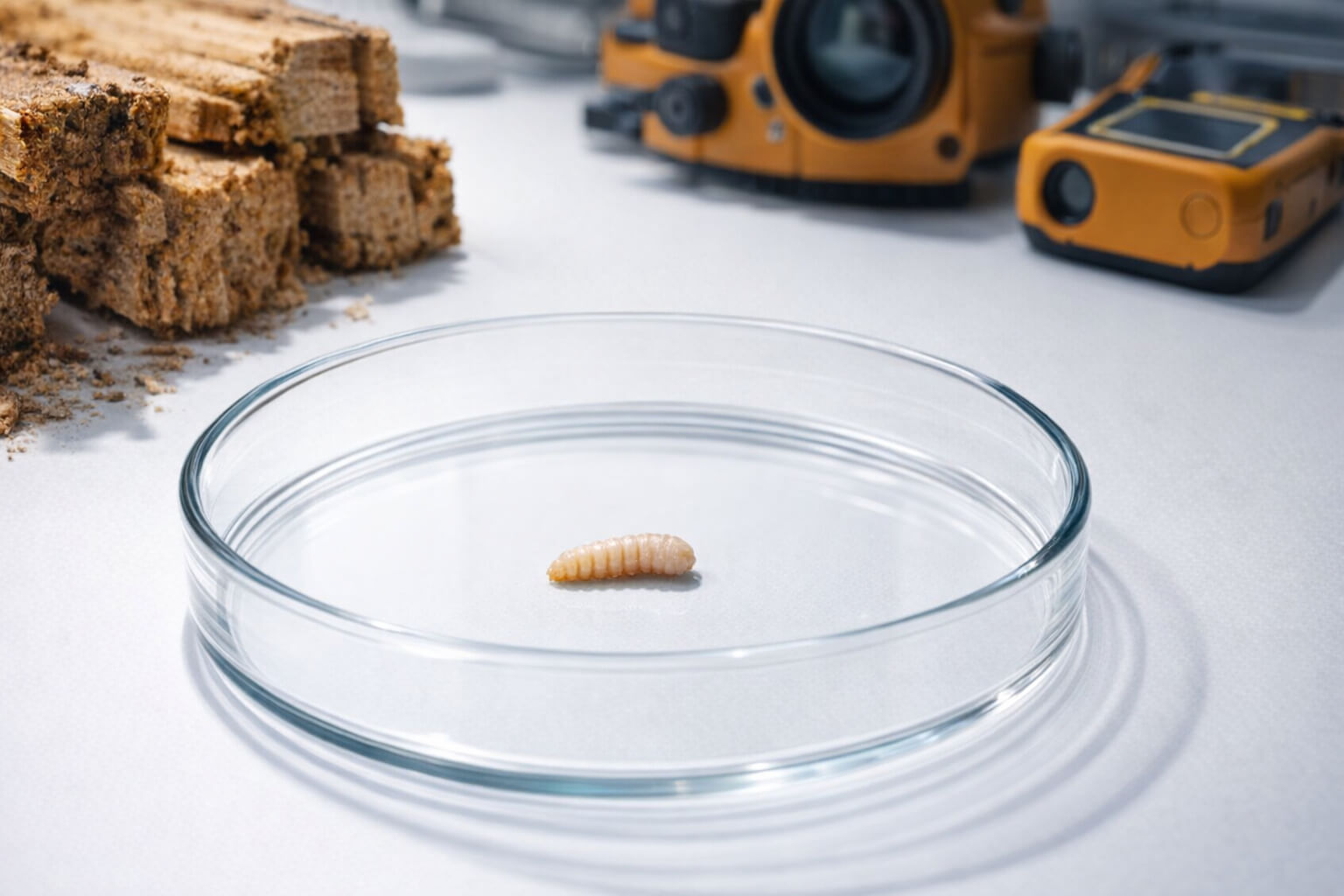
A specialist survey matters more than a trap when you need to judge timber condition, repair urgency, or purchase risk.
If you can already see fresh frass, new sharp-edged holes, water staining, softening timber, or signs of decay around structural members, the decision has moved beyond monitoring. If a beam feels crumbly at the edge or sounds hollow when tapped, the worry is no longer just insect presence. English Heritage says severe attack can hollow beams and lead to structural failure, while Historic England advises that treatment should start by deciding whether the problem is current or historic and by addressing the source of damp rather than treating symptoms alone.
Visible signs that justify survey first
Survey first if you have obvious fresh activity, widespread pellets under principal beams, leaking roofs, damp wall plates, sagging or distorted members, or you are buying a period property and need a defensible view on repair risk. Good pre-purchase advice for older buildings makes the same point: a proper survey helps you understand defects, priorities and likely consequences if nothing is done, and a mortgage valuation is not a substitute.
What a proper deathwatch beetle survey should involve
A proper survey should look at more than beetles. It should assess timber species and location, fresh versus historic signs, moisture levels, likely water ingress, ventilation, fungal decay and the structural importance of the affected members. In traditional buildings, experience of older construction matters because modern-building knowledge alone is not enough to identify causes or specify cost-effective repairs.
Micro-scenario: pre-purchase pressure
If you are buying an older house and the seller says, “It is only old woodworm,” a trap will not give you the certainty you need before exchange. You need to know whether there is active deathwatch beetle, what is feeding it, what the repair options look like, and what the likely consequences are if you do nothing. That is survey territory, not gadget territory.
How survey findings change the picture
Survey findings can shrink the problem as often as they enlarge it. You may discover the attack is historic and no longer active. Or you may discover that a persistent leak, trapped condensation or local fungal decay is making one beam vulnerable while the rest of the roof is sound. Either way, you get a building answer, not just an insect answer.
Using traps alongside professional assessment

Trap results become far more useful when you read them alongside inspection findings, moisture evidence, and the way your building behaves.
The best use of a trap is usually in combination. Monitoring can tell you whether adults are active during a defined period, while inspection tells you where the holes, frass, damp and decay actually are. In practice, the question is less “trap or survey?” and more “what order should these happen in?” The answer is usually driven by risk: if the timber may be weak, inspect first; if the signs are ambiguous, monitor as part of the picture.
Before treatment
Before any treatment decision, traps can help confirm whether you are seeing current seasonal activity in the same area that inspection has already flagged as vulnerable. That can be useful when the visual evidence is suggestive rather than conclusive. But the trap should still sit behind the survey logic, not in front of it.
After treatment or repair
After targeted repair, drying-out or treatment, a trap can help you watch for continuing adult activity through the next emergence period. That follow-up is often more valuable than the first catch because you can compare it with a known baseline and with changes you have made to moisture conditions.
For long-term building management
Older buildings benefit from regular observation. Gutters block. Roofs age. Ventilation changes. Small leaks become slow, chronic wetting. In that context, a trap can be one piece of a sensible management plan, especially in roofs or hidden voids that deserve periodic checking. A simple log helps: date, location, catch count, nearby frass, and any damp staining you notice on the same visit.
Next steps: working out whether your building needs traps, a survey, or both
Your next step depends on whether you need monitoring, diagnosis, or repair planning, because those are not the same decision.
If you take one thing from this, make it this: a pheromone trap can be worth buying when you need a non-invasive way to check for adult activity over time, but it is the wrong tool if you need confidence about timber condition, structural risk or pre-purchase liability.
“We use trap catches as supporting evidence, not as a verdict; the real answer comes from reading beetle activity alongside moisture, fungal decay, frass and the condition of the timber.” — Our senior surveyor, Sussex Damp Experts
Choose monitoring first if…
Choose traps first if the signs are limited, the building is sensitive, you want to compare suspect areas through the emergence season, or you need one more layer of evidence before deciding whether wider investigation is justified. In that situation, you are paying for clarity at the edge of uncertainty.
Choose a survey first if…
Choose a survey first if you have fresh pellets, obvious new holes, damp timber, structural concern, a live purchase or sale decision, or a listed building where the cost of getting the diagnosis wrong is high. Proper surveys for older buildings matter because they explain condition, defects, repair priorities and the likely consequences of inactivity.
Choose both if…
Choose both if you already know there is some deathwatch beetle history but you want a better quality baseline before or after repair. A survey can tell you what matters now; monitoring can tell you whether activity changes next season. That is often the most balanced route in churches, large roof spaces and complicated period buildings.
If you want a clearer answer than a trap alone can give, Sussex Damp Experts can assess the timber, moisture conditions and wider evidence before you commit to treatment or repair. That gives you a decision based on your building as a whole, not just on whether a trap happened to catch a beetle this week.
Frequently Asked Questions
Is it worth installing deathwatch beetle traps yourself, or should you pay for professional setup?
Yes, you can install traps yourself, but the real difference is usually not the trap itself — it is the interpretation.
DIY installation can make sense if you already know where the suspect area is, you can reach it safely, and you are simply trying to gather one extra layer of evidence during the active season. In that situation, your main jobs are practical: choose the right trap type, place it where adult beetles are most likely to move, label it clearly, and keep a basic record of what you find. For a small loft, one or two carefully placed traps may be enough to give you a useful signal. For a larger roof, church-like void, or split-level period house, DIY results become much less reliable because one badly chosen location can make the whole exercise look inconclusive.
Where professional setup earns its keep is in the context around the trap. A specialist is not just hanging a lure. We are looking at timber condition, leak history, damp staining, access issues, older repairs, and the likely routes insects are using through the structure. That can change where traps go, how many are needed, and what counts as meaningful. A professional also reduces common DIY mistakes: putting a trap in a draughty but irrelevant area, hanging it too near windows, checking it too rarely, contaminating the lure with bare hands, or assuming one catch equals one hotspot.
There is also a safety point. Many suspect deathwatch locations are in old lofts, bell towers, ceiling voids, and roof edges with poor boarding and weak access. If you are balancing on old joists with a torch and a trap, the risk can outweigh the saving very quickly.
A practical rule is this: use DIY only when access is safe and your question is narrow. If you need an answer you could rely on for repairs, purchase decisions, or listed-building planning, professional setup and interpretation are usually worth far more than the cost difference.
Can a pheromone trap tell deathwatch beetle apart from other wood-boring beetles?
No, a trap catch on its own does not always give you a clean species diagnosis unless the trap is truly species-specific and the catch is checked properly.
This matters more than many people expect. In an older property, you may have historic furniture beetle holes, occasional other insects in the roof void, and one current suspicion that everything gets blamed on. A trap may attract what it is designed to attract, but you still need to confirm what has actually been caught. Dead insects in sticky traps can be damaged, dusty, or mixed with other small beetles, flies, or roof-space debris. If you are not used to looking at insect features, it is easy to turn “some beetles were caught” into “deathwatch confirmed” too quickly.
The safest approach is to treat the trap as a collection point, not a final label. If you do catch insects, photograph them clearly next to a ruler, keep the specimen, and compare against a reliable identification guide. Deathwatch adults are 5-9mm, chocolate brown, with a distinctive rounded pronotum. Furniture beetle adults are smaller (3-5mm), lighter coloured, and their pronotum has a different shape. But in a dusty sticky trap, these differences can be hard to spot without magnification.
If you need a definitive answer — particularly for a listed building, a mortgage survey, or a timber repair decision — send the specimen to a qualified entomologist or ask your surveyor to confirm identification in person. A trap that catches “something” is useful. A trap result that gets misidentified can lead to unnecessary treatment, wrong treatment, or false reassurance.
How should you reset, clean, and prepare traps between one monitoring season and the next?
You should treat the end of one monitoring season as a reset point, not simply leave the same traps in place and hope they are still reliable next year.
Start by checking every trap before you remove it. Record the location, the date it was set, the date you last checked it, and whether there were any catches, loose dust, or obvious contamination on the sticky surface. If you want to keep a trap as evidence, seal it in a clear bag or flat box, label it properly, and store it somewhere dry and dark. Do not fold it, scrape it, or stack heavy items on top of it. Once the insects smear or break, the trap becomes much less useful for later identification.
For traps you plan to reuse, be realistic. Sticky surfaces collect dust, spider debris, soot, fibres, and dead non-target insects. By the end of a season, many are too dirty to trust. Lures are even more time-sensitive. Once opened, some begin losing strength within weeks, and very few are worth trusting after a long, warm summer in a loft or outbuilding. If a lure has sat in heat, sun, or fluctuating temperatures for months, assume it is compromised. The safest practice is to use fresh lures every season and replace any adhesive board that looks dry, cloudy, or debris-coated.
Storage matters as well. Keep unused traps and sealed replacement lures indoors in a cool, dry cupboard. Avoid garages, damp sheds, boiler cupboards, and roof spaces. Heat can soften adhesives or age lures prematurely, while damp can distort card backings and reduce stickiness. As a rough rule, prepare your replacements in late February, check that packaging is intact, and aim to redeploy fresh traps in early March so you are ready before the first likely activity.
The simple routine is this: remove, label, store evidence, discard dirty boards, replace lures, and start the next season with clean materials. Fresh kit gives you cleaner answers.
How many traps do you need for a typical period property, and where exactly should they go?
There is no universal number, but most single-roof period properties need between three and eight traps placed in specific high-risk zones rather than spread evenly.
The number depends on the size of the suspect area, the complexity of the roof or floor structure, and how many separate timber zones you need to monitor independently. A straightforward two-bedroom cottage with one accessible loft might need three or four traps. A larger period house with multiple roof voids, a church, or a barn conversion with open trusses might need eight or more to cover the key zones properly.
Placement matters more than quantity. The strongest positions are: near timbers where you have already seen exit holes or frass; close to joints, bearing ends, and areas where moisture is most likely (valley gutters, parapet walls, chimney abutments); and along likely flight paths between suspect timbers and light sources or ventilation points. Beetles emerging from timber will move towards light and air movement, so traps placed between the suspect area and the nearest window, vent, or gap tend to catch more reliably.
Avoid placing traps in draughty corridors where air movement disperses the lure too quickly, directly on windowsills where non-target insects dominate the catch, or in areas so inaccessible that you cannot check them regularly without risk. Every trap you cannot check safely or consistently is a trap that adds no useful data.
For monitoring to mean anything, each trap needs a clear label (location, date deployed, trap type) and a checking schedule — typically every two to three weeks during the active season. If you are comparing zones, keep the trap type and placement logic consistent so your results are comparable.
If you are unsure about placement, a specialist survey can identify the highest-risk timbers and recommend a monitoring layout matched to your building. That often saves money compared with blanketing the roof with traps that may be in the wrong places.
Do pheromone traps work in churches, barns, and other large open-timber buildings?
Yes, they can work in churches, barns, and other open-timber buildings, but you should expect weaker signals, more awkward access, and a longer monitoring job.
The first challenge is sheer scale. In a domestic loft, air movement is fairly limited and the area you are trying to monitor is usually compact. In a church nave, tithe barn, or open hall house, the air volume is huge and the lure plume becomes much less predictable. Open louvers, broken glazing, ridge ventilation, and even heating cycles can shift airflow enough to weaken trap performance. A lure that feels decisive in a small roof void may tell you much less when the nearest suspect beam is 10 or 15 metres away across an open space.
Access changes the job as well. In larger heritage buildings, the timbers you care about most are often the hardest to reach: tie beams, wall plates, principal rafters, ridge members, and bearing points over masonry. Getting traps close to those areas may require mobile towers, scaffold lifts, or cherry-picker hire. That affects budget, but it also affects monitoring quality. In practice, many high-level traps in large buildings are checked monthly rather than every fortnight simply because access takes planning, labour, and safety controls.
That said, large heritage buildings are where traps can be especially useful, because other forms of investigation are often more disruptive. If you are managing a church or barn, you do not want to open up historic fabric blindly. Traps can help narrow down which bays, trusses, or roof slopes deserve closer attention first. The smartest approach is usually layered: seasonal traps near the highest-risk timbers, repeated photographs from the same vantage points, moisture checks at accessible bearing ends, and visual inspection whenever scaffold is already up for roof repairs or maintenance.
So yes, traps can still earn their place in big buildings. You just need to treat the results more cautiously, budget for access, and accept that a large open structure usually needs more patience than a normal house loft.
What should you do if traps stay blank but fresh frass keeps appearing?
You should treat blank traps plus fresh frass as an escalation point, not as a contradiction you can ignore.
When pale dust or pellets keep reappearing after you have cleaned the area, something is still happening in or around that timber. The question is not automatically “the trap failed.” It may be that the frass is falling from a location the trap does not cover, that another wood-boring insect is involved, or that vibration, heat changes, and hidden voids are releasing material from older workings in a way that looks new. Your next step is to move from general monitoring to targeted investigation.
Start by making the frass evidence stronger. Clean the surface completely, photograph it, note the date, and check again after a set interval such as seven to ten days. If material returns, look closely at where it is landing. A tight cone directly under one timber face tells a different story from a broad scatter across dusty boarding. Then inspect above that point if it is safe to do so. You are looking for fresh-cut hole edges, tiny loose pellets in cracks, or staining that suggests a damp source nearby.
If the traps remain blank, do not just add more traps at random. Consider a different method. A borescope can help you inspect inside voids or behind coverings with minimal disruption. Acoustic equipment may help where active feeding is suspected in important structural timber. Local opening-up may be justified if the timber is load-bearing and other signs keep strengthening. At Sussex Damp Experts, this is the point where we would usually stop relying on passive monitoring alone and shift to a more direct condition-led inspection.
The key is to stop treating the blank trap as the headline result. If the building is still producing physical signs, those signs deserve to lead the next decision. Blank traps can be inconclusive. Repeated fresh frass is a stronger prompt to investigate further.

