
 By
 March 28, 2026


Why period properties are especially vulnerable to deathwatch beetle
Pre-1900 homes are at the highest risk from deathwatch beetle not because age alone attracts it, but because older buildings are far more likely to combine historic oak, persistent moisture, permeable fabric and concealed structural details that allow fungal decay to prepare the timber for attack. That is the part many articles miss. In period buildings, the real chain is usually oak, moisture, fungus, then beetle. If you want to judge the seriousness of a finding, that chain matters more than the holes alone, as Historic England makes clear in its guidance on traditional buildings.
Pre-1900 homes create the exact conditions deathwatch beetle needs
Pre-1900 homes are more vulnerable because they more often contain damp-prone oak structure, breathable walling and hidden timber junctions where decay can persist unnoticed.
Older buildings do not manage moisture like modern ones. Traditional construction relies on absorbent materials taking in moisture and then releasing it again, while modern construction depends more on barriers, cavities and separation. That difference matters because deathwatch beetle becomes plausible where timber stays damp for long enough for fungal change to begin, which is the same moisture pattern described in SPAB advice on how old buildings breathe.
Pre-1900 is not just older — it is built differently
Pre-1900 buildings are more likely to contain substantial oak frames, heavy beams, embedded joist ends, thick solid walls, lime mortar, lime plaster and voids that dry slowly. None of those features is defective in itself. Risk begins when maintenance slips or later alterations interfere with drying, because moisture then lingers where the building was meant to breathe it away.
Many older houses also lack the damp barriers that became normal in later construction. Damp-proof courses became standard later, but most old buildings either pre-date that change or behave differently enough that moisture has to be understood as part of the whole building rather than as an isolated defect.
Why the period fabric matters more than the date alone
Lime mortar and lime plaster are often blamed when damp appears, but they are usually part of the drying mechanism, not the cause of failure. Their porous nature allows evaporation. Trouble follows when gutters overflow, ground levels rise, air bricks are blocked or hard cement repairs trap water in the surrounding fabric. That is how a breathable wall becomes a damp wall, and how a sound oak end becomes a damp oak end buried in masonry.
You buy a timber-framed cottage. The survey mentions “possible woodworm” in one short line, and suddenly every beam starts to look suspicious. The important question is not whether the house is old. It is whether damp, decayed oak exists in concealed structural areas such as beam ends, wall plates, cellar joists or roof bearings, because that is where deathwatch risk becomes specific rather than generic, which is why RICS recommends a whole-building approach in traditional buildings.
Why deathwatch beetle is not the same as common woodworm
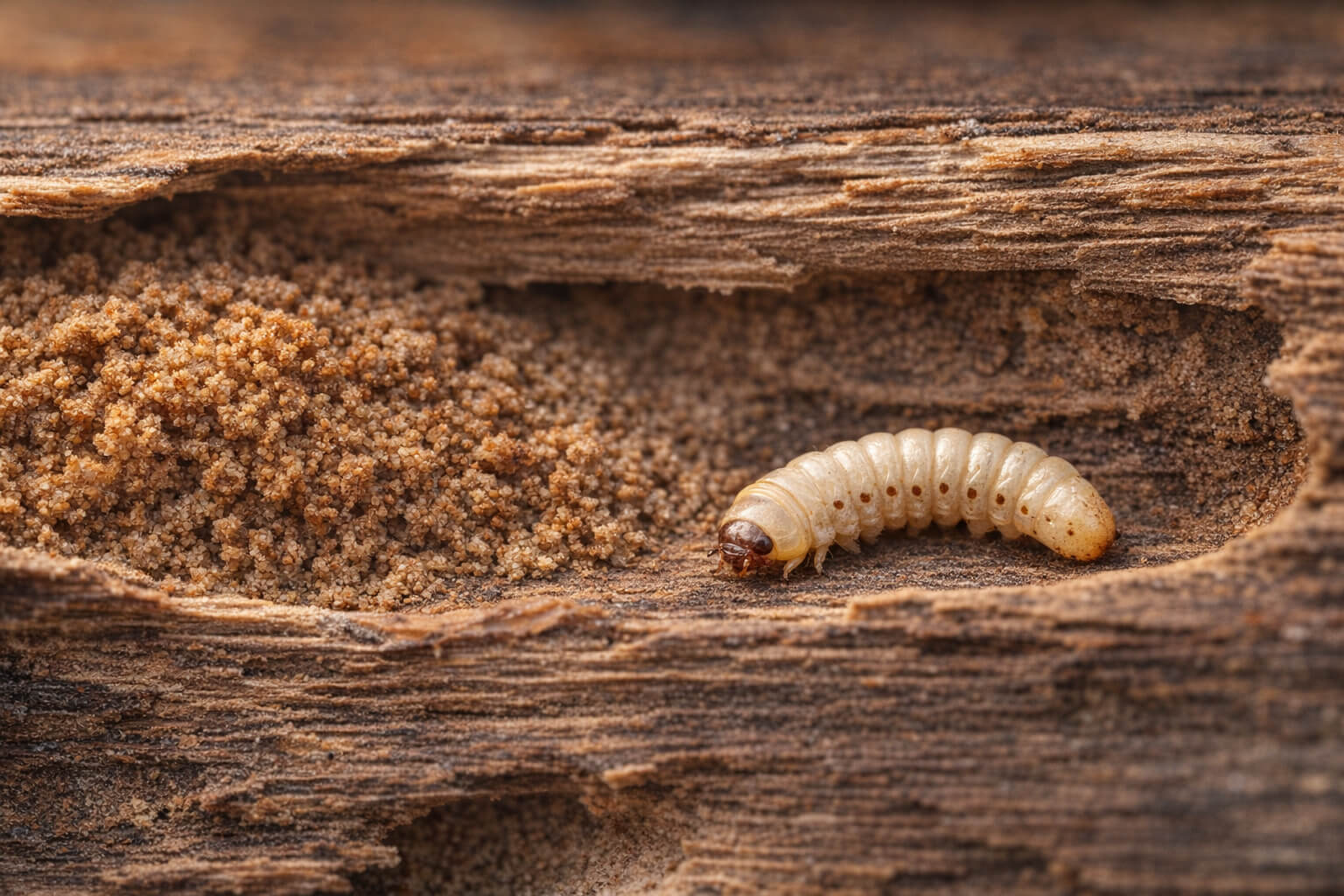
Deathwatch beetle is not just another way of saying woodworm. The Natural History Museum identifies Xestobium rufovillosum as a distinct species associated with old hardwoods, especially oak, and notes that it is commonest in southern England. Adults are typically 5-9 mm long, flight holes are about 3 mm across and the frass is characteristically bun-shaped rather than flour-like.
That is why a pre-1900 risk assessment has to be more precise than “old house equals beetle”. What matters is whether your building contains the timber species, moisture history and fungal change that make deathwatch beetle biologically plausible. Without that, many holes in old timber turn out to be something else, or belong to old inactive damage.
The real mechanism is fungal change

Deathwatch beetle becomes a serious structural risk when persistent moisture allows fungal decay to alter oak, especially heartwood that would otherwise resist attack.
That is the mechanism worth understanding. It is also the point most generic woodworm articles gloss over. Deathwatch beetle is strongly associated with damp, decayed hardwood, so the important threshold is not simply “old oak” but “oak whose condition has been changed by moisture and fungal activity.”
Oak sapwood and oak heartwood do not behave the same way
The Exeter City Council planning document makes the distinction unusually clear. Oak sapwood is not durable and is readily attacked by fungi and insects, including deathwatch beetle. Oak heartwood is different. It is generally only attacked by deathwatch beetle where there has been preceding or concurrent fungal attack. In other words, the beetle problem is often secondary to a fungal problem, which is itself secondary to a moisture problem.
That explains a pattern you see repeatedly in period buildings. One oak beam survives for centuries with little more than surface weathering, while another becomes vulnerable at a single bearing end, one scarf joint or one hidden face. The difference is rarely age alone. It is whether repeated wetting has created the fungal conditions that begin to modify the timber. Once that starts, the oak-moisture-fungus-beetle chain is in motion.
The biological sequence in a period building
The sequence is slow. That is why it catches people out. Water enters through failed rainwater goods, a leaking valley, raised ground, a blocked air brick or poor sub-floor ventilation. Timber remains damp. Fungi colonise. Decay changes the structure of the wood. Only then does the timber become suitable for deathwatch larvae, especially where oak is concealed and slow to dry. By the time you notice holes, the enabling conditions may have existed for years.
As one conservation specialist puts it:
“Deathwatch beetle populations flourish where there is water penetration and decline when the building is dry and well maintained.” — Paul Leary, Building Conservation Building Conservation Directory: Eradicating wood-boring insects
The Exeter evidence also gives useful moisture context. It notes that fungi die below about 24% moisture content, while timber in a well-ventilated unheated building is typically around 16-18%, and below 16% in a heated building. The lesson is not that one number solves the diagnosis. It is that persistent elevated moisture changes the biology of the timber and makes fungal preconditioning possible.
That is why a dry-looking beam can mislead you. You may only be seeing the exposed face while the critical zone is buried in a wall, trapped behind plaster or sitting above a poorly ventilated cellar. When surveyors find deathwatch activity at a bearing end, they are often finding the last visible sign of a much older moisture history rather than the first sign of a new problem.
Deathwatch beetle and common furniture beetle are not equivalent risks
Common furniture beetle can affect a wider range of timbers and is the species most people mean when they say woodworm. Deathwatch beetle is more specialised, more strongly tied to historic hardwood and more likely to raise structural questions because it appears in large-section oak members rather than just secondary softwoods.
“Both furniture beetles and deathwatch beetles require a little more water than is generally found in a dry and well maintained building.” — Brian Ridout, Building Conservation Building Conservation Directory: Insect damage in historic buildings
| Feature | Deathwatch beetle | Common furniture beetle |
|---|---|---|
| Typical timber attacked | Damp, decayed hardwood, especially oak | Wider range of timbers, often softwood |
| Exit hole size | Around 3 mm | Usually smaller, around 1-2 mm |
| Frass | Bun-shaped gritty pellets | Fine, flour-like powder |
| Typical setting | Period buildings, churches, old oak structure | General domestic timber defects |
| Structural concern | Often linked to concealed oak decay | Variable, often less specific |
The distinction matters because the diagnosis changes with the species. If your problem is deathwatch beetle, you are not just looking for insects. You are looking for fungal preconditioning in oak and for the moisture route that enabled it.
Where the damage hides in period buildings

The highest-risk timber in a period property is usually the timber you cannot see clearly, especially where oak disappears into damp masonry or unventilated voids.
Deathwatch damage rarely announces itself in the most convenient place. In old buildings it tends to hide at beam ends, wall plates, roof bearings, joist pockets and other junctions where moisture lingers and inspection is awkward. That is why a quick look from the middle of a room often tells you less than you think.
Embedded beam ends in masonry walls
The classic high-risk location is the beam end built into a solid wall. The exposed face may look acceptable while the embedded section sits in a cooler, damper zone with limited evaporation. If that wall is holding moisture because of cement pointing, high external ground or leaking rainwater goods, fungal change can begin where you cannot see it and where the timber is doing some of its most important structural work.
Roof structures and wall heads
Roof timbers are another classic blind spot. Purlins, wall plates, rafter feet and valley junctions are all vulnerable if slates slip, flashings fail or gutters overflow. A minor leak at the eaves may not look dramatic from below, but repeated wetting at one wall head is enough to start fungal change in oak or weaken a sapwood margin that matters at a joint.
Floor timbers over earth or cellars
Ground-floor joists over shallow voids, bare earth or cellars can also become vulnerable where ventilation has been lost. Old suspended timber floors depend on air movement. Once vents are blocked or voids are bridged by debris, the timber environment changes. You then get the quiet combination that period buildings dislike most: elevated moisture, reduced drying and concealed decay progressing below your line of sight.
You notice small round holes in a ceiling beam and assume the visible face is the whole story. It rarely is. The next checks are where that beam bears, whether staining or softness appears near the wall, whether the ceiling line hides a damp pocket and whether a roof defect or blocked ventilation path is feeding moisture into the timber from beyond the room.
| Location | Risk level | Typical signs | Access difficulty |
|---|---|---|---|
| Beam ends in solid walls | High | Localised holes, softness, staining, hidden decay | High |
| Wall plates and rafter feet | High | Holes near eaves, damp patches, roof leak history | Medium to high |
| Ground-floor joists over cellar/earth | Medium to high | Damp smell, debris, weakened ends, poor ventilation | Medium |
| Ceiling beams behind plaster lines | Medium | Isolated holes, surface frass, uncertain extent | High |
| Secondary exposed timbers in dry rooms | Lower | Old holes, little fresh frass, no damp history | Low |
This pattern is why deathwatch surveys cannot rely on what is obvious. The places that matter most are usually the hardest to inspect and the slowest to dry, which is exactly why the oak-moisture-fungus-beetle chain can keep developing without much visible warning.
How to identify deathwatch beetle (and what gets misdiagnosed)

You identify probable deathwatch beetle by combining larger holes, gritty pellet frass, seasonal activity and nearby evidence of damp-decayed hardwood.
Adult deathwatch beetles are typically 5-9 mm long, with exit holes of about 3 mm and distinctive bun-shaped frass. Those are useful field clues. They are not enough on their own. The surrounding timber condition matters just as much, because the species is associated with old damp hardwood rather than dry sound oak.
The tapping sound that gives the beetle its name is real, but it is not a reliable domestic diagnosis. Adults are most active in spring, commonly from April to June, so that is the best period for confirming fresh emergence and current activity. In winter, by contrast, you may only be identifying the conditions that support infestation rather than the insects themselves.
Misdiagnosis is common. Smaller holes in softwood are often common furniture beetle. Old holes in oak may be historic. Loose dust can be disturbed by vibration or cleaning and mistaken for fresh frass. Even a genuine deathwatch finding may represent an old episode rather than an active one, and flight holes do not necessarily indicate live infestation.
“We kept being told it was just old woodworm, but the real problem turned out to be damp around a buried beam end that had been quietly rotting for years.” — A period-property owner in East Sussex
You sweep up gritty debris below a beam in May, then notice a few clean-edged holes that were not obvious before. That is a more meaningful pattern than finding old rounded holes in a dry attic timber that has no damp history. The key diagnostic question is simple: is there active or historic fungal decay in the surrounding timber, and is the timber still in a moisture condition that allows the problem to continue? If the answer is yes, the structural implications need proper assessment.
What a proper survey should find

A proper survey should explain the moisture source, the extent of fungal change, whether infestation is active and what the timber has actually lost structurally.
A general building survey may flag timber infestation, but it is not always detailed enough to resolve deathwatch risk in a period property. What you need is a survey that connects entomology, moisture behaviour and structural significance. Otherwise you can end up with the vaguest and most expensive phrase in the trade: “chemical treatment”, with no serious explanation of why the timber became vulnerable in the first place.
What the investigation should include
A useful timber and damp survey should include moisture mapping, inspection of rainwater and ventilation defects, probing of suspect timber, assessment of bearing ends and joints, and selective opening-up or borescope inspection where concealed risk is likely. Traditional buildings need a whole-building approach rather than surface meter readings and assumptions.
The report should answer four questions clearly. Is the species likely to be deathwatch beetle. Is the infestation current or historic. Is fungal decay present. Does the timber loss matter structurally at that specific location. If a survey cannot answer those points, it is not yet specific enough for a listed cottage, a timber frame or a period roof structure.
You receive a survey that recommends “spray treatment throughout roof void” but says little about gutters, masonry moisture, timber ends, wall heads or decay extent. That is a warning sign. The recommendation may be aimed at the symptom while ignoring the reason deathwatch beetle became possible in the first place.
“When we inspect suspected deathwatch beetle in a period home, we do not start with the holes. We start with the moisture route, the timber condition and the hidden junctions where oak begins to change.” — Senior Surveyor, Sussex Damp Experts
At Sussex Damp Experts, we approach these cases as building-pathology problems first. We assess where moisture is entering, how the fabric is drying, which timber is genuinely at risk and whether the signs point to active infestation or old damage. That gives you a basis for a decision instead of a generic treatment label.
Treatment is not just about killing beetles

The right treatment sequence removes moisture, deals with fungal decay, assesses structural repair and only then decides whether beetle treatment is justified.
Timber treatment may not be necessary, and chemical application alone does not address the conditions that allowed attack. In period buildings, the oak-moisture-fungus-beetle chain has to be broken at the moisture end if you want lasting control.
That usually means fixing rainwater defects, reducing trapped moisture, restoring ventilation and removing impervious finishes that are preventing evaporation where appropriate. Once the building is drying properly, you can judge much more confidently whether infestation is active, whether decay is progressing and whether timber repair is required at all.
In conservation work, minimum intervention matters. Timber does not always need wholesale replacement. Localised repairs, piecing-in, support at bearing zones or selective replacement may be enough where sound historic fabric remains, and that approach often makes better technical sense than cutting out large sections of old oak that still have serviceable strength.
There are practical constraints as well. Structural timber interventions in listed buildings may require Listed Building Consent if they affect the building’s character, and work that needs consent cannot safely be treated as a routine repair. Treatment choices can also narrow where bats roost in the structure, because chemical pest-control products cannot simply be applied as a matter of convenience in those spaces, as the Planning Portal guidance on listed building consent makes clear.
So the useful question is rarely “what kills deathwatch beetle”. The better question is “what sequence of moisture control, decay management, repair and monitoring is appropriate for this specific timber in this specific building”. In period property work, that is the difference between informed intervention and expensive over-intervention.
Protecting your period property long-term
Long-term protection comes from keeping the building dry enough to prevent fungal change, because once moisture is controlled the beetle loses the conditions it depends on.
That means practical maintenance. Keep gutters, valleys and flashings in order. Maintain ventilation to sub-floor and roof voids. Watch for raised external ground, bridged air bricks and hard cement repairs that trap moisture into old walls. In spring, if you already know where the vulnerable areas are, check for fresh frass or clean-edged holes rather than relying on old evidence alone.
You can monitor some things yourself. You can note new debris below a beam, record the season, photograph changes and keep an eye on damp-related defects nearby. What you cannot do reliably from the visible face is judge concealed decay at a beam end or know whether a deathwatch finding is structurally trivial or structurally important. That is where specialist inspection earns its place.
If your pre-1900 property shows suspicious holes, gritty frass or damp-decayed oak in hidden structural zones, the safest next step is to have the whole chain assessed: moisture source, fungal condition, beetle activity and repair implications. Sussex Damp Experts can inspect those conditions in context, so you know whether you are looking at old evidence, active risk or a repair issue that needs careful planning before the building loses more of the timber you rely on.
Frequently Asked Questions
Can you still buy a pre-1900 house if a survey finds deathwatch beetle?
Yes, you can still buy it, but only if you turn the finding into a defined risk with a repair path, not a vague warning. A deathwatch note in a survey is not a verdict. It is a prompt to ask better questions before you exchange contracts.
Your next move should be a second-stage investigation that narrows uncertainty. RICS is clear that older, larger and more unusual buildings often need the most detailed level of survey, and pre-1900 houses often need specialist follow-up before you commit. What you need from that follow-up is simple: which timbers are affected, whether the evidence looks active or historic, how structurally important those timbers are, and what moisture defect is feeding the issue. If the report cannot answer those points, it is not yet useful enough for a buying decision.
This also becomes a negotiation issue. A clear specialist report gives you options. You may renegotiate the price, ask the seller to fund further opening-up, request a retention from the lender, or proceed but budget for repairs after completion. A vague survey line gives you none of those advantages, because nobody can price uncertainty properly. Lenders and insurers are often less worried about the beetle itself than about not knowing whether the defect is cosmetic, structural or still progressing.
Your solicitor should ask practical follow-up questions as well. Was there previous treatment. Are there invoices, guarantees, specifications or photographs. If the property is listed, were any structural timber repairs authorised. If the seller cannot answer, that does not automatically kill the purchase, but it should increase caution and affect the price.
So yes, you can still buy. Just do not buy on the strength of one alarming phrase. Buy with a diagnosis, a timetable and a realistic allowance for the repairs your building may need.
How serious can deathwatch beetle become if you ignore it?
Deathwatch beetle can stay localised for years, but if you ignore the moisture and hidden decay behind it, the repair bill usually grows in only one direction. The real danger is not sudden drama. It is silent loss of strength where you cannot see it.
That is why time is such a poor guide. One building may sit for years with limited damage to a non-critical timber. Another may have active decay in a beam end, purlin bearing or wall plate and look outwardly calm until a storm, a roof repair or a small movement in the masonry changes the load path. Then the symptoms appear: springy floors, slight dips, cracks opening around junctions, doors catching, local sagging or crumbling timber where support matters most. By that point, access, propping and making-good may all be part of the job.
You should be most cautious if the suspected attack is in load-bearing or tying timbers rather than decorative pieces. Principal rafters, truss junctions, purlin bearings, cellar joists and embedded beam ends all deserve a higher level of urgency. The Exeter City Council planning document is useful here because it explains why deathwatch in oak is bound up with fungal change, which means the insect damage is part of a wider decay process rather than a neat, isolated infestation.
Delay also changes the character of the repair. Early intervention may mean moisture correction, targeted opening-up and localised timber work. Late intervention may mean temporary support, removal of finishes, wider access work and more disturbance to historic fabric. In a listed building, that can complicate consents and extend the programme.
So if you leave it alone, you are not merely postponing treatment. You are giving hidden decay more time to reduce structural resilience and more time to turn a contained defect into a disruptive project.
Does deathwatch beetle affect insurance, selling disclosure or legal responsibilities?
Yes, but usually through paperwork, disclosure and repair history rather than through any special reporting duty. The practical issue is not that deathwatch beetle has a unique legal status. It is that once you know about a defect, the way you document and disclose it starts to matter.
If you are selling, the safest approach is full and orderly disclosure. Keep survey reports, photographs, quotations, invoices, repair specifications and correspondence together. A buyer is rarely reassured by being told “it was treated years ago.” A buyer is reassured when you can show a sequence: concern identified, moisture source traced, repairs specified, works completed and condition monitored afterwards. That sequence turns a worrying story into a manageable one.
Insurance is often about defined risk. Proposal forms and renewal questions may ask about timber decay, infestation, known defects or prior structural movement. If you know there has been an issue and fail to disclose it when asked, you can make life much harder later. If, however, you can show that the matter was investigated and the building is now being managed sensibly, the conversation is usually calmer. Insurers prefer evidence to ambiguity.
Listed property adds another layer. If significant timber replacement or intrusive repair affected historic character, consent may have been needed at the time. The Planning Portal makes clear that listed building control can apply to internal work as well as external change. So if you inherit a history of major timber repairs with no approvals or no records, that may matter as much as the beetle history itself.
The practical answer is to build a property file now, not later. Keep everything in one place, with dates and photographs. If you refinance, insure, sell or need to defend the standard of earlier work, that file can be as valuable as the repair itself.
What does treatment actually involve if your property is listed or has bats in the roof?
Treatment in a listed building or bat-sensitive roof space is a conservation process first and a pest-control process second. You are no longer dealing only with insects. You are balancing legal duties, historic fabric and practical building repair.
The first question is always what work is actually proposed. Surface treatment, opening-up, timber splicing, exposing beam ends, lifting floors and replacing historic members sit at very different levels of intervention. In a listed building, the issue is whether that work affects character. The Planning Portal guidance on listed building consent makes clear that internal works can require consent where significant historic fabric is involved. In practice, that often means you need a method statement, repair philosophy and materials proposal before anything intrusive starts.
If bats are present, or even reasonably suspected, treatment slows down further. GOV.UK guidance on timber treatments in or near bat roosts explains that chemical products cannot simply be used in or near a known roost when bats are present, and even where treatment is allowed, product choice is tightly controlled. Timing, access and sequencing can all change. Sometimes the first useful step is not treatment at all but ecological advice and moisture control.
That usually means the programme runs in phases. First you stop water entry and improve drying. Then you expose only what needs to be exposed. Then you assess whether the timber needs monitoring, local strengthening, splicing, partial replacement or nothing more than environmental correction. In listed buildings, retaining sound historic fabric is normally the starting point, not wholesale replacement.
So expect more coordination and a slower timetable. You may need a surveyor, conservation officer, timber repair specialist, ecologist and sometimes an engineer. That extra caution is not bureaucracy for its own sake. It is what stops one timber problem becoming a legal, ecological or heritage mistake.
How much should you budget for a proper deathwatch beetle survey and repair project?
You should budget in stages, because deathwatch beetle in a period property is rarely a one-price problem. The cost is usually a sequence: investigation, access, opening-up, moisture correction, repair design, timber repair and making-good. If you compare only headline prices, you risk choosing the cheapest quote for the least complete job.
The first cost is diagnosis. RICS notes that survey costs vary widely, from a few hundred pounds at the lower end to more than £1,000 for more detailed services. In a pre-1900 house, that may be only the first layer. A Level 3 survey may identify concern, but you may still need a specialist timber and moisture investigation to establish whether the issue is active, where decay is concealed and whether structural timbers are involved. If opening-up is required, that becomes a separate budget line. So can engineering input.
Repair costs vary even more because access often drives the total. A visible secondary timber with easy access is one level of expense. A concealed beam-end repair in a listed building, with careful opening-up, temporary support, matching oak, conservation joinery and traditional making-good, is something else entirely. Scaffolding, protection, drying time and lead times for bespoke timber can matter as much as the beetle itself.
A better way to budget is to ask for quotations under clear headings: investigation, opening-up, moisture correction, timber repair, making-good, permissions or specialist reports, and follow-up monitoring. That lets you compare like with like and see whether a contractor is pricing the cause or only the visible symptom.
We find that clarity saves money. Once you know what is active, what is historic and what the building actually needs, the budget stops being a guess and starts becoming a plan.
What should you do in the first 48 hours if you find fresh frass or a live beetle?
Your first 48 hours should focus on preserving evidence, limiting obvious moisture and avoiding DIY actions that make diagnosis worse. The biggest mistake is to clean, spray or disturb the area before anyone has properly identified what you are looking at.
Start by recording everything. Take close photographs and wider shots that show the timber in context. Put a ruler or coin in at least one image for scale. If you find fresh debris, place clean paper or card beneath the area so you can tell whether more appears. If you find a live or dead beetle, collect it carefully in a small container if you can do so without damaging it. A specimen can make species identification far easier than a description over the phone.
Next, look for live moisture clues without opening anything up. Has there been recent rain. Is a hopper overflowing. Is there staining nearby. Has the room suddenly started to smell stale, damp or fungal. If the timber is in a loft, cellar, outbuilding or roof void, resist the urge to start spraying insecticide, sealing vents or stripping finishes. That can destroy useful evidence and create extra complications if bats are present. The Natural History Museum is helpful for basic identification, while GOV.UK guidance on treatments near bat roosts explains why roof-space treatment has to be handled carefully.
Then make one practical call: can you safely reduce active water entry right now. Clearing an overflowing outlet or catching a known drip is sensible. Drilling, cutting back finishes, sanding timber or applying an aerosol treatment is not.
Fresh evidence is valuable. If you arrange inspection while the frass, beetle and moisture clues are still present, you give the surveyor a much better chance of distinguishing an active event from an old story.

