
 By
 March 27, 2026


You’ve found signs of deathwatch beetle in a listed building — what should you do first?
If you suspect deathwatch beetle in a listed building, the safest next step is to confirm the species, establish whether activity is current, and investigate the moisture or decay conditions behind it before anyone sprays, strips, or replaces historic timber. In older buildings, what you first notice — flight holes, dust, scarred oak — may reflect historic rather than live activity, which is why diagnosis comes before treatment, a point set out clearly in the English Heritage deathwatch beetle fact sheet.
You notice fine dust on loft boarding beneath an old beam. The timber is dark, uneven, and clearly old. Because the building is listed, your worry runs in two directions at once: are the timbers being eaten now, and could the wrong repair do more harm than the beetle? That is why a listed-building response has to be calmer and more deliberate than a generic “woodworm treatment” callout, which fits the conservation-led approach in the Planning Portal listed building consent guidance.
“You see a cluster of holes in an old oak beam and your first fear is collapse; your second is whether the wrong repair will damage the listing.”
Listed buildings change the decision because original timbers, finishes, and structural arrangements carry heritage value. A modern joist can often be replaced with little consequence. An early oak beam, roof truss, wall plate, or embedded timber end may be part of the building’s significance, so the real question is not “How fast can this be treated?” but “What is the least destructive way to solve the real problem?”
This is not a product guide. It is a decision guide. You should finish it knowing how to distinguish deathwatch beetle from other wood-boring insects, judge active versus historic evidence, understand why moisture and decay matter, and see where treatment, repair, monitoring, and listed building consent fit into the same picture.
How to recognise deathwatch beetle — and why it is not just “woodworm”

Deathwatch beetle is not simply another word for woodworm; it is a specific species, Xestobium rufovillosum, and getting that distinction right affects everything that follows, from survey method to treatment choice.
What deathwatch beetle usually attacks
In buildings, deathwatch beetle is associated with older hardwood timbers, especially oak, particularly where timber has been softened by decay. That is very different from the picture many people have of minor attack in modern joinery or furniture. In heritage buildings, the risk is often structural oak in roofs, floors, or embedded ends rather than light decorative timber alone.
The label “woodworm” is only a rough umbrella term. It does not tell you which beetle is involved, whether the attack is active, or whether the timber conditions still support it. In a listed building, that lack of precision can lead straight to over-treatment. English Heritage also separates deathwatch beetle from common furniture beetle rather than treating them as interchangeable.
How it differs from common furniture beetle
The most useful comparison is with common furniture beetle, which is also often called woodworm. English Heritage treats them as different pests with different habits, preferred conditions, and implications for survey and treatment.
| Feature | Deathwatch beetle | Common furniture beetle |
|---|---|---|
| Typical timber context | Older hardwoods, often oak, often where decay is present | More commonly softwood and a wider range of timbers |
| Typical building location | Historic structural timbers, roof structures, larger members | Floorboards, joinery, furniture, smaller elements |
| What visible holes mean | Can be historic for many years and need context | Also may be historic; still need activity checks |
Species identification matters because the right response is usually less about “which chemical” and more about “what building condition is supporting the insect.” With deathwatch beetle, that usually brings you back to moisture, decay, ventilation, and the health of the surrounding fabric.
The signs that matter most
What you are looking for is a pattern, not a single clue: old hardwood timber, exit holes, fine powder or frass, localised concentrations around vulnerable structural areas, and a wider building context that may include dampness or decay. Reports of tapping sounds are well known, but they are not a dependable basis for diagnosis in buildings. The timber and its environment matter more.
Why listed buildings are vulnerable: old oak, moisture traps and modern alterations

Listed buildings are often vulnerable to deathwatch beetle not because they are old in the abstract, but because they combine historic oak, complex moisture pathways, and repairs or alterations that can trap damp where the timber needs to breathe.
Why old oak and historic roof timbers are often involved
Many listed buildings retain substantial original or early hardwood members. Those timbers may have survived for centuries, but survival does not mean invulnerability. Where oak has been softened by fungal decay, it can become more attractive to deathwatch beetle larvae. That is why the insect is so often discussed alongside old roof structures and long-term moisture problems rather than in isolation.
How moisture and decay create suitable conditions
Rainwater ingress, slipped coverings, failed flashings, blocked gutters, and long-term roof defects can all feed moisture into historic timbers. So can condensation in poorly ventilated roof voids. Historic England’s condensation in historic roofs research shows how changes in ventilation and moisture balance can create hidden risk in roof structures that once performed differently.
How modern changes can make old timbers less stable
You improve insulation in a loft, tighten the roof void, and assume the building is safer. But if airflow drops and moisture lingers in the roof structure, you may have improved thermal performance while making timber conditions worse. The same can happen where impermeable repairs, dense insulation, or blocked vents interrupt the way an old building used to shed moisture.
Cadw’s roof guidance stresses routine inspection and early repair because minor failures can escalate into much larger fabric problems if left alone.
| Building issue | Effect on timber | Why it matters |
|---|---|---|
| Poor roof void ventilation | Moisture stays longer | Raises condensation risk in historic timbers |
| Incompatible modern repair | Traps moisture | Stops old fabric drying as intended |
| Deferred maintenance | Defects persist | Gives insect and decay problems time to develop |
The key shift is simple: deathwatch beetle is often a symptom of a habitat problem. If you only treat the insect and leave the habitat intact, you are treating the result, not the reason it persisted.
Active infestation or old damage? How a proper assessment works
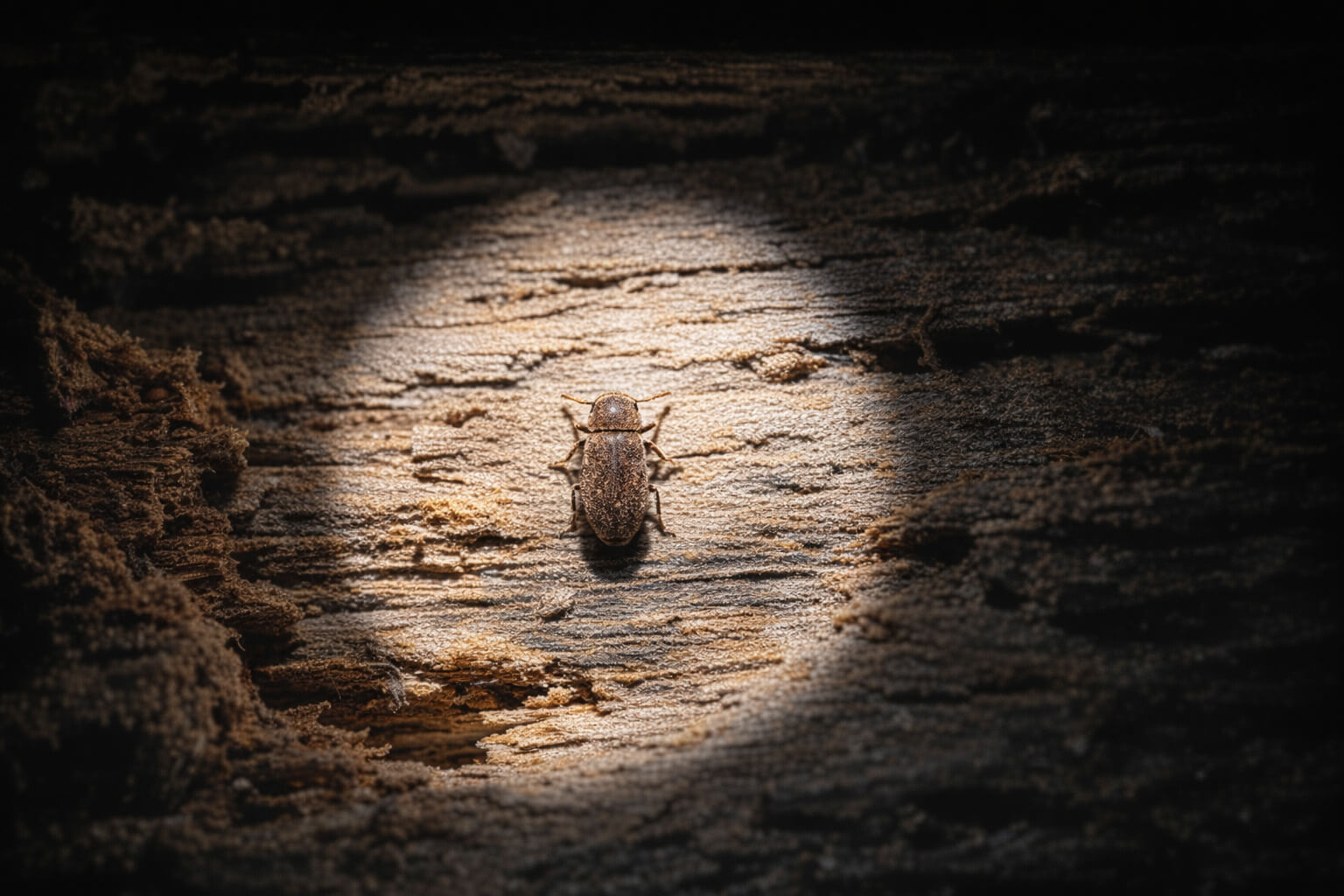
Active deathwatch beetle is diagnosed by current evidence, not by old holes alone, and that distinction is where good decisions begin.
Signs that suggest current activity
Fresh frass, sharp-edged new emergence holes, recent beetle remains, and evidence of current emergence in season all point more strongly toward active infestation than old scarring in timber. Even then, each sign needs context. Dust can be disturbed by maintenance or airflow. Old holes can look cleaner after surface disturbance. One clue is rarely enough, as Cranfield University deathwatch beetle damage research shows.
You brush a beam clean during a viewing, return a week later, and find new powder below the same cluster of holes. That is the sort of change that matters. A building that has sat unchanged for years with no fresh evidence tells a different story.
Why old holes can mislead you
Historic beams can carry the visible record of several past insect life cycles. That is why a listed building can look alarming long after active attack has ceased. English Heritage’s guidance is clear: past emergence holes do not prove a current infestation.
“The great majority of Death Watch Beetle attacks found in historic buildings died out many years – even centuries – ago.” — Robert Demaus, timber diagnostics specialist and partner, The Demaus Partnership Building Conservation Directory: Deathwatch beetle
What a specialist may use to confirm the picture
A proper assessment combines close visual inspection with broader building diagnosis. Depending on access and significance, that may include local opening-up, borescope inspection into concealed voids, assessment of decay, moisture mapping, and targeted resistance drilling or similar methods to understand the condition of larger members. The aim is to answer precise questions with the least disturbance necessary.
Readings in old timber can vary and need careful interpretation, so they should support judgment rather than replace it. A number on a meter is not, by itself, a diagnosis of active deathwatch beetle, according to Historic England research on moisture meter variability in medieval roofs.
| Sign | What it may mean | What it does not prove |
|---|---|---|
| Fresh frass beneath holes | Recent activity nearby | Exact species without further assessment |
| Sharp-edged clean holes | Recent emergence | Extent of hidden damage |
| Old darkened holes only | Historic attack | That the problem is ongoing |
| High moisture reading | Risk condition present | Active infestation on its own |
| Beetle remains in season | Current emergence likely | Structural severity without timber assessment |
When uncertainty means monitoring, not guesswork
Sometimes the right answer is “uncertain for now.” In a listed building, that can be a disciplined outcome, not a failure. If evidence is borderline, a specialist may recommend monitoring while moisture defects are addressed and access is improved. You are not ignoring the problem. You are refusing to guess at the building’s expense.
What conservation-compliant treatment actually looks like

Conservation-compliant treatment starts with the building, then the infestation, and only then the chemical, because the aim is to preserve sound historic fabric while removing the conditions that allow activity to continue.
Step 1: deal with the building conditions first
If moisture, condensation, decay, or water ingress is part of the picture, that work comes first. Repairing a leak, improving roof void ventilation, correcting trapped moisture, or addressing embedded damp timber ends may be the most important part of the specification. In many cases, that is what changes the environment from suitable to unsuitable for continued attack.
This is the conservation-first principle in practice. You are working with the building’s fabric and moisture balance, not against it. Old fabric needs to be understood before modern sealed-up assumptions are imposed on it.
Step 2: choose targeted treatment only where evidence supports it
Chemical treatment has a place, but not as a reflex. If a survey supports active deathwatch beetle in a defined area, localised treatment may be appropriate as part of a wider plan. That might involve a paste, gel, or carefully specified surface treatment, but those are delivery methods, not complete strategies in themselves. The real test is whether the treatment is targeted, justified, compatible with the building, and proportionate to the evidence.
Historic England also advises caution with chemicals in historic buildings, especially where work affects roof spaces or sensitive habitats. Even where products are appropriate, they should sit inside a broader conservation method statement rather than substitute for one.
Step 3: repair historic timber before replacing it
A listed-building mindset assumes retention first. If a historic member is still doing its job, or can do so with local repair, splicing, strengthening, or carefully designed reinforcement, that is usually preferable to wholesale replacement. Planning guidance and listed-building policy support minimal intervention and protection of significant historic fabric.
You find isolated active evidence around one end of a major oak beam, and there is a long-term roof leak above it. The conservation-led answer is not to strip out the whole beam because its face is scarred. It is to diagnose the extent, stop the moisture source, decide whether the timber is structurally compromised, specify localised treatment if justified, and repair only the part that genuinely needs intervention.
“Most of the damage seen will be historic and superficial.” — Tim Floyd, conservation scientist and chartered surveyor, Floyd Consult Country Life: Should we fear the deathwatch beetle?
Step 4: monitor and reinspect
Even after justified treatment or repair, monitoring matters. Reinspection lets you confirm that moisture conditions have improved, no fresh activity is appearing, and repairs are performing as intended. In a listed building, that ongoing evidence can be as valuable as the initial survey because it shows the building is stabilising without unnecessary escalation.
| Option | When it is appropriate | Risk if overused |
|---|---|---|
| Moisture and defect repair | When damp, leaks, or condensation are present | None; this is often essential |
| Local timber repair | When historic timber is partly affected but largely retainable | Poor workmanship can remove too much fabric |
| Full replacement | Only when timber is beyond repair or unsafe | Unnecessary loss of historic significance |
Minimal intervention does not mean leaving unsafe timber untouched. It means retaining what is sound, repairing what is repairable, and targeting treatment only where the evidence says it will make a real difference.
When listed building consent and conservation officers come into the picture

Listed building consent questions usually arise from what you plan to do to the fabric, not from the beetle itself.
When treatment is unlikely to raise major consent issues
If work is truly minor, non-destructive, and does not affect the building’s character, formal consent issues may be limited. Pure diagnosis, careful inspection, and some low-impact maintenance may fall into that category. But the threshold is defined by whether the work affects the special interest of the listed building.
When repair or disturbance may trigger consent questions
The risk rises when you move beyond diagnosis into opening up historic fabric, removing finishes, cutting back original timber, replacing beams, altering roof structure details, or applying treatments to sensitive historic surfaces. At that point, the work is no longer just “beetle treatment.” It becomes building alteration, and the heritage implications need proper thought.
You lift a ceiling to inspect a beam and discover the inspection itself may affect historic fabric. That is the moment consent stops feeling theoretical. In listed buildings, even sensible repair work needs the right route.
A conservation officer is not there to obstruct sensible repair. Early dialogue can protect you from costly mistakes, especially where access is poor, finishes are original, or structural timbers are significant. If the repair is substantial, you may also need structural design input and a Building Regulations conversation alongside the heritage discussion.
How to approach the local authority early and well
The strongest approach is evidence-led: clear survey findings, a plan showing what is active and what is not, an explanation of moisture causes, and a repair hierarchy that shows you intend to retain as much historic material as possible. That is far easier to support than a vague instruction to “treat woodworm and replace damaged beams.”
A practical rule is simple: if the proposed work changes historic fabric, character, or structure, check early. If the work stays at the level of diagnosis and careful maintenance, the consent question may be lighter. Either way, treating consent as protective rather than obstructive usually leads to better repair decisions.
What a proper survey and specification should include — and how to judge severity

A proper survey should tell you what is happening, why it is happening, how far it goes, what it means structurally, and what the least invasive effective response looks like.
At minimum, you should expect likely species identification, a view on active versus historic evidence, the timber types and locations affected, moisture and decay findings, extent mapping, structural significance, recommendations on retention and repair, and any flags around listed-building consent or further opening-up. If chemicals are proposed, the report should explain why, where, and as part of what wider strategy.
A weak report reveals itself quickly. It jumps from “holes found” to “spray recommended,” says little about moisture or decay, does not distinguish historic from active evidence, and treats all timber as equivalent regardless of heritage value. That is not a conservation-led diagnosis. It is a generic treatment recommendation.
Where severity is concerned, keep it simple. Low severity usually means historic holes, no fresh frass, dry stable timber, and no meaningful structural concern. Medium severity means some evidence of current activity, but localised and linked to defects that can be corrected. High severity usually means active infestation plus decay plus structural importance plus repair or consent complexity. The word “deathwatch” alone does not make a case high risk; the combination of activity, condition, and significance does.
| Survey item | Why you need it | Red flag if missing |
|---|---|---|
| Active vs historic assessment | Prevents unnecessary treatment | All holes treated as live attack |
| Moisture and decay diagnosis | Finds the real cause | No building context given |
| Extent and structural significance | Guides repair decisions | No distinction between major and minor timbers |
| Repair/treatment hierarchy | Protects historic fabric | Blanket spraying or replacement proposed |
Your next step: protect the timber, protect the listing, and get the right help
Your next step is to replace panic with evidence: photograph what you have found, note where it appears, look for fresh frass and obvious moisture defects, and resist the urge to sand, strip, inject, or replace historic timber before the building has been properly assessed.
If you can safely inspect a roof void or beam line, look for the wider story as well as the holes. Is there a slipped tile, a damp masonry abutment, blocked ventilation, staining from a long-term leak, or evidence that modern alterations have changed how the area dries? Those clues often matter more than the holes themselves.
“At Sussex Damp Experts, we treat suspected deathwatch beetle as a diagnosis problem first: prove activity, find the moisture source, then specify the least invasive fix.” — Our senior timber surveyor, Sussex Damp Experts
If you need a conservation-aware assessment, Sussex Damp Experts can inspect suspected deathwatch beetle in listed and period buildings, identify the moisture and timber conditions behind the signs, and help you move towards the least invasive effective combination of monitoring, repair, and targeted treatment. The aim is simple: protect your timber, protect your listing, and give you confidence that the next decision is the right one.
Frequently Asked Questions
How much should you budget for a deathwatch beetle problem in a listed building?
You should budget by scenario and risk level, not by searching for a single “deathwatch beetle treatment cost.” In a listed building, the price difference between a straightforward reassurance survey and a complex repair programme can be enormous, even when the same insect is involved. What matters most is not the beetle name on the report, but the access difficulty, fabric significance, and how much supporting investigation the building needs before anyone can responsibly act.
A useful way to budget is to decide which of these situations you are actually in:
- Buyer or seller scenario: you need a clear answer quickly, often with limited opening-up, so the main cost is specialist inspection and reporting.
- Owner-occupier scenario: you already know there is a problem and need a realistic repair budget, so costs may include access equipment, local opening-up, making good, and moisture-related repairs.
- Managed or commercial building scenario: you may need multiple inspections, formal documentation, contractor coordination, and a longer programme because decision-making involves more than one party.
The biggest cost drivers are often the ones people do not think about at first:
– Access: scaffolding, tower access, or cherry pickers for high roof structures
– Opening-up and reinstatement: careful removal and repair of finishes to see concealed timbers
– Professional input: structural engineer, heritage consultant, or detailed method statements
– Site constraints: restricted access, occupancy, protected species timing, or phased working
– Extent uncertainty: one suspect beam is cheaper to investigate than an entire roof range
When you compare quotes, ask whether they all cover the same scope. A fair comparison should state:
– what areas are included
– whether access is included
– whether opening-up is included
– whether repair design is included
– what assumptions sit behind the figure
A “cheap” quote is often misleading when it jumps straight to treatment without explaining access, exclusions, or what happens if concealed damage is found. For larger listed-building jobs, it is sensible to ring-fence a contingency rather than spend your whole budget on the first visible issue. That way, if access reveals more, your project stays controlled instead of reactive.
What time of year is best for surveying, treatment work, and follow-up checks?
The best time depends on what you are trying to prove. If your main question is whether activity is current, late spring into summer is often the most useful window because emergence evidence is easier to spot. If your main concern is the building condition behind the problem, autumn and winter can also be valuable because leaks, condensation patterns, and ventilation failures often show themselves more clearly when the weather is working against the structure.
There is no single perfect season. There are better seasons for different tasks. A spring or summer inspection can help you pick up fresh signs more easily. A wet winter may reveal the roof weakness, blocked gutter, or moisture path that made the timber vulnerable in the first place. Cadw recommends regular roof checks before and after winter and after high winds because small failures can quickly become larger fabric problems, and that principle matters just as much when beetle risk sits in the background Cadw roof guidance.
If you are planning works, think in this order:
– inspection window
– decision window
– access window
– repair window
– review window
That sequence matters because listed-building work is often delayed by more than the timber problem itself. Access equipment, contractor availability, ecology constraints, and the time needed to agree suitable methods can all affect timing. If you are buying a property, a lender deadline may push you toward an initial scoped survey first, with more invasive investigation later. If insurance-related water ingress is involved, you may need early documentation before repairs begin. If a school holiday or church event calendar affects access, the “best” technical season may not be the best practical season.
A strong approach is to inspect when evidence is easiest to read, repair when conditions are suitable, and review across at least one season change. That gives you a fuller picture of how the building behaves. Speed matters sometimes. But timing that improves certainty usually saves more trouble than rushing into the wrong sequence.
Will your insurance cover deathwatch beetle treatment or repairs in a listed building?
In many cases, standard buildings insurance will not pay for routine insect treatment, long-term decay, or gradual deterioration. That can be an unpleasant surprise, especially if you assumed the policy would respond to any issue affecting structural timber. Insurers often draw a firm line between a sudden insured event and a defect that developed slowly. A storm-damaged roof may be treated one way. The long-term consequences of moisture and insect activity are often treated another.
The question to ask is not simply, “Do you cover beetles?” It is, “Do you cover the event that led to the damage, and what exclusions apply to decay, infestation, maintenance failure, and historic fabric?” If you own a listed building, you may have a more specialist policy, but that still does not guarantee cover for treatment itself. Some policies may help with associated works after an insured event, while excluding the infestation. Others may contribute only to emergency stabilisation, access, or professional fees, and only in narrow circumstances.
When you review your policy, focus on:
– exclusions for infestation, vermin, rot, or gradual damage
– trace-and-access wording
– professional fees clauses
– heritage or listed-building extensions
– responsibility wording if the property is tenanted or managed
How you contact the insurer also matters. Keep the first description factual and specific. Explain what has been found, what is not yet confirmed, and whether there has been a recent insured event such as storm damage or escape of water. Avoid turning a suspected condition into a confident diagnosis before a specialist has reported.
Good documentation strengthens your position whether the claim succeeds or not. Keep dated photographs, inspection notes, maintenance records, and the survey report. Even where the policy does not cover treatment, that record can still help with purchase negotiations, lease or management disputes, and any later claim linked to a separate water-ingress event. Clarity helps. So does paperwork.
Can deathwatch beetle spread to other parts of your building or to neighbouring properties?
Yes, it can spread within a building if suitable timber and suitable conditions exist, but it does not behave like a fast-moving outbreak jumping randomly from house to house. Deathwatch beetle depends on the right habitat: usually older hardwood timbers, often with some degree of dampness or decay-softening. That means the real question is not “Can it spread anywhere?” but “Where else in or around the building offers the same conditions?”
Within your own property, the highest-risk locations are usually timbers connected by similar exposure and moisture history:
– adjoining roof members
– embedded beam ends
– hidden junctions near masonry
– repeated timber details on the same elevation
– similar voids with restricted airflow
If one truss foot has active conditions because of a long-term leak, another truss foot on the same range may deserve attention too. That does not mean you should assume the whole building is infested. It means you should think in terms of risk zones, not isolated holes.
Spread to neighbouring buildings is much less straightforward. In a terrace, courtyard range, or converted farmstead, the practical risk depends on shared fabric, common roof voids, and whether adjacent timbers offer the same habitat. If neighbouring roofs are structurally separate and dry, beetle evidence in one building does not automatically create a problem next door. If there is continuous historic timber structure across a boundary, or a shared roof with common defects, the position changes.
The same principle applies to non-oak timbers. Deathwatch beetle is strongly associated with old hardwoods, but a mixed historic structure can still contain local exceptions. If you manage a larger estate, hall house, or former agricultural complex, it can be worth mapping:
– timber type
– moisture history
– repair history
– exposure pattern
– access constraints
That sort of map is more useful than blanket assumptions. Calm mapping beats panic. You are trying to understand pathways of risk, not imagine the insect moving through every part of the site in the same way.
What should make you worry after treatment or repair, and when should you reopen the case?
You do not need to panic every time you see an old hole after treatment, but you do need to know which signs count as normal background evidence and which signs suggest the case is still live. The most useful post-treatment question is not “Does the timber still look marked?” Historic timber often will. The better question is “Is there new evidence, worsening building condition, or a breakdown in the repair assumptions?”
Some findings are not automatically alarming:
– old exit holes still visible on the timber face
– minor cosmetic variation around repaired areas
– dust from access work, cleaning, or old debris shifting after disturbance
– unchanged surface scarring on long-attacked historic beams
Other findings should make you pause and escalate:
– fresh accumulations of fine dust appearing repeatedly in the same place
– new moisture staining around repaired defects
– movement, distortion, or cracking around timber junctions
– repair materials separating from adjacent timber
– worsening musty odour or dampness in the same void
– repeated signs after a period when the area was stable
It helps to keep a simple building log. Record dates, weather conditions, photographs from fixed viewpoints, any new dust, and any changes to roof coverings, gutters, ventilation, or nearby finishes. If you are selling, refinancing, or managing on behalf of others, that log becomes useful evidence. It shows whether the issue is stable, improving, or drifting back into risk.
You should reopen the case when one of three things happens:
1. new signs appear
2. the moisture story changes
3. a later project exposes more concealed timber
That last point matters. You might have a stable situation for two years, then open up an adjacent section during unrelated repair work and discover conditions have changed behind the visible surface. That does not mean the original advice was wrong. It means the building has revealed new information.
At Sussex Damp Experts, we treat that point seriously: your outcome improves when reinspection is triggered by evidence, not by fear or wishful thinking. If the signs are changing, reopen the file early while the next step is still proportionate.
Do churches, barns, and converted outbuildings present different deathwatch beetle risks from listed houses?
Yes. Different listed building types create different risk patterns, even when the insect is the same. A timber-framed barn, a church roof, and a Georgian town house do not hold moisture, move air, or receive maintenance in the same way. If you treat them as though they do, you can end up with the wrong priorities and the wrong repair plan.
Churches and chapels often have large roof voids, long inspection intervals, and difficult access, which means small defects can remain unnoticed for years. They may also contain very old structural timber where safe survey and repair are expensive and logistically complex. A listed house is more likely to be heated, occupied, and inspected informally, which can help you spot change earlier. That does not make the house lower risk in every case. It just changes how evidence appears and how quickly problems are noticed.
Barns and converted agricultural buildings bring a different set of questions:
– are old timbers now enclosed inside insulated rooms?
– have new linings reduced airflow?
– do exposed elevations drive repeated wetting?
– are service runs trapping moisture at timber junctions?
– is part of the structure still effectively an outbuilding while another part is fully domestic?
Occupancy pattern matters too. An intermittently heated building can behave very differently from one that is occupied all year. A church used once a week, a holiday let with long vacant spells, and a permanently lived-in listed house may all show different condensation and ventilation behaviour even if the roof form is similar.
Outbuildings also tend to have a broader mix of timber histories. Some members may be original and dry. Others may have been reused, patched, or exposed to neglect before conversion. That means your survey brief should be shaped around building type, use, and adaptation history, not just the insect name. The same hole pattern in a parish church roof and a converted cart barn may point to very different priorities because access, significance, occupancy, and moisture drivers are all different.
If your building is unusual, the right question is not “What is the standard treatment?” It is “How does this specific building behave?” That shift usually leads to better decisions.

