
 By
 March 27, 2026


What matters most when checking joists for deathwatch beetle
Yes, you can assess structural risk from deathwatch beetle without lifting the floor in many cases, but only by building evidence methodically rather than trusting surface appearance. Old holes alone do not tell you whether a joist is safe, active, or still damp enough to deteriorate further. The useful question is not “Can I see beetle damage?” but “How much sound timber remains at the points that actually carry load?” According to the Natural History Museum, deathwatch beetle is associated with older hardwood timbers, leaves 2-3 mm exit holes, and is more common in southern England.
Can you assess structural risk without lifting the floor?

You can often judge whether deathwatch beetle in floor joists is low, moderate, or high risk without lifting boards, but you cannot prove everything from the room above alone. A sensible no-lift assessment combines how the floor behaves under load, where damp is entering, whether activity looks current, and whether hidden faces can be checked through existing access or very small inspection points. That is usually enough to decide between monitoring, specialist survey, or targeted opening-up, which is consistent with the inspection limits set out in the Contracts Finder survey brief.
Deathwatch beetle at a glance
- Species: Xestobium rufovillosum
- Typical exit holes: about 2-3 mm
- Frass: rounded, bun-shaped pellets rather than fine dust
- Emergence period: spring to early summer
- UK pattern: especially associated with older hardwood timbers and more common in southern England
What a no-lift assessment can tell you
A no-lift assessment can tell you whether the pattern fits historic attack, active infestation, moisture-linked risk at joist ends, or a floor already showing reduced stiffness. If the signs cluster around an external wall, chimney breast, or damp pocket, that matters more than scattered old holes in a dry central span.
What it cannot prove from the room above alone
A room-above inspection cannot directly measure the remaining cross-section at every hidden bearing end, nor confirm the condition of timber buried in masonry. Confidence therefore sits on a spectrum: sometimes you can monitor, sometimes you need concealed-timber assessment, and sometimes targeted opening-up becomes the careful option.
Why floor joists can look sound while the dangerous damage stays hidden
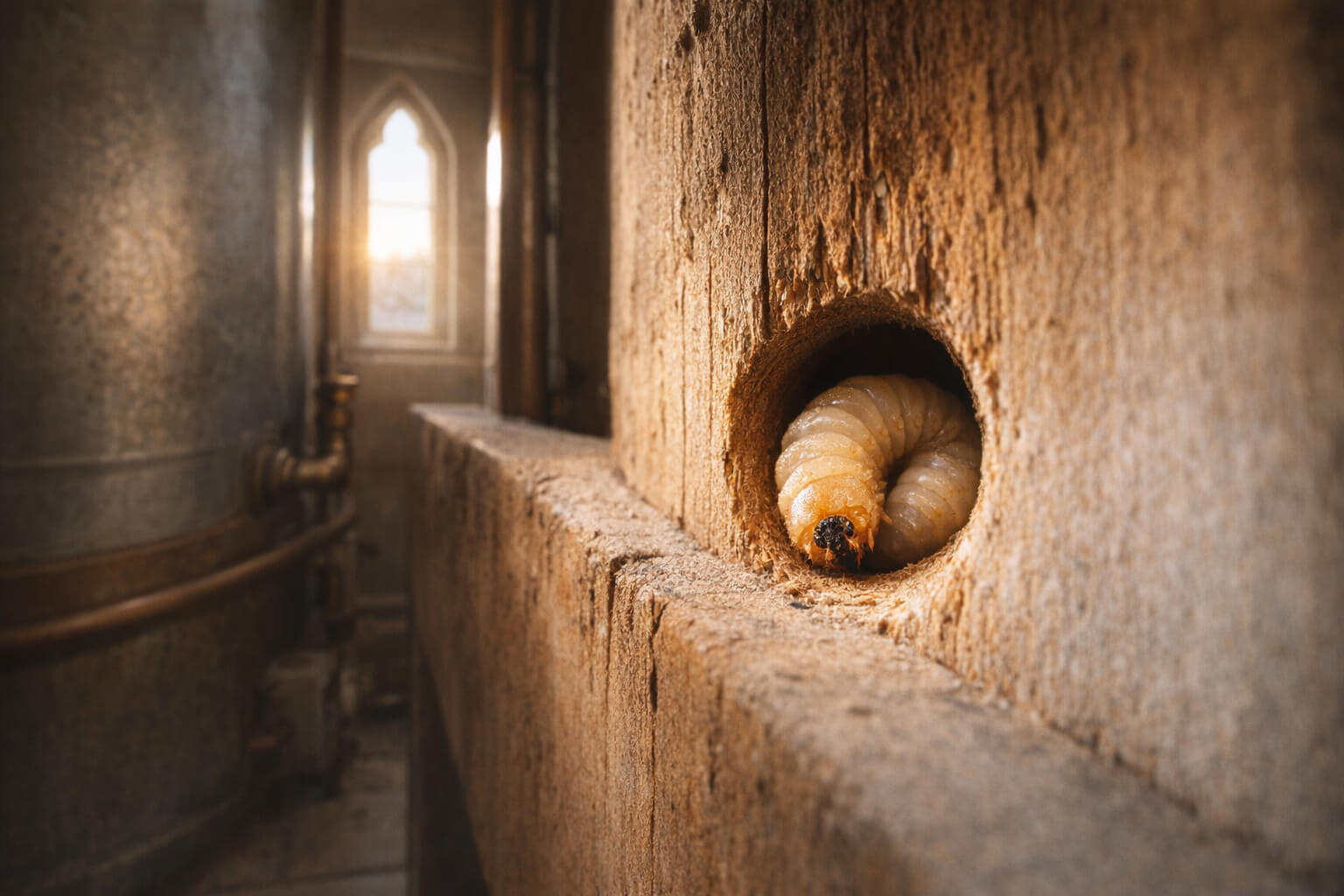
Visible holes do not measure structural strength, because a floor joist can keep a firm outer face while losing material where you cannot see it. In old suspended floors, the most important timber is often not the timber in the middle of the room but the quiet bearing end disappearing into masonry, where damp, fungal change and insect attack can overlap. Surface evidence is not structural evidence. Guidance in the Exeter timber report supports that distinction between visible condition and concealed timber performance.
Residual section matters more than hole count
What matters structurally is the amount of sound timber still carrying load. A joist does not fail because it has a certain number of flight holes. It becomes a risk when boring and decay reduce the effective section at a critical point, especially where loads transfer into a wall or support. A peppered visible face can be less serious than a hidden end that has softened, hollowed or lost bearing.
If you stand in a room with a floor that looks respectable but feels different at one edge, that mismatch matters. You can have a sound skin and a weakened core. In older hardwood floors, especially where moisture altered the timber first, the outside can stay calm while the inside tells a harder story.
Why bearing ends matter more than mid-span appearance
Joist ends built into solid walls are classic risk points because moisture accumulates there and drying is poorest. Historic guidance on old floors and timber repairs repeatedly points to joist ends in masonry as vulnerable to damp-related decay, and that matters more when deathwatch evidence is present because the insect is strongly associated with damp or previously damp hardwoods. The New Forest National Park Authority flooring guidance is particularly relevant on joist-end vulnerability in older floors.
This is the practical reality on site.
“You start with the holes because that is what you can see, but the real answer is nearly always waiting at the joist end, where damp, bearing and hidden loss meet.” — A heritage building surveyor in Sussex
You see this most clearly in period buildings where external ground has risen, underfloor airflow is poor, gutters have leaked for years, or a chimney breast has created a colder, less ventilated corner. In those conditions, the key question is rarely “How many holes are in the board?” It is “What is happening where the joist actually bears?”
Why springiness and local distortion can appear late
Movement often appears late, after hidden loss has already developed. A joist can lose integrity gradually, redistribute load for a time, and only then show local bounce, dish, cracking at the perimeter, or a definite dip near one support.
That is why “the floor still feels mostly fine” is only mild reassurance. If the movement is localised near a wall, hearth, chimney return, or previously damp corner, the right response is not panic. It is sharper assessment.
Moisture is the real story — why the beetle needs damp timber to breed

Deathwatch beetle in floor joists is usually a moisture problem before it is an insect problem, because the lifecycle depends on timber staying damp enough for long enough. English Heritage guidance notes that breeding becomes possible when timber moisture content is above about 16%, while wider decay risk rises as timber stays wetter for longer; fungal processes usually need higher moisture again, often into the low-to-mid twenties and above. That moisture-first approach also sits behind joint guidance from RICS on moisture in traditional buildings, which advises surveyors to take a whole-building approach and look for the source of excessive moisture.
A useful rule sits behind that whole approach.
“The key to controlling insect infestations is controlling moisture.” — Mike Parrett FRICS, RICS On the lookout for wood-boring insects
The moisture threshold that keeps deathwatch beetle active
There is no single magic number that divides safe from unsafe. For practical assessment, think in bands. Below about 15% moisture content, beetle activity becomes much less sustainable and drying is usually part of control. Above around 16%, breeding becomes more plausible. Once timber is regularly sitting in the wetter twenties, fungal activity and softening become a much bigger part of the structural picture. A hard “28% means deathwatch” rule is too crude, but sustained damp in that range is certainly bad news for timber.
Where damp reaches floor joists in older buildings
In period floors, the moisture sources are usually familiar: blocked air bricks, shallow underfloor voids with poor ventilation, raised outside ground bridging the lower wall, leaking rainwater goods, plumbing faults, damp chimney masonry, and impermeable repairs that trap moisture instead of letting a traditional structure dry. Each one raises risk at the joist ends first.
You might recognise this in a room where one perimeter feels cooler, skirting paint keeps failing, the outside path sits too high against the wall, and the floor near that edge has a slight give. That combination tells you more than the holes do. It points to a damp environment capable of keeping the problem alive.
How a moisture map changes your assessment
A moisture map turns a vague worry into a specific risk pattern. If readings, staining and building detail all point to one damp corner, one external wall, or one chimney return, you are not looking at random historic scarring. You are looking at an active risk environment. If the timber is dry, the void is ventilated, and the evidence is old and unchanged, the same holes may mean something very different.
Moisture readings still need context. Electrical meters can be distorted by salts, finishes and surface conditions, so they should never be treated as absolute truth on their own.
Fungal decay — the hidden factor that accelerates structural loss

Fungal change often makes deathwatch beetle more structurally important, because softened timber and insect tunnelling can remove strength together rather than separately. In older hardwoods, especially oak, deathwatch attack is strongly associated with timber that has been damp or water-damaged and altered by fungi. A beetle-only diagnosis is often too shallow for floor joists. Guidance published in the English Heritage fact sheet confirms that severe attack can hollow beams and result in structural failure.
Why beetle larvae prefer timber that fungi have already softened
Historic entomology guidance describes deathwatch beetle as mainly attacking hardwoods, particularly oak, where the wood has been damp or water-damaged and fungal action has broken down the structure and provided nutrients. That relationship explains why apparently minor insect evidence can conceal a larger fabric problem.
This is why the structural conversation changes when you find both insect evidence and softness. If prolonged damp and fungal activity have already altered the timber, the larvae are not simply decorating an otherwise sound joist. They may be exploiting wood whose strength was already reduced.
Wet rot and brown rot — different risks to the same joist
Wet rot usually points to prolonged high moisture and can cause softening around damp bearing areas. Brown rot can cause more brittle, cuboidal breakdown in susceptible timbers. The practical point is simple: once fungal evidence is present, you are dealing with combined loss, not separate labels.
When fungal evidence changes the structural conversation
Fungal evidence shifts the question from treatment to residual strength. It does not mean the floor is about to fail, but it does mean appearance has become an even poorer guide and the case for concealed assessment is stronger.
What you can learn without removing a single board

A sensible no-lift assessment follows a hierarchy: visual evidence, moisture pattern, hidden-view inspection, resistance testing, and only then targeted opening-up if uncertainty remains. Each tool answers one part of the problem and each has limits. What matters is how the findings align or conflict.
Visual signs and what they actually indicate
Start with what the floor is telling you. Look for local springiness, a dip near a wall, cracking at skirting junctions, loose boards at one edge, or a drummy feel under load in one area but not the rest. Then look beyond the room: blocked air bricks, damp lower masonry, rainwater defects, and any accessible cellar or void evidence below. Fresh pellet-like frass in spring is far more meaningful than old dark debris shaken loose by dry timber movement.
If you are buying a listed cottage and the survey mentions wood-boring insect evidence but says the subfloor was not visible, that limitation matters. It does not prove serious damage, but it does mean the most important evidence may still be missing at the supports.
Moisture readings and their context
Moisture readings guide attention, but they do not settle the diagnosis on their own. Surface meters and resistance readings can identify a damp pattern, but they are vulnerable to false readings from salts, conductive contamination and finishes.
Endoscope inspection of hidden faces
Where there is existing void access, a cellar ceiling below, or a suitable discreet access point, an endoscope or borescope can give you visual evidence from the hidden side of the timber. That can reveal tunnelled zones, frass accumulations, damp staining, fungal growth, or the condition of a joist where it meets masonry. It is minimally invasive, not magically non-invasive, because a small hole may still be needed.
A heritage surveyor put the broader point well.
“You can’t really understand a building until you see how it’s put together or taken apart.” — Marianne Suhr MRICS, Old House Consultancy / RICS Marianne Suhr MRICS
Resistance micro-drilling for residual section
Resistance micro-drilling goes a step further. It allows a specialist to read how the timber resists a fine drill along a line through the section. Used properly, it can distinguish sound timber from softened or voided zones and give a much better sense of how much loadbearing material remains. It does not replace engineering judgement, but it is one of the best low-disturbance ways to move from guesswork to evidence.
When targeted opening-up becomes the right call
Targeted opening-up becomes right when the remaining doubt sits at a critical support. In heritage terms, that is often the least harmful path because it keeps investigation small, purposeful and repair-led rather than broad and speculative. Sussex Damp Experts take that approach when concealed timber needs clearer evidence but the floor itself also has historic value.
Reading the evidence — active infestation vs old damage

Fresh frass and recent emergence matter more than old holes, but activity and structural adequacy are still two different questions. You can have active beetles in timber that is not yet dangerously weakened, and inactive beetle damage in timber that still needs structural attention because the legacy loss remains. That distinction is essential. Guidance from Mid Suffolk District Council is clear that old holes do not prove active infestation and that spring is the key period for judging emergence.
Fresh frass, sealed holes, and spring emergence
The best time to judge activity is spring into early summer, when adults emerge. Fresh holes look sharp and pale inside. Fresh frass is light-coloured, rounded and clean rather than compacted and dirty. You may also find stunned or dead beetles below affected timbers. Old holes darken with age, and old dust can fall out later as timber dries and shrinks, so debris alone is not proof of current activity.
Old damage that no longer needs treatment
Historic attack often needs monitoring rather than treatment if the timber is now dry, there is no sign of new emergence, and the floor is not showing structural symptoms. Visible scars are often treated as if they were live evidence. In old buildings, extinct attack is common.
The grey zone — and how to resolve it
Some cases sit in a grey zone where method matters more than first impressions. You may have ambiguous frass, uncertain moisture, no direct view of the joist ends, and a floor that feels only slightly different. Seasonal monitoring, concealed inspection and selective resistance testing are what turn suspicion into a defensible decision.
Structural risk in context — when beetle damage actually matters
Deathwatch beetle damage becomes structurally important when it affects the wrong timber in the wrong place under the wrong moisture conditions. Position, load path, residual section and compounding damp matter more than the simple presence of holes. A secondary trimming timber with old damage is not the same risk as a primary joist end carrying floor loads into a damp external wall.
Position and load path — which joists carry the real weight
The first structural question is where the affected timber sits in the load path. Joists at bearing ends, trimmer details around hearths, areas near stair openings, and heavily loaded spans deserve more attention than isolated evidence in a lightly loaded or redundant section. A defect at mid-span can matter, but the hidden support zone is usually where modest-looking deterioration becomes disproportionate.
How much section loss before a joist needs intervention
There is no honest universal percentage at which a deathwatch-damaged joist must be repaired. That depends on species, span, loading, support detail, and where the loss is concentrated. What you can say confidently is that intervention becomes more likely when resistance testing or concealed inspection suggests reduced section at a bearing end, softness under probing, abnormal movement above, or combined insect and fungal deterioration.
Cumulative risk — when several moderate factors combine
Several moderate factors together can matter more than one dramatic sign on its own. A little springiness, some fresh frass, high readings at one wall, blocked vents and a known gutter leak form a more serious picture than any single item in isolation. You are weighing a chain, not a clue.
| Timber position | Evidence type | Action level |
|---|---|---|
| Mid-span, dry context | Old holes, no new frass, no movement | Monitor and record |
| Bearing end near damp wall | Old holes plus raised moisture pattern | Specialist concealed assessment |
| Primary support with softness/voiding | Combined insect and fungal evidence | Repair design / engineer input |
| Multiple joists in one zone | Moderate signs across several members | Escalate because risk is cumulative |
If you notice a distinct dip near a chimney breast and also find fresh pellet-like frass along that perimeter in spring, “keep an eye on it” stops being enough. The evidence is no longer cosmetic. It is directional.
When to stop assessing and start acting
You should stop assessing and start acting when active evidence, sustained damp, concealed section loss and structural importance converge in the same place. That does not always mean major strip-out. It means the next step should become decisive: controlled opening-up, repair design, or structural input rather than more speculation.
The four-question decision framework
A useful decision framework is simple. Is the evidence active? Is the timber still damp enough to sustain deterioration? Is the affected timber structurally important? Can hidden condition be judged confidently without broader opening-up? If you answer yes to the first three and no to the fourth, the professional path is escalation.
Monitoring — when patience is the professional response
Monitoring is reasonable when the evidence looks historic, the timber is dry, the floor is not moving abnormally, and the risk sits away from critical supports. In those cases, dated photographs, spring checks for fresh frass, and review of moisture conditions can be more intelligent than immediate disturbance.
Escalation — when the evidence says act now
You should escalate when fresh activity, damp, movement and structural importance align in one area. A good report should then tell you where the risk sits, what evidence supports it, what remains unknown, and whether the least disruptive next step is monitoring, targeted opening-up, repair, or engineering design.
“We do not treat old exit holes as a verdict. We assess moisture, movement, access and residual timber condition first, so your next step is based on evidence rather than disturbance.” — Our senior surveyor, Sussex Damp Experts
If you need that level of clarity, Sussex Damp Experts can assess the concealed timber systematically so you can decide with evidence rather than guesswork.
Frequently Asked Questions
How much does it usually cost to assess deathwatch beetle in floor joists without lifting the floor?
You will usually pay more for certainty than for a quick opinion, and that difference matters when the timber is concealed. A low-cost inspection may tell you that insect evidence is present, but it often will not tell you whether the hidden joists are dry, structurally relevant, or likely to need further opening-up. In practical terms, you are paying for access strategy, interpretation, reporting quality, and whether the survey is tailored to a period building rather than treated like a generic timber check.
Using typical market pricing in southern England, a straightforward damp or timber survey often falls in the region of £300 to £700. A more specialist concealed-joist assessment, especially where the floor is part of a listed or sensitive building, is more often £600 to £1,500. If selective resistance drilling is added, you may see another £200 to £600 depending on the number of locations, access time, and how the results are reported. If the inspection has to move from survey work into careful opening-up and making good, costs often rise to £500 to £2,000+ before you even reach structural repair.
| Level of assessment | Typical UK range | What usually drives the price |
|---|---|---|
| Basic survey | £300-£700 | Time on site, report depth, travel |
| Specialist concealed assessment | £600-£1,500 | Access difficulty, equipment, interpretation |
| Add resistance drilling | £200-£600 extra | Number of test points, reporting |
Three things tend to push the price upward. The first is heritage sensitivity: if original boards, skirtings or hearth details must be protected, the survey takes longer and the tolerance for damage is lower. The second is poor access: a cellar-less house with blocked vents and no obvious inspection route takes more planning than a house with a clear void below. The third is making good: lifting and reinstating broad old boards or matching finishes can cost more than the inspection itself.
The useful budgeting rule is to separate survey cost, temporary access or opening cost, and repair cost. They are not the same line item, and combining them too early often makes the whole job sound worse than it is.
Is deathwatch beetle in floor joists usually covered by buildings insurance?
Usually, no. Most buildings insurance policies treat beetle attack, rot, and slow deterioration as maintenance issues rather than sudden insured events. That means you should not assume that a policy will fund investigation, treatment, or timber replacement just because wood-boring insects are involved. In many policies, infestation sits in the same broad category as wear, decay, shrinkage, and defects that develop over time.
Where cover sometimes becomes possible is through the cause or the resulting damage, not the beetle itself. If a burst pipe, storm damage, or a sudden escape of water created a clear moisture event and that event led to urgent timber failure, your insurer may focus on the insured peril rather than the infestation that followed. Even then, many insurers will look closely at timing. They may consider the immediate consequences of the leak, but not months or years of overlooked dampness that allowed insects and decay to persist.
The wording in your policy matters more than the name of the beetle. Before you ring your insurer, search for these phrases first:
- gradual deterioration
- vermin or infestation
- escape of water
Those three expressions often tell you, very quickly, whether the policy is likely to help or resist. Also look for language around “defective workmanship”, “maintenance”, and “latent defect”, because those exclusions can shape the outcome of a claim just as much as the infestation wording itself.
A practical example makes the difference clearer. If a joist end has quietly weakened over several winters because an air brick was blocked and a gutter leaked, that is usually treated as maintenance. If a washing-machine hose bursts, saturates the floor zone, and you then discover immediate timber instability, the insurer may at least consider the water event. Before you notify them, gather your policy, dated photographs, any earlier reports, and a short timeline of leaks or repairs. If you need to claim, stick to facts and let the evidence lead.
Can deathwatch beetle in floor joists affect a sale, mortgage, or remortgage?
Yes, it can affect all three, but usually because of uncertainty rather than because of the insect name alone. Buyers, valuers, and lenders tend to react most strongly to phrases such as “further investigation required”, “possible structural timber decay”, or “subfloor not inspected”. A survey that raises concern without explaining whether the issue is active, historic, localised, or structurally significant can slow a transaction far more than a precise diagnosis.
If you are buying, the problem is confidence. You may worry that the floor hides a large repair bill or that the lender is relying on incomplete information. If you are selling, the problem is delay. A general survey may mention insect evidence and stop there, leaving the buyer to request a specialist report before exchange. That can trigger renegotiation, a retention, or a pause while access is arranged. On remortgage, the same issue can surface through a valuation comment that the lender wants clarified before releasing funds.
The most useful way to keep a sale moving is to replace vague concern with a specific conclusion. A strong follow-up report should say where the evidence is, whether it appears active or historic, whether the timber is still damp, whether structural significance is likely, and whether targeted opening-up is actually necessary. “Further investigation” on its own is weak. “Localised historic evidence, no abnormal movement, monitor only” is much more helpful because it gives the buyer and lender something they can act on.
A common real-world example is a lender offering a mortgage subject to a timber specialist report before funds are released. Another is a buyer asking for a price reduction because the survey language is broad and alarming even though the condition may turn out to be limited. If you are selling, commissioning a clear report before marketing can stop that uncertainty defining your sale. If you are buying, ask for the most precise wording available. In conveyancing, clarity is often more valuable than reassurance.
Should you treat deathwatch beetle before you repair the floor, or repair the moisture problem first?
You should usually deal with the moisture problem first, or at least at the same time, because treatment alone rarely solves the condition that allowed deathwatch beetle to matter in the first place. If the timber stays damp, any insecticidal approach risks becoming an expensive gesture rather than a durable solution. The sequence matters: stabilise immediate structural risk if needed, stop the moisture source, let the timber environment improve, and then decide what treatment or repair is proportionate.
That does not mean you always wait passively for timber to dry before doing anything. If a floor is already showing dangerous weakness, you may need temporary support, restricted loading, or local opening-up first. Safety comes before sequencing. But once the situation is stable, the most durable order of work is usually cause before cure. Fix the leaking rainwater pipe. Lower the external ground if it is bridging the wall base. Reinstate ventilation. Remove trapped moisture conditions. Only then can you judge whether you are dealing with active infestation, historic damage, fungal decay that still needs repair, or a combination of all three.
There are also cases where treatment is justified but still secondary. If a repair specification involves retaining significant historic timber with evidence of activity, a specialist may recommend targeted treatment as part of a wider repair strategy. That is very different from spraying or injecting chemicals into a damp floor void and hoping the structural question disappears. In listed buildings especially, unnecessary chemical treatment can complicate conservation decisions without solving the root problem.
A simple decision order helps:
1. Is the floor safe enough to use?
2. What moisture source is keeping the timber vulnerable?
3. Does the timber still need repair once drying starts?
4. Is treatment proportionate to the actual risk, or just a reaction to old holes?
If you reverse that order, you often spend money early and think clearly later. That is rarely the cheapest or safest route.
Do you need listed building consent before treatment or repair for deathwatch beetle in floor joists?
Sometimes you do, and sometimes you do not, but you should never assume that internal floor work is exempt just because it sounds like maintenance. In a listed building, floorboards, joists, hearth details, skirtings, fixings, and even signs of earlier alteration may contribute to significance. The legal question is not whether the work feels modest to you; it is whether it affects the building’s character as a building of special architectural or historic interest, which is the test under the Planning (Listed Buildings and Conservation Areas) Act 1990.
Small investigative steps may not always need formal consent, especially where they are reversible and cause minimal harm, but that judgement depends on context. Drilling a discreet hole through a modern board inside a cupboard is very different from lifting a run of eighteenth-century boards in a principal room. Likewise, splicing a joist end may be treated differently from wholesale replacement, resin repairs, hidden steelwork, or extensive chemical treatment. The fact that beetle evidence exists does not automatically override conservation control.
The safest approach is to separate the project into three parts: investigation, treatment, and repair. They may not all need the same approvals. For example, you may be able to carry out a very limited inspection exercise after discussion with the conservation officer, but still need formal consent before replacing original timber or altering the floor build-up. Churches and some other heritage buildings may also fall under faculty or equivalent consent routes, so standard listed building assumptions do not always apply.
If your building is listed, check the list entry, look for any old consent decisions, and ask for written guidance where possible. A short method statement with photographs, marked-up plans, and a clear explanation of why access is needed usually travels better than a vague request to “lift some boards and see”. Early clarity protects you. It also reduces the risk of doing investigative work that later complicates consent for the repair you actually need.
What happens if you ignore suspected deathwatch beetle in floor joists, and how quickly can it get worse?
It can remain fairly stable for years, or it can worsen much faster than you expect if the building conditions shift against you. Deathwatch beetle is rarely a dramatic next-week failure story, which is why it is so often underestimated. The real risk is quiet change: a leak left unresolved, a property left under-heated through winter, a vent blocked during landscaping, or a previously breathable floor covered with impermeable finishes. Those changes can accelerate timber deterioration without producing much obvious warning until the floor begins to feel different.
The speed of decline depends less on the insect name and more on the whole environment. A dry, well-ventilated floor with old evidence may change very little over several years. A joist end beside an external wall can behave differently if a gutter starts overflowing or a bathroom alteration introduces new moisture above. A vacant period house is another common trap. If you leave it closed up, lightly heated or unheated, and poorly ventilated over one or two winters, the underfloor climate can become more favourable to both fungal activity and hidden timber stress.
A few practical examples show how timing changes:
– a small gutter defect can matter more after one wet winter than after three dry summers
– a kitchen leak discovered late may turn a historic concern into an active repair problem within months
– heavy rugs, vinyl, or sealed coverings can hide subtle floor changes until distortion is already noticeable
| Situation | Reasonable response window |
|---|---|
| Old holes, dry timber, no movement | Monitor over months |
| New damp source or fresh frass | Arrange specialist assessment within weeks |
| Local dip, bounce, or cracking near support | Prioritise inspection quickly |
If you are deciding whether it is safe to wait, watch for change rather than just presence. Has the floor dipped more since last winter? Is a door binding? Has skirting opened at one end? Did a leak appear shortly before new debris? Static evidence can justify patience. Moving evidence usually means the clock has changed.

