
 By
 March 17, 2026


Do Deathwatch Beetles Actually Fly
Adult deathwatch beetles (Xestobium rufovillosum) can fly. They have functional wings beneath their elytra — the hardened outer casings that protect the membranous flight wings when the beetle is at rest. But the question of whether they can fly and whether they will fly are quite different, and the distinction matters for understanding how infestations spread and how seriously to treat flight as a transmission route.
The short answer is: yes, they have the capability. The more useful answer is: in most established infestations, flight plays a secondary role. Adults typically emerge from the same timber they developed in, mate nearby, and deposit eggs back into the same or immediately adjacent wood. The re-infestation loop is largely self-contained.
That said, flight does become relevant under specific conditions — warm spring evenings, properties near untreated timber structures, or buildings where population pressure has reached a point where beetles are actively seeking new hosts. Understanding when flight matters, and when it doesn’t, gives you a more accurate picture of spread risk than a simple yes-or-no answer.
Deathwatch Beetle Anatomy — Wings, Elytra and Flight Capability

The deathwatch beetle is a small, mottled-brown wood-boring beetle, typically 5–9mm in length as an adult. Like all beetles (Order Coleoptera), it carries two pairs of wings. The outer pair — the elytra — are hardened wing-cases that protect the delicate membranous flight wings beneath. During flight, the elytra lift outward, the membranous wings unfold, and the beetle becomes capable of sustained movement through the air.
In structural terms, deathwatch beetles are not flightless. They have the full anatomical apparatus for flight, and there is documented evidence of adults in flight during the spring emergence period. The question is not capability but behaviour.
What distinguishes deathwatch beetle flight from other flying insects is the beetle’s aerodynamic profile. The body is dense relative to wing surface area. This makes deathwatch beetles weak, laboured fliers — capable of covering modest distances under their own power, but not the kind of insect that moves confidently across long stretches of open air. Flight tends to be short-burst, directionally imprecise, and typically nocturnal or crepuscular.
According to Historic England’s guidance on deathwatch beetle in timber structures, adults emerge during the spring emergence window — generally between March and June in UK conditions, with peak activity typically occurring in April and May depending on the year’s temperature profile. During this period, adults that have completed their development (which may take 3–12 years in the larval stage) chew through to the surface and emerge ready to mate.
“Deathwatch beetle adults emerge in spring, typically between March and June. The adults live for only a few weeks and do not feed, their sole purpose being to mate and deposit eggs.” — Historic England, Advice on Timber: Deathwatch Beetle
The elytra and wings are functional at emergence. Whether a given adult uses them depends on environmental conditions, proximity to other timber, and the local population density.
Why Deathwatch Beetles Rarely Fly in Practice
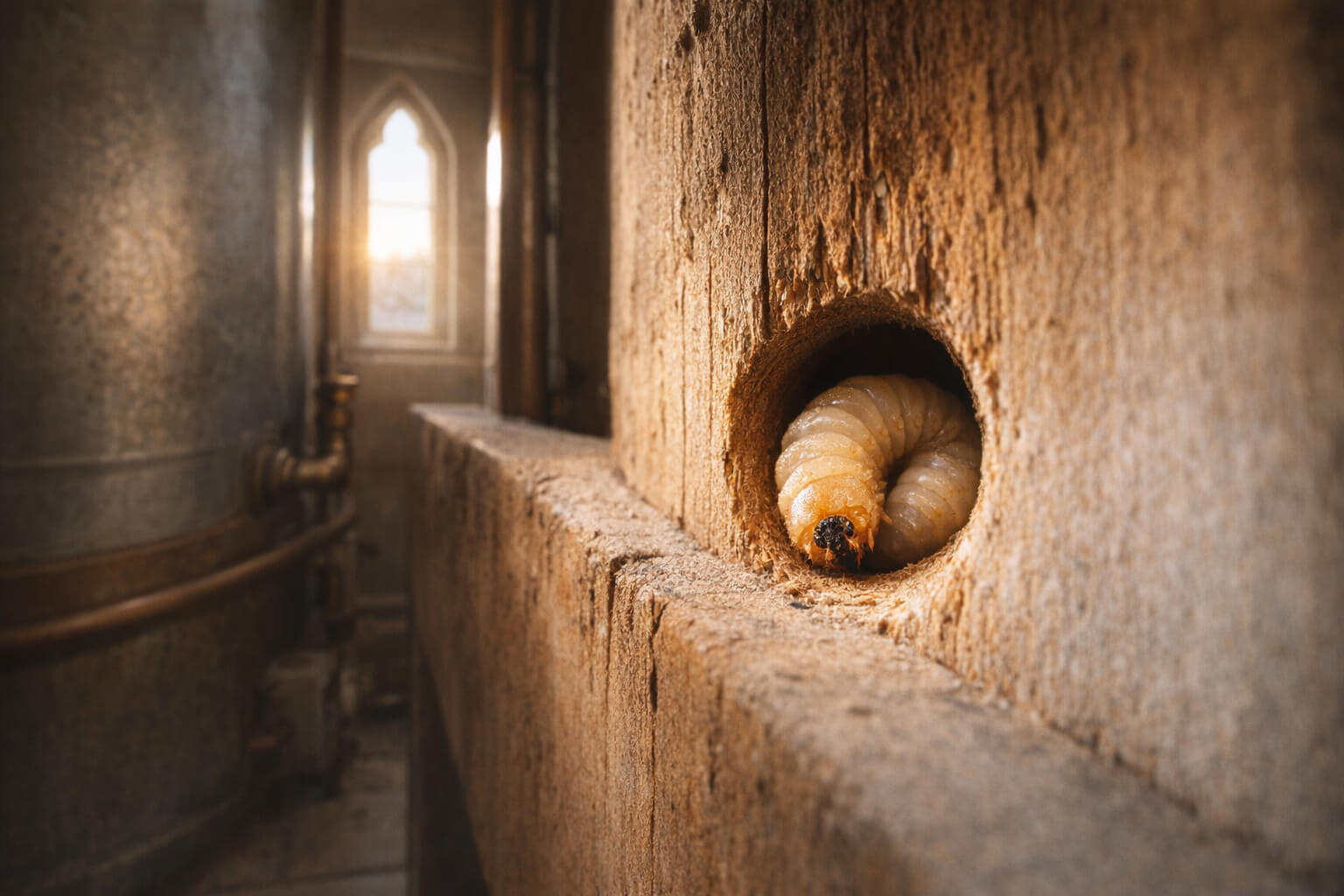
In most infestations observed in traditional UK buildings — oak-framed farmhouses, medieval church roofs, Victorian terraces with softwood floor joists, Georgian townhouses with original structural timbers — the primary spread mechanism is not flight between timbers but re-infestation of the same timber.
The cycle works as follows: larvae develop inside compromised wood over multiple years, feeding on the cellulose that fungal decay has made accessible. Adults emerge in spring, mate on or immediately adjacent to the emergence surface, and females deposit eggs back into crevices, splits, and old emergence holes in the same wood. A new generation of larvae enters the timber. The infestation deepens and widens within the original host timber without any movement between structures.
| Behaviour | Typical Pattern | Flight Involved? |
|---|---|---|
| Adult emergence | Chew through to surface | No |
| Mating | On or near emergence surface | Rarely |
| Egg deposition | Return to same crevices and holes | No |
| Larval development | Internal to host timber | No |
| Spread to adjacent timber in direct contact | Very common | No |
| Spread to nearby timber across a small gap | Uncommon but possible | Yes |
| Spread to distant timber or separate structure | Rare | Yes |
This pattern is why infestations are often described as localised. A single oak beam or a section of floor joist can sustain decades of beetle activity without the population establishing in timbers more than a metre away — not because the beetles cannot fly, but because they have no incentive to do so while a viable host remains.
The Society for the Protection of Ancient Buildings notes in its wood-boring insect guidance that deathwatch beetle is predominantly a problem of older, oak-framed buildings where timber has experienced prolonged moisture exposure enabling the fungal decay the beetle requires. In such buildings, the infested timbers are typically clustered — sill plates, principal posts, wall plates — and direct contact between timbers provides a transmission route that makes flight unnecessary.
“Deathwatch beetle requires wood previously softened by fungal decay. In older buildings, this creates localised concentrations of infestation around structurally vulnerable areas rather than widespread colonisation.” — A timber specialist surveying a 17th-century farmhouse in the Weald
Where flight activity does occur is in buildings where the original host timber is fully degraded — so saturated with previous infestation that it no longer offers suitable egg-laying sites — or where population density has reached a point of internal competition. At that threshold, adults emerging from spent timber have a reason to seek new hosts, and flight becomes the mechanism.
When Flight Becomes a Real Risk
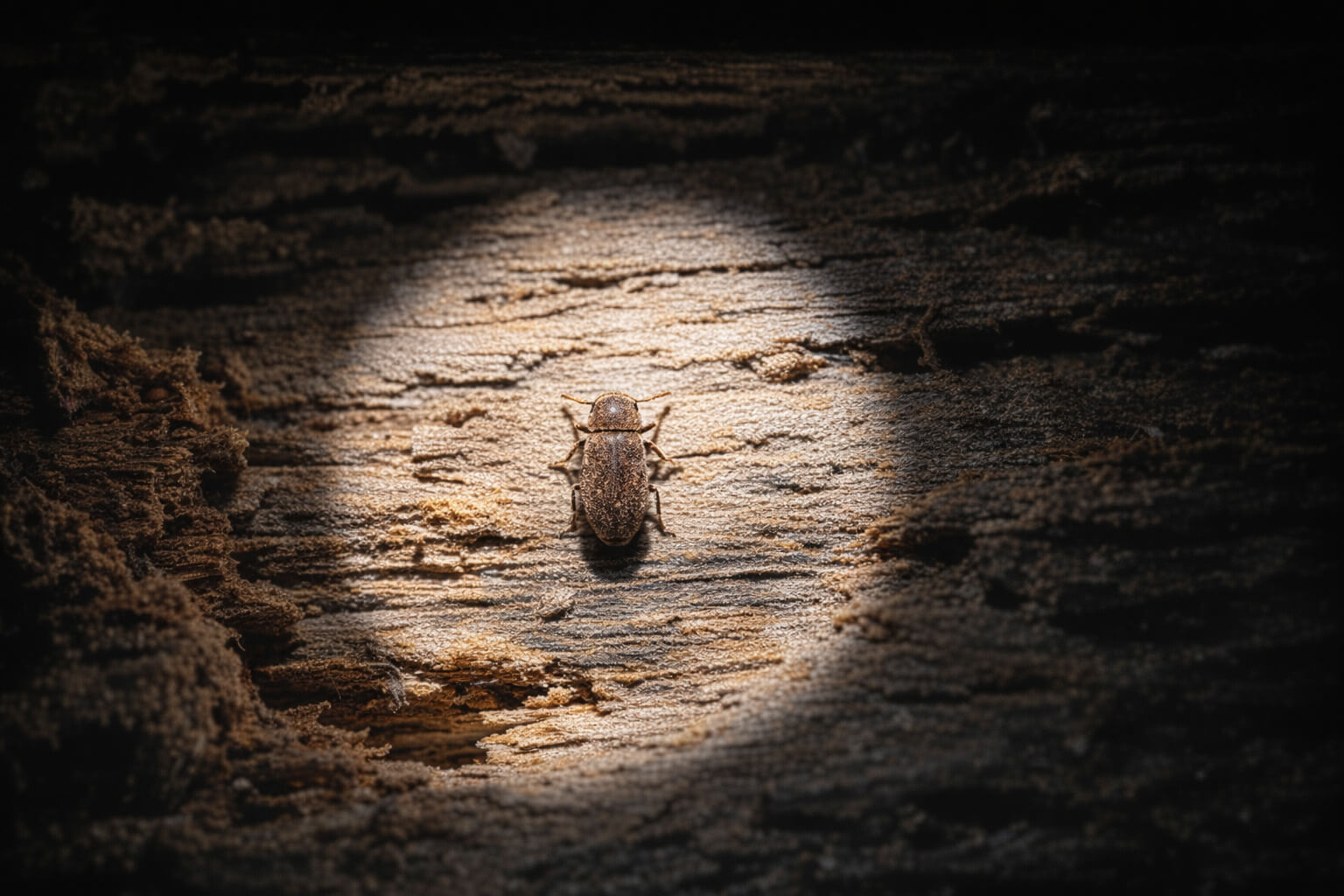
Flight risk is not constant. It is condition-dependent and population-dependent. Understanding the triggers helps to assess whether a given infestation is likely to remain contained or is approaching a threshold where dispersal becomes probable.
The primary environmental trigger is temperature. Deathwatch beetles are crepuscular to nocturnal fliers, and flight activity increases significantly above approximately 17°C. In the UK, this threshold is typically reached on warm spring evenings from late April through May. Cold, wet springs suppress adult activity even when emergence is occurring; warm, dry springs with mild evenings increase the probability of sustained flight.
Light attraction is a secondary factor. Like many nocturnal insects, adult deathwatch beetles can be drawn to light sources — including artificial lighting near open windows, ventilation gaps, and unglazed apertures in roof voids. This is a mechanism by which a beetle emerging from an infested oak truss may find its way into an adjacent space, not through directional navigation, but through phototaxis drawing it toward a lit opening.
| Condition | Effect on Flight Risk | Practical Implication |
|---|---|---|
| Temperature above 17°C on spring evenings | Significantly increases | Monitor in April–May; seal ventilation gaps |
| Artificially lit openings near infested timber | Draws adults toward light | Close windows near roof voids on warm evenings |
| Spent or exhausted host timber | Drives dispersal pressure | Adults actively seeking new hosts |
| High population density | Increases dispersal frequency | May indicate long-standing untreated infestation |
| Cold, wet spring conditions | Suppresses flight activity | Emergence may still occur without flight |
| Adjacent uninfested timber within direct contact | Provides easy route without flight | Contact spread more likely than flight |
Building Research Establishment literature and guidance from Building Conservation on deathwatch beetle in historic structures both note that spread by flight between entirely separate structures is possible but not the primary transmission pathway in most UK building contexts. The more commonly observed pattern is spread along continuous or near-continuous structural timber runs — the kind found in roof spaces, floor systems, and party wall structures of older properties.
“We see flight-related dispersal most clearly in buildings where the infestation has been active for 20 or 30 years without treatment. By that point, the original host timber is significantly degraded and adults are emerging into a structure where the remaining viable wood may be metres away — which is when flight becomes a practical transmission route rather than a theoretical one.” — Sussex Damp Experts senior surveyor
Flight vs Shared Timbers — How Beetle Actually Spreads Between Properties

For homeowners in terraced or semi-detached properties, the question of whether deathwatch beetles can fly often contains a more specific concern: can the infestation from a neighbouring property reach mine?
The honest answer is: yes, but probably not by flight.
In most terraced and semi-detached properties built before 1919 — the building type most commonly affected by deathwatch beetle — structural timbers frequently pass through or across party walls. Floor joists may be built into the same party wall on both sides. Roof timbers may share a continuous run across multiple properties. Wall plates and sill plates in timber-framed party walls may be in direct contact with timbers on both sides.
In these configurations, deathwatch beetle spread from one property to another does not require flight. The larvae travel through the timber itself. A joist that extends through or into a shared party wall is a direct larval transmission route that no amount of gap management will interrupt.
| Spread Mechanism | Typical Speed | Requires Flight? | Primary Risk Scenario |
|---|---|---|---|
| Larval movement through shared structural timber | Slow, over years | No | Party wall joists, continuous roof timbers |
| Adult emergence and re-infestation of contacted adjacent timber | Moderate | No | Any timber in contact with infested member |
| Adult flight to adjacent timber in the same building | Moderate | Yes | Gaps between roof timbers, same-property floor voids |
| Adult flight to neighbouring property | Slow, rare | Yes | Open windows, ventilation gaps, warm evenings |
| Adult flight between separate buildings | Very rare | Yes | Outbuildings, barns, properties in close proximity |
The Property Care Association’s guidance on deathwatch beetle treatment notes that treatment in connected properties should ideally be coordinated, precisely because larval spread through shared timbers can make single-property treatment insufficient if the adjacent property remains untreated.
From a survey perspective, this means that if you discover deathwatch beetle activity in a terraced property, the correct first question is not “can it fly to my neighbour?” but “do we share structural timbers, and have those timbers been assessed on both sides of the wall?” This is particularly relevant in properties where original timber floor systems have not been replaced and where Victorian or Edwardian construction methods placed joists into shared masonry.
Book Your Consultation With Sussex Damp Experts

If you have found emergence holes, frass, or structural damage that suggests deathwatch beetle activity — or if you are purchasing a period property and want a clear picture of timber condition before exchange — we carry out specialist timber and structural surveys across Sussex.
Our surveys are diagnostic-first. We assess the extent and activity of any infestation, identify the structural timbers at risk, and where shared party walls are relevant, advise on what cross-boundary assessment may be needed. The survey is the work. The report is yours whether or not treatment is recommended.
Book Your Consultation With Sussex Damp Experts to arrange a site assessment.
Frequently Asked Questions

Deathwatch beetle flight generates a range of questions — not just about whether it happens, but about what it means for spread risk, treatment urgency, and neighbouring properties. The answers below draw on observed infestation patterns across Sussex properties and current guidance from timber specialists and conservation bodies.
Can Deathwatch Beetles Fly?
Yes. Adult deathwatch beetles (Xestobium rufovillosum) have functional membranous flight wings beneath their elytra — the hard outer wing-cases that give the beetle its characteristic mottled-brown appearance. When conditions are right, adults can open their elytra, unfold their wings, and become airborne.
The capability is not in question. What is often misunderstood is the relationship between capability and behaviour.
Deathwatch beetles are poor fliers by insect standards. The body is dense relative to wing surface area, which makes sustained, directed flight energetically costly and aerodynamically imprecise. Flight tends to be short-burst and reactive — triggered by light, warmth, or the absence of a local egg-laying site — rather than navigational. A deathwatch beetle does not fly toward a specific timber structure in the way a bird navigates toward a nesting site. It may be drawn toward a light source or carried on air movement, but flight is not goal-directed in a way that makes long-distance colonisation a common outcome.
In practice, most adults emerging from infested timber in spring do not take flight at all. They emerge through the round exit holes (typically 1.5–3mm in diameter), move on the timber surface, mate, and deposit eggs back into crevices, splits, and old emergence holes in the same wood or immediately adjacent timbers. The re-infestation cycle is self-contained unless something pushes adults to seek new hosts.
The conditions that trigger flight include:
- Temperatures above approximately 17°C on spring evenings
- The presence of artificial light sources near emergence areas
- Exhausted host timber that no longer offers viable egg-laying sites
- High local population density creating dispersal pressure
Under standard UK spring conditions, these thresholds are reached on warm evenings from April through May, which is why this is the period when adults may occasionally be found on windowsills, near light fittings, or on surfaces away from the host timber.
What the question of flight capability does not tell you is whether an infestation is actively spreading. For that, you need to understand whether flight is occurring (rare, condition-dependent), whether the timber structure provides direct contact pathways between infested and uninfested elements (common in traditional buildings), or whether shared structural timbers provide larval transmission routes between connected properties (the most frequently overlooked spread mechanism in terrace situations).
The presence of adult beetles on their own does not confirm flight-based spread — it confirms emergence, which happens regardless of whether any flight follows. If you have discovered adult beetles, the priority is assessing the extent of the infestation in the structural timbers, not tracking individual beetle movement.
How Far Can Deathwatch Beetles Fly?
Precise flight distance data for deathwatch beetle is not definitively established in the published literature, which reflects both the difficulty of tracking a small, nocturnal insect in field conditions and the relative rarity of flight-based spread compared to other transmission mechanisms.
What is known from observation and field studies is that deathwatch beetles are short-range fliers. The combination of body density and relatively small wing surface area makes sustained directional flight demanding. Most documented flight activity involves movement of a few metres — typically within the same roof space, floor void, or structural bay rather than between separate buildings.
For practical assessment purposes, a working framework for flight range is as follows:
- Within the same structure: Ready movement is possible, particularly in roof voids and floor spaces where emergence may occur near uninfested timbers a short distance away
- To adjacent structures within approximately 5–10 metres: Possible, but conditional on temperature, wind conditions, and the presence of attractive stimuli such as light sources and suitable host timber
- Between separate buildings more than 10 metres apart: Rare; documented in isolated cases but not a primary spread pathway for established infestations
These are not hard boundaries. Flight is probabilistic, not deterministic. A warm, still evening with open windows near a lit roof void creates meaningfully different conditions than a cold, wet April night. The receiving timber also matters: deathwatch beetle colonisation requires wood that has experienced fungal decay. A brand-new timber frame is not an attractive target regardless of how close it is to an active infestation.
The practical implication is this: if you have an active infestation in a roof space and an uninfested outbuilding within 5 metres, flight-based spread is a genuine risk that should be considered in any treatment and protection strategy. If the nearest vulnerable structure is 25 metres away across an open garden, flight is an unlikely primary spread route — though this does not eliminate the need to assess timber condition in that structure if it has its own history of moisture problems.
For connected properties in a terrace or semi-detached context, flight distance is less relevant than structural continuity of timber across party walls. In those scenarios, the operative question is whether the timbers are physically shared — which is a matter for a structural survey, not a flight distance calculation.
Will Deathwatch Beetles Fly Into My House?
It depends on the circumstances. Deathwatch beetles can and occasionally do fly into properties through open windows, ventilation gaps, and unglazed apertures, but this is not the most common route of primary infestation in most residential contexts.
The mechanism, when it does occur, is typically phototactic — the beetle is drawn toward artificial light rather than navigating toward your property specifically. An adult emerging from an infested oak beam in a neighbouring roof space, a church roof, a converted barn, or a period property nearby may take flight on a warm spring evening, be drawn toward interior lighting visible through an open window, and enter the building.
For this to result in a new infestation, several conditions need to be met simultaneously:
- The incoming beetle must be a mated female, or mating must occur inside the property after entry
- The property must contain timber that has experienced sufficient fungal decay to support larval development — specifically, wood softened by white rot fungi, which requires prolonged moisture exposure at or above approximately 18% wood moisture content
- The female must locate suitable timber and deposit eggs successfully
This combination is possible in older properties with a history of moisture problems and original structural timbers. It is not the most probable route of first infestation. Most deathwatch beetle problems we assess have developed internally over long periods — beginning in timbers that were already moisture-compromised — rather than arriving via a single colonising flight event from outside.
The practical steps for reducing flight entry risk are relatively straightforward:
- Keep windows closed on warm spring evenings (above 17°C) if you are in an area with known deathwatch beetle activity in nearby structures
- Ensure roof ventilation gaps are adequately screened with appropriate mesh
- Reduce interior lighting visible from the exterior during the April–May emergence window, particularly from roof void hatches and stairwells
- Where loft access points or ventilation tiles are unscreened, consider adding fine mesh as a precautionary measure
These are precautionary measures rather than primary infestation controls. They reduce the probability of a beetle entering on a warm spring night; they do not address an existing infestation or the larval transmission routes that are more commonly responsible for spread in connected properties.
If you are purchasing a property adjacent to a church, barn, or other structure with a known or likely deathwatch beetle history, a pre-purchase timber inspection can establish whether your structural timbers show any signs of existing or historic activity. This gives you a baseline rather than waiting for the problem to declare itself through emergence holes — which may not appear for several years after a new infestation is established.
Can Deathwatch Beetles Spread to Neighbouring Properties by Flying?
Yes, but flight is rarely the primary transmission pathway when deathwatch beetle spreads between connected properties. Understanding the distinction matters because it affects both the scope of the survey and the treatment strategy.
In terraced and semi-detached properties built before 1919 — the building types most commonly affected by deathwatch beetle — structural timbers frequently cross or abut party walls. Floor joists may be built into the same masonry on both sides. Roof timbers in a continuous terrace may form an uninterrupted run from one end to the other. Wall plates, sill plates, and bressumer beams in timber-framed party wall structures may be in direct physical contact with timber on both sides.
In these configurations, larval spread through shared timber is the dominant transmission route — not flight. The beetle larvae simply develop within the wood, which happens to extend through or across the property boundary. No adult emergence, no flight, no crossing of open space. The spread happens slowly over years, invisibly, inside the structural member.
This is why single-property treatment in a connected terrace can sometimes be insufficient. If the timber extends into the neighbouring property and that property is untreated, the infestation may re-establish from the untreated section even after thorough treatment of accessible timbers on your side. Coordinated survey and treatment across adjacent properties — wherever shared structural timbers are suspected — is the more defensible approach.
Flight between neighbouring properties becomes more relevant in scenarios where:
- Properties are in proximity but do not share structural timbers (detached houses within approximately 5–10 metres)
- One property has an active, high-density infestation with degraded host timber creating dispersal pressure
- Spring conditions — warm evenings, open windows, light attraction — are favourable
- The receiving property contains moisture-damaged timber capable of supporting a new infestation
Even in these scenarios, flight-based colonisation is a slower, lower-probability route than direct timber transmission. The assessment question for any party-wall scenario should always be: “Do we share structural timbers?” before “Can they fly across?” The former is more likely to explain spread; the latter is a secondary risk that may require precautionary measures but rarely defines the treatment approach on its own.
When Are Deathwatch Beetles Most Likely to Fly?
Deathwatch beetle flight activity is concentrated in the spring emergence period, typically from late March through to early June in UK conditions, with the peak usually falling in April and May. Outside this window, adults are not present — the adult stage is brief, lasting only a few weeks, during which the beetle does not feed and exists solely to mate and deposit eggs.
Within the emergence period, flight activity is not uniform. Several environmental factors modulate the probability of flight on any given evening.
Temperature is the most significant variable. Flight activity increases substantially above approximately 17°C. In practical terms, this means warm, still spring evenings rather than cold or wet ones. The UK’s variable spring climate means that some years see concentrated emergence activity over a two-to-three week window; others see it spread across six weeks depending on temperature fluctuations.
Time of day also matters. Deathwatch beetles are predominantly crepuscular to nocturnal. Flight activity peaks in the hours after dusk rather than during daylight. This is why adults found indoors are most commonly discovered in the morning — they flew in overnight and became trapped or disoriented once daylight reduced their phototactic drive.
Wind conditions play a secondary role. Calm evenings favour flight; sustained wind disrupts it. Even weak fliers can cover more ground with less energy expenditure when air turbulence is low.
Host timber condition and population density affect the proportion of adults that fly rather than remaining local. In a building where the same timbers have sustained infestation for 30 or more years without treatment, emergence-to-flight ratios may be significantly higher than in a recently colonised structure, because the host timber is more degraded and adults face greater competition for viable egg-laying sites.
The seasonal concentration of flight risk is useful from a practical standpoint. The heightened-concern window is approximately six weeks in spring. During that period, measures that reduce flight entry risk — screened ventilation, closed windows after dark, reduced lighting visible from roof voids — are worth implementing in properties adjacent to known infestation sources. Outside that window, adult flight risk returns to effectively zero, though larval activity within timbers continues year-round regardless of season.
Are Deathwatch Beetles Attracted to Light?
Yes. Adult deathwatch beetles exhibit phototaxis — movement toward light — which is the primary mechanism by which they may travel beyond their emergence timber into the wider building or toward neighbouring properties.
Phototaxis in nocturnal insects is a well-documented phenomenon. The widely cited explanation is that nocturnal insects use natural light sources — primarily the moon — for navigation, and that artificial light disrupts this orientation system, causing the insect to spiral toward the artificial source rather than hold a straight course. Whatever the precise mechanism, the practical outcome is that artificial light visible from an emergence area can draw adult deathwatch beetles away from the host timber.
This has a direct implication for where adults are found in a building. If you discover adult beetles on windowsills, near light fittings, or on walls at night during the spring emergence period, this does not necessarily mean the infestation is in those locations. It may mean the adults emerged elsewhere and were drawn toward the light. The emergence timber may be some distance away — possibly in the roof void above, or in the floor structure below.
The light attraction effect is most relevant in roof voids, where a lit stairwell, landing, or open loft hatch can draw adults from infested roof timbers into the habitable space. It is also the mechanism by which beetles emerging from external structures — a church, a barn, a neighbouring property’s infested roof — may occasionally find their way into a lit residential property through open windows or ventilation gaps on a warm spring evening.
From an assessment standpoint, the location of discovered adult beetles is useful evidence but requires careful interpretation:
- Adults found near windows or light fittings should prompt investigation of structural timbers within the same roof void or floor space — not just the surfaces where the adults were found
- The emergence sites and the discovery sites are frequently different, sometimes significantly so
- Multiple adults found consistently in the same location may indicate the emergence timber is close to that point; isolated adults near light sources may have travelled from some distance within the structure
Reducing artificial light visible from known emergence areas during the April–May window — particularly in roof voids and areas adjacent to infested timber — is a low-cost, non-chemical measure that may reduce the spread footprint during the emergence period. It will not address an active infestation, but it can limit the secondary dispersal that occurs once adults are airborne.

